

Quick Summary
Mukesh Verma (name changed), from Moradabad, Uttar Pradesh, lost ₹5,71,000 after strangers on WhatsApp pushed him onto a fake trading platform. It showed made up profits, then demanded margin money, taxes, and charges before any withdrawal. His claim of ₹5,71,000 went through a cyber crime complaint, followed by our team’s push for a freeze on the receiving accounts. The freeze worked, and the full ₹5,71,000 returned to his account in three credits, which made it a complete recovery for him.
What if the profits on your trading app were never real?
That is exactly what happened to one man, and it is why many people now ask how to recover money from a fake trading platform scam.
Mukesh Verma (name changed) is from Moradabad, Uttar Pradesh.
He saw his wallet balance grow every day. None of it was real.
Here is how a bank freeze brought every rupee back.
How Fake Trading Scammers Approached the Victim on WhatsApp?
Between August and October, two people contacted Mukesh again and again on WhatsApp.
One gave a personal name. The other said he represented a trading broker.
They talked about an online trading scheme and promised profitable returns.
Each conversation led him one step closer to depositing money.
Fake Trading Platform Deposits Sent to Personal Bank Accounts via UPI and IMPS
They guided him step by step on how to deposit funds into a trading platform.
Instead of a regulated broker, the money went to bank accounts they gave him.
Mukesh paid by UPI and by IMPS. Each transfer went to an account provided by the scammers.
How Scammers Used Fake Trading Wallet Balance and Fake Daily Profits Shown on Screen
The platform showed a trading wallet with a growing balance.
It also showed open trading positions, and every one of them looked profitable.
That display was the whole trick.
The numbers were drawn by the platform itself, so they rose as long as he kept paying.
Fake Trading App Withdrawal Charges, Margin Money and Tax Demands
When Mukesh tried to withdraw, the excuses started.
First came a demand for margin money. Then a charge for positions kept running.
After that, he was told to pay taxes.
Then his account was said to be blocked, and a fee was needed to unblock it.
Why Paying “Withdrawal Taxes” Never Unlocks Your Money?
Every payment he made produced another reason to pay again.
None of the payments produced a withdrawal.
Anyone who is told to pay tax before withdrawing profits should stop.
A genuine platform deducts such charges from the amount it pays out.
The Negative Balance Trick Scammers Use to Drain Victims
At the end, the platform showed a negative balance.
It then used that figure to ask for still more money.
Mukesh finally saw that the entire arrangement was a fake.
His total loss stood at ₹5,71,000.
Evidence Saved for the Cyber Crime Portal Fraud Complaint
Mukesh filed a complaint on the cyber crime portal under the category of financial fraud.
After weeks, he had no meaningful update.
His evidence was good. He had saved the WhatsApp conversations, screenshots of the fake platform, payment receipts, and transaction records.
He also had the scammers’ phone numbers and the receiving account details.
Why a Fake Trading Platform Scam Is Not a SEBI Complaint?
Nobody in this chain held any SEBI registration.
The platform pretended to be a broker, and the people pretended to represent one.
Regulatory complaint portals act against registered intermediaries.
Here, the route ran through the police, the banks, and the accounts that received his money.
How We Traced and Froze Scam Money Through Receiving Bank Accounts?
We worked backward from the receiving accounts.
Every step aimed at one result, a hold on the money before it moved on.
Step 1: Listing Every UPI and IMPS Transfer With Its Destination Account
Each UPI and IMPS payment was written down with its date, amount, and the account that received it.
This became the map of where his money went.
Step 2: Packaging Digital Evidence for Investigating Officers
The chats, the fake platform screenshots, and the payment receipts were dated and arranged in one file.
They were ready for the investigating officers.
Step 3: Following Up With the Cyber Cell on the Complaint
Our letter cited the complaint reference and set out the payment trail.
It asked for an update and for a freeze on the beneficiary accounts.
Step 4: Pressing for a Bank Account Freeze on Beneficiary Accounts
The accounts that received his payments were held.
A freeze stops withdrawals and keeps the money where it is.
Step 5: Following Through Until the Frozen Amount Was Released
A freeze alone does not return money.
We kept the file moving until the frozen amounts were released back to Mukesh.
Full ₹5,71,000 Recovery in Three Credits After the Bank Freeze
Mukesh’s claim stood at ₹5,71,000.
After the bank freeze and release, the full amount returned to his account in three credits of ₹91,000, ₹100, and ₹4,79,900.
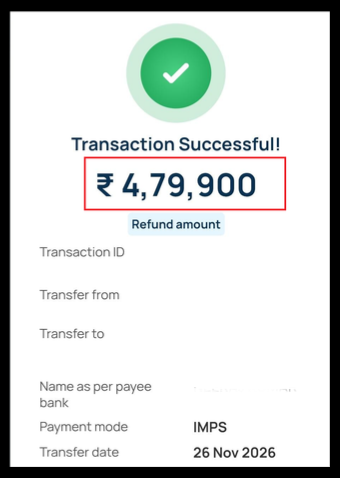
That is a full recovery, and we do not promise it.
It depends on how fast the accounts are held and how much remains in them. Most cyber fraud cases return less.
Paid Fees to Withdraw Profits From a Trading App?
Get Expert Help to Recover Your Money
Stop paying, save every chat and receipt, and report on the cyber crime portal right away.
Register with us and we will help you chase the money.
Conclusion
Mukesh’s case ends well, and the reason is speed and paper.
He kept every chat and receipt, and he reported quickly.
The receiving accounts could be traced from the details he had saved.
Fake trading platforms follow one script.
They show a balance, add open positions, and then demand margin, position charges, taxes, and unblocking fees.
Each demand sounds small next to the profit on the screen. Together they drained ₹5,71,000.
If you are in the middle of this, do not pay a single further rupee to withdraw.
Report on the national cyber crime portal or call the helpline 1930, save your evidence, and ask your bank to flag the receiving account.
The earlier the report, the better the chance of a hold.
Report. Recover. Stay Fraud Free.
It asks for payment into personal bank accounts, shows profits you cannot withdraw, and demands taxes or fees before paying out. No. Taxes and charges are deducted from what is paid to you, not collected from you first. Report on the national cyber crime portal or call the helpline 1930 at once. Early reports give banks more time to hold the money. Sometimes. When receiving accounts are frozen in time, the money can be released after due process. Results differ from case to case. SEBI acts against registered intermediaries. When the platform and the people are fake, the route is the police, banks, and the cyber crime portal.Frequently Asked Questions





 Add us as a preferred source on Google »