

Quick Summary
Initial Claim: ₹1,00,000 Core Violation: An individual falsely claiming to be a SEBI registered Research Analyst ran a profit sharing scheme, quietly raised his cut from 25 to 40 percent, extracted ₹1,00,000 under this arrangement, then deliberately mismanaged the remaining trades and vanished. Forum Used: Direct pursuit and documentation pressure, after a cybercrime complaint sat unanswered. Recovery Secured: ₹83,000. Debashish Roy (name changed) is from Siliguri, West Bengal. He got his original capital back in full at one point. That single fact almost made everything after it feel safe. It wasn’t.
Debashish was contacted by an individual who presented himself as a SEBI registered Research Analyst, offering to manage his portfolio directly and generate a specific daily profit figure.
The arrangement was framed as a profit sharing model, initially set at twenty five percent of gains.
That ratio did not stay fixed. Later in the relationship, it was raised to forty percent, without any renegotiation Debashish had agreed to or any documentation recording the change.
A profit share ratio that moves upward unilaterally, well after the relationship has begun, is itself a sign of an arrangement built to extract as much as possible rather than operate on any consistent, disclosed terms.
The Withdrawal That Built The Trust
Debashish invested ₹1.5 lakh into his own Zerodha account, following the individual’s direction. Early results looked genuine, and at one point his account balance reflected close to ₹2.5 lakh.
He was able to withdraw his original ₹1.53 lakh capital in full, a moment that did more to build his confidence than any promise could have.
This is precisely why the arrangement felt safe enough to continue.
A real, successful withdrawal of principal capital is a powerful signal, and it is exactly the kind of moment a scheme like this relies on to keep a client engaged for what comes next.
Fees Paid On Gains That Were Never Secure
Across this period, Debashish paid approximately ₹1,00,000 under the profit-sharing arrangement, calculated against gains shown on an account that had never actually been made secure.
Shortly after, the individual began mismanaging trades deliberately, wiping out the remaining balance before cutting off all communication entirely.
Anyone who claims SEBI registration without ever producing a verifiable registration number can be reported through a channel that lets you report a fake research analyst, since impersonating a registered status to collect fees is itself a documented fraud, separate from any trading outcome.
A Cybercrime Complaint That Went Nowhere
Debashish filed a formal complaint through the national cybercrime portal and escalated it further, seeking urgent intervention, receiving an acknowledgment number in return.
Beyond that filing, no meaningful assistance or resolution followed on its own.
This is a familiar outcome for cases involving individuals with no traceable registration or licensed identity.
An acknowledgment number confirms a complaint has been logged. It rarely, on its own, produces active pursuit of the funds involved.
How We Separated the Returned Principal From the Fees That Never Came Back?
The fact that Debashish had already recovered his original capital shaped how this case needed to be argued, since the remaining claim rested entirely on the fees paid under a shifting, undisclosed arrangement.
Step One: We Documented The Ratio Change From 25 To 40 Percent
Every message referencing the original and the later, increased profit share percentage was compiled, establishing that the terms had moved unilaterally without any renegotiation on Debashish’s part.
Step Two: We Isolated The Fee Payments From The Trading Activity Entirely
Since the principal had already been returned, we focused the claim specifically on the ₹1,00,000 paid under the profit sharing arrangement, rather than reconstructing a broader trading loss narrative that no longer applied.
Step Three: We Confirmed No Verifiable SEBI Registration Existed
We checked for any registration connected to the individual’s claimed status and found none, establishing the profit sharing scheme as fraudulent from its very foundation rather than a poorly run advisory relationship.
Step Four: We Compiled The Full Communication And Payment Trail From The Cybercrime Filing
The existing evidence submitted with Debashish’s original complaint, including communication logs and transaction records, was reorganised into a more actionable package for direct pursuit.
Step Five: We Actively Followed Up Where The Official Complaint Had Stalled
Rather than allowing the acknowledgment number to sit without further movement, our team engaged directly to push for genuine progress on a matter that had already gone quiet.
Step Six: We Pursued Recovery Directly Using The Documented Fee Payments As Leverage
With the ratio change, the missing registration, and the clean fee payment trail all clearly established, our team pushed for direct recovery of the specific amount paid under the profit sharing arrangement.
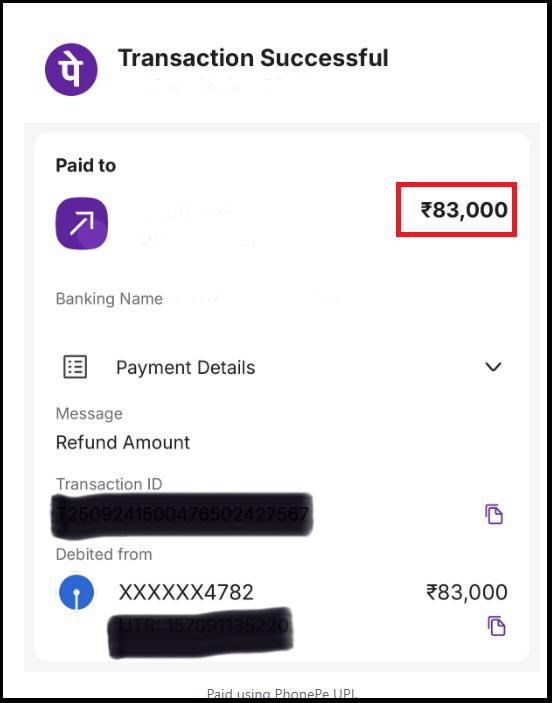
Through this sustained pursuit, the matter was resolved with a recovery of ₹83,000.
Paid A Profit Share To Someone Who Later Raised The Rate And Then Vanished? Our Team Can Help
Debashish’s case worked because we focused entirely on the fee payments once his principal was already back in hand. If a similar ratio shift happened to you, gather your payment history and every message referencing the rate today.
Register with us and we will take it from there.
Conclusion
Getting your original capital back does not mean a scheme was ever legitimate; it often means you were being kept engaged long enough to pay more under terms that kept shifting in the other side’s favour.
Debashish’s case shows why a profit share percentage that moves upward without any documented agreement deserves the same scrutiny as a completely fabricated promise, since a shifting ratio reveals an arrangement designed around extraction rather than any genuine, consistent partnership.
Once his principal was recovered, focusing the claim precisely on the fee payments made the case sharper and easier to pursue than trying to relitigate the entire relationship.
Report. Recover. Stay Fraud Free.
Frequently Asked Questions
No. Profit sharing arrangements are prohibited for SEBI registered research analysts entirely, and an unregistered individual offering one has no legitimate basis for it at all.
Not necessarily. A returned principal can be a deliberate step to build trust before extracting further payments under a scheme that later collapses.
A unilateral increase in the agreed rate, with no renegotiation or documentation, shows the arrangement was never operating on fixed, disclosed terms in the first place.
Active follow up is often necessary to move a stalled complaint forward, particularly when the individual involved has no traceable licensed identity.
Focus specifically on any fees, profit shares, or additional payments made beyond your original capital, since that is the portion still genuinely lost.





 Add us as a preferred source on Google »

