

Quick Summary
SEBI has fined SMC Global Securities Ltd ₹1 lakh for failing to supervise one of its Authorised Persons, Amit Lilhare, who ran a fixed-payout scheme for clients in Chhattisgarh. SEBI found that 161 clients paid a combined ₹6.11 crore, and Lilhare returned ₹1.84 crore to them, through commissions paid into his own undisclosed bank accounts. SMC had already disabled his trading terminal and filed a police complaint before SEBI’s inspection began. The order is dated October 1, 2026.
If you trade in India, you’ve definitely heard of SMC Global Securities.
But what happened at one of its regional branches will leave you stunned.
An Authorised Person managed to pull off a private ₹6 crore fixed-return racket, right under the broker’s nose.
He took client funds, promised illegal monthly payouts, and hid the commission trail using secret bank accounts.
It took switching off his trading terminal for 322 complaints to come crashing down suddenly.
Who Is SMC Global Securities, and What Did SEBI Investigate?
SEBI conducted a thematic inspection of SMC Global Securities Ltd, covering January 1, 2024 to September 30, 2024.
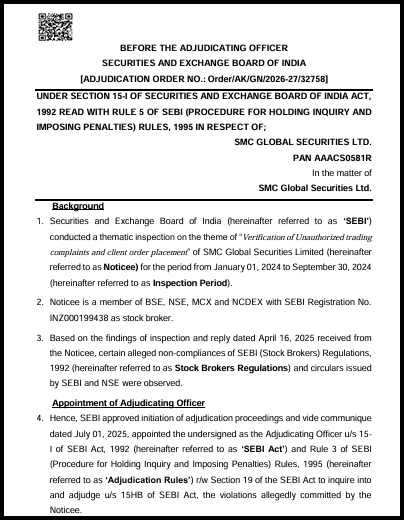
The theme was specific: “Verification of Unauthorized trading complaints and client order placement.”
SMC holds SEBI registration number INZ000199438 as a stock broker.
A Show Cause Notice followed on July 30, 2025, alleging violations of the Stock Brokers Regulations, SEBI circulars, and NSE circulars.
Meet Amit Lilhare, the Authorised Person at the Centre of This Case
Amit Lilhare had been registered with SMC as an Authorised Person since January 28, 2011, with NSE. His BSE registration followed on September 8, 2015.
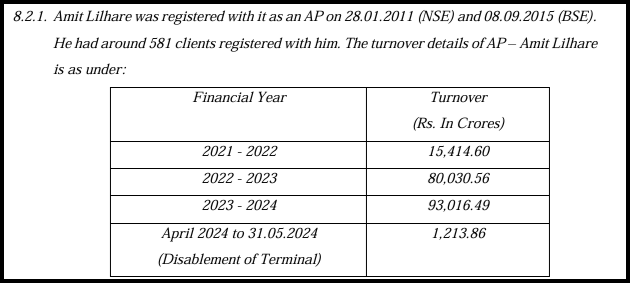
He operated out of Bhilai and Rajnandgaon, Chhattisgarh, with around 581 clients registered to him.
His turnover peaked at ₹93,016.49 crore in FY 2023-24, a scale that makes his later conduct harder to miss, not easier.
SMC disabled his trading terminal on May 31, 2024, after irregularities surfaced. It issued a formal Notice of Dissociation on July 15, 2024, and filed a police complaint the same day.
The ₹6.11 Crore “Fixed Payout” Pattern SEBI Found
SEBI’s inspection dug into the ledgers of clients mapped to Lilhare, and a pattern emerged quickly.
Of 343 active clients checked, 161 showed a clear pattern: a fixed amount credited to them at regular intervals.
Across these clients, SEBI found ₹6,11,27,000 invested for the fixed payout arrangement, and ₹1,84,59,000 actually paid out to them.
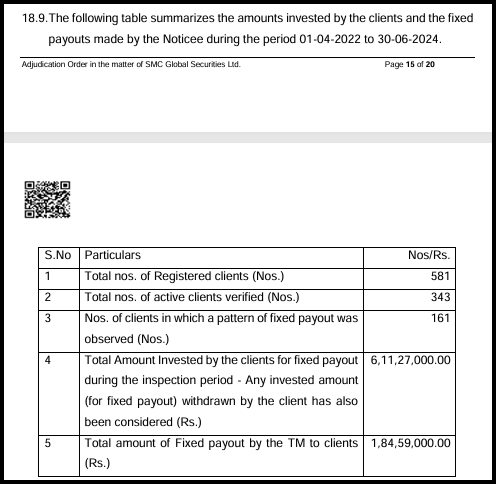
Sixteen of these clients had filed complaints. Their ledgers showed fixed monthly payouts landing in the first week of every month, as far back as July 2022.
SMC argued there was no written scheme, no brochure, no email promising fixed returns. SEBI found that detail beside the point. The pattern of payments spoke for itself.
How the AP’s Commission Trail Led Through Hidden Bank Accounts?
This is where SMC’s own supervision gap becomes clear.
Lilhare had officially declared only one bank account to SMC, held with IDFC Bank.
SEBI’s inspection relied on an NSE report. It found Lilhare was also operating accounts with Kotak Mahindra Bank and State Bank of India, neither disclosed to SMC.
Client commissions on the fixed payouts moved through these undisclosed accounts, via direct transfers and UPI payments.
Under SEBI’s Master Circular for Stock Brokers, an Authorised Person isn’t allowed to receive or pay money in their own name at all.
Every transaction is meant to flow through the broker’s own account.
Why 322 Client Complaints Surfaced Immediately After Disabling the Terminal?
SMC received 322 complaints in FY 2024-25 related to unauthorised trading and fund misappropriation.
Of those, 279 arrived between June and September 2024, right after Lilhare’s terminal was switched off on May 31.
SMC suspected the complaints might be coordinated with its own expelled AP. The first one landed the very next day after disablement.
SEBI didn’t find that argument persuasive.
The complainants had opened accounts at different times, spread across more than two years. SEBI found no coordination between them beyond the same region and the same AP.
Why SMC’s “Double Jeopardy” Defence Against SEBI Failed?
SMC’s central legal argument was that NSE had already initiated proceedings on the same facts. It said SEBI pursuing a separate case amounted to double jeopardy.
The Adjudicating Officer disagreed, citing the Supreme Court’s ruling in S.A. Venkataraman v. Union of India.
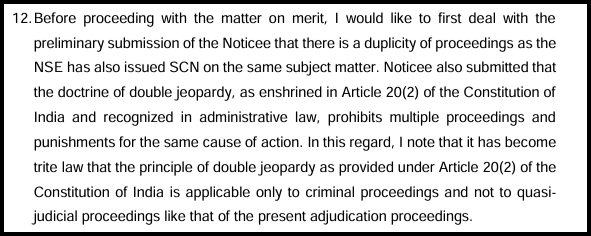
Double jeopardy under Article 20(2) of the Constitution applies to criminal prosecutions before a court, not to parallel regulatory proceedings.
NSE’s case covers disciplinary action, things like client-onboarding bans or membership suspension, under its own rules. SEBI’s case is a separate adjudication under the SEBI Act, with its own, distinct outcome: exoneration or a monetary penalty.
The two inspection periods didn’t even fully overlap. NSE’s ran from April 2022 to June 2024. SEBI’s ran from January to September 2024.
What SEBI Found SMC Actually Responsible For?
SEBI didn’t accept that Lilhare’s conduct was something SMC had no way of catching.
Under Clause 32.5.1 of SEBI’s Master Circular, a stock broker is responsible for all acts of omission and commission of its Authorised Persons.
That includes lapses the broker never actually noticed.
SMC had actually inspected Lilhare in March 2024, just two months before the irregularities surfaced. That inspection flagged only a minor issue with his visitor register.
SEBI established two separate violations.
One was the failure to maintain client order-placement records. The other was the failure to supervise an Authorised Person running a fixed-returns arrangement under SMC’s own licence.
Why the Penalty Is Only ₹1 Lakh Despite ₹6 Crore Changing Hands?
Given the ₹6.11 crore figure, the final penalty looks small. The reasoning behind it is worth understanding.
Section 15HB, the provision used here, caps penalties for violations with no separately prescribed penalty at ₹1 crore, with a floor of ₹1 lakh.
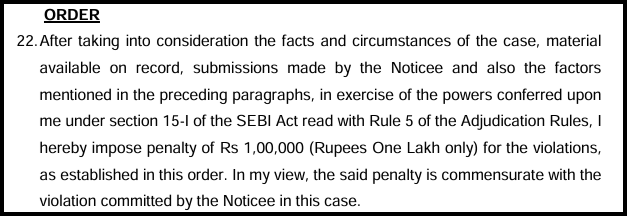
Section 15J asks the Adjudicating Officer to weigh three factors: disproportionate gain, investor loss, and repeat conduct.
SEBI noted that the ₹6.11 crore and ₹1.84 crore figures describe money moving between clients and the AP. None of it was a quantifiable gain SMC itself pocketed.
The order also notes that SMC has been penalised multiple times before for other violations. That history weighed against it, even as the final number stayed at the regulatory floor.
Is SMC Global Securities Still SEBI Registered?
Yes. This order penalises SMC for a supervision failure.
It does not touch its registration as a stock broker.
Its SEBI registration number, INZ000199438, remains active as of this order.
Why SMC Walked Away From a Settlement Before This Order?
SMC didn’t go straight to a hearing. In September 2025, it applied to settle the matter under SEBI’s Settlement Regulations, 2018.
That route lets a Noticee pay a settlement amount and close a case without a formal finding of violation.
SMC withdrew that application in February 2026, and the case went back to full adjudication, ending in this order and the ₹1 lakh penalty.
Fixed Returns and Oversight Lapses: A Recurring Pattern at SMC
An Authorised Person operates under a broker’s licence, not their own. Legally, that makes the broker responsible for what the AP does.
This case shows that responsibility has limits in practice. SMC’s own March 2024 inspection of Lilhare, after all, found almost nothing wrong.
Excess charges tell a related story about the same oversight gap. Our coverage of SMC Global excess charges shows how brokerage churning complaints have followed a similar pattern at this broker.
From Unauthorised Trades to Misappropriation: Pattern Recognition
The Amit Lilhare case isn’t the only time unauthorised activity has surfaced at this broker.
Our detailed look at unauthorised trading by SMC Global walks through what counts as unauthorised trading and how to build a case if it happens to you.
Guaranteed Returns from an Account Handler? It’s Always Illegal
If anyone, an AP, a relationship manager, or anyone claiming to manage your trades, offers fixed or guaranteed payouts in exchange for handling your account, that arrangement is illegal on its face.
Our guide on SEBI registered account handling explains exactly what’s legally permitted and what isn’t.
Mishandled Account? How to Report a Broker or Authorised Person
Reading about Lilhare’s clients might feel uncomfortably familiar. Maybe you’ve also noticed a payment pattern you couldn’t explain, or an AP who promised a little too much certainty.
That feeling is worth trusting. Most investors who end up in a case like this noticed something was off long before they actually acted on it.
The good news is you don’t need SEBI’s full machinery to start. A formal complaint against the broker, naming the AP involved, is usually the first real step.
Here’s how to complaint against broker, a process that also covers an Authorised Person acting under that broker’s own licence.
Checking SMC’s Own Trading Tools
We’ve also reviewed SMC’s own trading tools directly. Our SMC Autotrender review covers what the platform can and can’t legitimately claim.
Conclusion
This order is less about SMC Global Securities acting in bad faith. It’s more about how far a broker’s supervision can quietly fail at the branch level.
One Authorised Person ran a fixed-payout arrangement for over two years. He collected ₹6.11 crore from 161 clients through bank accounts his own broker never saw.
SMC caught it, disabled the terminal, and filed a police complaint before SEBI even inspected. The ₹1 lakh penalty reflects a supervision lapse, not a scheme SMC itself ran.
The lesson still holds for any trader, whichever broker’s name is on the account.
A fixed-return promise from anyone, however senior-sounding, is the warning sign to act on immediately.
Report. Recover. Stay Fraud Free.
Failing to maintain client order-placement records, and failing to adequately supervise its Authorised Person, Amit Lilhare, who ran a fixed-payout scheme for clients. SEBI found 161 clients invested a combined ₹6.11 crore, of which ₹1.84 crore was paid back to them as fixed payouts. SMC stated it only discovered irregularities in May 2024, disabled Lilhare's terminal, and filed a police complaint before SEBI's inspection began. Double jeopardy under Article 20(2) applies to criminal prosecutions, not parallel regulatory proceedings. NSE's case and SEBI's adjudication cover different legal grounds and different outcomes. Section 15HB sets a floor of ₹1 lakh for this kind of violation. SEBI found no quantifiable gain to SMC itself, since the money moved between clients and the AP, not into SMC's own accounts. Yes. This order imposes a penalty for a supervision failure and does not affect SMC's registration as a stock broker. Treat it as illegal, regardless of the AP's experience or client base. Stop any further payments, and report it to the broker's head office and SEBI directly.Frequently Asked Questions





 Add us as a preferred source on Google »

