
Quick Summary
SEBI’s Adjudicating Officer fined Supriya Kothari ₹10,00,000 in an order dated October 13, 2026. SEBI had examined trades in Wipro Limited options around a June 6, 2024 deal announcement and sought her details through three summons and repeated reminders. She did not provide them. The penalty is for not furnishing information, not for the trades. The order sets a 45-day payment deadline.
Three SEBI summons. Months of reminders. And the documents never arrived.
That silence has now cost Supriya Kothari ₹10 lakh in an order linked to Wipro options trades around a $500 million deal announcement.
Here is what SEBI asked for, what she did and did not do, and why the officer went ahead without her reply.
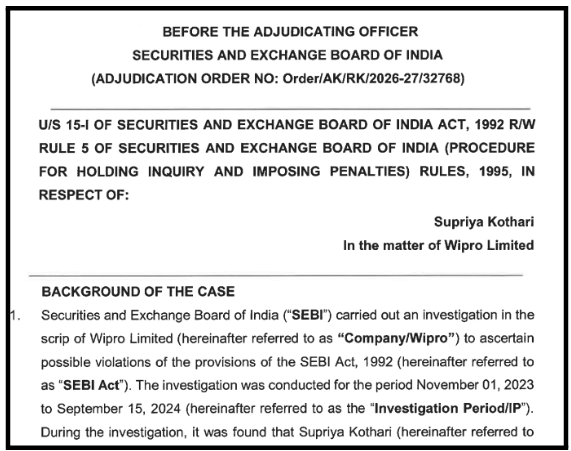
Supriya Kothari SEBI Order At A Glance: Date, Officer, Penalty And Sections
This table puts the order’s key details in one place. Wipro Limited is the company whose shares were examined. It is not the noticee.
Every entry comes straight from the adjudication order.
|
Detail |
What The Order Says |
|---|---|
|
Noticee |
Supriya Kothari |
|
Matter |
Suspected insider trading in the scrip of Wipro Limited (as titled in the order) |
|
Order date |
October 13, 2026, Mumbai |
| Passed by |
Amit Kapoor, Adjudicating Officer, SEBI |
| Order number |
Order/AK/RK/2026-27/32768 |
| Investigation period |
November 1, 2023 to September 15, 2024 |
| Provisions violated |
Sections 11C(3) and 11C(6)(a) and (b) of the SEBI Act |
|
Penalty provision |
Section 15A(a) of the SEBI Act |
|
Penalty |
₹10,00,000 |
| Payment deadline |
45 days from receipt of the order |
| Proceedings |
Ex-parte under Rule 4(7) |
Why The Penalty Is ₹10 Lakh: Not Furnishing Information, Not A Finding On The Trades
This is the point most readers miss. The penalty does not say the trades were wrong.
It says the noticee did not give SEBI the information SEBI was entitled to ask for.
1. What The Officer Actually Decided
The officer held that the noticee failed to provide the details and documents sought by SEBI during the investigation.
He found it established that she violated Section 11C(3) and 11C(6)(a) and (b) of the SEBI Act.
2. What The Order Did Not Decide
The order says that, because there was no response, it could not be established why she bought and sold the call options around the announcement.
It also says trading by her family members could not be ascertained.
3. No Gain Or Loss Was Quantified
The officer noted that the record has not quantified any disproportionate gain or unfair advantage, or any loss to investors, as a result of the failure.
So the penalty rests on non-cooperation alone.
Wipro $500 Million Deal Announcement: The Trades SEBI Was Examining
SEBI looked at trading in Wipro’s scrip between November 1, 2023 and September 15, 2024.
It was checking whether the noticee, along with three other entities, traded while having access to price-sensitive information.
Here is the announcement and the trades the order records.
1. The Announcement And Why SEBI Treated It As Price Sensitive
On June 6, 2024, Wipro told the exchanges that a leading US communication service provider had awarded it a $500 million managed-services deal over five years.
The filing was made at 16:30:40 IST on BSE and 16:30:53 IST on NSE.
2. What UPSI Means Here
SEBI treated that announcement as unpublished price sensitive information (UPSI) before it was made public.
The price rose after the announcement, so the UPSI was considered positive.
Our post on the Axis Mutual Fund front-running order shows how SEBI examines trading ahead of non-public information in another case.
3. The Three Periods SEBI Used
The order splits the investigation into three windows:
- Pre-UPSI period: November 1, 2023 to February 13, 2024
- UPSI period: February 14, 2024 to June 6, 2024
- Post-announcement period: June 7, 2024 to September 15, 2024
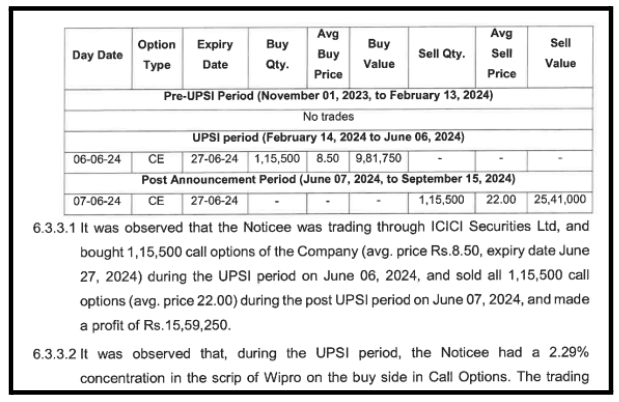
4. The Call Option Trades Recorded In The Order
The order records no trades in the pre-UPSI window for the contract in question. It then records one purchase and one sale.
|
Date |
Action | Quantity | Avg Price | Value |
|---|---|---|---|---|
|
June 6, 2024 |
Bought call options (expiry June 27, 2024) | 1,15,500 | ₹8.50 |
₹9,81,750 |
| June 7, 2024 | Sold the same 1,15,500 call options | 1,15,500 | ₹22.00 |
₹25,41,000 |
5. The Profit Figure Noted In The Order
The order observes that the trades produced a profit of ₹15,59,250.
It also notes a 2.29% concentration on the buy side in call options during the UPSI period.
These are observations from the show cause notice. The final penalty is not based on them.
SEBI Summons Timeline: 13 Contacts Between September And December 2025
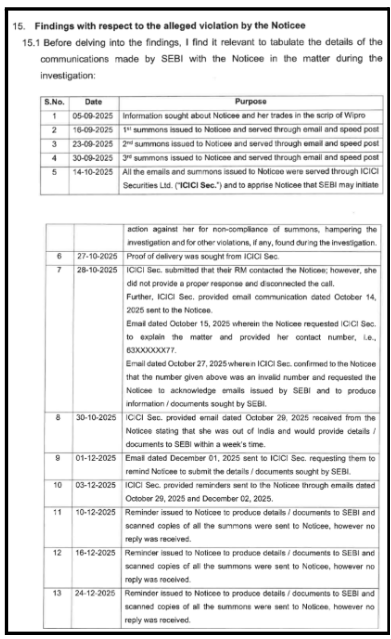
SEBI tried to reach the noticee for months. The order lists every contact in a table.
Here is how the contact log reads, in order.
|
No. |
Date | What Happened |
|---|---|---|
|
1 |
Sep 5, 2025 | SEBI sought information about the noticee and her trades in Wipro scrip |
|
2 |
Sep 16, 2025 | First summons sent by email and speed post |
|
3 |
Sep 23, 2025 |
Second summons sent by email and speed post |
| 4 | Sep 30, 2025 |
Third summons sent by email and speed post |
| 5 | Oct 14, 2025 |
Emails and summons served through ICICI Securities Ltd, with a warning that SEBI may act for non-compliance |
| 6 | Oct 27, 2025 |
SEBI sought proof of delivery from ICICI Securities |
|
7 |
Oct 28, 2025 | ICICI Securities said its relationship manager called, and the noticee did not respond properly and disconnected |
|
8 |
Oct 30, 2025 | ICICI Securities shared the noticee’s email saying she was out of India and would send details within a week |
|
9 |
Dec 1, 2025 | SEBI asked ICICI Securities to remind the noticee |
|
10 |
Dec 3, 2025 |
ICICI Securities shared its reminders of Oct 29 and Dec 2 |
| 11 | Dec 10, 2025 |
Reminder to the noticee with scanned summons, no reply |
| 12 | Dec 16, 2025 |
Reminder to the noticee with scanned summons, no reply |
| 13 | Dec 24, 2025 |
Reminder to the noticee with scanned summons, no reply |
1. The First Contact Went Unanswered
SEBI’s first communication on September 5, 2025 asked for details about her and her trades.
The order says it remained unanswered.
2. Three Summons In September
SEBI then issued three summons under Section 11C(3) on September 16, 23 and 30, 2025.
All were served by email and speed post, and the officer found them duly served.
3. The Broker Route In October
When the summons went unanswered, SEBI used her broker as a channel.
ICICI Securities Ltd was the trading member through which she traded.
SEBI also asked the broker for proof of delivery, and the broker reported that its relationship manager had called her.
Brokers hold records that SEBI itself does not.
Our explainer on whether SEBI keeps trade records shows where your own trade records actually sit.
4. What She Did Say, And Why It Did Not Count
The noticee replied through the broker on October 28 and 30, 2025.
Those messages said she was out of India and gave a contact number.
The order records that the number was invalid, and that she promised details within a week but did not send them.
5. Three More Reminders In December
SEBI reminded her again on December 10, 16 and 24, 2025, sending scanned copies of the summons each time.
The order records no reply to any of them.
What Happened After The Show Cause Notice: Representative, Extension And Hearing Notice
The proceedings did not end with the investigation.
SEBI then started adjudication and gave her more chances to respond.
Here is the sequence, with dates from the order.
1. Officer Appointed And Notice Served
SEBI appointed the Adjudicating Officer by an order dated February 11, 2026, communicated on February 13, 2026.
The show cause notice is dated March 17, 2026, with a corrigendum dated March 18, 2026.
It was delivered by speed post and email.
2. A Representative Reached Out
A person who claimed to be the noticee’s son and authorised representative wrote to SEBI on March 23, 2026, asking for guidance on what was sought.
SEBI replied the same day and asked for an authorisation letter in his favour.
3. The Representative’s Message And The Extension
On April 6, 2026, the representative wrote that the trades were placed “seeing the news”.
He asked for more time and promised the authorisation letter.
SEBI gave the noticee until April 14, 2026 to reply and to provide the letter.
4. Hearing Notice And Silence
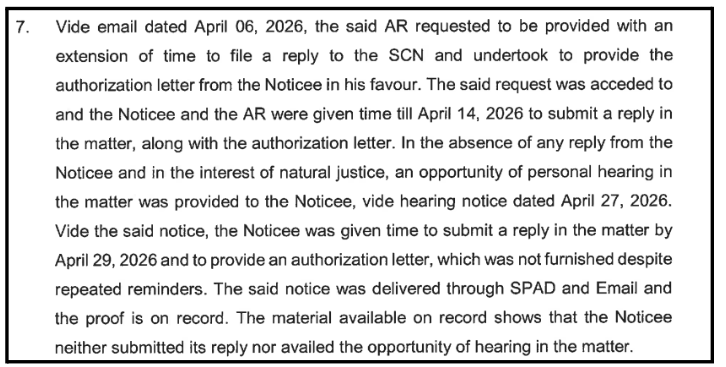
With no reply, SEBI issued a hearing notice on April 27, 2026 and asked for a reply by April 29, 2026.
The order records that the authorisation letter was never provided, no reply was filed, and she did not attend the hearing.
Ex-Parte Proceedings Explained: How The Officer Used SAT Rulings On Unanswered Notices
Because there was no reply and no hearing, the officer proceeded ex-parte under Rule 4(7).
That means he decided on the material on record, without her side.
He leaned on Securities Appellate Tribunal rulings to explain why.
1. What The Officer Concluded On Natural Justice
He found that the notice and hearing notice were duly served, and that sufficient opportunities were given.
He held that no prejudice had been caused to her and presumed the allegations were admitted.
2. The SAT Cases He Cited
The order cites three tribunal rulings on notices that go unanswered:
- Classic Credit Ltd. vs. SEBI (Appeal No. 68 of 2003, December 8, 2006)
- Sanjay Kumar Tayal and Others vs. SEBI (Appeal No. 68 of 2013, February 11, 2014)
- Dave Harihar Kirtibhai vs. SEBI (Appeal No. 181 of 2014, December 19, 2014)
3. What The Tribunal Said In Those Cases
In substance, the tribunal observed that a party that files no reply to a show cause notice is presumed to have admitted the charges in it.
It also criticised parties who ignore notices and then claim a lack of natural justice in appeal.
Officer’s Findings: Why Ignoring SEBI Summons Led To A ₹10 Lakh Penalty
The officer found that the noticee’s conduct went beyond a missed deadline. Here is how he reasoned.
These findings come from paragraphs 15.2 to 15.6 of the order.
1. The Officer’s View Of Her Conduct
He recorded that she remained silent despite summons served by email and speed post.
In his words, her conduct showed she was “deliberately not responding” and “trying to dodge the proceedings”.
2. The Effect On The Investigation
He noted that SEBI’s Investigating Authority had to complete its investigation into her activities without complete information.
He added that the failure showed a lack of sincerity in assisting SEBI.
3. The Tribunal Rulings On Cooperation
He quoted the tribunal in Vikas Gourihar Narnavar v. SEBI (November 27, 2010), which said the regulator cannot function if market players defy summons with impunity.
He also quoted Rich Capital & Financial Services Limited and Another vs. SEBI (October 22, 2013), which said cooperation with investigations is the first requirement.
4. The Conclusion
He held that it stands established that she violated Sections 11C(3), 11C(6)(a) and 11C(6)(b) of the SEBI Act.
Section 11C And Section 15A(a) Of The SEBI Act In Plain English
Two sections do the work in this order. One lets SEBI demand information. The other sets the penalty for refusing.
Here is what each says, as the order reproduces them.
1. Section 11C(3): SEBI Can Demand Information
The Investigating Authority may require any intermediary, or any person associated with the securities market, to furnish information or documents.
It can do this whenever it considers the material necessary for the investigation.
2. Section 11C(6): Failing To Comply
The section says a person who fails or refuses without reasonable cause to produce documents or furnish information is punishable.
The punishment can be imprisonment up to one year, or a fine up to ₹1 crore, or both, with a further fine up to ₹5 lakh per day after the first.
3. Section 15A(a): The Penalty The Officer Used
The officer imposed the penalty under Section 15A(a), which sets a penalty of not less than ₹1 lakh, and up to ₹1 lakh for each day of failure, subject to a maximum of ₹1 crore.
The order imposed only a monetary penalty. It did not impose imprisonment.
Is Supriya Kothari SEBI Registered Or Not?
The order does not list any SEBI registration for her. It describes her as a client trading through ICICI Securities Ltd.
Her business or profession is shown as “not provided”.
1. What The Order Records About Her Status
The details table in the order lists her as a client with a trading member, and does not describe her as an intermediary.
The order does not say whether any registration exists.
2. Why Section 11C(3) Still Applied
Section 11C(3) covers any intermediary or any person associated with the securities market.
The officer treated her as bound to furnish the information, and found she failed to.
3. Where Brokers Fit In
The order shows ICICI Securities Ltd acting as a channel for SEBI’s messages.
It does not allege any wrongdoing by the broker.
For context on how SEBI acts when brokers do fall short, read our roundup of SEBI action against brokers.
Penalty Reasoning Under Section 15J: Why The Officer Chose ₹10 Lakh
After finding the violation, the officer had to decide the amount. He did so using the factors in Section 15J.
Here is how each factor played out.
1. Gain Or Unfair Advantage
The record has not quantified any disproportionate gain or unfair advantage made as a result of the default.
2. Loss To Investors
The record has not quantified any loss caused to investors as a result of the failure.
3. Repetitive Nature
The officer noted that she has not been penalised by SEBI in the past.
4. Why Non-Compliance Is Serious
He said that if a person under investigation does not provide summoned information, it can adversely affect the investigation, which is a serious matter.
He concluded that compliance with the summons is an integral part of an investigation.
5. The Final Amount
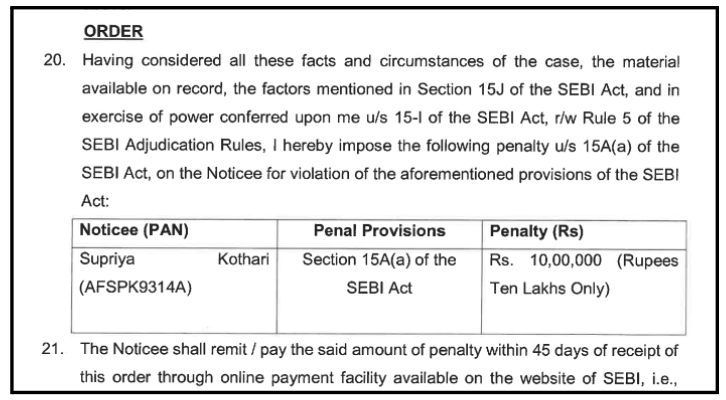
Weighing these, he imposed ₹10,00,000 (Rupees Ten Lakhs Only) under Section 15A(a).
For a different kind of lapse, our post on the Ultracab promoters disclosure penalty shows how SEBI adjudication officers penalise non-disclosure.
When Is the ₹10 Lakh SEBI Penalty Due and What Happens If It Remains Unpaid
The order sets a deadline, a payment route and a consequence for non-payment. These come from paragraphs 20 to 24.
1. The 45-Day Deadline
The noticee must pay within 45 days of receiving the order.
2. The Payment Path
Payment is online on SEBI’s website at sebi.gov.in, through Enforcement, Orders, Orders Of AO, Pay Now.
3. Recovery If Unpaid
If she does not pay in 45 days, SEBI may start recovery proceedings under Section 28A, with interest.
These can include attachment and sale of movable and immovable properties.
4. Copies Of The Order
Under Rule 6 of the Adjudication Rules, a copy of the order goes to the noticee and to SEBI.
What Traders Should Do If SEBI Sends A Summons Or Notice
This section is general guidance. The order does not set out these steps.
The case shows how costly it can be to leave a SEBI communication unanswered.
1. Read And Respond Before The Deadline
Summons carry strict timelines. If you cannot meet one, say so in writing and ask for time.
The order shows SEBI followed up for months and still recorded no documents.
2. Use A Working Contact Number And Email
The order records that the number given to SEBI through the broker was invalid. Keep your contact details current with your broker.
This is how SEBI and your broker reach you.
3. Authorise Anyone Who Speaks For You
SEBI asked for an authorisation letter and never received one. A relative or adviser cannot represent you without it.
If someone represents you, give them a signed letter early.
4. Know The Risk Before Trading Options
Options trading carries high risk. SEBI’s own study found most individual traders lose money in the segment.
Read our breakdown of the SEBI F&O profit and loss report to see the numbers.
Conclusion: What The Supriya Kothari SEBI Order Means For Traders
SEBI fined Supriya Kothari ₹10,00,000 for not furnishing information it sought during an investigation into Wipro scrip trading.
The order does not decide why she traded. It records only that she did not respond, and that the officer proceeded ex-parte.
Report. Recover. Stay Fraud Free.
Frequently Asked Questions
SEBI's Adjudicating Officer imposed a penalty of ₹10,00,000 under Section 15A(a) of the SEBI Act.
The order is dated October 13, 2026.
For not providing details and documents sought by SEBI during its investigation, in violation of Section 11C(3) and 11C(6)(a) and (b).
No. The order penalises only the failure to furnish information. It says it could not be established why the trades were made.
No. Wipro is the company whose scrip was examined. The noticee is Supriya Kothari.
The order records a purchase of 1,15,500 call options on June 6, 2024 and a sale on June 7, 2024.
The order lists 13 communications between September 5 and December 24, 2025, including three summons.
SEBI may start recovery proceedings under Section 28A, with interest, including attachment and sale of property.


 Add us as a preferred source on Google »