

Quick Summary
SEBI doesn’t act on complaints alone, it runs scheduled inspections and surveillance-triggered ones, issues show-cause notices, and passes adjudication orders that go public. Recent cases show the range: 119 brokers penalised for links to an algo platform promising guaranteed returns, a commodity broker fined for failing to segregate client funds, and a full-service broker fined ₹10 lakh for cybersecurity gaps that left client data exposed. None of these are abstract compliance failures, each one has a direct cost attached to real investors.
Have you ever felt your broker isn’t being fully honest with you, trades you don’t remember, charges you don’t understand, statements that feel rushed?
You’re not alone, and many of the things brokers do in the shadows aren’t just unfair; they’re direct violations of SEBI regulations that the regulator does act on.
What Actually Triggers SEBI Action Against a Broker?
SEBI doesn’t take action randomly; there’s a pattern to what invites scrutiny.
Inspections repeatedly turn up the same violations:
- Misuse of client funds: Deposits used for another client’s obligations or the broker’s own expenses without your knowledge.
- Incorrect margin reporting: Wrong data filed with exchanges, distorting risk controls and enabling wrongful square-offs.
- Unauthorised trades: Orders placed without your consent or proper record.
- Late settlement of client funds: Idle funds not returned on the mandated quarterly or monthly schedule.
- KYC non-compliance: Failure to verify identity documents in time.
- Association with unregulated platforms: API links to algo platforms advertising guaranteed returns, a direct violation of SEBI’s 2022 circular.
- Excess brokerage collection: Charging beyond the regulatory cap, sometimes by secretly switching fee structures.
The process itself is structured.
It starts with an inspection or surveillance trigger, either a scheduled inspection or a surveillance-system alert flagging unusual trading patterns, complaint spikes, or association with flagged platforms.
If violations turn up, SEBI issues a show-cause notice laying out the specific breaches and giving the broker a formal chance to respond.
If the response is insufficient, adjudication proceedings begin, a quasi-judicial process ending in a penalty, censure, or, in serious cases, suspension or cancellation.
Every order is then published on SEBI’s website under its Enforcement section, a deliberate transparency measure that creates a public record and deters the broader industry, and a parallel Designated Authority track can issue a formal regulatory censure alongside the monetary penalty for the same set of violations.
When 119 Brokers Got Linked to a Guaranteed-Return Platform
ATS Share Brokers Private Limited was one of several brokers penalised in SEBI’s coordinated enforcement action in March 2026, tied to Tradetron, a SaaS-based algorithmic trading platform.
In 2022, SEBI issued a circular explicitly prohibiting stockbrokers from associating with any platform that directly or indirectly promoted algo strategies offering assured or guaranteed returns, and Tradetron’s strategy listings advertised highly consistent or assured returns, a clear red flag under that circular.
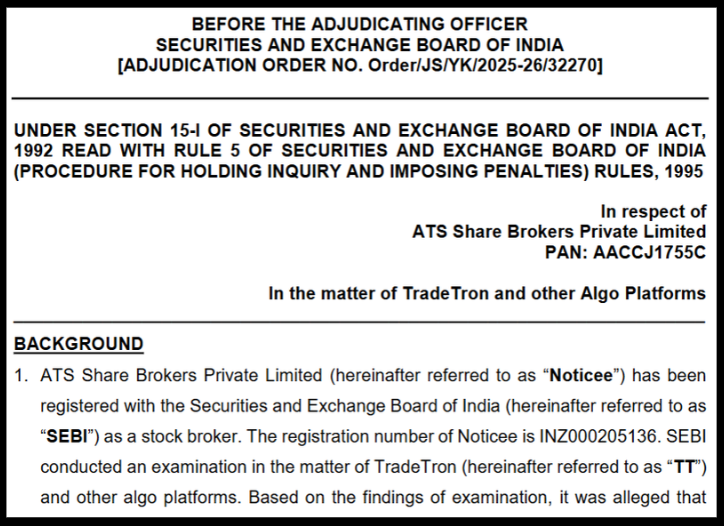
SEBI’s investigation found the APIs of as many as 119 stock brokers were integrated with Tradetron, with 86 of them having paid a one-time integration fee collectively amounting to approximately ₹1.21 crore over three years.
The violations went beyond continued association after the 2022 circular; brokers had failed to honour prior assurances given to SEBI about disconnecting from the platform, and commercial linkages ran deeper still; strategies on Tradetron included links encouraging users to open accounts with specific partner brokers, sometimes with discounted strategy access in return.
Total penalties across the batch of orders reached ₹16 lakh.
The takeaway for any investor using an algo tool: if the platform claims “assured” or “guaranteed” returns, both the platform and any broker connected to it through API integration are operating in violation, and that broker bears regulatory responsibility for the nature of what the platform offers.
When a Commodity Broker Failed to Segregate Client Funds
Samdhyan Commodities Brokers Private Limited, an Ahmedabad-based commodity broker registered with MCX, faced a December 2025 SEBI adjudication order following an inspection that uncovered multiple operational failures.
The firm failed to maintain proper segregation between client funds and its own operational funds, a fundamental SEBI requirement, and showed negative values in mandatory fund reconciliation parameters, indicating client funds may have been used beyond what’s permitted.
Inadequate record-keeping meant account settlement documentation wasn’t maintained as required, and KYC compliance gaps included failure to upload client documents and complete verification within prescribed timelines.
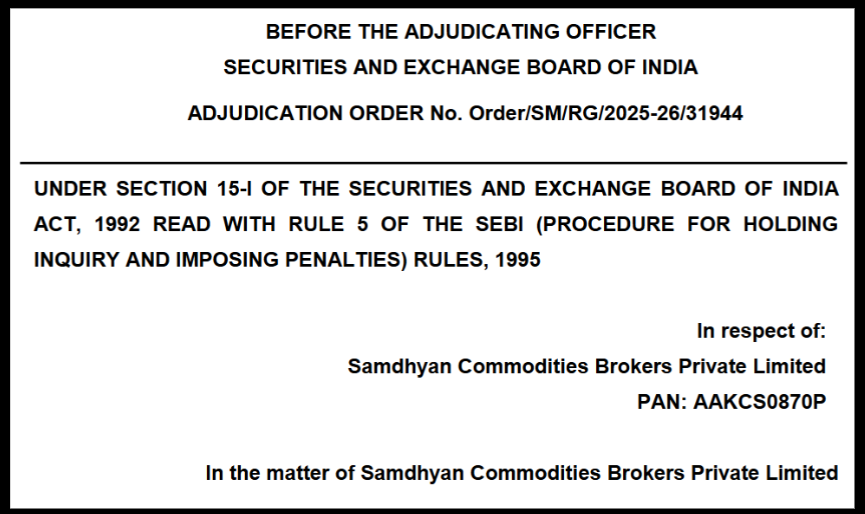
SEBI imposed a total penalty of ₹2,00,000 on the firm.
For investors, the lesson is practical: request your broker’s fund settlement statement periodically, since SEBI mandates regular settlement and an irregular pattern is itself a warning sign, and verify your KYC documents are properly registered directly on the KRA portal rather than assuming a smaller or lesser-known broker faces lighter obligations than larger ones.
When Cybersecurity Gaps Became a ₹10 Lakh Penalty
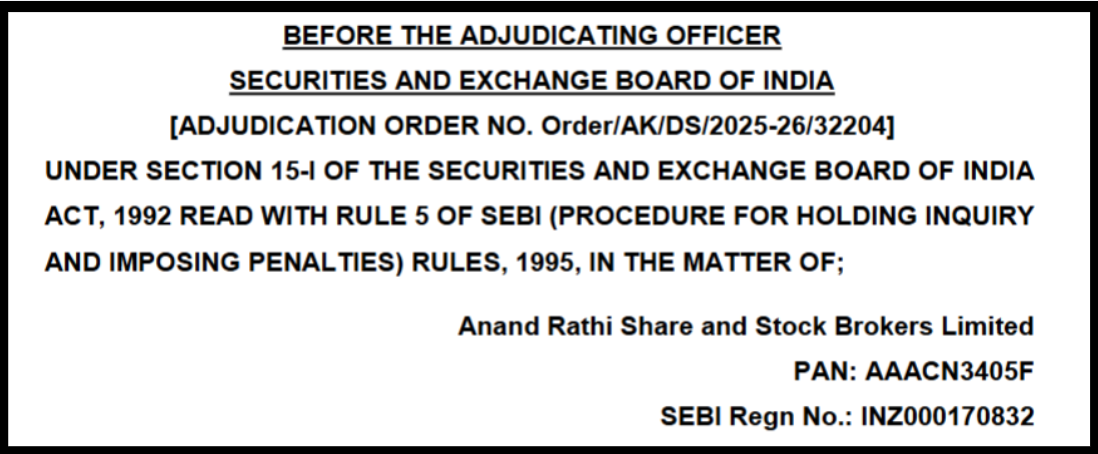
Anand Rathi Share and Stock Brokers Limited, one of India’s established full-service brokerages, faced a ₹10 lakh monetary penalty in March 2026 following a thematic inspection conducted between January 6 and 10, 2025, focused specifically on cybersecurity compliance.
The inspection found a lack of automated alerts when system capacity exceeded 70% of installed capacity, a basic monitoring requirement under SEBI’s cyber framework, alongside gaps in business continuity and disaster recovery policies, meaning no adequately tested plan existed for service disruptions.
Weak password policies and inadequate access control for trading systems, deficiencies in data leakage prevention, insufficient vulnerability testing exposing potential entry points, and non-compliance with incident reporting and KYC validation controls rounded out the findings.
Your broker’s cybersecurity health directly affects the safety of your trading account and personal financial data, so enable two-factor authentication regardless of whether your broker makes it mandatory, and regularly check for unauthorised login attempts rather than waiting for something to go visibly wrong.
SEBI now treats cybersecurity compliance as a core regulatory obligation, not a technical afterthought, a stance that matters if you’re separately dealing with a case of broker traded without my permission that might trace back to exactly this kind of infrastructure gap.
How to Report a Broker in India?
Start by collecting every relevant document immediately: trade statements, contract notes, call recordings, and written messages, since strong evidence is the foundation of any successful complaint.
Write a formal complaint to your broker’s grievance cell first, giving a reasonable window to respond and keeping a copy of everything sent and received.
If unresolved, file through SEBI SCORES, which carries direct regulatory weight and a tracked complaint ID.
If SCORES doesn’t produce a satisfactory outcome, SMART ODR handles disputes through structured, time-bound online conciliation and arbitration, and if the dispute remains unresolved, exchange arbitration through NSE or BSE provides a legally binding resolution.
The complete step-by-step process, with timelines and what to attach at each stage, is covered in full in our guide: file a complaint against your stock broker.
If your specific concern is whether your broker holds a legitimate registration at all before you even get to a complaint, that verification process is covered separately in our guide on SEBI registered brokers.
Worried your broker’s systems, fund handling, or reporting don’t add up?
We compare your account records against what SEBI’s enforcement orders show brokers actually get penalised for, and build your complaint around the specific violation involved.
Register with us to get our support.
Conclusion
The enforcement orders we looked at in this blog, from algo platform violations to cybersecurity lapses to fund management failures, are not isolated incidents.
They represent patterns that repeat across the broking industry, and they directly affect retail investors in ways that are often invisible until damage is already done.
Check your contract notes, question unexplained charges, verify your KYC records, and stay away from any platform that promises guaranteed returns, no matter how convincing the pitch sounds.
Report. Recover. Stay Fraud Free.
Frequently Asked Questions
An adjudication penalty is a monetary fine issued by SEBI's Adjudicating Officer after a formal quasi-judicial process. A Designated Authority censure is a separate, parallel regulatory reprimand that goes on the broker's record, and both can apply simultaneously for the same set of violations, as seen in cases where a broker faces both a fine and a formal censure.
Not automatically, but the association itself is a violation once SEBI's 2022 circular applies, regardless of whether the broker directly made the guarantee. Continued API integration after being warned to disconnect, as seen in the Tradetron enforcement action, is what actually triggers the penalty.
All adjudication orders are published on SEBI's official website under its Enforcement section, a deliberate public record you can search directly by the broker's name before opening an account or after a dispute arises.
No. Established, long-registered brokerages including Prabhudas Lilladher, Anand Rathi, and others covered across recent SEBI orders have all faced penalties for fund misuse, cybersecurity gaps, or unauthorised trading, showing that reputation and client base don't substitute for compliance.





 Add us as a preferred source on Google »

