

Quick Summary
A SEBI registered research analyst can publish research reports, give buy, sell, and hold recommendations backed by analysis, share market and sector opinions, and charge a transparent fee for it. What they cannot do is where most investors get hurt: no guaranteed returns, no handling your account, no profit-sharing, no personalised execution, and no pushing unsuitable products. Registration tells you what an analyst is allowed to do. It does not promise they stay inside those limits. This page maps the full scope, what is permitted, what is banned, the rules and guidelines behind it, and the real SEBI orders that show what crossing the line looks like.
SEBI registration gets treated as a badge of total trust. It is not. It is a licence for a specific job, with clear edges.
Understanding those edges is what protects you.
Most retail traders get hurt not because they trusted a registered analyst, but because they did not know where that analyst’s authority stopped.
So here is the full picture: what a registered research analyst is genuinely allowed to do, and the far longer list of things they are not.
Once you can see the line, you can spot the moment someone steps over it.
What Is a SEBI Registered Research Analyst?
A SEBI registered research analyst is a person or firm authorised by the Securities and Exchange Board of India to provide research-based opinions and recommendations on securities.
That authority comes from the SEBI (Research Analysts) Regulations, 2014, and it carries both rights and hard limits.
A valid registration number, starting with INH, means the analyst met SEBI’s eligibility criteria.
It does not mean they can do whatever they like with your money, or promise you any outcome.
That gap between “registered” and “trustworthy in every action” is the whole subject of this page.
What a SEBI Registered Research Analyst CAN Do?
Before you can spot overreach, you need to know what genuine, permitted work actually looks like.
A registered analyst’s job sits in one lane: producing and sharing research, and charging fairly for it.
That covers written reports, general recommendations, market opinions, and transparent fees, with proper paperwork behind it all.
The points below map that lane fully:
1. Publish Research Reports on Listed Securities
A registered analyst can put out structured research reports on stocks, indices, sectors, or broader market trends.
Every report is expected to rest on real financial data, valuation methods, risk factors, and clearly stated assumptions.
The keyword throughout is research.
Documented analysis, not tips, hunches, or vague reasoning like “the stock is in an uptrend.”
2. Share Research-Based Recommendations
An analyst can give you buy, sell, or hold calls on securities.
But the call only counts as legitimate when it is grounded in proper research, carries a documented rationale, and comes with a clear risk disclosure.
What it cannot carry is any language implying a guaranteed outcome.
A recommendation rushed at you with no reasoning and no stop-loss is not how a compliant analyst works.
3. Offer Analytical Opinions on Markets and Sectors
A registered analyst can share macro-level views on market conditions, sector performance, and economic developments.
They can compare investment options and explain why they are bullish or bearish on a theme.
The boundary is that these stay opinions and analysis, not execution.
An analyst is not your portfolio manager, and is not there to run your trades.
4. Charge a Fee for Their Work
There is nothing wrong with paying a registered analyst for quality research. They are allowed to charge for it.
The fee must be disclosed upfront and kept fixed and transparent, so you know exactly what you are paying and why.
What it can never be is a share of your profits.
The moment an analyst wants a cut of your gains, that is a red flag, not a fee.
5. Onboard Clients With Proper Documentation
Before any money changes hands, a registered analyst must give you a written agreement, risk disclosures, and a clear statement of services.
This paperwork is not a formality. It is a regulatory requirement built to protect you.
If someone asks for payment with no agreement, no disclosures, and no records, that alone should make you stop and question it.
What a SEBI Registered Research Analyst CANNOT Do?
This is the side most traders never learn until after they have lost money, and it is where nearly every dispute begins.
The prohibitions fall into a clear pattern.
A research analyst cannot touch your money or your account, cannot promise you any outcome, and cannot use pressure or half-truths to sell you their service.
Everything below is a version of one of those three lines being crossed.
Read them as a checklist against your own experience.
If a “registered” analyst has done any of these, they have stepped outside their licence, and that gives you grounds to act.
1. Promise Guaranteed Returns or Fixed Profits
No analyst can legally promise you a fixed monthly income, an assured percentage, or a “sure-shot” call that cannot lose.
The market is uncertain by nature, and no registration changes that.
Any promise of guaranteed profit is not confidence; it is a regulatory offence, and one of the most common violations SEBI acts on.
2. Offer to Recover Your Past Losses
An analyst cannot pitch you a scheme to win back losses you have already taken, least of all by pushing you into risky or offshore products.
This trap almost always targets people who are already down and desperate to break even.
Using that distress to drive more trades is treated as manipulative conduct, not advice.
3. Charge Fees Linked to Your Profits or Capital
Profit-sharing is flatly banned for research analysts.
The reason is simple: tying an analyst’s income to your gains gives them a direct incentive to push you into bigger risks than you should ever take.
It quietly turns their “advice” into something built around their payout, not your safety.
4. Manage Your Account or Place Your Trades
A research analyst provides research. They cannot log in to your account, place orders, manage your positions, or operate your demat.
Even telling you the exact quantity to buy edges into execution and portfolio management, which needs an entirely different licence.
If you have an issue with someone operating under a PMS license, that would require a complaint against portfolio managers entities, not a research analyst, who is strictly prohibited from holding or managing your money in the first place.
So, if someone calls themselves a registered analyst and offers to “handle your account,” they are operating completely outside their legal scope, and that exact setup has wiped out many traders.
5. Push You Into Unsuitable Products
Every analyst is meant to weigh your financial situation, age, and risk appetite before recommending anything.
Selling high-risk index options to a conservative, elderly investor, for instance, is a direct breach of SEBI’s suitability norms.
When a recommendation ignores who you are and what you can afford to lose, it is serving the seller, not you.
6. Show Only Their Winning Calls
An analyst cannot cherry-pick their best trades to show off while quietly hiding all the losing ones.
That paints a false picture of accuracy and counts as misleading communication under SEBI’s rules.
Every recommendation is meant to be presented with balanced disclosure, the risks and the losses included, not just the wins.
7. Use Pressure-Based Sales Tactics
Urgent cold calls, repeatedly chasing someone who already said no, or manufacturing “act now before it closes” pressure all fall outside compliant conduct.
These tactics are designed to stop you thinking clearly.
An analyst who rushes you is already operating past the line a genuine professional stays behind.
Which SEBI Regulations Govern a Research Analyst?
Everything above traces back to one legal foundation.
A registered analyst operates under the SEBI (Research Analysts) Regulations, 2014, along with the amendments and circulars that have updated it since, including the rules on fees, disclosures, and conflict of interest.
These regulations are the law of what an analyst may and may not do. They define who must register, how they must conduct research, and what happens when they break the rules.
We break down the legal framework in plain language in our guide: SEBI registered research analyst regulations.
The Guidelines Every Research Analyst Must Follow
If the regulations are the law, the guidelines are how an analyst is expected to behave day to day.
They cover the code of conduct: honesty and fair dealing, full and balanced disclosure, managing conflicts of interest, keeping proper records, and never misleading a client with selective or exaggerated claims.
An analyst can hold a valid registration and still breach these conduct standards, which is exactly how many disputes begin.
The full conduct code is set out in our guide: SEBI guidelines for research analysts.
Real SEBI Orders: What Crossing the Line Looks Like
The boundaries above are not theoretical.
SEBI regularly acts against registered analysts who cross them, usually over guaranteed returns, loss-recovery schemes, or high-pressure selling.
Three orders show the pattern clearly, and each maps directly to a “cannot do” from the list above.
1. Equity Mania Financial Advisory
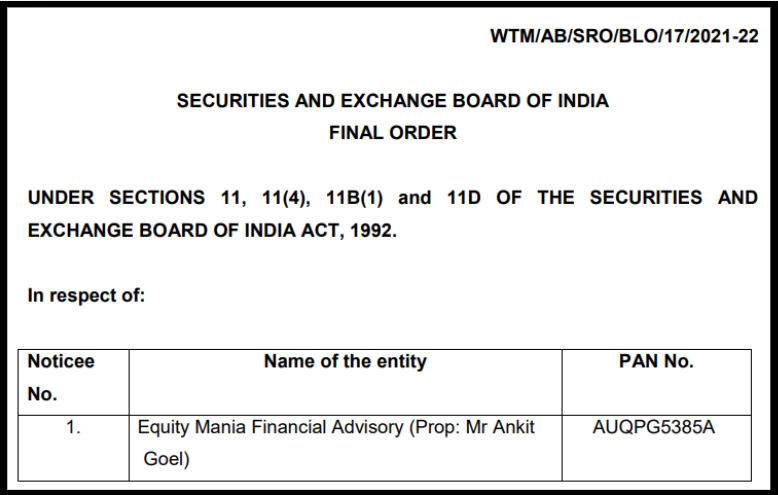
This firm lured clients with “sure-shot” promises, the guaranteed-returns violation in action.
What SEBI found: the firm used phrases like “assured returns” and “daily 15 to 20% returns” with no risk disclosures, breaching the PFUTP Regulations and the RA Code of Conduct.
The penalty: a ₹5 lakh fine, plus an order to refund affected clients.
The lesson: a legitimate analyst always highlights risk prominently. Treat “sure-shot” hype as a warning, not a selling point.
2. Punit Kumar / Shrimoney
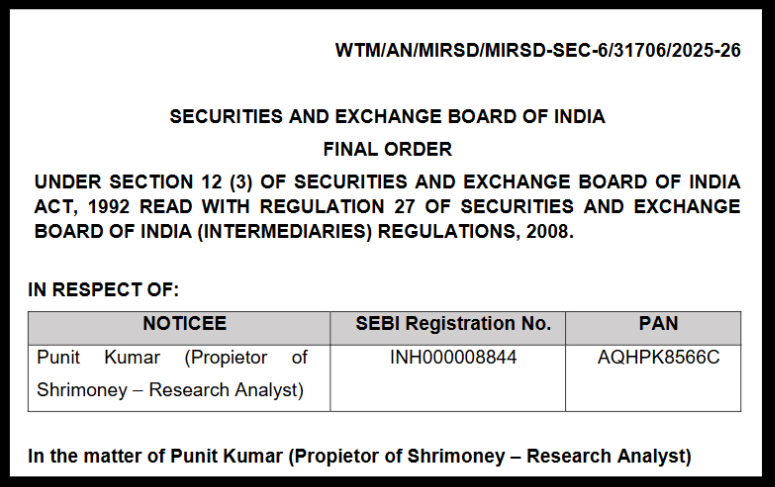
This case is the loss-recovery trap made real, exploiting clients who were already down.
What SEBI found: the analyst offered “loss-recovery” schemes carrying guaranteed-return undertones, and engaged in manipulative practices under PFUTP Regulation 3.
The penalty: disgorgement of the unlawful gains, and a bar on taking new clients for one month.
The lesson: any “loss recovery” pitch is a red flag. No analyst can legitimately promise to win back what the market took.
3. Mir Uniserv
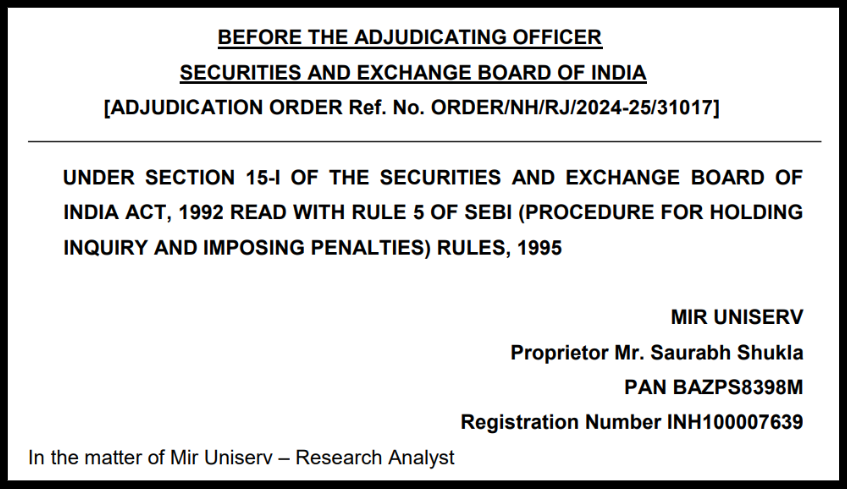
This case shows the pressure-tactics boundary being crossed in plain sight.
What SEBI found: repeated high-pressure calls, a refusal to give clear stop-loss levels, and pushing clients to trade immediately before “windows closed,” all breaching the RA Code of Conduct and the PFUTP Regulations.
The penalty: a ₹10 lakh penalty.
The lesson: demand written risk details and stop-losses, and never let urgency rush your decision.
We cover the full case on our page on the Mir Uniserv research analyst order.
Recognise any of these tactics from your own analyst?
We will compare what you were told against what an analyst is actually allowed to do, gather the evidence, and build your complaint if the conduct broke SEBI’s rules.
How to Verify an Analyst Before You Trust Them?
Before you trust anyone with your money, spend five minutes confirming their credentials. It is the single highest-value check you can make, and it is simple enough that there is no excuse to skip it.
Here is how to check SEBI registered research analyst properly, step by step:
- Start with the INH registration number: Every genuine analyst has one, and it always begins with “INH” followed by nine digits. Ask for it, or find it on their website or disclosure documents.
- Verify it on SEBI’s own records: Do not trust a number shown on the firm’s own site or a forwarded screenshot. Go to SEBI’s official intermediary records and look the number up directly.
- Confirm the name matches: Check that the entity name attached to that registration is the exact firm or person you are dealing with. A real number sitting against a different name is a forgery in progress.
- Check the status is active: Make sure the registration reads active or perpetual, not expired, suspended, or cancelled. A lapsed registration means they cannot legally operate.
- Look for enforcement orders: SEBI publishes its action orders publicly. Search the analyst’s name to see whether any penalty or adjudication order already exists against them.
- Get everything in writing: Before you pay a rupee, ask for the written service agreement, the risk disclosure, and the fee structure. A legitimate analyst provides these without hesitation.
- A valid registration is a starting point, not a stamp of good conduct: It rules out the outright imposters, but it does not promise the analyst behaves once you are a client. So verify first, then stay alert.
What to Do If an Analyst Crossed the Line?
If a research analyst promised returns, handled your trades, or pushed you with pressure tactics, that conduct breaks SEBI’s rules, and you have a clear process to pursue stock market fraud recovery India.
It begins with a written complaint to the firm. If that fails, the next step is SEBI SCORES complaint registration, where you lodge the matter formally.
From there it can move to SMART ODR dispute resolution, and to arbitration as a final step if it stays unresolved.
For the complete process and what each stage can realistically recover, see our guide: how to complain against research analyst SEBI.
Conclusion
SEBI registration is a credential, not a guarantee of ethics or skill.
A registered analyst may publish research, give reasoned recommendations, and charge a transparent fee.
They cannot promise returns, run your trades, push unsuitable products, or take a cut of your profits.
The gap between what they are allowed to do and what some of them actually do is where most retail traders get hurt.
So when someone flashes a registration number, do not stop there.
Verify it, get everything in writing, ask questions, and always understand the reasoning behind a recommendation before you act.
Your capital is your responsibility, and knowledge is its best protection.
Frequently Asked Questions
They can publish research reports, give buy, sell, or hold recommendations backed by analysis, share market and sector opinions, and charge a transparent, disclosed fee. Everything they do must rest on documented research, not tips or guarantees.
No. An analyst provides research only. They cannot log in to your account, place orders, manage positions, or operate your demat. Anyone offering to "handle your account" is acting outside their licence.
No. Guaranteed returns, fixed monthly income, and "sure-shot" calls are all banned. SEBI has penalised registered analysts for exactly this, treating it as a violation of the PFUTP Regulations and the RA Code of Conduct.
No. An analyst's fee must be fixed, disclosed, and independent of your profits. A profit-sharing arrangement is prohibited because it pushes the analyst to make you take bigger risks for their own gain.
No. Registration confirms the analyst met SEBI's criteria and operates under its rules. It does not guarantee ethical conduct. Verify the number, check for enforcement orders, and keep everything in writing.





 Add us as a preferred source on Google »

