

Many investors searching for Mir Uniserv Research Analyst are usually trying to answer one simple but important question:
“Can this firm really be trusted with my money?”
At first glance, Mir Uniserv appears to have the credibility many investors look for.
But when investors start digging deeper, the picture becomes far more complicated.
Online searches around Mir Uniserv Research Analyst now show a combination of regulatory action, investor complaints, compliance-related observations, and growing concerns regarding how certain advisory services were allegedly handled.
Before paying large subscription fees, joining premium packages, or acting on trading calls, investors should understand the full background carefully and evaluate both the positive and negative aspects properly.
In this blog, we will break down everything in a simple and factual manner.
Mir Uniserv Research Analyst Review
Mir Uniserv is a Kanpur-based research analyst firm with contact person Saurabh Shukla at its helm.
The firm offers investment research services, including equity tips, Nifty and Bank Nifty recommendations, intraday calls, and options advice.
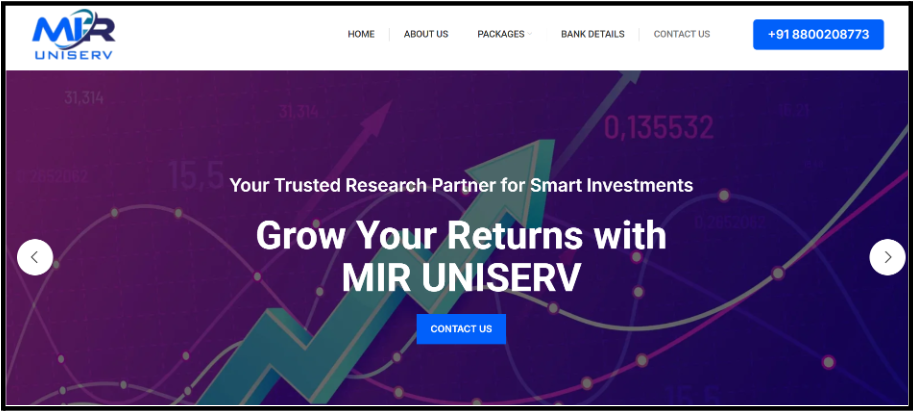
It markets itself through its website under the tagline “Your Trusted Research Partner for Smart Investments” and promotes packages across multiple price points.
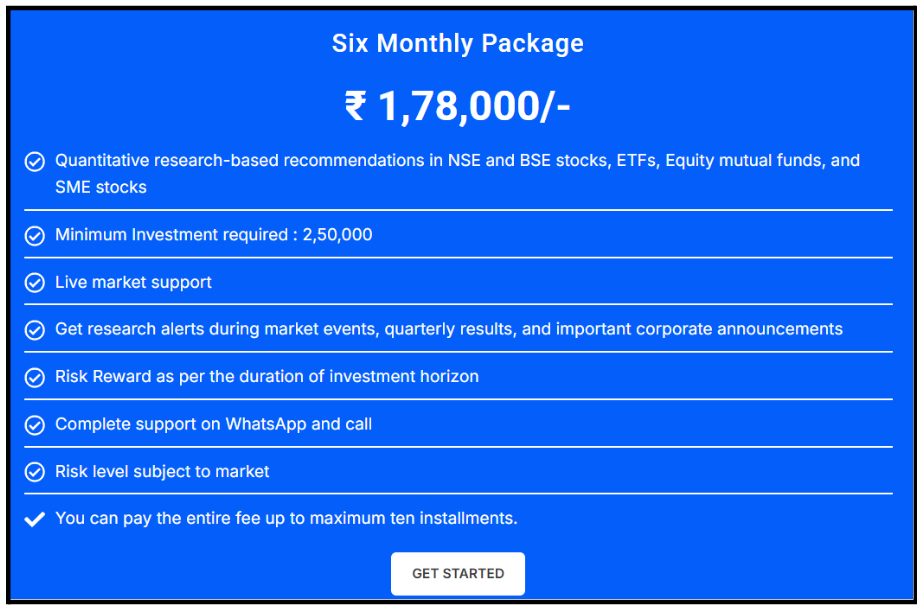
The firm also operated or maintained associations with related entities, including Banknifty Expert and appeared on platforms including Facebook pages and YouTube channels.
Is Mir Uniserv SEBI Registered?
Yes, Mir Uniserv holds SEBI registration number INH100007639 under the Research Analyst Regulations, 2014, with validity from June 24, 2020, on a perpetual basis.
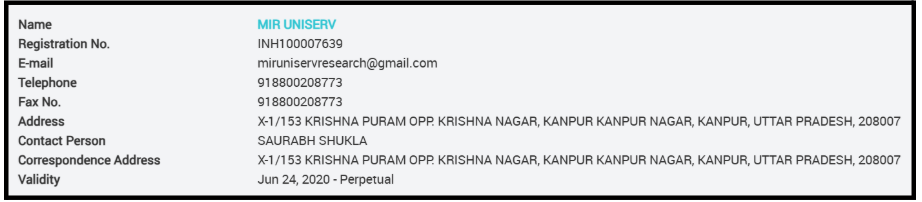
The contact person on SEBI’s records is Saurabh Shukla, with a registered address at X-1/153 Krishna Puram, Opp. Krishna Nagar, Kanpur, Uttar Pradesh, 208007.
However, holding an SEBI registration does not mean the firm operates without violations.
SEBI’s own adjudication order against Mir Uniserv confirms that registration and compliance are two different things entirely.
SEBI Action Against Mir Uniserv
SEBI conducted a formal inspection of Mir Uniserv covering the period April 1, 2022, to December 31, 2023.
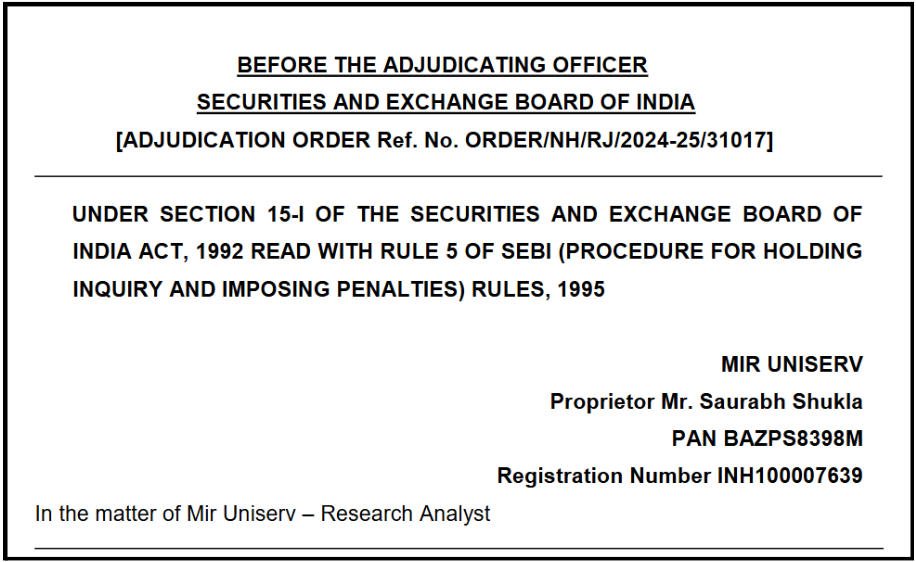
The inspection uncovered multiple categories of violations spanning client onboarding, grievance handling, profit assurances, and conduct during the inspection itself.
The order examined five distinct issues and established violations across all of them.
-
Key Violations by Mir Uniserv
SEBI established the following violations through the adjudication order, each one directly connected to client harm or regulatory obstruction.
1. KYC Violations Across Hundreds of Clients
Mir Uniserv failed to maintain KYC records for at least 190 clients out of 1,270, a number the firm itself admitted after SEBI reconciled the data.
The firm claimed a technical glitch caused the gap but produced no supporting evidence.
SEBI found this claim unsubstantiated and held the firm in violation of Regulation 16 of the KYC Regulations and multiple SEBI circulars governing client identification requirements.
2. Delayed Grievance Redressal and Late SCORES Registration
Mir Uniserv obtained its SCORES ID on July 5, 2022, two full years after receiving SEBI registration in June 2020.
Additionally, SEBI found that 12 investor complaints saw resolution delays ranging from 31 to 94 days, well beyond the prescribed 30-day and 21-day timelines.
The firm failed to demonstrate any timely efforts toward resolving these complaints.
This established violations of the December 18, 2014 SEBI circular, Clauses 45 and 49 of the November 7, 2022 Master Circular, and Regulation 26B(1) of the RA Regulations.
3. Outsourcing Core Functions Without Contracts or Policy
SEBI found that Mir Uniserv outsourced client onboarding, KYC collection, and client servicing to third-party marketing associates and telecallers and paid them a total of ₹2,54,72,612.
The firm maintained no written contracts, no outsourcing policy, and no verifiable evidence that these individuals were on its payroll as employees.
SEBI rejected the firm’s claim that these were internal sales staff, finding the salary records unverified and the coercion defence unsubstantiated.
4. Making Assured Profit Claims to Clients
Multiple SCORES complaints against Mir Uniserv referenced specific, quantified profit promises.
SEBI found claims of 100% profit, monthly returns of ₹50,000 to ₹60,000, and assured outcomes that induced clients to pay fees.
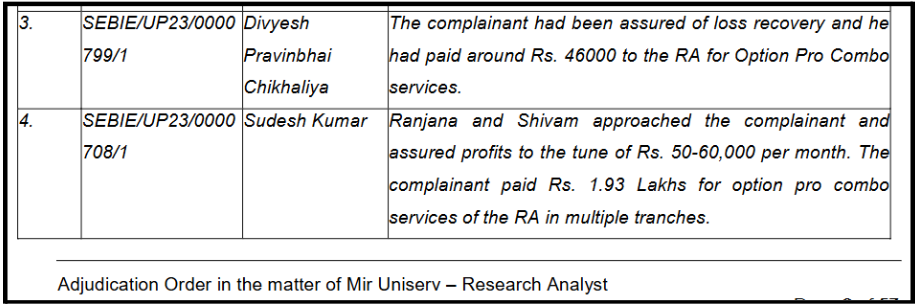
Mir Uniserv’s own email to a client referenced “expected profits with predefined maximum and minimum losses” language SEBI found constituted a profit assurance rather than a risk disclosure.
The Securities Appellate Tribunal has held that such profit assurances are fraudulent and violate Regulation 4 of the PFUTP Regulations.
5. Destroying Website Records During Inspection
Mir Uniserv submitted NIL information when SEBI asked for details of third-party payments during inspection.
Mir Uniserv cleared all content from its website, preventing the inspection team from verifying regulatory compliance.
-
Penalty
The Adjudication Order imposed a total monetary penalty of ₹10,00,000 (Ten Lakh Rupees) on Mir Uniserv, broken down as follows:
| Violation | Penalty Provision | Amount |
| Failure to provide information, concealment of records, non-cooperation during inspection | Section 15A(a) of SEBI Act | ₹1,00,000 |
| Delayed SCORES registration and grievance resolution beyond prescribed timelines | Section 15C of SEBI Act | ₹1,00,000 |
| KYC violations, outsourcing of core functions, Code of Conduct breaches | Section 15EB of SEBI Act | ₹3,00,000 |
| Assured profit claims in violation of PFUTP Regulations | Section 15HA of SEBI Act | ₹5,00,000 |
| Total Penalty | ₹10,00,000 |
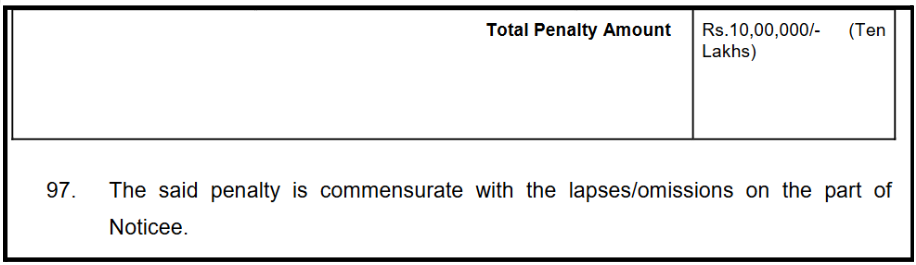
Payment of the full penalty was directed within 45 days of the order dated November 29, 2024, through SEBI’s online enforcement portal.
Mir Uniserv Research Analyst Complaints
Mir Uniserv displays its grievance data on its own website, showing 18 total complaints received, with 17 resolved and 1 still pending as of 2026-27.
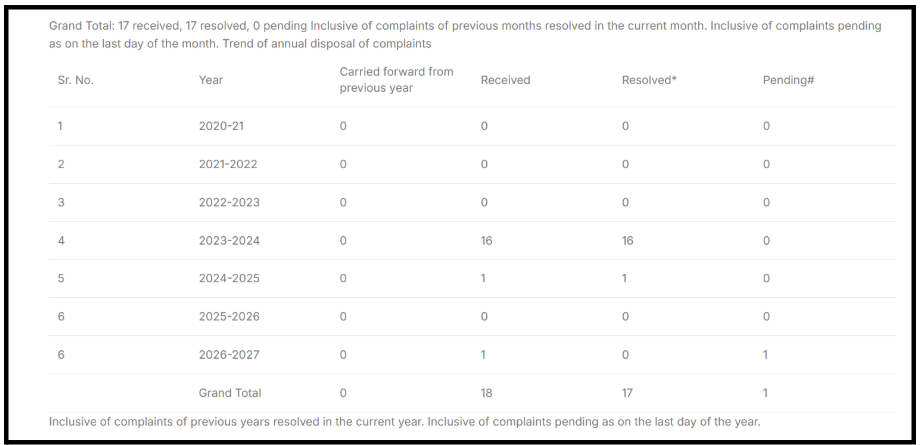
On the surface, this looks clean but the timeline raises questions.
The firm recorded zero complaints for three consecutive years (2020-21 to 2022-23), then suddenly received 16 complaints in 2023-24 alone, the same period SEBI’s inspection covered.
This spike aligns directly with the profit promise allegations SEBI documented in its adjudication order.
More importantly, Mir Uniserv obtained its SCORES ID only in July 2022, two full years after registration, meaning clients had no formal grievance channel for the firm’s entire early operating period.
This self-reported data leaves investors without a fully reliable picture of the firm’s actual complaint history, and real user experiences fill that gap more honestly.
Mir Uniserv User Reviews
User reviews of Mir Uniserv across public platforms reflect experiences that align closely with what SEBI found during its inspection.
Clients consistently describe a pattern of profit promises at the point of sale, losses after subscribing, and difficulty reaching the firm afterwards.
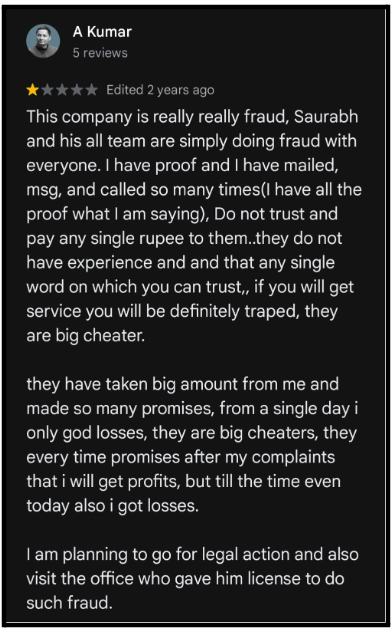
1. Profit Promises Followed by Trading Losses
One investor alleged that large payments were made after repeated promises regarding trading performance and expected returns.
However, according to the complaint, losses reportedly began almost immediately after joining the service.
2. Allegations of Fake Reviews and No Customer Support
Another investor described a similar pattern involving upfront payment, trading activity that allegedly resulted in heavy capital erosion, and later complete unresponsiveness to calls and messages.
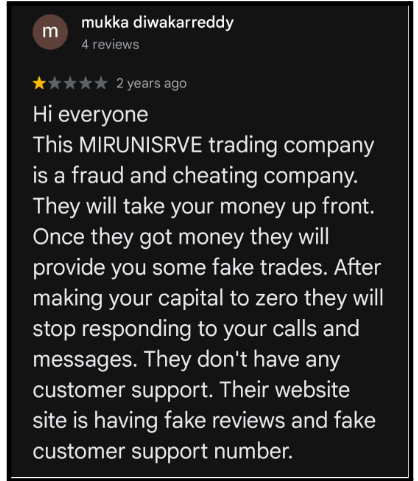
Mukka Diwakarreddy also flagged that the firm’s website carried fake reviews and a fake customer support number, and noted the firm offered no genuine customer support after collecting fees.
3. Unreachable Advisors After Subscription
A separate complaint also mentioned that after subscribing to Mir Uniserv’s advisory services through a company representative, communication reportedly stopped once trading losses were suffered.
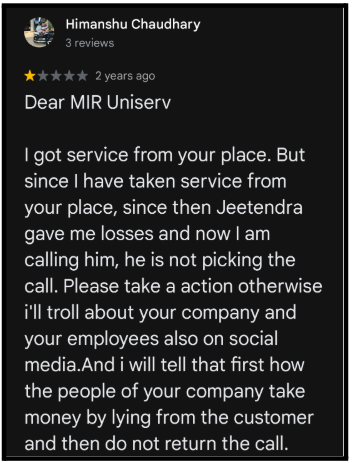
Himanshu’s direct message to the firm on the review platform received no adequate response.
The review describes a situation where money changed hands and accountability disappeared, a pattern that mirrors the conduct SEBI documented in its order regarding client complaints referencing specific profit promises.
However, after going through these issues, can you trust Mir Uniserv?
You need to think twice before availing such services that are against the SEBI guidelines for RA.
What Investors Must Keep in Mind?
No investment in the stock market carries a guarantee, and any research analyst who tells you otherwise is crossing a clear legal and ethical line.
Before engaging any research analyst, including Mir Uniserv, investors must apply a simple but non-negotiable standard of due diligence.
- Always verify the current registration status of a research analyst on SEBI’s registered intermediaries database before paying.
- Any promise of specific monthly returns, percentage profit, or assured outcomes is illegal under SEBI regulations; treat it as a red flag, not a selling point.
- Save every communication, call, message, email, and payment receipts before and after subscribing to any service.
- Never pay additional fees to recover previous losses on the promise that the analyst will make up what you lost.
A legitimate research analyst gives you documented recommendations with a clear rationale, discloses all conflicts of interest in every research report, and never links your payment to a specific profit outcome.
If the conversation focuses more on what you will earn than on the risks you face, step back and reassess.
How To File A Complaint Against Research Analyst?
If Mir Uniserv took your fees, gave you recommendations that caused losses, and then became difficult to reach, you have formal legal remedies available.
Act quickly, because delays weaken your case and reduce your options.
Step 1: Reach Out to Mir Uniserv in Writing
Send a formal written complaint to Mir Uniserv before escalating anywhere else. State clearly what you were promised, how much you paid, what losses you suffered, and on what dates the key events occurred.
Attach copies of payment receipts, messages, and any other communication where a profit or return was promised.
This creates a formal record of your attempt at direct resolution, which regulators and arbitrators may ask you to show before processing your escalation.
Step 2: Lodge a Complaint in SCORES
SEBI SCORES is the primary platform for investor complaints against SEBI-registered intermediaries.
Register and file a detailed complaint against Mir Uniserv with your complete timeline and supporting documents.
SEBI directs every complaint to the registered intermediary and monitors the response.
Step 3: File a Complaint in SMART ODR
If SCORES does not produce a satisfactory resolution, move to SEBI’s SMART ODR portal.
SMART ODR handles investor-intermediary disputes through structured conciliation, where a neutral third party works with both sides.
This process moves faster than court litigation and costs significantly less.
Step 4: Arbitration in Stock Market
If conciliation through SMART ODR does not resolve your dispute, escalate to formal arbitration within the same framework.
Arbitration produces a legally binding award. Approach this step with your full documentation organised and ready.
An arbitration award against a SEBI-registered intermediary carries legal enforceability, meaning the firm cannot simply ignore it.
Need Help?
We work directly with investors who suffered losses after engaging research analysts, including those who paid fees based on profit promises.
Our services cover every stage of the process:
- Case review: We assess your documents, payments, and communications to evaluate the strength of your complaint before you file anything.
- Complaint drafting: We write clear, structured, and professionally formatted complaints for SEBI SCORES and SMART ODR .
- Evidence organisation: We help you compile payment records, messages, and loss calculations into a complete, coherent file.
- End-to-end escalation support: We guide you from your first complaint filing through conciliation and arbitration.
Register with us to discuss your case and explore the next steps available to you.
Conclusion
Mir Uniserv research analyst holds a SEBI registration but registration alone does not equal trustworthiness or compliance.
SEBI’s adjudication order established violations involving assured profit claims to clients, concealment of associated entities, and obstruction of the inspection process.
User reviews reflect experiences consistent with those findings.
If you paid fees to Mir Uniserv based on profit promises and suffered losses, you have formal remedies through SEBI SCORES, SMART ODR, and arbitration.
Document everything, act quickly, and use the system that exists precisely for situations like yours.





 Add us as a preferred source on Google »

