

SEBI action against Mir Uniserv documented multiple compliance failures involving investor handling, operational conduct, and regulatory cooperation.
The adjudication order contains findings that go far beyond a routine regulatory observation and provide important context for investors evaluating the firm.
Here is every significant detail from the order, without omission.
Mir Uniserv Research Analyst
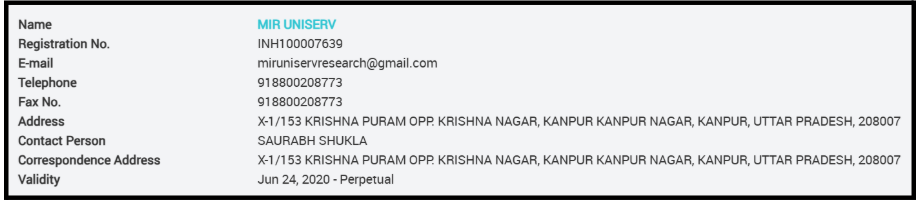
Mir Uniserv is a Kanpur-based research analyst firm run by proprietor Saurabh Shukla, offering equity, Nifty, Bank Nifty, and F&O tips through packages marketed under the tagline “Grow Your Returns with MIR UNISERV.”
The firm holds SEBI registration number INH100007639, valid since June 24, 2020, on a perpetual basis.
However, as SEBI action against Mir Uniserv demonstrates, registration and compliant operations are two very different things.
SEBI Order Against Mir Uniserv
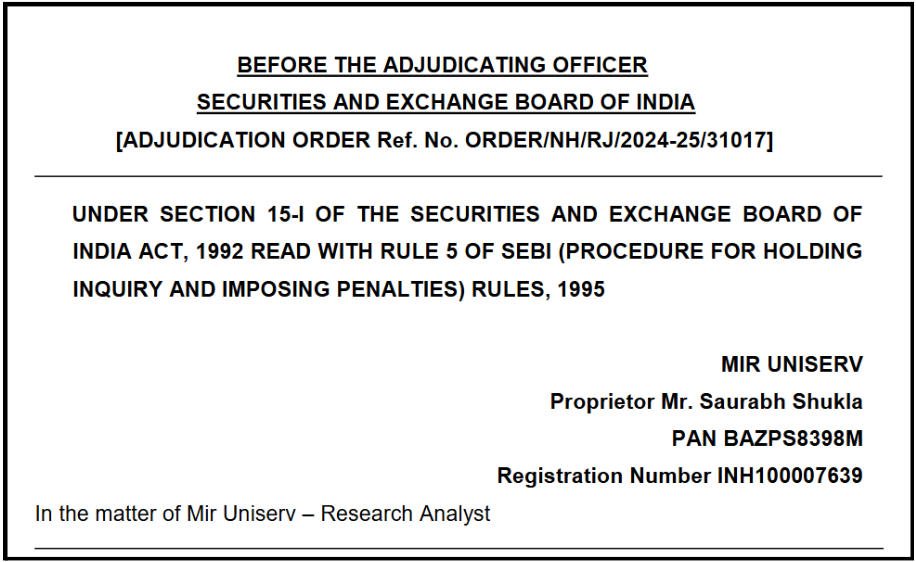
SEBI initiated adjudication proceedings against Mir Uniserv following a formal inspection covering April 1, 2022 to December 31, 2023, culminating in Adjudication Order Ref. No. ORDER/NH/RJ/2024-25/31017 dated November 29, 2024.
The Adjudicating Officer examined distinct issues and established violations across every single one.
-
What Was the Case?
SEBI action against Mir Uniserv found that the firm failed to maintain KYC records, outsourced core functions to third parties, promised specific profits to clients, and delayed grievance resolution.
Additionally, the firm concealed associated entities and removed website records during the investigation.
Accordingly, the Adjudicating Officer stated that the Noticee submitted misleading information and displayed a “lackadaisical attitude” that “cannot be condoned.”
-
Violations by Mir Uniserv
SEBI established the following violations across distinct issues, each one documented with specific evidence and regulatory provisions.
1. 190 Clients Without KYC and No Explanation That Held Up
Mir Uniserv admitted that 190 out of 1,270 clients had no KYC records on file.
The firm blamed a technical glitch but produced no server logs, no expert report, and no backup records to support this claim.

Even if data loss had occurred, the firm could have produced physical KYC documents, it did not.
SEBI held this as a violation of Regulation 16(a) of the KYC Regulations and multiple SEBI circulars governing client identification norms.
2. Two Years Without a SCORES ID, No Formal Grievance Channel
Mir Uniserv obtained its SCORES ID on July 5, 2022, a full two years after receiving SEBI registration in June 2020.
During those two years, clients who wanted to formally escalate grievances had no registered channel through which to do so.
Furthermore, SEBI found 12 investor complaints that the firm resolved beyond prescribed timelines, with one complaint taking 94 days against the stipulated 30-day limit.
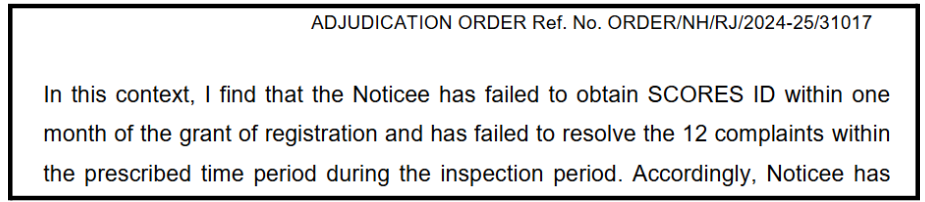
This violated Regulation 26B(1) of the RA Regulations and SEBI’s grievance redressal circulars.
3. ₹2.54 Crore Paid to Uncontracted Third Parties for Core Functions
Mir Uniserv’s own email to SEBI admitted that third-party associates handled client sourcing, onboarding, and payment guidance, functions that a registered research analyst must control directly.
The firm paid these individuals ₹2,54,72,612 during the inspection period, held no written contracts with any of them, and maintained no outsourcing policy.

The names of these individuals appeared directly in investor complaints on SEBI SCORES. This violated SEBI’s December 15, 2011 circular on outsourcing by intermediaries.
4. Specific Profit Promises to Clients With No Risk Disclosure
There are multiple allegations along with Mir Uniserv loss recovery promises.
Mir Uniserv’s own email described explaining packages to third-party associates in terms of “expected profits with predefined maximum and minimum losses and profits.”
SCORES of complaints from actual clients made this even more explicit; one complainant reported being told “earn 100 prc. profits,” another was promised “₹50,000-60,000 monthly”.
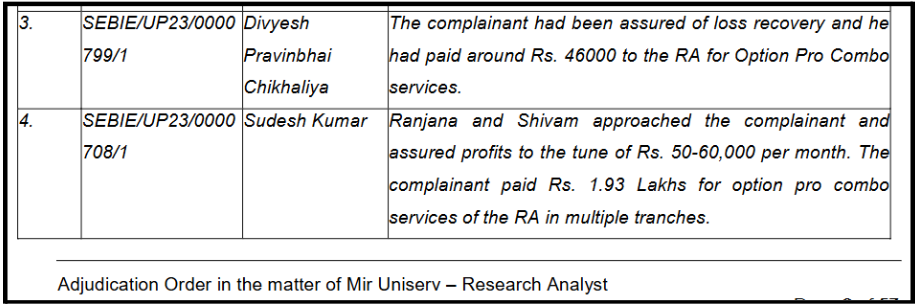
SEBI has held that such profit assurances are totally fraudulent and directly violate Regulation 4 of the PFUTP Regulations.
5. Submitted NIL, Undisclosed Entities
When SEBI asked Mir Uniserv to provide details of payments made to third parties, the firm submitted NIL information.
Inspectors then found that it had paid entities, including Banknifty Expert, a proprietorship of Saurabh Shukla himself, and Chetan Dhokiya.
A random Google search by the inspection team also revealed the proprietor’s name and SEBI registration number appearing on the Facebook page of MCXcommodityresearch and the YouTube channel Tradepix Investment Planner.
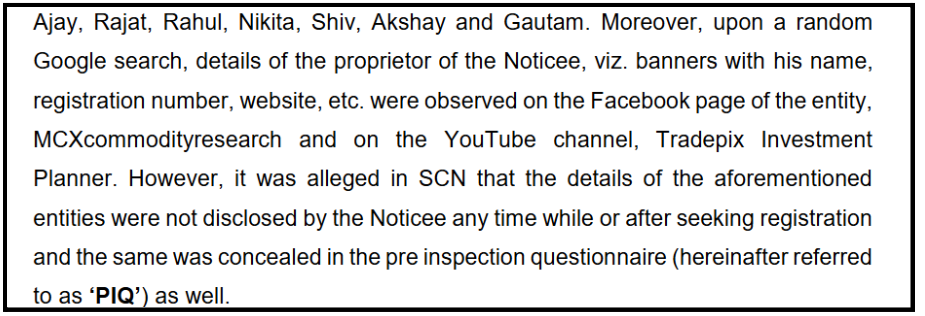
None of these associations appeared in the firm’s registration disclosures or pre-inspection questionnaires.
6. Cleared the Website on the Same Day as Pre-Inspection Questionnaire Submission
On January 8, 2024, the exact day Mir Uniserv submitted its pre-inspection questionnaire, the firm removed all content from its website.
The inspection team could not access the website until March 31, 2024, making it impossible to verify whether the firm’s online presence met regulatory compliance requirements.
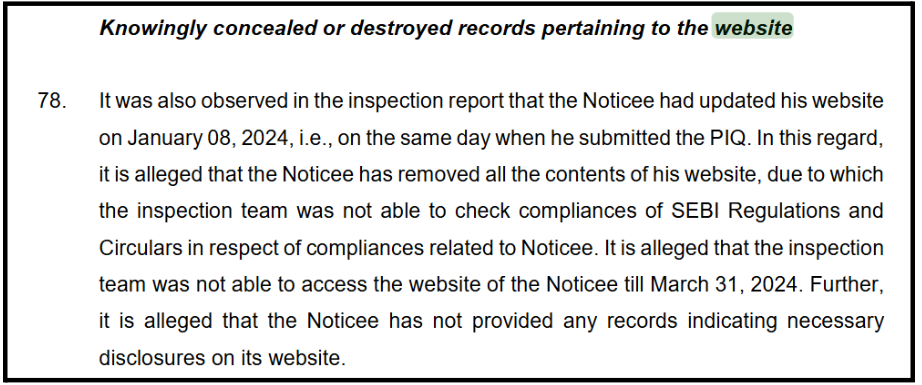
The firm claimed its web hosting had expired, but produced no evidence, no communication from the hosting provider, no migration records, nothing.
SEBI rejected this explanation and treated the timing as deliberate concealment, establishing violations of Regulations 29(1) and 29(2) of the RA Regulations.
-
Penalty and Final Decision
SEBI imposed a total monetary penalty of ₹10,00,000 (Ten Lakh Rupees) on Mir Uniserv through the adjudication order dated November 29, 2024:
| Violation | Penalty Provision | Amount |
| Concealment of records, failure to cooperate during inspection | Section 15A(a) | ₹1,00,000 |
| Delayed SCORES registration and grievance resolution | Section 15C | ₹1,00,000 |
| KYC violations, outsourcing of core functions, Code of Conduct breaches | Section 15EB | ₹3,00,000 |
| Assured profit claims in violation of PFUTP Regulations | Section 15HA | ₹5,00,000 |
| Total | ₹10,00,000 |
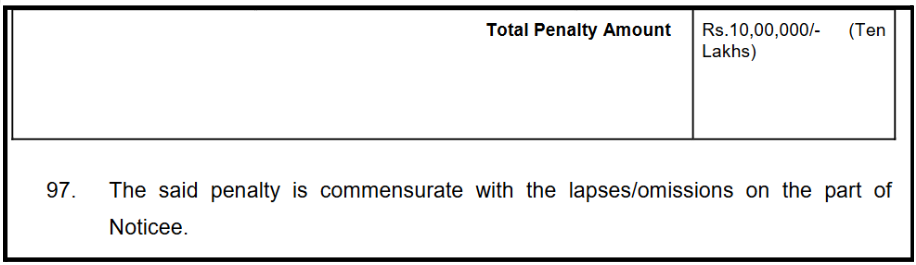
The Adjudicating Officer noted that no prior penalty existed against Mir Uniserv.
However, the firm’s handling of investor grievances, concealment of information, and misleading conduct left no room for leniency and initiated the SEBI action against Mir Uniserv.
-
Lessons for Investors
The SEBI action raises a critical question investors should consider: can you trust Mir Uniserv?
The ans lies beyond the operations and the services.
It implies why investors must look beyond a registration number:
- A SEBI registration does not guarantee compliant conduct.
- SEBI found violations involving KYC, outsourcing, and grievance handling.
- The firm also faced findings related to profit assurances and concealment of information.
- Investor due diligence must include regulatory history, complaint records, and operational conduct.
Investors who stop at verifying registration often miss the risks that matter most.
What Investors Must Keep in Mind?
Before engaging any research analyst, including Mir Uniserv, investors must verify far more than just the registration number.
Mir Uniserv’s case shows how a firm can hold a valid registration while still facing serious regulatory findings and investor complaints.
- Check whether the firm maintains an active SCORES ID and review its complaint history carefully.
- Reject any communication that promises assured returns, fixed profits, or guaranteed outcomes.
- Save all messages, emails, payment records, and research communications from the beginning.
Additionally, demand proper research rationale with every recommendation instead of simple buy or sell calls.
Also verify whether the firm transparently discloses all associated entities and business relationships.
If the interaction feels more like a sales pitch than an investment analysis, treat it as a warning sign.
How To File A Complaint Against Research Analyst?
If Mir Uniserv took your fees, made profit promises that did not materialise, and then became difficult to reach, you have formal legal remedies available right now.
Act quickly, because delays reduce your options at every stage.
Step 1: Reach Out to Mir Uniserv in Writing
Before escalating anywhere, send a formal written complaint to Mir Uniserv. State what was promised, what you paid, what losses you suffered, and the specific dates everything occurred.
Keep a complete copy, this record shows regulators and arbitrators that you attempted direct resolution first.
Step 2: File a Complaint on SCORES
File a detailed complaint on SEBI SCORES with your full timeline and supporting documents. SEBI directs every complaint formally to the intermediary and monitors the response.
Given that SEBI already holds an enforcement record against Mir Uniserv, your complaint strengthens the documented regulatory pattern and increases pressure on the firm to respond.
Step 3: Lodge a Complaint in SMART ODR
If SCORES does not produce a satisfactory outcome, move to SEBI’s SMART ODR portal for structured conciliation.
A neutral third party works with both sides toward a resolution outside of court.
This process moves far faster than litigation and costs significantly less. File with your complete evidence and a clear statement of what you are claiming.
Step 4: Escalate to Stock Market Arbitration
If conciliation through SMART ODR does not resolve your dispute, escalate to formal arbitration within the same framework.
Arbitration produces a legally binding award.
Approach this step with every document organised, payments, communications, loss calculations, and a written account of how each specific claim or recommendation contributed to your financial harm.
Need Help?
We support investors dealing with disputes involving research analysts, misleading investment communications, and regulatory complaint procedures.
- Document Review: We examine your payments, records, and communications to assess the overall strength of your case
- Regulatory Complaint Drafting: We prepare properly structured complaints for SEBI SCORES and SMART ODR proceedings
- Evidence Compilation: We organise transaction records, chats, emails, and loss calculations into a coherent file
- Dispute Resolution Guidance: We assist throughout conciliation and arbitration while helping you stay compliant with procedural timelines
Register with us if you need professional assistance in pursuing your investor grievance or regulatory complaint.
Conclusion
SEBI action against Mir Uniserv resulted in a ₹10 lakh penalty across five categories of violations.
These included KYC failures, grievance delays, outsourcing without contracts, assured profit claims, and concealment during inspection.
The order’s language leaves no ambiguity about how the Adjudicating Officer viewed the firm’s conduct.
If you engaged Mir Uniserv and suffered losses, the formal remedies exist, use them now, while your evidence is intact and your timelines are still within reach.





 Add us as a preferred source on Google »

