

Mir Uniserv loss recovery promises now appear repeatedly across regulatory findings, arbitration records, and investor complaints.
Several investors alleged that representatives encouraged them to continue paying for upgraded plans with assurances that earlier trading losses would soon be recovered.
The legal findings against the firm raise an important question: Are such promises even permissible under SEBI regulations?
Can You Trust Mir Uniserv?
Mir Uniserv is a SEBI-registered Research Analyst firm based in Kanpur, run by proprietor Mr Saurabh Shukla under registration number INH100007639.
SEBI’s framework for Research Analysts clearly prohibits any promise of loss recovery, guaranteed returns, or assured profits.
Furthermore, SEBI’s PFUTP Regulations (Prohibition of Fraudulent and Unfair Trade Practices) classify misleading profit assurances as actionable violations.
These rules apply equally to written communications and verbal statements made over phone calls.
So what does responsible advisory conduct actually look like in practice?
What Can An SEBI Registered Research Analyst Do?
As per the SEBI guidelines for RA, research Analysts must present recommendations as market insights, not guaranteed outcomes, and cannot promise loss recovery, assured profits, or encourage borrowing based on expected returns.
When a representative crosses any of these lines, they step outside the legal scope of a Research Analyst’s registration.
With that benchmark in place, here is what SEBI’s own inspection uncovered about Mir Uniserv.
SEBI Action Against Mir Uniserv
SEBI conducted a formal inspection of Mir Uniserv covering April 1, 2022, to December 31, 2023.
The Adjudicating Officer issued Order No. ORDER/NH/RJ/2024-25/31017 on November 29, 2024, after reviewing inspection findings & SCORES complaint records.
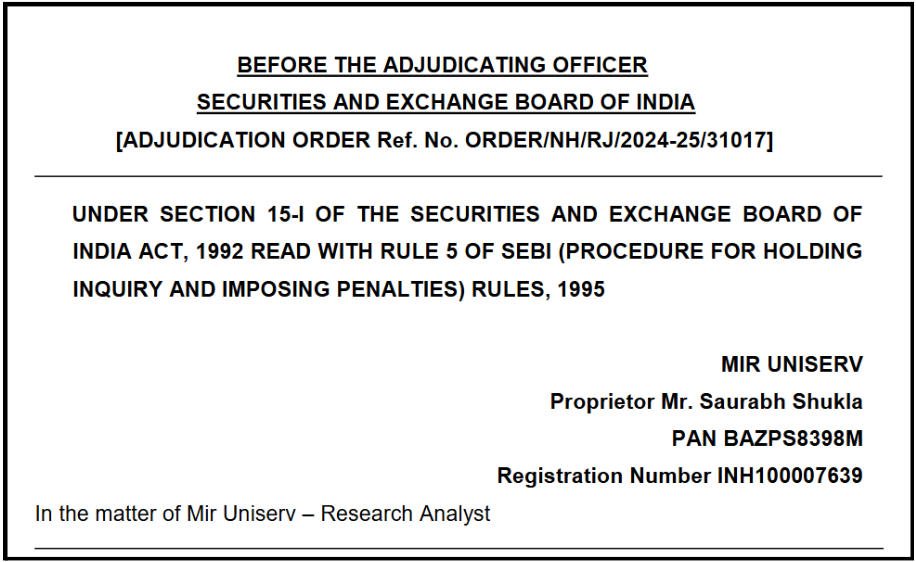
The order pinned down specific ways in which Mir Uniserv’s representatives made loss recovery and assured profit claims to clients.
Each violation below reflects a documented finding from that order.
-
Violations by Mir Uniserv Identified in the SEBI Order
The Adjudicating Officer examined each violation independently before reaching conclusions.
Here is how loss recovery promises operated inside Mir Uniserv’s sales process:
1. Pre-Defined Profit and Loss Figures Communicated to Telecallers
Mir Uniserv briefed its third-party telecallers on “expected profits with pre-defined maximum and minimum losses” before sending them to cold-call prospective clients.
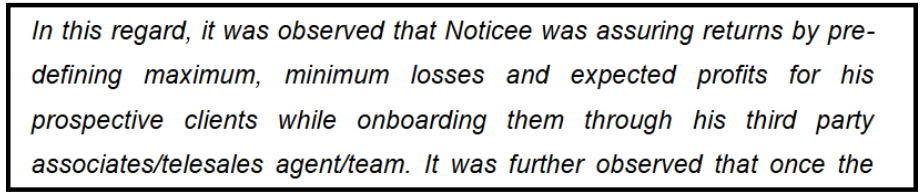
The firm confirmed this in its own submission to SEBI.
Communicating pre-set profit figures to sales agents who then relay them to clients as near-certain outcomes, directly violates SEBI’s prohibition on assured return representations.
2. Specific Monthly Profit Amounts Promised to Clients
SCORES complaint records show at least one complainant received a promise of ₹50,000–₹60,000 in monthly profits.

Another complainant’s records reference an assurance of “100% profits.”
These figures are specific, quantified, and completely contrary to SEBI regulations that bar any mention of target returns or percentage accuracy in client communications.
3. Loss Recovery Used as an Upgrade Tool
Multiple SCORES complainants reported that representatives promised loss recovery, specifically to push them toward higher-value service plans.
One complainant’s records show representatives assured recovery of the subscription amount itself “within 15 trading sessions” as an incentive to upgrade.
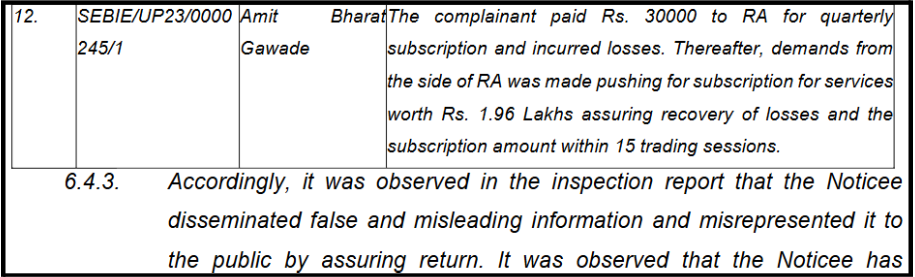
The Adjudicating Officer found no basis to accept the firm’s defense that closed SCORES complaints amounted to exoneration.
-
Penalty
SEBI imposed a total penalty of ₹10,00,000 (Ten Lakh Rupees) on Mir Uniserv.
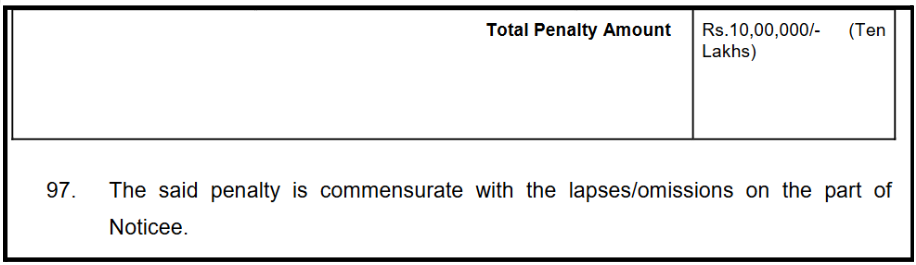
The largest penalty, ₹5,00,000 under Section 15HA, targeted misleading profit and loss recovery assurances made to clients.
Beyond the SEBI order, a retail investor also took Mir Uniserv directly to arbitration and the documented evidence there tells an equally detailed story.
Mir Uniserv Arbitration Case Over Loss Recovery Promises
An NSE arbitration award dated August 6, 2025, examined claims against Mir Uniserv filed by a Rajkot investor through the CORD ODR platform.
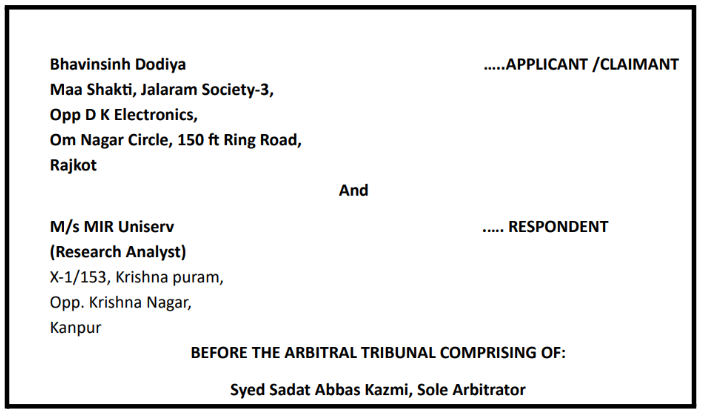
The investor submitted 160+ call recordings, trade records, and financial statements alleging that loss recovery promises pushed him into deeper losses.
Here are the violations identified:
1. Direct Verbal Promises to Cover All Losses
On a recorded call, a representative named Rajat assured the investor that all trading losses would fully recover if he continued trusting the firm’s guidance.
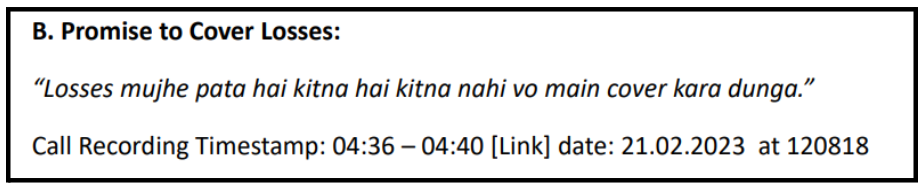
The Tribunal treated these as repeated verbal guarantees of full loss recovery.
Such statements directly violate SEBI’s Research Analyst regulations that bar any assurance of recovery or risk-free returns.
2. Mathematical Projections Used to Justify More Payments
After the investor incurred losses, a representative constructed arithmetic scenarios to show that a few more recommendations would generate enough profit to clear all liabilities.
One recorded exchange showed a representative projecting ₹34,500 in profits across five days as a reason to pay ₹41,000 immediately.
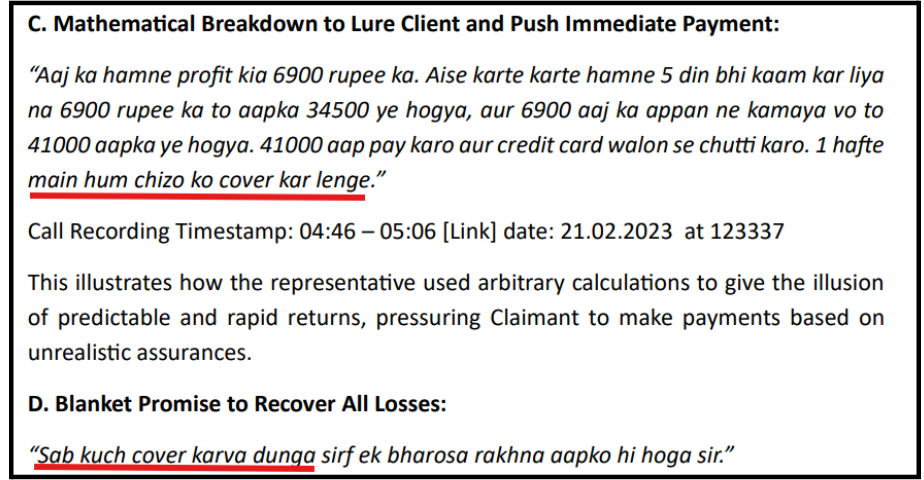
The Tribunal found these projections created an illusion of predictable and rapid recovery with no basis in market reality.
3. Offer to Deliver Any Profit Amount the Investor Named
A representative told the investor “Aap bolo ki kitna profit aap manoge to main utna profit karwa dun.”
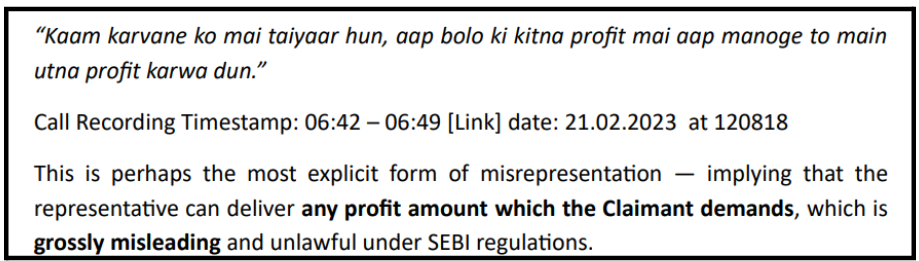
The Tribunal identified this as perhaps the most explicit form of misrepresentation in the entire record.
Offering to deliver a client-specified profit figure goes far beyond research advisory and constitutes a clear regulatory violation.
4. Recovery Promises Deployed to Sell Higher-Cost Plans
Representatives consistently paired loss recovery assurances with pressure to upgrade subscription plans.

After promising to cover losses, they directed the investor toward a ₹1,25,000 plan.
The Tribunal noted the recovery promise functioned as a sales mechanism, not a genuine commitment and repeatedly appeared in the context of pushing costlier packages.
5. Pressure to Borrow Money Based on Recovery Assurances
Despite knowing the investor faced financial stress and borrowed funds, a representative still pushed him to arrange more money by promising quick lump-sum profits.
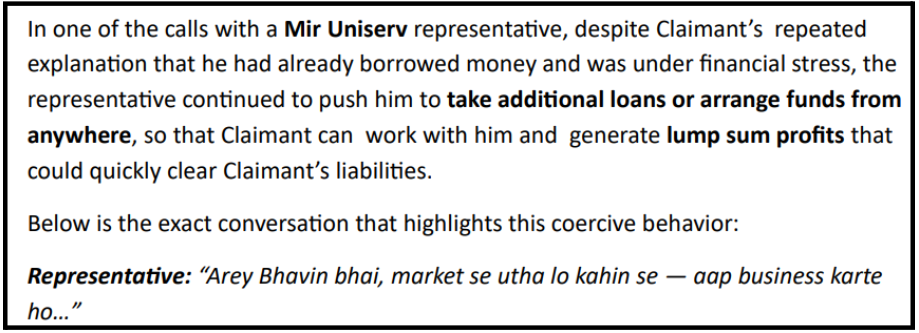
The Tribunal found this conduct showed complete disregard for the investor’s financial wellbeing and for the regulatory boundaries applicable to Research Analysts.
- Penalty
The Arbitral Tribunal awarded the investor ₹3,12,000 as compensation for financial losses attributable to Mir Uniserv’s conduct.
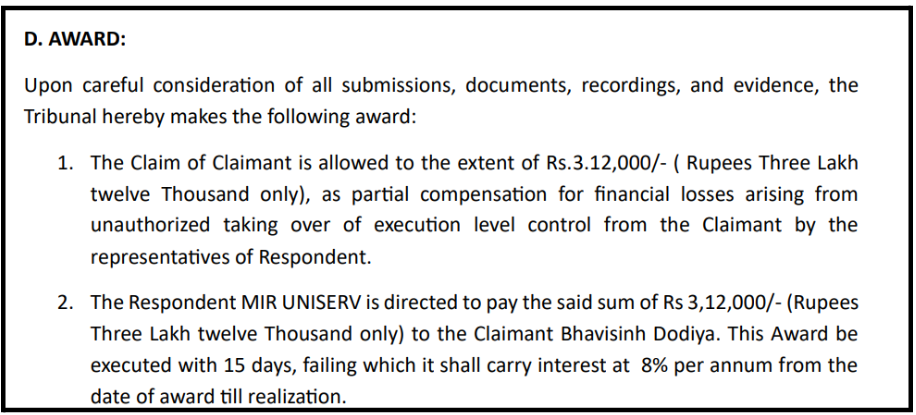
The Tribunal directed payment within 15 days, with 8% annual interest applying from the award date if payment does not happen on time.
The award reflects financial damage, but the real-world impact on investors went far beyond a single case.
- Impact on Investors
Consider what the documented record shows:
- Investors borrowed money on the strength of recovery assurances and incurred fresh financial liabilities.
- Investors liquidated existing equity portfolios and moved into higher-risk F&O trading on representatives’ persuasion.
- Investors paid escalating subscription fees, sometimes in the range of ₹1,25,000 to ₹1,96,000, chasing promised recoveries that never materialised.
- Investors delayed filing complaints because representatives kept assuring them that recovery was just around the corner.
The documented gap between what representatives promised and what investors actually received forms the core of both the SEBI order and the arbitration award.
Given all of this, the obvious question follows: Can investors actually recover their money from Mir Uniserv?
Is Recovery from Mir Uniserv Possible?
Practical recovery remains possible through legal channels and the arbitration record proves it.
The Bhavinsinh Dodiya case resulted in a binding award of ₹3,12,000 through the NSE arbitration process, demonstrating that the system works for investors who document their claims thoroughly.
Here is what investors need to understand about the recovery pathway:
- The NSE arbitration mechanism specifically covers disputes between retail investors and SEBI-registered Research Analysts
- Conciliation through the SMART ODR portal precedes arbitration and can itself produce a binding settlement
- Arbitration awards carry legal enforceability; the respondent must pay within the directed timeline or face interest liability
- SEBI’s SCORES system creates a formal complaint record that supports subsequent arbitration claims
Investors should act before the limitation periods expire. The Limitation Act allows three years from the date the cause of action arises in most cases.
Knowing that recovery is possible is one thing; avoiding the trap in the first place is even better.
What Investors Must Keep in Mind?
Never continue paying a service provider simply because they promise to recover your previous losses; that promise has no legal backing and no regulatory sanction.
Maintain a record of every call, every payment, and every instruction from the day you subscribe to any advisory service.
A well-documented complaint stands a significantly stronger chance in both conciliation and arbitration than one built on memory alone.
Prevention starts with recognition, so here is how to spot a misleading recovery promise the moment you hear one.
How To Identify Misleading Recovery Claims By an RA?
Research Analysts operate within a defined regulatory scope, and certain phrases signal an immediate boundary violation.
Train yourself to recognise these patterns before they cost you money:
- Any representative who says “main aapka loss cover kar dunga” or equivalent crosses a legal line that SEBI explicitly prohibits
- Specific monthly profit figures like ₹30,000 or ₹50,000 per month, stated as expected outcomes, qualify as assured return promises under SEBI regulations
- A push to upgrade your plan immediately after a loss, backed by a promise that the new plan will recover everything
- A representative who encourages you to borrow money or use credit cards for investment based on expected profits violates SEBI’s investor protection framework
- Statements framing one profitable call as proof of consistent future profits function as misleading inducements, not legitimate research communication
If you hear any of these, stop the call, save the recording, and document the date and time before taking any further action.
Once you recognise a violation, the next step is knowing exactly how to respond.
How To File A Complaint Against Research Analyst?
Investors who received loss recovery promises from any Research Analyst carry concrete legal options. Move systematically and preserve every piece of evidence at each stage.
Step 1: Send a Formal Written Complaint to the Research Analyst
Write a detailed complaint to the Research Analyst through its official communication channels.
Mention the representative’s name, dates of interaction, promises made, payments transferred, and losses suffered.
Attach supporting proof and preserve copies of everything sent. This creates a documented record and shows that you first attempted direct resolution before escalating further.
Step 2: Register the Complaint in SCORES
File your complaint on SEBI SCORES with complete supporting evidence, including payment receipts, call recordings, trade statements, chats, and emails.
SEBI forwards the complaint to the registered intermediary and monitors its response within prescribed timelines.
Delayed or evasive replies can themselves strengthen the regulatory record against the firm.
Step 3: File a Complaint in SMART ODR
If SCORES does not resolve the matter, move to SEBI’s SMART ODR platform for online conciliation.
A neutral Conciliator works with both parties to explore a settlement without court litigation.
Where conciliation fails, the Conciliator’s report becomes an important part of the next arbitration stage.
Step 4: Arbitration in Stock Market
When conciliation does not produce a settlement, initiate arbitration through the ODR framework.
The Arbitral Tribunal reviews call recordings, written submissions, transaction records, and oral arguments before issuing a binding award.
The Mir Uniserv arbitration matter shows that investors with properly documented evidence can secure enforceable compensation orders.
If the process feels difficult to handle alone, professional guidance can help you avoid procedural mistakes and preserve the strength of your claim.
Need Help?
Building a strong claim for SCORES, conciliation, or arbitration demands precision.
We work alongside investors at every stage of this process. Register with us.
Our services cover:
- Claim Evaluation: We assess your call recordings, payment history, and correspondence to determine the strength and scope of your claim
- Evidence Organisation: We structure your documents, recordings, and trade records into the format that SCORES and ODR platforms require
- Conciliation Support: We prepare your grievance brief and supporting arguments for the conciliation stage to maximise settlement prospects
- Arbitration Assistance: We assist with rejoinder preparation, written briefs, and oral submission strategy through all hearing stages
Every step of this process becomes more manageable with the right support alongside you.
Conclusion
Mir Uniserv loss recovery promises, documented in over 160 recorded calls, SCORES complaints from multiple investors, a SEBI adjudication order, and a binding arbitration award, reveal a consistent pattern.
Representatives used the language of recovery and guaranteed profit to sell plans, extract fees, and keep investors engaged through accumulating losses.
SEBI penalised the firm ₹10 lakh. An arbitration tribunal awarded a retail investor ₹3,12,000 in compensation.
Investors who face similar promises carry legal remedies but they must act on evidence, follow the right escalation path, and move before time runs out.





 Add us as a preferred source on Google »

