

Have you ever been on the verge of trusting a financial advisory firm, only to wonder whether they are truly authorised to give you advice?
That one small hesitation, that moment of doubt, could be the most important thing standing between you and a costly mistake.
Every day, investors across India search for reliable guidance in a market that can feel overwhelming.
Advisory firms come and go. Some are genuine, some are not. And even among the genuine ones, not everything is always as straightforward as it appears on the surface.
Shubh Stocks Capital is one such firm that investors have been asking questions about. The most common of them is simple and important: is Shubh Stocks Capital SEBI registered?
But that is really just the first question. The more important ones follow immediately after.
In this blog, we look at Shubh Stocks Capital’s registration status, what it holds under SEBI’s framework, how its complaint history has shaped up over the years, and what investors must consider before engaging with this firm.
Is Shubh Stocks Capital SEBI Registered or Not?
Yes, Shubh Stocks Capital is SEBI registered. The firm holds a valid SEBI Investment Adviser (IA) licence under registration number INA000014942.
It operates in the equity, commodity, and index advisory segments and presents itself as one of the trusted names in financial services.
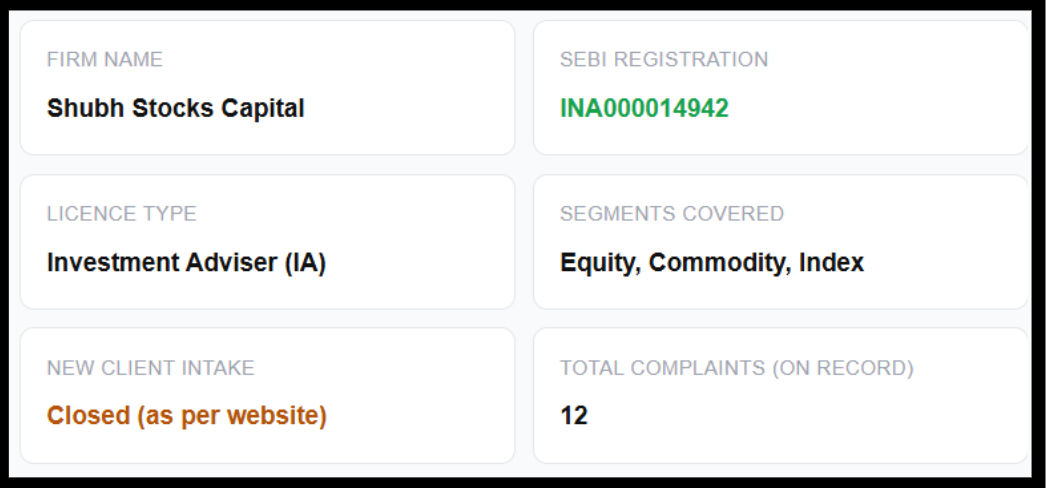
The IA registration is verifiable on SEBI’s official website. This is a meaningful credential; it places Shubh Stocks Capital in a specific regulatory category with defined obligations and client protections.
But as we will see, registration is only part of the story.
To truly understand the firm’s current status, we have to look beyond their SEBI license and examine their active market presence.
Is Shubh Stocks Capital Still Operating?
Shubh Stocks Capital Complaints
Complaint data is one of the most honest mirrors a financial advisory firm has. It does not tell the full story, but it reveals patterns that no marketing material ever will.
For Shubh Stocks Capital, the complaint history carries two numbers that investors must read together.

The firm’s disclosure shows a total of 12 formal grievances between 2023 and 2024, with all of them marked as resolved and nothing carried forward. On paper, that is a clean record, a 100% resolution rate.
However, the numbers tell a more layered story. Complaints jumped fivefold from just 2 in 2023 to 10 in 2024. That is a significant spike in a single year.
And then in 2025, the number dropped to zero, not because the firm grew more trustworthy, but because, as visible on its own homepage, the firm stopped accepting new clients and new payments altogether.
Having understood the registration and complaint picture, the natural next question is: what should you actually do if you have already engaged with this firm and something does not feel right?
How to Complain Against Shubh Stocks Capital?
If you are an existing client of Shubh Stocks Capital and have concerns about service quality, unresolved issues, or the implications of the firm’s current closure, there is a formal and structured path available to you.
Here is how to use it:
Step 1: Organise All Your Documentation
Begin by gathering every relevant document, your signed advisory agreement, fee payment receipts, all trade recommendations received, and the full history of your communication with the firm.
Arrange everything in chronological order.
This is the foundation of any formal complaint.
Step 2: Contact the Firm First, in Writing
Before escalating to a regulator, write to the firm’s designated compliance officer. State your concern clearly and allow them to resolve it.
Keep a record of every response and every non-response. This written trail becomes important evidence in any subsequent filing.
Step 3: File a Complaint in SCORES
If the firm does not resolve your issue satisfactorily, register your grievance on the SEBI SCORES portal.
Select “Investment Adviser” as the category, enter the registration number, and describe each concern as a clearly stated, separate point with supporting documents attached.
SEBI will forward the complaint and monitor the resolution.
Step 4: Report in SMART ODR
If SCORES does not yield a satisfactory outcome, move your case to SEBI’s Online Dispute Resolution platform, SMART ODR.
This provides a faster, structured pathway for dispute resolution through mediation, without the delays of conventional proceedings.
Step 5: Stock Market Arbitration
If all prior steps fail to resolve the matter, arbitration is the final formal option. An independent arbitrator examines all submitted evidence and delivers a binding decision.
This step is particularly relevant if you have suffered a measurable financial loss.
Timing Matters
The earlier you act, the stronger your position. Delays in filing complaints can complicate resolution timelines and weaken the evidentiary record you need.
If something feels wrong, do not wait.
Need Help?
If this process feels daunting or if you are unsure how to draft your complaint effectively, you do not have to figure it out alone.
Many investors lose out, not because their case is weak, but because the complaint was not structured correctly from the start.
Simply register with us, and we will guide you through the right steps from day one.
Whether it is organising your documentation, drafting your SCORES complaint, navigating SMART ODR, or understanding your arbitration options, our team is here to help you through every stage.
Conclusion
To answer the question directly, yes, Shubh Stocks Capital is SEBI registered, with a valid Investment Adviser license covering equity, commodity, and index advisory segments.
The registration is genuine and verifiable on SEBI’s official portal.
However, registration alone does not tell the full story.
The firm’s complaint record shows a fivefold jump from 2023 to 2024. And the firm’s own website currently carries a notice confirming it is no longer accepting new clients or payments, with no public explanation for that decision.
These two facts, read alongside the registration, paint a picture that every investor must take seriously. If you are an existing client, seek written clarification about your service status without delay.
If you are evaluating the firm from the outside, treat the current closure as a material factor in your decision.
SEBI registration is the first checkpoint, not the final one.
Always verify independently, ensure any advisory engagement begins with a signed agreement and full fee disclosure, and never let a company’s past reputation substitute for your own current-day due diligence.





 Add us as a preferred source on Google »

