

Quick Summary
Shubh Stocks Capital held SEBI Investment Adviser registration INA000014942, but a June 2026 check against SEBI’s own official list reportedly found the firm no longer listed there at all, a serious conflict with earlier reporting that confirmed it as actively registered. The firm’s website has stopped accepting new clients and payments without public explanation. Formal complaints rose from 2 in 2023 to 10 in 2024, and complaint data disclosure has gone silent since June 2025. This blog covers the full registration conflict, complaint history, red flags reported by users, and the exact process to file a complaint.
When a financial advisory firm posts a notice on its own homepage announcing it will no longer accept new clients or new payments, that isn’t a minor operational detail buried in fine print.
It’s the very first thing a visitor sees, and it immediately raises a question that deserves a clear, documented answer: what exactly led to this point?
That question about Shubh Stocks Capital gets more serious the deeper you look, because the answer to “is it SEBI registered” may not even be the same today as it was a few weeks ago.
Shubh Stocks Capital Review
Shubh Stocks Capital describes itself as “one of the trusted names in the arena of financial services,” providing stock market advisory and research across Stocks, Commodities, and Index segments.
The most striking thing on the firm’s current homepage is this notice, published openly for every visitor to see: the company is no longer accepting new clients and is not accepting new payments.

A firm that voluntarily closes itself to new clients could be managing regulatory correspondence, undergoing structural changes, or winding down operations entirely.
Without a public explanation, investors are left to draw their own conclusions from the available evidence, which is exactly what the rest of this page works through.
Is Shubh Stocks Capital SEBI Registered?
This is where the picture gets genuinely uncertain, and it’s worth reading carefully before assuming either answer.
Earlier reporting confirmed the firm holds a valid SEBI Investment Adviser (IA) licence under registration number INA000014942, an IA licence, categorically different from a Research Analyst registration, carrying distinct obligations to both clients and the regulator.
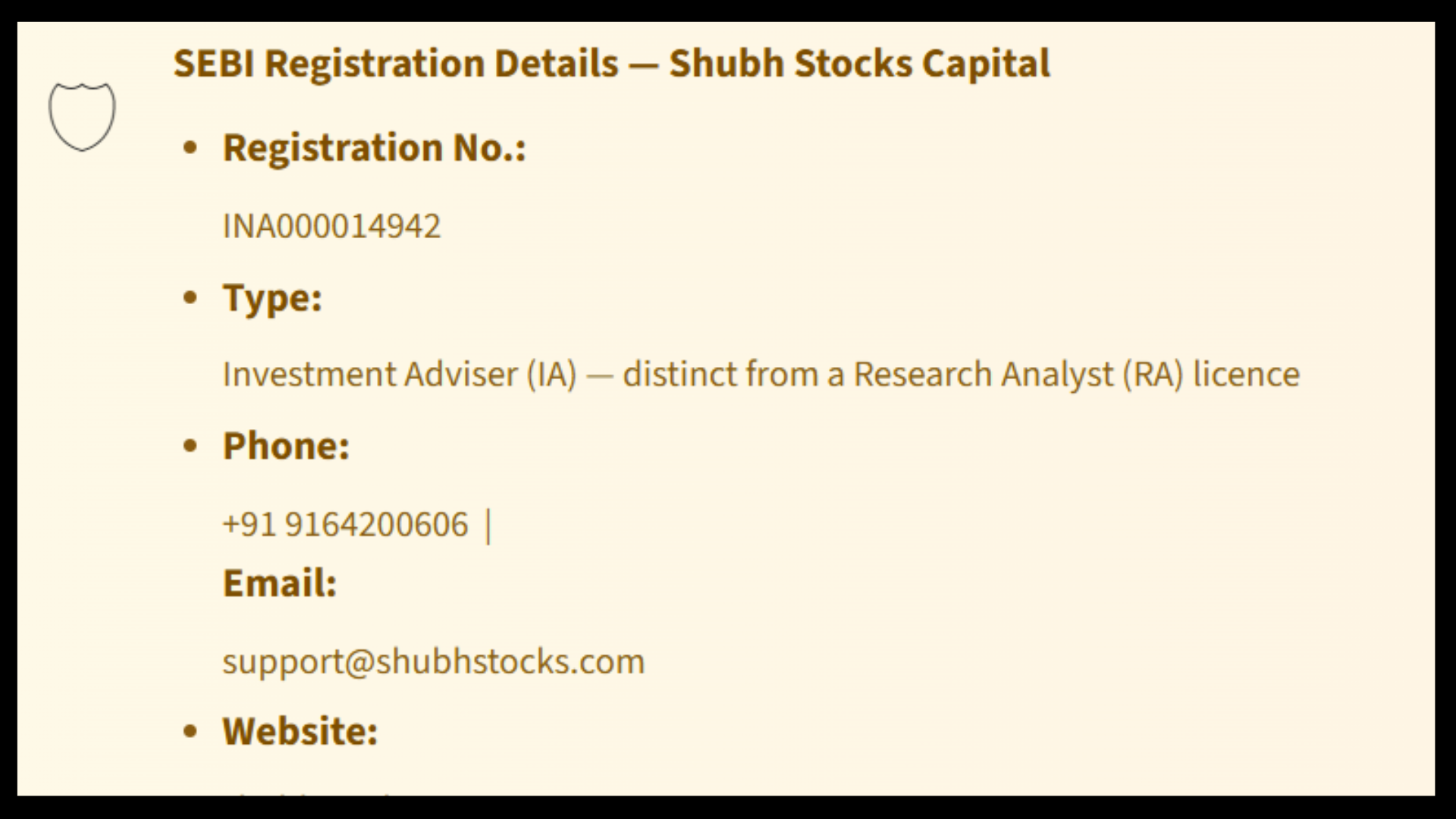
It operates in the equity, commodity, and index advisory segments, verifiable at the time on SEBI’s official website.
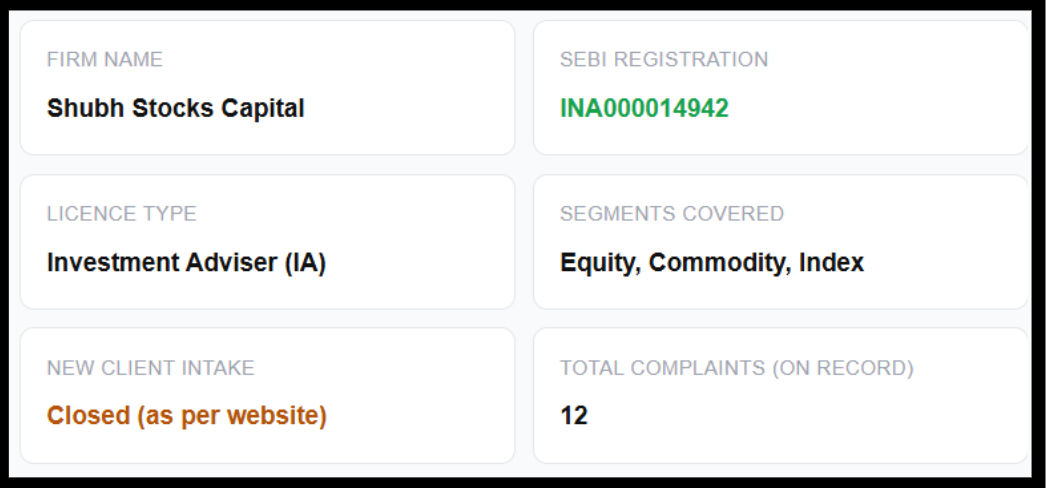
But a more recent check tells a different story.
When the registration number was searched directly on SEBI’s official Investment Adviser list, Shubh Stocks Capital reportedly did not appear there at all.
That’s not a minor discrepancy; it’s a direct conflict with the firm having a currently active, listed registration.
This raises three real possibilities: the registration has since lapsed or been cancelled, the listing has a technical or administrative gap unrelated to actual status, or there’s an error somewhere in how the number was searched or matched.
Given how serious this conflict is, the only responsible advice is to verify it yourself, right now, before making any decision involving this firm.
Check SEBI registered company status directly rather than relying on any single source, including this one, since the registration status may have changed since either version of this reporting was published.
Registration, when confirmed active, is a meaningful credential placing a firm in a specific regulatory category with defined obligations and client protections.
But as the rest of this page shows, registration status alone was never the complete picture here.
Also Read: The Equal Research. Find out what investors should know about the firm’s advisory model.
Is Shubh Stocks Capital Still Operating?
Several specific, separate signals have converged to raise this exact question, and each one deserves its own explanation rather than being lumped together vaguely.
- The registration search gap described above is the most serious signal on its own; a firm whose number doesn’t appear on SEBI’s current list is a fundamentally different situation from one that’s gone quiet.
- Complaint data disclosure has not been updated since June 2025. Given the current date, that’s a gap of well over a year with no fresh public disclosure at all, an unusually long silence for a firm required to publish this data regularly.
- 2025’s complaint volume was reportedly nearly three times higher than 2024’s, based on the same disclosure trail, which makes the subsequent silence considerably harder to read as a simple administrative pause.
- The firm has made no public statement, announcement, or explanation for why it suddenly stopped accepting new clients. That absence of communication is itself part of what’s driving investors to search for answers.
Each of these facts on its own would be worth a cautious pause. Together, they build a pattern that’s reasonable to treat seriously rather than dismiss.
Shubh Stocks Capital Complaints
Complaint data is one of the most honest mirrors a financial advisory firm has.
It doesn’t tell the full story, but it reveals patterns no marketing material ever will, and here, the patterns pull in two different directions depending on which disclosure period you look at.
The firm’s official disclosure shows the following for 2023–2024:
| Year | Complaints Received | Resolved | Pending |
|---|---|---|---|
| 2023 | 2 | 2 | 0 |
| 2024 | 10 | 10 | 0 |
| Total | 12 | 12 | 0 |
On paper, that’s a clean record, a 100% resolution rate across that specific window. But complaints jumped fivefold from just 2 in 2023 to 10 in 2024, a significant single-year spike that shouldn’t be read in isolation from what followed.
Here’s where the two accounts genuinely diverge.
One version of this data shows the 2025 count dropping to zero, coinciding with the firm’s decision to stop onboarding new clients, a framing that reads the silence as a side effect of shrinking activity.
A separate, more recent account states the opposite: that 2025 complaints ran nearly three times higher than 2024’s figure; no exact number is disclosed, only that comparison, and that the disclosure simply stopped being updated after June 2025:
| Year | Reported Figure |
|---|---|
| 2025 (Version 1) | 0 complaints |
| 2025 (Version 2, approximate, based on “nearly 3x 2024”) | Roughly 25–30 complaints, no exact figure disclosed |
| Disclosure status | Not updated since June 2025 |
These two readings can’t both be describing the same reality accurately. Either the complaint count genuinely fell to zero, or it kept rising, and the public reporting of it simply stopped.
Given the registration conflict already covered above, and the general pattern of communication silence from the firm, the more cautious reading, rising complaints followed by a disclosure gap, deserves at least as much weight as the cleaner alternative.
The firm’s Complaint Board page is reportedly live, but the actual data table on the live page does not render; visitors see only a heading and an asterisked footnote about resolution methodology, with no underlying numbers actually displayed.
The complaint figures referenced above have been sourced from the firm’s official disclosure documentation rather than the live page itself.
Lost money and not sure what to do next?
We will review your case directly against these exact facts and help you build a complaint that holds up.
Common Shubh Stocks Capital Complaints: Are You Facing These Red Flags?
Around April 2025, several discussions and complaints related to Shubh Stocks Capital began surfacing online. Certain users raised concerns about misleading and unethical practices followed by the company.
These complaints have not been adjudicated yet, but if any of them match your experience, that pattern matters for your case.
What other clients have reportedly experienced:
- Being promised guaranteed profits or fixed returns on investment calls.
- Feeling pressured into purchasing expensive subscription plans immediately.
- Seeing exaggerated success stories with no real documented proof behind them.
- Having the actual risks of trading strategies hidden during conversations.
- Getting recommendations without anyone understanding their financial position first.
- Being pushed into quick decisions through fear-based sales language.
- Facing zero transparency about fees charged or losses that occurred.
SEBI is absolutely clear on this: no registered entity can legally promise guaranteed returns, assured profits, or loss-free advisory calls under any circumstances.
If even one of those points sounds familiar to you, do not dismiss it. These are serious warning signs that can directly damage your financial future.
If those promises were made to you, that is a direct violation of SEBI regulations and your rights as an investor, and in such cases you need to take action.
Also Read: 360 One what “unauthorized channels” actually means as a red flag.
What Shubh Stocks Capital’s Registration Was Actually Meant to Cover?
Every red flag covered above traces back to a specific line an IA registration isn’t supposed to let a firm cross.
Here’s how Shubh Stocks Capital’s registration, when it was confirmed active, maps against its own reported conduct.
1. Advice Was Supposed to Be Tied to Your Actual Risk Profile
An IA registration authorises personalised advice built on a documented risk profile and suitability assessment, not general recommendations handed out uniformly.
User accounts describing recommendations given without anyone first assessing their financial position describe exactly the gap this registration was meant to close, not a grey area.
2. Fees Were Supposed to Be Disclosed in Writing, Never Tied to Profits
A registered IA can charge directly for advice, but only through a signed agreement stating fees upfront, never linked to trading outcomes or assets under advice.
Accounts describing zero transparency about charges, discovered only after money had already changed hands, sit outside that requirement entirely.
3. Every Recommendation Needed a Written Agreement Behind It
No advice or fee collection is permitted without a signed client agreement in place first, covering risk profiling and suitability together.
This is the specific gap several of the red flags above point back to: recommendations and payments happening before any of that documentation existed.
4. No Promise of Guaranteed Returns, Ever
This is the one absolute line an IA registration never permits crossing, regardless of firm size, brand, or current registration status.
The guaranteed-profit claims described in user accounts above aren’t a grey area or a matter of interpretation; they’re the single clearest violation this framework was built to prevent.
Also Read: Capital Vraddhi Financial Services, two orders, thirteen months apart, same conduct.
When Should You Complain Against Shubh Stocks Capital?
Not every uncomfortable experience means wrongdoing has occurred, but certain specific situations should never be ignored, and each deserves its own honest look at whether it applies to you.
1. Misleading Advisory Services
If recommendations were presented in a misleading way, or important details were hidden, that’s worth raising as a concern, particularly where benefits were emphasised heavily while risks went unexplained.
2. Promise of Guaranteed Returns
Investment and trading markets involve genuine, unavoidable risk. If someone promised fixed profits or assured success, treat that claim seriously and consider reporting it.
3. Pressure to Purchase Paid Services
If you felt unnecessary pressure to buy expensive plans, upgrade quickly, or make rushed payment decisions, that pressure itself is worth examining before you consider it settled.
4. Lack of Transparency About Risks or Charges
A complaint may be warranted if service costs, risks, or limitations weren’t properly explained before payments were made or recommendations were shared.
5. Contact for New Services Despite the Website’s Own Disclaimer
The firm states on its own website that it isn’t accepting new clients. If someone approaches you claiming to offer fresh advisory services under this name, stay cautious and verify independently before proceeding.
6. Unresolved Service Issues After the Firm’s Client Closure
If you’re an existing client unable to get clarity about your active subscription, pending recommendations, or refund status since the firm stopped onboarding new clients, that’s a legitimate concern worth pursuing formally.
7. Difficulty Getting Support or Clarification
If you’ve repeatedly faced problems seeking clarification or answers about your services, subscriptions, or advisory claims, documenting the issue and considering formal action is a reasonable next step.
None of these situations confirm wrongdoing on their own.
But financial decisions shouldn’t be made casually, and if something feels unclear, misleading, or uncomfortable, raising the concern at the right time protects your money and your position.
How to Complain Against Shubh Stocks Capital?
If you have unresolved concerns about Shubh Stocks Capital, whether around advisory quality, service delivery, or the registration and complaint discrepancies covered above, acting through the correct channels in the right sequence is essential.
- Compile your service agreement, fee receipts, advisory communications, and full correspondence, organised chronologically.
- Contact the firm’s compliance officer directly first, documenting every response or non-response.
- File a SEBI SCORES portal complaint with KYC-matching credentials if that doesn’t resolve things.
- Use SCORES’ own escalation mechanism if the response is inadequate, attaching all prior correspondence.
- Move to SMART ODR login for a faster, structured pathway if SCORES doesn’t resolve it.
- Pursue formal stock market arbitration as the final, binding option if prior steps fail.
- Preserve every submission, acknowledgment number, and response throughout the process.
Acting early strengthens your position meaningfully. Delays in filing complicate resolution timelines and can weaken the evidentiary record you’ll need later.
If you want to know the full process, check our guide on complaint against SEBI registered investment advisor.
Conclusion
Shubh Stocks Capital presents a genuinely more complicated picture than a simple “registered” or “not registered” answer allows.
Earlier reporting confirmed an active SEBI Investment Adviser registration under number INA000014942.
More recent findings raise a serious question about whether that registration still appears on SEBI’s own current list at all.
Alongside that conflict sits a complaint history that rose fivefold from 2023 to 2024, a disclosure trail that’s gone silent since June 2025, user-reported red flags including guaranteed-return promises and pressure sales tactics, and a firm that’s closed itself to new clients without any public explanation.
None of these facts individually proves wrongdoing. Together, they’re a pattern that deserves serious, immediate attention rather than a wait-and-see approach.
If you’re an existing client, seek written clarification about your service status without delay. If you’re evaluating the firm from the outside, verify its current registration status yourself, directly, before committing anything.
Report. Recover. Stay Fraud Free.
This is genuinely unclear as of the most recent check. The firm previously held registration INA000014942, but a more recent search of SEBI's own Investment Adviser list reportedly did not find the firm listed. Verify current status directly before making any decision. Its website remains live but displays a notice that it's no longer accepting new clients or payments. Existing clients may still be serviced, but the firm isn't currently operating for anyone new. That's unclear and worth treating with caution. One account frames 2025 as dropping to zero complaints; a separate, more recent account states complaints actually rose nearly threefold before disclosure simply stopped in June 2025. Document everything immediately, payment records, communications, and any promises made, then follow the complaint process above in order, starting with direct contact and escalating through SEBI SCORES if unresolved.Frequently Asked Questions





 Add us as a preferred source on Google »

