
Ever trusted a “SEBI Registered” tag blindly? This case might change your mind.
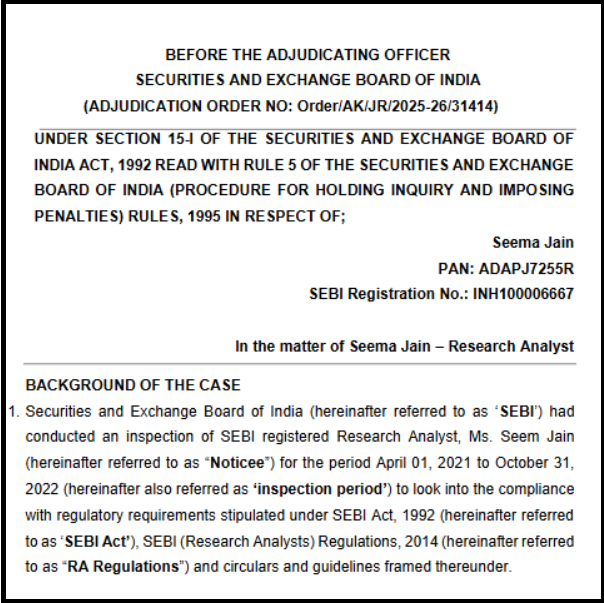
Dr. Seema Jain, a PhD from IIT Delhi and SEBI-registered research analyst, recently faced adjudication proceedings.
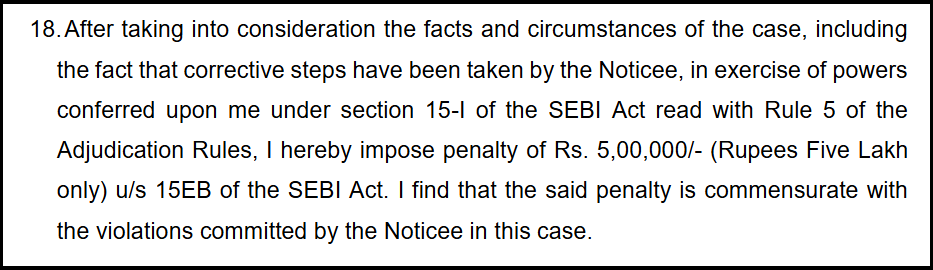
The market regulator imposed a penalty of ₹5,00,000 in May 2025.
So what went wrong?
Let’s break down what actually happened.
Who is Seema Jain?
As mentioned, Dr. Seema Jain is a legitimate SEBI-registered research analyst. Her registration, obtained on December 14, 2018, is still valid.
But registration alone doesn’t guarantee full compliance.
According to the SEBI Adjudication Order dated May 23, 2025, the regulator inspected her activities for the period April 1, 2021 to October 31, 2022. That’s when things started to unravel.
The core issue?
She was actively operating through two different entities, and the line between them wasn’t clearly maintained.
Entity 1: M/s. Concepts (Proprietorship)
This was her registered research analyst setup—
- Individual SEBI registration
- Official research recommendations
Entity 2: StockPro (Partnership Firm)
Founded on February 21, 2018, StockPro offered:
- Paid educational courses
- Telegram channels sharing stock “calls”
- YouTube market analysis
Course prices ranged from ₹1,499 to ₹44,999, covering technical analysis, price action, and risk management.
The problem, as SEBI saw it, was simple but serious: there was no arm’s-length separation between these two entities.
StockPro’s Telegram channels regularly shared stock recommendations. While these were claimed to be “educational,” SEBI classified them as research reports under Regulation 2(w).
The regulator didn’t accept the education-only defence. Once those recommendations were treated as research analyst services, multiple compliance violations automatically followed.
That’s where the trouble really began.
SEBI’s Key Findings Against Seema Jain
Here’s the reality: Dr. Seema Jain had valid credentials. SEBI registration intact. Real educational services. Yet violations occurred.
The gap between her understanding and regulatory expectations created the violations.
Impact on legitimate analysts: Reputation damage happens fast. Client trust erodes. Business operations suffer.
For Seema Jain, a ₹5 lakh penalty plus three years of proceedings left a permanent mark.
SEBI identified seven major categories of violations. Let’s examine each one.
1. Lapse in Mandatory NISM Certification
What happened
- NISM certification expired on April 2, 2022
- New certificate obtained on March 2, 2023
- 11-month gap with no valid certification
Why does this matter?
SEBI regulations require research analysts to hold a valid NISM certification at all times.
During this period, services continued despite the lapse.
SEBI’s view
Dr. Jain acknowledged the lapse and stated she believed the certification was valid for life.
SEBI rejected this explanation, citing Regulation 7(2) of the Research Analyst Regulations.
2. Failure to Maintain Mandatory Records
SEBI found multiple gaps in record-keeping, a core compliance requirement for research analysts.
(a) No Annual Compliance Audit
- No annual audit was conducted during the inspection period
- Auditor appointed only after SEBI inspection
(b) Incomplete Records of Stock Recommendations
- Records maintained in Excel were incomplete

- Recommendations shared on Telegram channels were missing
- Documents were not digitally signed
(c) Missing Records of Public Appearances
- Stock recommendations made via YouTube videos were not documented
- No systematic record of public communications
(d) Inadequate Research Rationale Documentation
- No proper documentation explaining the basis of the recommendations
- No verifiable evidence during the inspection period
- Records not digitally signed
3. Trading During the Restricted Period
This was one of the most significant findings.
SEBI’s findings
- Trades by Seema Jain: 268 instances
- Trades by associate (Anushka Rajora): 29 instances

- Total violations: 297
What the rule says
Under SEBI regulation, research analysts are prohibited from trading in securities:
- 30 days before and
- 5 days after issuing a recommendation.
On this, Seema Jain mentioned that all “live trading was done for educational purposes.”
SEBI rejected this explanation, stating that intent is irrelevant—trading during the restricted window is strictly prohibited.
4. Inadequate Disclosures to Investors
SEBI noted that several mandatory disclosures were missing from reports and public content.
Key gaps identified
- SEBI registration details not disclosed
- Financial interest in recommended stocks not revealed
- No conflict-of-interest disclosures
- YouTube videos lacked the required disclaimers
Why does this matter?
Since trading was occurring in the same stocks being recommended, disclosure of financial interest was mandatory.
5. Investor Grievance Redressal Failures
SEBI found shortcomings in handling investor complaints and disclosures.
(a) Delayed SCORES Registration
- SCORES registration obtained on August 30, 2021
- Required within one month of RA registration (December 2018)
- Delay: Nearly 3 years
(b) Delay in Resolving Complaints
- Total complaints received: 4
- All resolved beyond the 30-day limit
- Required timeline: 30 days
(c) Missing Website Disclosures
- Investor Charter not published

- Complaint-handling details not displayed
Why This Matters for Investors?
These violations were not about qualifications or intent, but about strict procedural compliance.
SEBI emphasised that even experienced and registered professionals must follow every regulatory requirement without exception.
SEBI Verdict
SEBI Imposed a ₹5 Lakh Penalty for:
While determining the penalty, SEBI considered the following:
- No Quantifiable Loss or Gain: There was no evidence of financial loss to investors or unfair gains by Jain.
- Non-Repetitive Nature: This was not a case of repeat offences.
- Serious Lapses in Compliance: Despite the above, SEBI emphasised that:
- Research Analysts play a critical role in market integrity.
- Violations undermine investor trust and market ethics.
- Jain’s actions showed a lack of professionalism and due diligence.
The penalty of ₹5,00,000 was deemed appropriate to uphold regulatory discipline and deter future non-compliance.
Why This Case Matters for Retail Traders?
This case highlights an important reality that many retail traders overlook: SEBI registration alone does not guarantee ongoing compliance or investor safety.
Dr. Seema Jain was a valid SEBI-registered Research Analyst with strong academic credentials. Yet, SEBI’s adjudication order shows that procedural lapses, disclosure failures, and compliance gaps can still occur, even among registered professionals.
1. “SEBI Registered” Is Only the Starting Point
Many investors assume that a SEBI-registered analyst automatically follows all rules at all times. This case proves otherwise.
SEBI registration must be supported by:
- Valid certifications
- Proper disclosures
- Strict trading restrictions
- Complete record-keeping
When these safeguards fail, investor protection weakens.
2. Educational Content Can Still Be Regulated Advice
Retail traders often rely on:
- Telegram stock calls
- YouTube market analysis
- Paid “educational” trading courses
SEBI made it clear that labels do not matter.
If stock recommendations are shared, they may be treated as research analyst services, regardless of whether they are called “education” or “training.”
For investors, this means:
- Do not assume “educational” content is unregulated
- Treat such advice with the same caution as formal research reports
3. Conflict of Interest Disclosures Are Critical
One of SEBI’s key concerns was trading in the same stocks that were being recommended, without proper disclosure.
For retail investors, this raises a vital question:
Is the person giving advice financially aligned with you—or trading ahead of you?
Always look for:
- Clear disclosure of financial interests
- Conflict-of-interest statements
- Transparent disclaimers in videos and reports
Absence of these is a major red flag.
4. Compliance Failures Can Directly Affect Trust
Poor record-keeping, delayed complaint resolution, and missing investor disclosures don’t just violate regulations—they:
- Reduce accountability
- Make grievance resolution harder
- Erode investor confidence
Even when no direct investor loss is proven, such lapses weaken the overall trust ecosystem.
What Can You Do in Such Cases?
Dr. Seema Jain’s case is a powerful reminder that SEBI registration alone does not guarantee compliance.
Even with valid registration, the May 2025 adjudication order found multiple regulatory violations, resulting in a ₹5 lakh penalty for procedural and compliance-related lapses.
If you’re concerned about similar issues with any SEBI-registered research analyst, learn how to complaint against stock advisory
Remember, you do not have to face this alone.
Our team is here to support you through every step of the grievance process.
Our Step-by-Step Support Process
- Initial Consultation & Case Review
We arrange a confidential call with a dedicated Case Manager who listens to your full experience, evaluates the nature of the violations, and guides you on your possible next steps.
- Professional Documentation & Complaint Drafting
We help you draft a clear, structured, and compelling complaint that outlines:
- The misconduct or non-compliance
- The impact on you
- The exact regulatory breaches involved
This ensures your grievance is strong, coherent, and ready for escalation.
- Direct Engagement & Escalation Assistance
Communication with the Research Analyst/Broker:
Before approaching SEBI, we guide you in sending a formal written complaint to the entity, an essential part of the grievance trail.
File a SEBI SCORES Complaint:
We provide detailed assistance in submitting your case on SEBI’s SCORES portal, tracking the status, and responding to SEBI queries.
Using Smart ODR:
For eligible cases, we help you explore SEBI’s Smart ODR platform, an efficient online dispute resolution system for quicker outcomes.
- Advisory & Strategic Counselling
Our experts offer practical guidance on:
- Possible outcomes
- Recovery prospects
- Expected timelines
- How similar cases (like Dr. Seema Jain’s) have been handled
We help you make informed decisions every step of the way.
- Guidance on Advanced Legal Recourse
If the outcome remains unsatisfactory, we assist you with further options, including:
Arbitration Route:
If your agreement contains an arbitration clause, we connect you with specialists experienced in securities arbitration for a more targeted recovery process.
Don’t let the process overwhelm you.
Register with us to report your case today, and let our expert team guide you toward clarity, resolution, and accountability.
Conclusion
Dr. Seema Jain’s case serves as a critical reminder. SEBI registration alone doesn’t guarantee compliance. According to the May 2025 adjudication order, she violated multiple regulations despite holding a valid registration.
The ₹5 lakh penalty addresses these compliance failures.
However, it’s worth noting: No investor losses were quantified. No unfair advantage amount was calculated. The violations were procedural and compliance-related.
The case highlights regulatory importance. Compliance matters. Registration without adherence means nothing. Investors must stay vigilant. Regulators must remain strict.