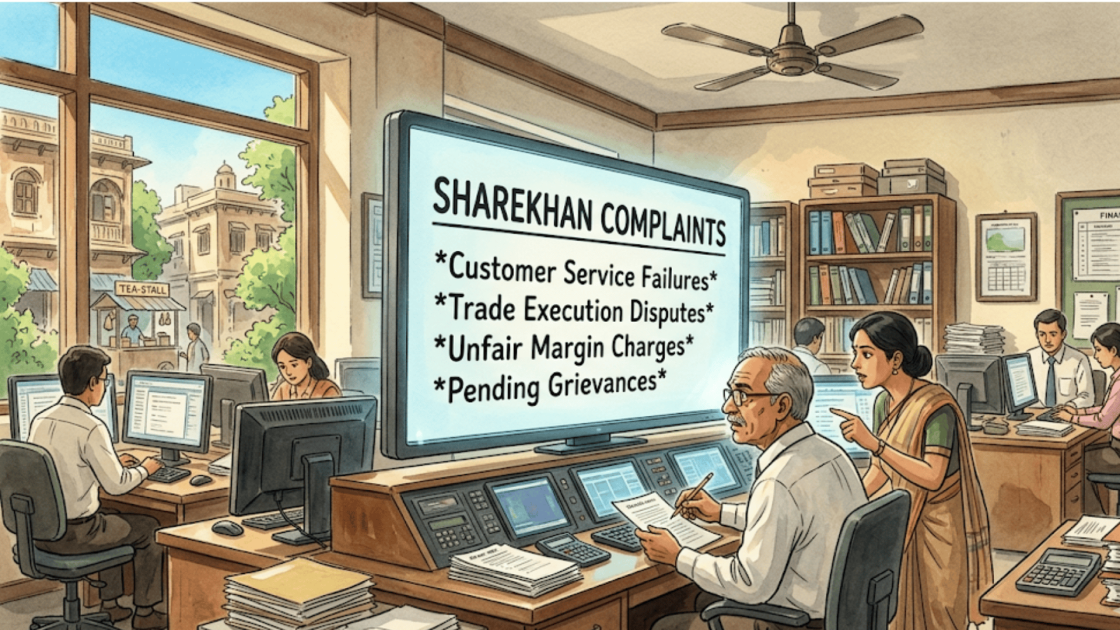
If you’re thinking about using Sharekhan, it’s worth taking a step back and asking a simple question; what are other users actually experiencing?
Because here’s the truth: no broker is perfect. Every platform comes with its own set of complaints. What really matters is what kind of issues people face and how serious they are.
In Sharekhan’s case, many users have talked about things like unexpected charges, account-related problems, delays in support, and in some situations, disputes that even reach arbitration.
Now, this doesn’t automatically make it a bad platform. But it does mean you shouldn’t go in blindly. It’s always better to understand the ground reality before you trust any broker with your money.
In this blog, we’ll walk through what users are actually reporting, what the official exchange data shows, and even look at a real arbitration case.
By the end, you’ll have a much clearer picture of whether Sharekhan fits your needs or not.
Sharekhan Complaints Overview
If you go through different platforms and user feedback, a pattern starts to show. The complaints aren’t random, they usually revolve around a few common issues.
Many users talk about charges they didn’t fully expect.
This often happens with brokerage, annual maintenance, or other fees that weren’t clearly understood at the start.
In a full-service broker like Sharekhan, this becomes even more important because the cost structure is more complex than discount brokers.
Another common issue people raise is around account handling.
Some users say they faced problems with how trades were executed or how their accounts were managed, and in certain situations, concerns related to Sharekhan unauthorised trading have also been raised.
Support is another area where complaints come up.
Users mention delays in resolving issues, repeated follow-ups, or not getting clear answers.
In some cases, users also report problems like Sharekhan app not working, which adds to the frustration during active market hours.
Then there are cases where things escalate further. When users don’t get a satisfactory resolution, they move to exchange-level complaints, and in some situations, even arbitration.
Now here’s the important part; these complaints don’t mean every user faces these issues. But when similar patterns keep showing up, it tells you what to watch out for.
And that’s the goal here; not to judge, but to help you stay aware so you can avoid problems before they happen.
Exchange Complaint Data
Now let’s move from opinions to actual data.
Here’s what the official exchange data shows for Sharekhan over the last few years:
| Financial Year | Total Clients | No. of Complaints | % of Complaints | Resolved Complaints | % Resolved | Arbitration |
|---|---|---|---|---|---|---|
| 2022–23 | 1,063,742 | 421 | 0.040% | 409 | 97.15% | 6 |
| 2023–24 | 1,063,742 | 438 | 0.041% | 427 | 97.49% | 4 |
| 2024–25 | 1,108,559 | 612 | 0.055% | 612 | 100% | 2 |
| 2025–26 | 1,084,331 | 588 | 0.054% | 541 | 91.99% | 0 |
When you look at these numbers, a few things become clear.
The complaint percentage stays very low across all years. Even at its highest, it’s just around 0.055%.
So on a large scale, most users are not raising formal complaints at the exchange level.
At the same time, the number of complaints has slightly increased over the years. This could be because of a growing user base or simply more awareness among investors.
The resolution rate looks strong, especially in 2024–25 where all complaints were marked as resolved.
But don’t take this at face value. A “resolved” complaint doesn’t always mean the user walked away satisfied, it just means the case was closed officially.
Now look at the arbitration numbers.
They’ve reduced over time and eventually dropped to zero in 2025-26.
This might suggest that fewer disputes are escalating that far, or that issues are getting settled earlier in the process.
So what’s the real takeaway here?
The data doesn’t show any alarming pattern, but it also doesn’t tell you everything.
To really understand what’s happening, you need to look at actual cases and user experiences, which we’ll get into next.
Sharekhan Arbitration Case
Sometimes, complaints don’t get resolved at the basic level. That’s when things move into arbitration.
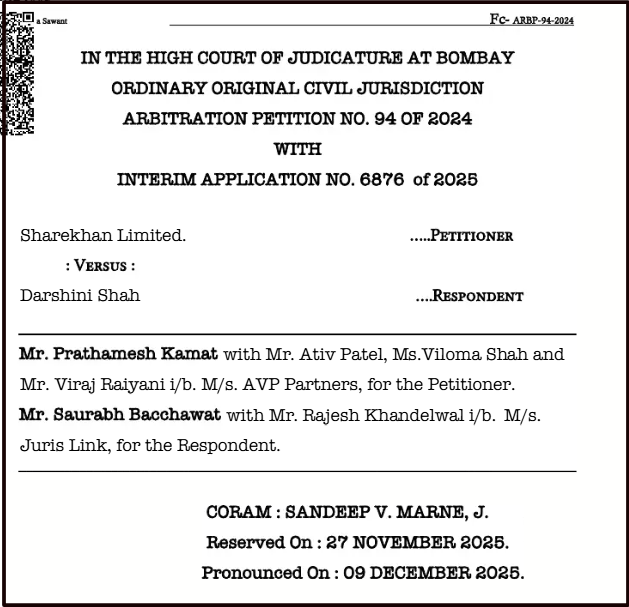
In this case, a client had been using Sharekhan for quite some time. The account stayed inactive for a while and then suddenly became active again. That’s where the problem started.
The moment trading resumed, the client noticed something off. Brokerage charges were higher than expected, and there was no clear communication about this change.
On digging deeper, another issue came up; the broker had restarted trading without completing fresh KYC, which is mandatory when an inactive account becomes active again.
The client raised the issue, but it didn’t get resolved properly. So the client took it to the exchange, and eventually, the matter went into arbitration.
Now this is where things got serious.
The arbitrator didn’t just look at whether the charges were high. He looked at how the entire situation unfolded.
The timeline played a big role. The account was inactive, then reactivated, and trading started.
But the broker didn’t complete the required KYC at that point. That’s not a small miss, it’s a clear compliance lapse under NSE rules.
Then came the question of consent. There was no strong evidence showing that the client had clearly agreed to the revised brokerage after the account became active again.
So the issue shifted completely. It was no longer about “the client didn’t like the charges.”
It became “the broker didn’t follow the required process.”
And once that became clear, the direction of the case changed.
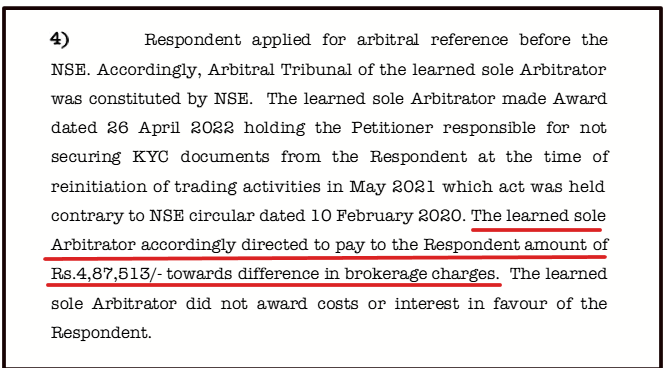
Based on this, the arbitrator directed Sharekhan to pay ₹4,87,513 to the client, which covered the excess brokerage charged. The arbitrator didn’t grant any additional interest or legal costs.
This case shows something most investors overlook.
Not every problem comes from market losses. Sometimes, the real issue sits quietly in the background – in charges, permissions, and basic compliance.
Most people don’t track these things. They focus on profits and losses, ignore statements, and assume everything is fine. That’s exactly how small issues turn into big losses.
At the same time, don’t misunderstand this case.
The client didn’t win just because they raised a complaint.
They won because the broker made a clear mistake; no proper KYC and no clear communication. Without that, the outcome could have gone the other way. So take this seriously.
Stay involved in your account. Check your charges. Question anything that doesn’t feel right. Because once things escalate to this level, fixing them becomes much harder.
Sharekhan User Reviews
Before you decide anything, it helps to see what real users are actually saying.
These are not filtered opinions -these are direct experiences shared by people who have used Sharekhan.
Let’s go through a few of them and understand what’s really happening behind the scenes.
1. Poor Support and Delayed Responses
When users need help, they expect quick support, especially during market hours. But this review shows a different reality.
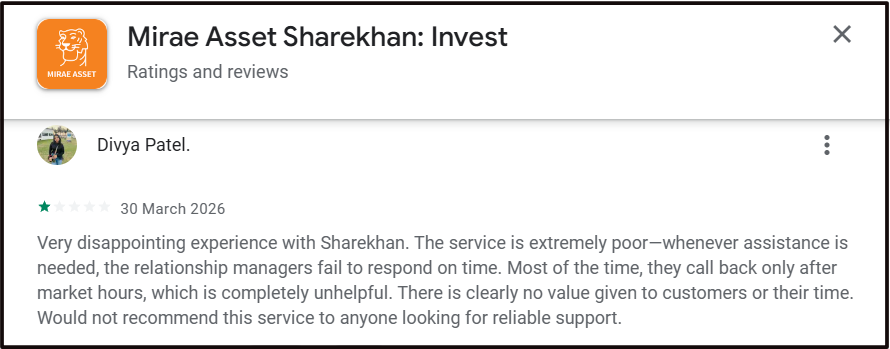
In this case, the user clearly struggles with delayed responses from relationship managers.
Instead of getting help when it matters, they receive callbacks after market hours, when the opportunity is already gone.
This is a serious concern.
In trading, timing matters. If your broker or relationship manager doesn’t respond when the market is open, the support becomes almost useless.
It also shows a gap between what full-service brokers promise and what users actually experience.
2. Unrealistic Promises and Blame-Shifting
Many users rely on advisors when they don’t have full market knowledge. But this review highlights what can go wrong.
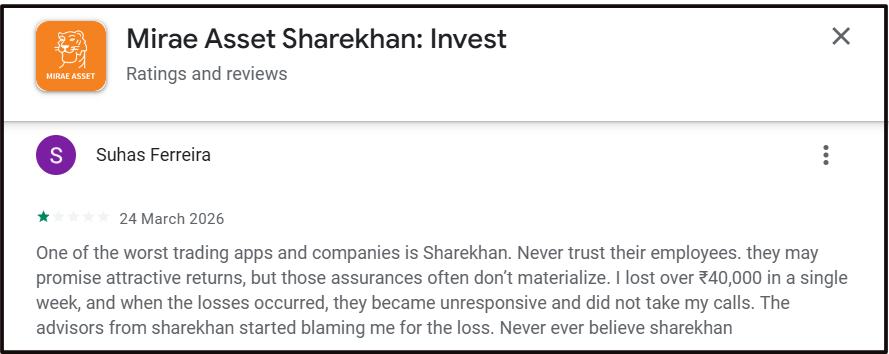
The user claims that employees made promises of returns, but when losses happened, they stopped responding and shifted the blame back to the client.
This is where you need to be very careful.
No broker can guarantee returns. If someone promises profits, that’s already a red flag.
And when losses happen, responsibility often shifts back to you. This review shows why you should never depend blindly on advisor calls.
3. Selling Stocks Without Clear Consent
This is one of the most serious types of complaints.
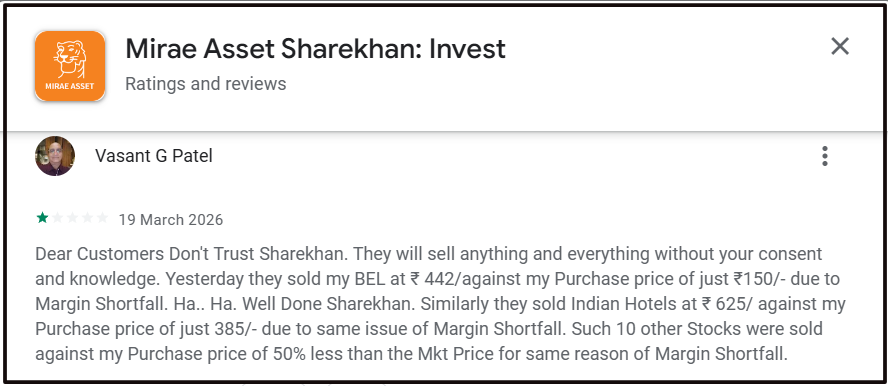
The user claims that multiple stocks were sold due to margin shortfall, even though they were in profit compared to the purchase price. The user feels these actions happened without proper understanding or control.
Now this needs clarity.
Brokers do have the right to sell positions in case of margin shortfall.
But the real issue here is awareness. Many users don’t fully understand margin rules, and when stocks get sold, it feels like the broker acted without consent.
This highlights a bigger problem, lack of communication and user understanding.
4. Issues with Order Execution and Pricing
Execution accuracy is basic expectation in trading. But this review raises doubts.
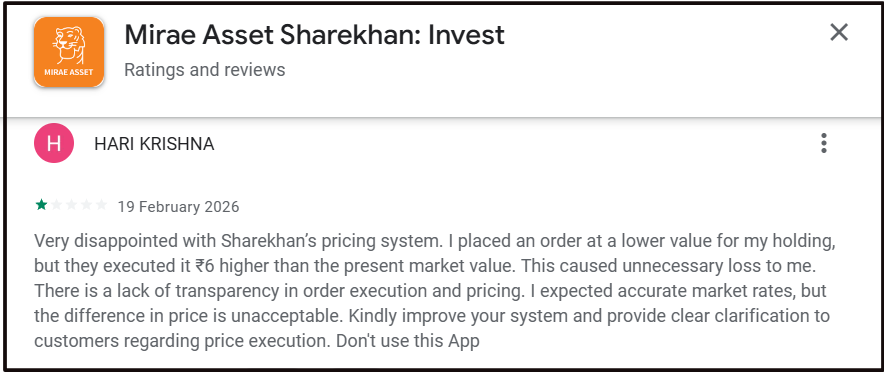
The user says the order was executed ₹6 higher than the market price, which led to a direct loss. They also mention a lack of transparency in how prices are executed.
This is something you shouldn’t ignore.
Even small price differences can impact your trades, especially if you trade frequently. While execution differences can happen due to market movement, the user clearly feels that the system lacks transparency.
That’s the key issue here, not just the price, but the lack of clarity around it.
What These Reviews Tell Us
When you step back and look at all these reviews together, a pattern starts to form.
Most complaints don’t come from one big issue. They come from:
- poor communication
- lack of clarity
- delayed support
- and unmet expectations
This doesn’t mean every user will face these problems. But it clearly tells you what to stay alert about if you choose to use Sharekhan.
When To Take Action Against a Broker?
You don’t need to react to every small issue. But you should never ignore clear warning signs.
Take action if you notice:
- Repeated delays in support during market hours: If your broker doesn’t respond when the market is open, you’re taking unnecessary risk.
- Charges you don’t understand or didn’t agree to: Don’t ignore small deductions. They can build into bigger losses over time.
- Promises of guaranteed returns or aggressive trading pressure: No one can guarantee profits. Treat such claims as a red flag.
- Trades or actions you didn’t clearly authorise: Whether it’s margin selling or unexpected execution, question it immediately.
- No proper resolution to your complaints: If you keep getting generic replies or no clear answers, it’s time to escalate.
Don’t act emotionally. Act early.
Don’t wait for the problem to turn into a loss before you take it seriously. The longer you delay, the harder it becomes to prove your case.
Stay alert from the beginning. Most serious issues don’t start big, they build slowly over time.
How to Report a Complaint Against a Stock Broker?
If you ever face an issue with your broker, follow a clear process instead of jumping steps. This helps you build a stronger case and increases your chances of getting a proper resolution.
Step 1: Contact the Broker
The first step is to contact the broker’s customer support team and report the issue.
Traders can reach out through the broker’s support channels such as customer care numbers, email, or in-app support.
Step 2: Keep Evidence
It is important to keep records of the issue. Useful evidence may include:
- screenshots of the error or login issue
- order logs showing failed or delayed orders
- timestamps showing when the problem occurred
Proper documentation can be helpful if the issue needs to be escalated later.
Step 3: File a Complaint in SCORES
If the issue is not resolved by the broker, you can register a complaint with the SEBI on the Complaints Redress System (SCORES) platform.
This system allows investors to report issues related to stock brokers and trading services.
Step 4: Go for Arbitration
If you’re still not satisfied, you can move to arbitration in stock market.
An independent arbitrator reviews your case and gives a decision based on the evidence you provide.
How you handle the complaint matters just as much as the complaint itself. Keep everything documented through email or written communication instead of relying only on calls.
Focus on facts and clearly explain what happened without adding emotional language.
Act early instead of waiting for the issue to grow, because delays make your case weaker. Stay involved throughout the process, follow up regularly, and don’t assume the system will resolve things on its own.
Need Help?
If you’re dealing with a broker issue and not sure what to do next, don’t try to figure everything out on your own.
Many investors lose time and money simply because they don’t take the right steps at the right time.
Getting proper guidance early can make a big difference.
Whether it’s understanding your charges, checking if something is wrong in your account, or deciding how to raise a complaint; the right support helps you avoid bigger problems later.
If you want clear guidance and a structured approach, you can register with us. We’ll help you understand your situation and guide you on the next steps so you can handle it confidently.
Conclusion
Sharekhan, like any other broker, comes with its own set of positives and concerns.
The data shows that complaints exist but stay relatively low compared to the overall client base. At the same time, user reviews and real cases highlight gaps in communication, support, and clarity.
So don’t look at just one side.
Don’t rely only on numbers, and don’t rely only on reviews. Look at both, understand the patterns, and then decide what works for you.
If you choose to go ahead, stay involved. Track your account, understand the charges, and question anything that doesn’t feel right. That’s the only way to avoid problems later.
At the end of the day, your broker handles your money, so awareness is not optional, it’s necessary.