
When investors hear the phrase Shoonya HNI Trading, many assume it refers to a specialised service for high-value traders. The combination of a brokerage name and the term “HNI” makes it sound premium and structured.
But before accepting that impression, we need to ask a simple question:
Does Shoonya officially offer a service called “Shoonya HNI Trading”? Or does “HNI” simply refer to an investor category within the stock market?
The market already uses the term HNI, High Net-worth Individual, especially in IPO applications and large investments. When this term appears alongside a brokerage name, confusion can easily arise.
Instead of relying on labels, let’s examine the facts. What exactly is Shoonya?
Shoonya HNI Trading Overview
Before we attach assumptions to the phrase Shoonya HNI Trading, we need to clearly understand what the term HNI actually means in the financial world.
Many investors hear “HNI” and immediately think of special trading access, insider strategies, or high-profit setups. But the financial definition is far more structured and far less dramatic.
On Shoonya’s website, HNI services are described in a broader financial context. The explanation focuses on individuals who have a higher level of wealth or income compared to the general population and, therefore, may require customized financial services.

Now look at how the platform itself defines HNI services:

As you can see in the screenshot, HNI services are described as financial services or products designed for high-net-worth individuals.
These may include investment opportunities, financial planning, wealth management, and other services tailored to their financial needs and preferences.
Notice what the definition emphasizes:
- Tailored financial services
- Wealth management
- Financial planning
- Investment opportunities
It does not describe a guaranteed trading model, and it does not describe high-accuracy options signals.
It does not describe a secret HNI trading app.
In financial terminology, HNI simply refers to investors who deploy larger capital and therefore may receive customized service structures. For example, in IPO applications, investors applying above ₹2 lakh fall into the HNI category.
Similarly, banks and wealth firms may assign relationship managers to such clients.
The important takeaway here is this:
HNI is a classification based on capital size and service customization, not a promise of extraordinary returns.
Now that we clearly understand what HNI means from the platform’s own description, the next step is to examine how the phrase “Shoonya HNI” is being used outside this official explanation.
What Is Shoonya by Finvasia?
Shoonya operates as a zero-brokerage trading platform under the Finvasia group, and it allows investors to trade across multiple segments, including equity, futures and options, currency, commodities, IPOs, and mutual funds.
The platform positions itself around one core idea: eliminating brokerage costs across segments, which is why many traders recognize it as a discount broker in the Indian market.
However, with a large user base, Finvasia Complaints regarding technical glitches or service delays are sometimes reported.
When these issues arise, it becomes crucial to understand exactly what Shoonya’s role is and what it isn’t.
Shoonya functions as a registered stockbroker under SEBI and the respective stock exchanges. That means it provides execution services. In simple terms, it allows you to place trades on the exchange.
It does not automatically become an advisory service just because someone trades large quantities through it. This distinction matters.
A brokerage platform executes orders. An investment adviser or research analyst provides regulated advisory services.
Shoonya’s primary role falls under brokerage operations. It provides trading infrastructure, margin policies, IPO application access, and platform tools. It does not publicly position itself as a guaranteed-profit trading service.
Understanding this foundation helps us move to the real question behind the phrase “Shoonya HNI Trading.”
If Shoonya is a brokerage platform, then what exactly does “HNI” refer to in this context?
Shoonya HNI Trading Complaints
Now that we clearly understand what Shoonya officially means by HNI services, the important question becomes this:
If the website only describes HNI as a financial classification for high-net-worth individuals, then how did the phrase “Shoonya HNI Trading” start sounding like a separate investment offering?
This is where the confusion begins.
In several online discussions and user forums, people have mentioned being introduced to something called “Shoonya HNI Trading” through messaging platforms.
In those discussions, the term is not used in the context of the IPO category or wealth classification.
Instead, it is associated with separate apps, structured trading plans, or investment opportunities.
Before forming any opinion, it helps to see what users themselves are discussing.
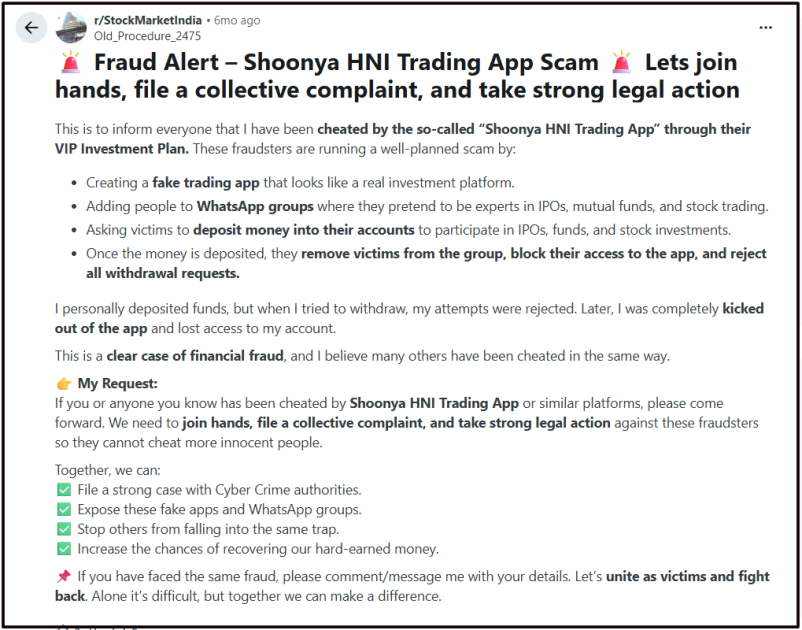
If you read through such community posts, you will notice that users describe being contacted, shown profit dashboards, or guided toward installing specific trading applications. Some discussions mention difficulties with withdrawals or confusion about whether the service was officially linked to Shoonya.
This becomes important because the tone in these discussions is very different from the official explanation of HNI services on Shoonya’s website.
To address misuse of its brand name, Shoonya has also issued public warnings.
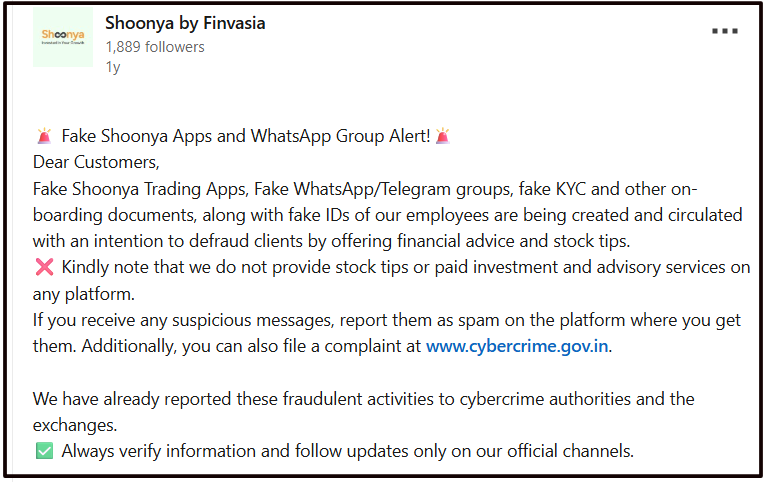
In its official communication, Shoonya clarifies that it does not operate unofficial trading apps, does not run paid WhatsApp or Telegram investment schemes, and does not authorize third parties to promise profits under its name.
When you compare both sides carefully, a clear difference appears:
On the official website, HNI refers to structured financial services for high-value clients.
In third-party marketing conversations, “Shoonya HNI” sometimes appears as a label attached to trading schemes or external apps.
That difference is not minor. It changes the entire risk profile for an investor.
Now that we understand how the term is being marketed by third parties, the next step is to understand how you can identify a fake Shoonya app before you trust it with your money.
How to Identify a Fake Shoonya App?
When someone approaches you with a “Shoonya HNI Trading” opportunity, do not rely on the name alone. Focus on how the platform operates. A regulated broker follows compliance rules, transparent onboarding, and verified payment systems. A fake setup usually reveals itself through gaps.
Here’s how you can check:
1. Check Where the App Comes From
A genuine trading app will be available on the official Play Store or App Store, and the developer name will match the registered brokerage entity.
If someone sends you a private APK link, a suspicious website, or a file through WhatsApp or Telegram, you should treat that as a warning sign.
Regulated brokers do not distribute apps through unofficial links.
2. Verify Registration Details
Every legitimate broker displays its SEBI registration and company details clearly.
You should cross-check those details on SEBI or stock exchange websites.
If the app avoids showing regulatory identity or gives vague company information, do not proceed.
3. Observe the Payment Structure
A real broker routes funds through official bank-linked trading accounts.
It does not ask you to transfer money to personal UPI IDs or unrelated bank accounts.
If deposits feel easy but withdrawals become difficult or delayed, that imbalance should concern you.
4. Question Profit Guarantees
No regulated broker guarantees fixed returns. If someone promises assured profits, high accuracy percentages, or “risk-free HNI trading,” you should step back immediately.
The stock market involves risk. Any claim that removes risk from the equation deserves scrutiny.
When you apply these checks calmly and logically, you reduce the chances of falling into a misleading setup.
Now, let’s look at what you should do if you actually come across a fake trading app.
How To File a Report Against Trading Scams?
If you encounter a fake “Shoonya HNI” trading app or misleading group, you should respond in a structured manner instead of reacting emotionally.
Proper documentation and timely reporting increase the chances of action.
Let’s break it down step by step.
1. Collect and Preserve Evidence
Start by taking clear screenshots of:
- The app interface
- Chat conversations
- Payment instructions
- Transaction receipts
- Any profit promises made
Save these records safely. A well-documented timeline strengthens your complaint.
2. Inform Shoonya Officially
If someone is misusing the Shoonya name, report it to Shoonya’s official support channels. This allows the company to issue clarifications and escalate the matter internally.
Brand misuse should always be reported directly to the company concerned.
3. File a Cyber Crime Complaint
You should file a complaint on India’s National Cyber Crime Portal if money was involved. Financial app fraud falls under cybercrime, and early reporting improves the chances of tracking transactions.
Do not delay this step if funds have already been transferred.
4. Approach SEBI (If Advisory Claims Were Made)
If the app or group made investment promises, claimed regulatory backing, or positioned itself as an advisory service, you can file a complaint in SCORES platform.
Attach all supporting documents and explain the sequence of events clearly.
5. Inform Your Bank Immediately
If you transferred money, contact your bank as soon as possible and request that they flag or freeze the transaction where feasible. The faster you act, the better your chances of limiting damage.
Structured reporting may feel overwhelming, but it creates accountability. Now, if you personally faced confusion or loss in a “Shoonya HNI” situation, let’s discuss what support options are available.
Need Help?
Whether you are facing issues like the Shoonya app not working, withdrawal delays, additional deposit demands, or sudden communication silence from support, do not leave the matter unresolved.
Act in a structured manner.
Secure all your records: transaction receipts, bank statements, chat conversations, screenshots of the app, and any profit claims made to you. Proper documentation strengthens your position.
Before filing complaints randomly, understand who you are dealing with: a broker, a research analyst, or an unregulated operator. Filing with the correct authority increases effectiveness.
If you need clarity on regulatory status, complaint procedures, or the right recovery approach, register with us.
We will examine your case, review the documentation, and guide you through the appropriate reporting and regulatory process.
Early action improves outcomes. Take the next step properly.
Conclusion
The phrase “Shoonya HNI Trading” sounds structured and premium, but you should not rely on how it sounds. You should check what it actually represents.
Shoonya operates as a registered brokerage platform. The term HNI refers to high-net-worth individuals within a recognised investor category.
These two facts, by themselves, do not create a special profit-generating trading model.
Confusion begins when third parties combine a known brand name with premium-sounding labels. That combination can create an impression of authority even when no official service exists under that name.
As an investor, you should always verify whether a service appears on the official website, whether the entity holds a valid regulatory registration, and whether the claims match how regulated financial markets function.
The stock market does not guarantee returns. It operates on risk, regulation, and transparency.
Before trusting any “HNI trading” offer, pause and verify the source. Careful verification protects capital far better than attractive labels ever can.