
Quick Summary
On July 24, 2026, SEBI passed an interim order freezing the bank and demat accounts of Stark Investments, Starkblue Ventures LLP, and three people connected to them. The order came after 16 complaints. SEBI found, on a preliminary basis, that at least ₹25,08,18,608 had been collected from investors for advisory and portfolio management services that neither firm was registered to provide. Investors were reportedly asked to share their trading account passwords and OTPs. This page explains who these entities are, what they were doing, and what you should do if your money is caught up in it.
Most people who lost money with Stark Investments were not reckless.
They were shown a professional-looking deck. They met people with real CVs from large, recognisable financial institutions.
They were told about a proprietary model built on algorithms, shown quarterly performance sheets beating the Nifty, and given a number for the worst case: your downside is capped at about 10 percent.
Then they were asked to open a trading account at a well-known broker, which felt safe, because the broker really was registered.
And then, in a WhatsApp group, they were asked to share the login ID. Then the password. Then the OTP that had just arrived by SMS.
That last step is where everything turned, and it is why the Stark Investments story is worth your time even if you have never heard the name.
The same sequence runs through case after case, with different branding painted on top each time.
So let us start with who was actually involved, because five parties are named here and they are easy to mix up.
Who the Five Parties in the Stark Investments SEBI Order Are
Three individuals and two firms sit at the centre of this. Here is how they connect.
- Surabhi Chauhan is the person most investors dealt with directly. She signed the mandate agreements, ran the client WhatsApp groups, and sent most of the buy and sell instructions.
Interestingly, she was not formally a partner in Stark Investments at all. SEBI still holds her responsible using a principle called holding out, which says that if you present yourself as a partner and people deal with you on that basis, you are treated as one. - Zahin Ismail Jessani was a former partner in Stark Investments with a 50 percent stake.
He also sent trading recommendations, handled the account opening process with clients, and was the one asking for login credentials in several of the chats that later surfaced. - Shakuntala Davendra Singh is Surabhi Chauhan’s mother and holds the other 50 percent of Stark Investments. SEBI notes she was not at the forefront of operations.
But the partnership deed gave her equal profits, full access to the books and authority to operate the firm’s bank accounts, so she is not treated as a passive partner and remains responsible for what the firm did. - Stark Investments is the partnership firm, owned by Zahin Jessani and Shakuntala Singh. This is the entity that signed advisory agreements with clients and collected fees from around 2020 onwards.
- Starkblue Ventures LLP came later, incorporated in February 2022, with Surabhi Chauhan and Zahin Jessani as designated partners.This is the vehicle that pooled investor money into a single fund. It collected the largest share of the total, close to ₹16 crore on its own.
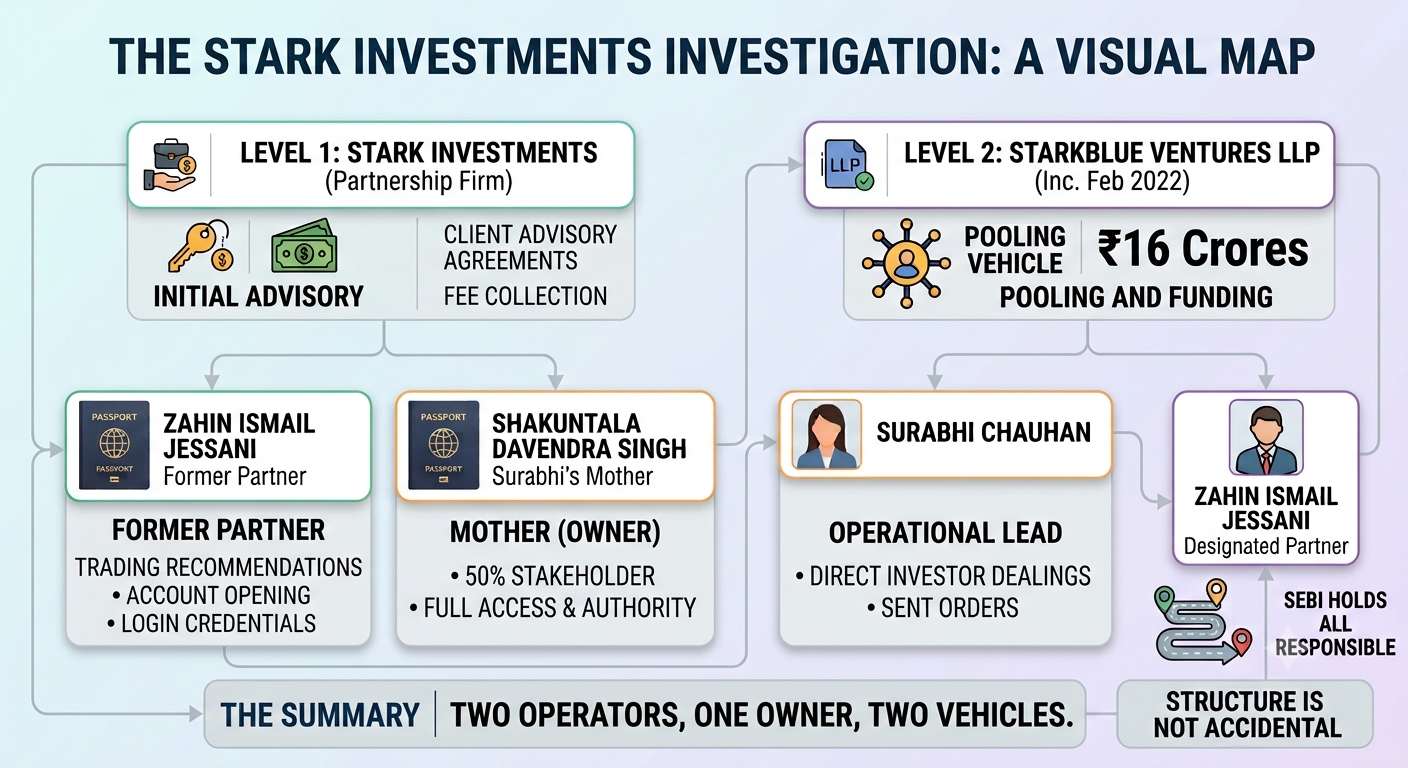
The simplest way to hold it in your head: two people ran everything, one mother sat on the ownership papers, and two firms were used at different stages for different purposes.
That structure is not accidental, and SEBI says so directly.
What SEBI Has Ordered Against Stark Investments
Sixteen people complained. Some of them were partners in the LLP they were complaining about.
By the time SEBI examined the bank statements, it could see something more worrying than the missing registration. Investor money was being depleted. Once that becomes visible, waiting for a full investigation to finish risks there being nothing left to recover at the end of it.
So on July 24, 2026, SEBI froze everything, acting immediately and without hearing the other side first. That is what an ex parte interim order means.
Here is exactly what is now in force:
- All five parties are barred from buying, selling or dealing in securities, or associating with the securities market in any way, until further orders.
- Banks cannot allow any debit from accounts held by them, whether jointly or individually. Depositories cannot allow any debit from their demat accounts either. Money can still come in. Nothing goes out without SEBI’s permission.
- Within seven working days, all five must file a complete inventory of everything they own, including property, bank accounts, demat accounts, shareholdings and mutual funds. They cannot sell or transfer any of it without permission.
- Registrars and transfer agents have been told to block any transfer or redemption of securities, including mutual fund units.
- They have 21 days to reply and can ask for a personal hearing.
One thing to be clear about, because it affects how you read everything below. All of this is interim, so every finding is preliminary. SEBI has not made a final decision, the parties have not yet given their side, and the examination is still running.
What has been documented so far, though, is unusually detailed, and it starts with how people were brought in.
How Stark Investments and Starkblue Ventures LLP Actually Operated
The arrangement did not stay the same. It changed shape over about five years, and each change made it look more legitimate than the last.
Phase one, from September 2020. Clients were signed up through Stark Investments on a mandate agreement, printed on the firm’s letterhead. The agreement named Stark Investments as the advisor, and listed its job as understanding the client’s goals, preparing an asset allocation strategy, reviewing the portfolio every quarter and recommending investments across asset classes. Fees were payable upfront and the mandate renewed each year automatically.
Phase two, running alongside. Clients were also offered what is known as account handling. In practice, this meant the client opened a trading account and then handed over the login so that trades could be placed for them. More on how that worked below, because it is the most important part of this whole case.
Phase three, from February 2022. Starkblue Ventures LLP was created. Now investors were not clients at all; they were partners in a limited liability partnership. They made a minimum contribution, accepted a lock-in period, and their money went into a single shared pool managed by a single strategy.
SEBI’s reading of that progression is worth quoting in substance. It found the parties continuously changed their methods, marketing, legal identity and operational structure, which let the activity continue while making it harder to detect.
In other words, becoming an LLP was not a step towards greater regulation. It was a step towards looking more regulated.
What made people say yes in the first place was the pitch.
What Stark Investments Promised Its Investors
The marketing material described Stark Investments as an investment advisory and management company serving Indian and NRI clients, run by a team with over fifty years of combined experience made up of CFAs, CFTs, and MBAs.
The leadership profiles were specific and checkable. One listed more than ten years in investment banking, deal making and equity research, with stints at large financial firms.
The other listed more than ten years in equity research and asset management, including time at a global bank and a well known asset manager.
The product claims followed a familiar shape:
A proprietary stock picking model built on quantitative investing with in-house algorithms. A multi asset strategy for diversification. Superior returns and alpha, described as consistently above the benchmark. Active risk management through position sizing and governance monitoring.
Clients received quarterly performance reports comparing the fund’s returns against benchmarks like the Nifty 50, along with individual success stories highlighting particular stock picks.
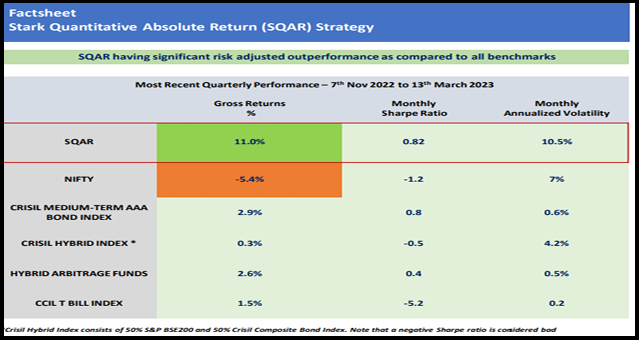
Then there was the LLP’s flagship product, marketed as SQAR, short for Stark Quantitative Absolute Return. The factsheet described it as an active equity and derivatives strategy targeting gross returns of 16 to 18 percent, at a medium risk profile with low downside volatility.
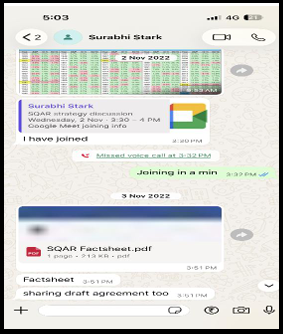
And in one WhatsApp message to an investor, an assurance was given in plain language: the money is protected, maximum downside 10 percent.
SEBI’s finding on all of this is short and damning. The material on record does not suggest any basis to justify these promotional claims.
SEBI found the parties had presented a rosy picture that was misleading, and designed to influence the decisions of investors, which is a preliminary violation of the rules against fraudulent and unfair trade practices.
That is worth pausing on. A capped downside in a derivatives strategy is not a conservative promise. It is a promise nobody can keep, because market risk does not agree to a ceiling.
How Stark Investments Sent Buy Calls on WhatsApp
This is where the advisory allegation gets concrete.
The chat extracts that surfaced during the examination are not market commentary or general education. They are instructions, with names, amounts and timing.
One client received messages telling him to add three lakh rupees of a named infrastructure stock and to place the order at a specific price. When he asked whether it was alright to proceed given the risk, the reply was to go ahead.
Months later, over one afternoon, the same client got a run of instructions to add two lakh rupees each across four different stocks in the space of about half an hour.
Another client, back in 2020, was told to buy a named stock at market price with a target attached, then told to buy three more for delivery.
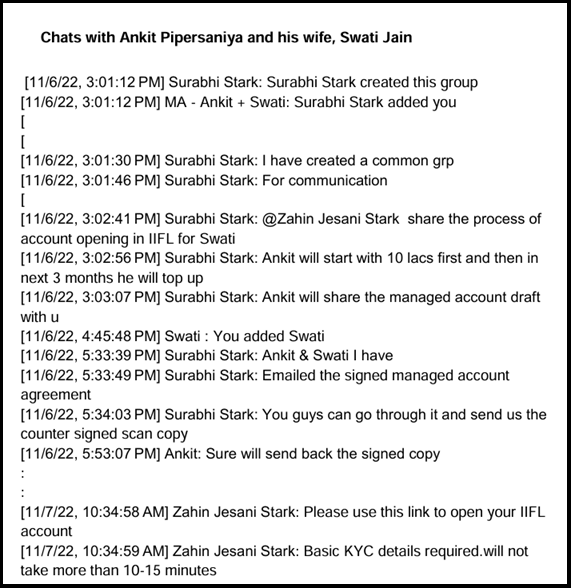
A third arrangement involved a dedicated WhatsApp group created for a client and his wife, where sell orders were specified at particular prices, and where, between the trading instructions, a message appeared asking for the quarterly advisory fees that were due.
SEBI assesses that these were specific investment recommendations, identifying the securities, the exact quantities, the price ranges, the timing of execution and instructions to buy, sell, hold or book profits.
Under SEBI’s rules, advice about buying or selling securities, given to a client for a fee, makes you an investment adviser. And nobody is allowed to act as an investment adviser without registration.
The fee side was traced through bank statements, where words like advisory, consultancy, subscription, portfolio and equity showed up repeatedly across the accounts.
Neither firm, and none of the three individuals, held any SEBI registration for advisory work.
Why Stark Investments Asked for Login Passwords and OTPs
If you read only one section of this page, make it this one. It is the part that turns a fee dispute into something far more serious, and it is the pattern most likely to show up in your own life under a different name.
Clients were guided to open trading accounts with registered brokers, and the chats show the sequence clearly.
First, the account opening link, with reassurance that it only takes ten to fifteen minutes. Then a follow up asking whether the account is open. Then a request for the login ID and client code. Then, once the broker sends the welcome SMS containing the password, a request to forward that message.
Login details including passwords and OTPs were obtained this way, and SEBI states plainly what that achieved: by obtaining the client’s credentials, control of the trading accounts was obtained.
The written agreement made the same thing explicit. Under the advisor’s responsibilities, it gave full power to direct, manage and change the investments in the client’s account, discretionary authority to buy and sell securities, and this line, which deserves reading twice:
The advisor has complete authority over the selection, buying and selling of securities, without obtaining specific client consent.
It also allowed borrowing from the broker to trade on margin, with prior consent.
Minimum investment to start ranged from ₹15 lakh to ₹30 lakh, with profits split on a customised basis. One agreement set that split at 85:15.
Now here is the legal position that matters to you regardless of this case. Managing someone else’s portfolio for them is a separate, licensed activity called portfolio management. Only a SEBI-registered portfolio manager can do it.
An investment adviser, even a properly registered one, can only advise. They cannot press the buttons for you.
So when someone asks for your password, they are not asking for convenience. They are asking you to let them do something they are not allowed to do, using your identity, with you carrying every rupee of the loss.
Our guide on whether account handling is legal breaks down exactly which permissions each type of registered entity holds, and what falls outside them.
If you have already shared your credentials with anyone, that is worth acting on today rather than waiting to see what happens. Register with us and we will walk you through securing the account and putting it on record with your broker.
Inside the Starkblue Ventures LLP Partnership Structure
The LLP is where the largest money sat, and it worked differently from the advisory side.
Prospective investors were invited to video calls, where the SQAR factsheet and a draft agreement were shared. The pitch was an exclusive partnership, available by reference only, with a minimum contribution and a lock-in requirement.
Those who joined signed an LLP agreement and became partners on paper. Their money went into one common pool held in the LLP’s bank account.
But partnership here did not mean control.
Every decision about deploying funds, executing trades, managing risk and running the strategy stayed with the two designated partners.
SEBI describes the investors as passive contributors with no role in day-to-day management, which is precisely the structure of a portfolio management service, whatever the paperwork calls it.
The agreement also provided that 25 percent of profits, plus GST, would be paid to Stark Investments as professional fees for managing the LLP’s business. So the partnership firm earned a management cut from the LLP that the same two people controlled.
The money movement is visible in the bank statements and follows a clear rhythm.
Over five days in late October 2022, roughly ₹55 lakh came in from several investors, and ₹55 lakh went out to the broker on the last day.
Over about a week in early April 2023, ₹3.08 crore came in and ₹3.79 crore went out. The same pattern repeats in January 2024 and again in May 2024.
SEBI identified at least 40 contributors to the LLP account, with individual amounts ranging from ₹15 lakh to over ₹2 crore.
All the LLP’s trading went through one registered broker, where both individuals were nominated as authorised persons.
Between June 2022 and June 2025, turnover across equity, equity derivatives, currency and commodity derivatives ran into thousands of crores, with the bulk of it in commodity and equity derivatives rather than the steady equity investing the marketing suggested.
Where the ₹25 Crore Came From
SEBI added up the credits across five bank accounts, after stripping out personal transactions like salary, rent and tax refunds.
| Account holder | Bank | Amount collected |
|---|---|---|
| Starkblue Ventures LLP | ICICI | ₹15,86,31,860 |
| Stark Investments | Axis | ₹6,22,56,908 |
| Zahin Jessani | Axis | ₹1,29,74,143 |
| Surabhi Chauhan | SBI | ₹1,11,69,616 |
| Surabhi Chauhan | HDFC | ₹57,86,078 |
| Total | ₹25,08,18,608 |
SEBI notes that the advisory and portfolio activities were run in an integrated way, with no separation in management, execution or fee collection, so it was not possible to split the money between the two activities. The whole amount is treated together.
Two things about this figure deserve attention.
First, SEBI describes it as at least ₹25 crore. The full extent of operations, the total number of clients and the complete fees collected are all still being examined. The number could grow.
Second, and more urgently, SEBI recorded a depletion of investor monies and a reasonable apprehension that the remaining funds could be dissipated, diverted, layered or otherwise put out of reach. That single finding is why the accounts were frozen on the spot rather than after a full hearing.
What To Do If Your Money Is With Stark Investments
If you paid fees to Stark Investments, contributed to Starkblue Ventures LLP, or shared your trading account credentials with anyone connected to either, here is what to do now.
- Save everything before it disappears. Export your full WhatsApp history with anyone involved, including any group you were added to. Chats get deleted and accounts go quiet fast once an order like this becomes public Save every agreement, factsheet, mandate letter and quarterly performance report you were sent. Download the bank statements showing what you paid and when. Pull your complete trading ledger and contract notes for the whole period your account was being operated.
- Secure your trading account today. If you ever shared a password or an OTP, change your credentials now.Then email your broker’s compliance team, in writing, stating that a third party had access to your account and asking them to record the dates involved.That written record becomes important later, because it separates trades you placed from trades someone else placed in your name.
- Put your complaint on record with SEBI. A freeze like this does not refund anyone.What it does is freeze assets so that if a direction to return money comes later, there is something left to return.Your claim, with your specific amount and your evidence, is what connects you to that process. Being on record matters more than being early.
- Be careful about private settlement offers. Assets are frozen and an asset inventory is due within a week. Anyone approaching you now to settle quietly, outside the regulatory process, is asking you to give up your position in it.
The reporting route for firms like this, and how it differs depending on whether the firm is registered, is set out on our page covering SEBI registered account handling.
The Warning Signs Behind the Stark Investments Case
Take away the LLP structure and the branded strategy, and what is left is a set of signals that repeat across almost every case like this.
- Impressive, verifiable CVs. The team credentials here were real names of real institutions. A good CV tells you where someone worked. It tells you nothing about whether they are licensed to manage your money today.
- A proprietary model nobody can inspect. Quantitative, algorithmic, in house. These words do real work in a pitch precisely because they cannot be checked from the outside.
- Performance sheets you cannot verify. Quarterly reports showing consistent outperformance are produced by the same people asking for your money. Registered entities report to a regulator. Unregistered ones report to you.
- A number attached to the downside. Ten percent, in this case. No honest participant in a derivatives strategy can promise a floor on your losses.
- A high minimum that feels exclusive. Fifteen to thirty lakh, by reference only. Exclusivity reduces the number of people comparing notes.
- And finally, the request for your login. This is the one that separates a bad investment from an illegal arrangement. Everything before it might just be aggressive marketing. This one crosses a legal line.
Every one of those can be checked before you send money. Registration status takes about a minute on SEBI’s website. Our breakdown of account handling in the stock market walks through the checks in order, and doing them takes less time than opening the trading account did.
Conclusion
As of July 24, 2026, Stark Investments, Starkblue Ventures LLP, Surabhi Chauhan, Zahin Ismail Jessani and Shakuntala Davendra Singh are barred from the securities market, their bank and demat accounts are frozen, and at least ₹25.08 crore stands recorded as collected from investors without any registration to collect it.
These are preliminary findings. The parties have 21 days to respond and nothing has been finally decided. But the freeze took effect immediately, and it exists because SEBI saw signs that investor money was already being run down.
If your money is in this, the useful thing you can do this week is document your position properly and get it on record while assets are still held.
And if you are reading this because someone has just asked you for your trading password, the answer is no. It always is.
Report. Recover. Stay Fraud Free.
Frequently Asked Questions
They are Surabhi Chauhan, who dealt with most clients and ran the WhatsApp groups; Zahin Ismail Jessani, a 50 percent partner in Stark Investments; Shakuntala Davendra Singh, Surabhi Chauhan's mother and the other 50 percent partner; Stark Investments, the partnership firm; and Starkblue Ventures LLP, the vehicle incorporated in 2022 that pooled investor funds.
SEBI found at least ₹25,08,18,608 credited across five bank accounts for the unregistered services, of which around ₹15.86 crore came through Starkblue Ventures LLP alone. The full extent is still being examined, so the figure may rise.
No. The order records that none of the five parties held registration from SEBI as an investment adviser or portfolio manager, which is why the activities were held to be prima facie in violation of Section 12(1) of the SEBI Act read with the respective regulations.
Change your credentials immediately and notify your broker's compliance team in writing that a third party had access, asking them to record the period involved. Preserve all chats, agreements and statements, and file your complaint with SEBI with your specific amounts and evidence.
The order does not direct any refund. It is an interim measure that freezes assets so that any future direction to return money is not defeated by funds being dissipated. Getting your claim documented and on record is what connects you to any later process.




 Add us as a preferred source on Google »

