Imagine waking up one morning to discover that ₹35 crores that were your life savings have vanished. This isn’t a Bollywood thriller; it’s the terrifying reality that happened to a 72-year-old Mumbai investor in 2025.
The shocking part?
He had no idea until the moment the company demanded he pay ₹35 crores back or face liquidation.
Welcome to the world of stock market fraud, a problem that’s growing faster than your investment portfolio should be.
Here’s what should terrify every investor: in 2024 alone, Indians lost ₹222 crores across 62,687 investment scams. That’s nearly ₹3.5 lakhs per victim, on average.
The worst part?
New scams are popping up faster than regulators can shut them down. Just last week, someone lost ₹33.3 lakhs to a fake Fyers Securities app, and another victim fell for a Telegram group promising “guaranteed returns.”
Scary right?
But don’t worry.
By the end of this blog, you’ll know exactly how these frauds work, which ones to watch out for, and most importantly, how to register a stock market fraud complaint if you become a victim.
Types of Stock Market Fraud
The problem with stock market fraud is that it’s not a one-size-fits-all crime.
Scammers have an arsenal of tactics, and understanding them is your first line of defence.
1. Pump and Dump Schemes
These are perhaps the most classic frauds in the book.
Here’s how they work: listed companies often manipulate users by running fake news on YouTube, encouraging viewers to buy stocks at rock-bottom prices. They flood social media, WhatsApp groups, and Telegram channels with hype.
They spread misleading positive statements about the company.
The buying frenzy pumps up the stock price artificially.
Once it reaches a peak, the company’s promoters and big investors dump their shares at inflated prices, causing the market price to crash.
The victims, who jumped in during the hype, are left holding worthless stocks.
2. Clone Trading Apps
These are the 2025 game-changers. Scammers create pixel-perfect copies of legitimate trading apps like Fyers, 5Paisa, or Shoonya.
You download what looks like the real app, set up an account with real money, and initially, everything seems legitimate.
The app shows you making profits. You might even be allowed to withdraw a small amount to build confidence.
Then, when you try to withdraw the bulk of your “earnings,” the app disappears, and your money is gone.
What makes this particularly cruel is that these fake apps can show you trades happening in real-time, making them virtually indistinguishable from genuine platforms.
3. Unauthorized Trading
This happens when fraudsters get access to your demat account details, or you share details with registered stock brokers, research analysts, or investment advisors with the hope of gaining profits.
They execute massive trades without your consent, manipulate contract notes, and rack up losses that suddenly become your problem.
Most of the beginners remain unaware of the fact that unauthorised trading is illegal and banned by SEBI.
Due to a lack of knowledge, most traders end up losing their money by sharing details and allowing registered and unregistered entities to trade on their behalf.
4. Insider Trading and Falsified Earnings Reports
It occurs when company insiders or corrupt officials use confidential information to manipulate stock prices.
They know about upcoming corporate announcements before the public and trade on that advantage.
Similarly, executives sometimes fabricate earnings reports to inflate stock prices, misleading retail investors into buying overvalued shares.
5. Circular Trading
It is when fraudsters execute trades between themselves using multiple accounts to artificially inflate trading volumes and manipulate stock prices.
It’s a sophisticated scheme that’s hard to spot unless you’re reviewing detailed trading statements.
Real Cases of Stock Market Fraud Complaints
Let me tell you about actual victims from just the last few months.
1. Globe Capital Market: Unauthorised Trading Fraud
In one of the most significant unauthorised trading risk reported in India, a 72-year-old investor from Mumbai accused Globe Capital Market Limited, a SEBI-registered broker, of conducting unauthorised trading in his and his wife’s trading accounts over a period of four years (from 2020 to 2024).
The victim had transferred inherited shares to the brokerage, believing the firm would safely manage the portfolio.
Throughout this period, the investor was shown misleading annual statements reflecting fictitious profits, keeping him unaware of the true activity.
However, in July 2024, he received a sudden call from Globe Capital’s risk team stating that his accounts had a combined debit balance of approximately ₹35 crore and that his shares would be liquidated if he did not pay.
Upon further review, he discovered that the broker had engaged in unauthorised high-risk trading, manipulated trades, and circular trading, leading to massive losses against his consent and best interests.
2. ₹35 Crore Fraud Reported in Mumbai
In November 2025, a Mumbai couple opened a demat account with Globe Capital Market, a supposedly registered brokerage.
Over four years, relationship managers at the firm convinced them to hand over their sensitive information and OTPs.

Unknown to them, massive Futures and Options trades were being executed through their accounts.
But here’s the kicker: the annual profit statements arriving at their house showed clean profits year after year.
It wasn’t until July 2024 that the firm suddenly demanded ₹35 crores, claiming their accounts had a debit balance. The couple, terrified of losing their remaining shares, sold assets and paid the entire amount.
3. Fake Fyers Company ₹14.34 lakhs Fraud
In December 2025, a young tech professional from Hyderabad was lured into downloading what he thought was the genuine Fyers Securities app through a WhatsApp message.
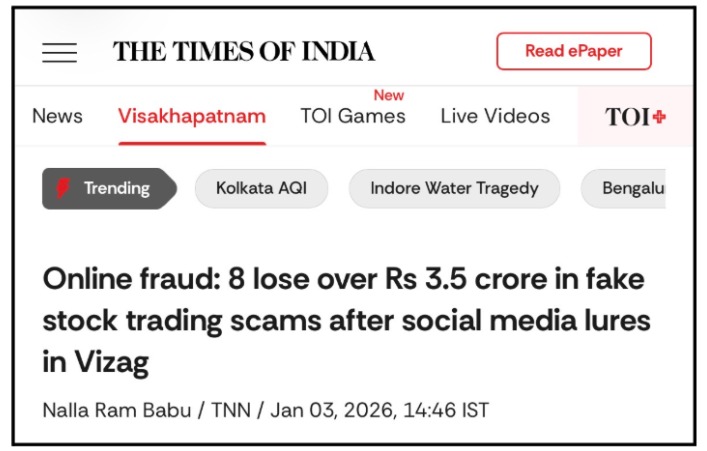
He invested ₹17.94 lakhs over weeks, and the fake app even allowed him to withdraw ₹3.60 lakhs initially.
Convinced everything was legitimate, he continued investing. When withdrawal requests started getting rejected, the scammers fabricated a ₹15 lakh “loan” on his account.
Only when he contacted the real Fyers did he realise the truth. He lost ₹14.34 lakhs.
4. Mumbai Woman’s ₹3.86 Lakh Telegram Scam Nightmare
Then there’s the January 2026 case of a woman from Mumbai who joined what seemed like an exclusive Telegram group offering stock market tips.
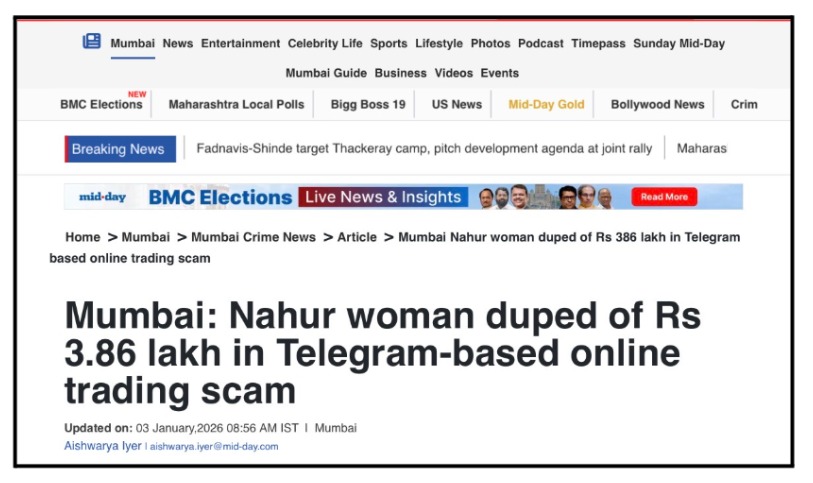
Within four days, between December 22 and 25, she transferred ₹3.86 lakhs across multiple UPI IDs. The “mentors” in the group shared fake profit screenshots to keep her excited.
One day, her withdrawal requests went unanswered, and the group went silent. She filed a police complaint only to discover that 11 different bank accounts had been involved in the scam.
How to Register Stock Market Fraud Complaint?
If you’ve become a victim, don’t panic.
Here’s a structured approach:
Step 1: Gather Evidence
Collect everything like:
- Your Client Agreement
- contract notes
- bank statements
- demat statements, emails
- call recordings
- WhatsApp messages
Document every transaction and communication. They become your shield when fighting for your own money.
Step 2: Contact Your Broker First
Send a formal complaint (email is best for documentation) to your broker’s grievance redressal system.
Mention the specific details such as:
- issue
- dates
- amounts
- evidence
Wait for 30 days for a response.
Step 3: File a Complaint in SCORES
If the broker doesn’t respond within 30 days, visit the scores portal.
Register using your PAN and email. Select “Stock Broker” as the intermediary, describe your issue clearly, attach supporting documents, and submit.
SEBI will then pursue the matter with the broker.
Step 4: Escalate if Needed
If SEBI doesn’t resolve it, you can file a complaint with NSE or BSE through their respective ODR (Online Dispute Resolution) portals.
Need Help?
If you have lost money due to stock market fraud and you feel confused about how to file a complaint in SEBI so that your money can be recovered, you can register with us.
We are a firm that specialises in recovering money lost to fraud.
Our team of dedicated personnel make sure that your complaint is heard and addressed properly.
You can also check your SEBI complaint status anytime to stay updated on its progress.
Conclusion
Stock market fraud isn’t something that happens to “other people.” It’s happening to retired couples in Mumbai, young professionals in Hyderabad, and housewives in Bangalore.
The scammers are sophisticated, well-funded, and getting better at their game every day. But here’s the empowering truth: you have recourse.
You have regulatory bodies like SEBI, NSE, and BSE that actually work when given proper documentation and evidence.
The key is to be paranoid but in a productive way. Verify everything twice.
Download the official app from the Google Play Store or App Store only, never from links sent via WhatsApp or email.
Check your demat and trading statements religiously. Never share your OTP or password with anyone, not even your “relationship manager.”
If a return sounds too good to be true, it absolutely is.
The stock market is already risky enough without fraudsters adding to the chaos. Protect yourself now, and you won’t have to fight to recover your money later.