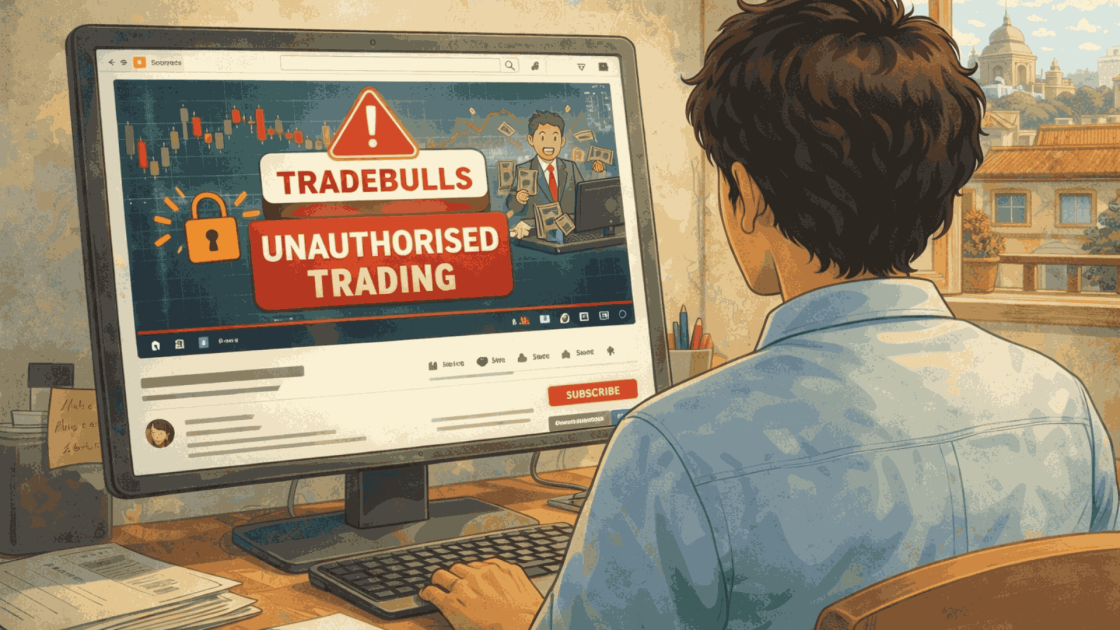
Some investors come across the term “Tradebulls unauthorised trading complaints” and immediately feel concerned, because it raises a deeper question many traders ask themselves: Can you trust a stockbroker?
It’s a serious phrase. After all, unauthorised trading suggests that trades may have been placed without a client’s approval.
But before forming any opinion, it’s important to understand two things clearly.
First, what exactly counts as unauthorised trading? Second, what do the official complaint records actually show?
Exchange complaint data can reveal patterns over time. However, a complaint by itself does not automatically establish a regulatory violation.
It simply reflects that an investor has raised a dispute under a particular category.
In this article, we’ll look at how unauthorised trading complaints are classified, examine the year-wise numbers related to Tradebulls, and understand what the broader trend indicates.
Tradebulls Unauthorised Trading Complaints
Tradebulls is a registered stock broker that provides trading services to investors. Like every broker, it falls under exchange supervision. When investors face issues, they file complaints.
The exchange then classifies those complaints into different categories.
One of those categories is Type IV, which relates to complaints about unauthorised trading.
In simple words, unauthorised trading means an investor claims that trades were placed in their account without their permission or proper approval.
Now, a complaint under this category does not automatically prove that the broker did something wrong. It simply means an investor raised a dispute under that heading.
The outcome depends on investigation, documents, and the grievance process.
Complaint Data
Here is the year-wise complaint data related to Tradebulls:
| Financial Year | Total Complaints | Type IV (Unauthorized Trades) | % of Complaints Under Type IV |
| 2020–21 | 114 | 60 | 52.63% |
| 2021–22 | 82 | 25 | 30.49% |
| 2022–23 | 44 | 8 | 18.18% |
| 2023–24 | 39 | 12 | 30.77% |
| 2024–25 | 21 | 4 | 19.05% |
| 2025–26* | 64 | 3 | 4.69% |
At first glance, the recent percentages may look small.
In 2025–26, Type IV complaints are just 4.69%. In 2024–25, they are 19.05%.
A retail trader might think, “That’s a small number. It’s not a big issue.” But here’s something important to understand.
Unauthorised trading complaints are not like technical glitches or minor service issues.
When someone raises a Type IV complaint, they are alleging that trades were executed without their approval. For a retail investor, that directly affects capital, risk exposure, and trust.
Even if the percentage looks small in a given year, each complaint represents a real dispute raised by a real investor.
Now look at the earlier data. In 2020–21, more than half of the total complaints fell under this category. That tells us that at one-point, unauthorised trading complaints formed a significant share of grievances.
Yes, the numbers decline sharply in later years. That is visible in the data. But as a retail trader, you should not ignore patterns just because the percentage drops in a particular year.
Instead, ask practical questions:
- Do you personally monitor every trade executed in your account?
- Do you check contract notes daily?
- Do you rely fully on relationship managers without written confirmation?
The key takeaway is not fear. It is awareness. The data shows improvement in recent years.
At the same time, retail investors must stay alert, review their statements regularly, and understand how trades are authorised in their accounts.
That is how you protect yourself, regardless of which broker you use.
When Can Action Be Taken Against a Broker?
In the context of unauthorised trading, regulatory action does not begin with suspicion. It begins with evidence.
If an investor alleges that a broker executed trades without consent, the key question becomes simple: Did the broker have proper authorisation?
A stock broker can face regulatory or exchange-level action in situations such as:
- Trades were placed without recorded client approval.
- The broker cannot produce call recordings, written instructions, or digital logs showing consent.
- Contract notes do not match the investor’s instructions.
- The issue remains unresolved even after the grievance process.
In such cases, exchanges and regulators examine documentation. They review communication records. They verify whether proper systems were followed.
It’s important to understand something clearly.
Not every complaint result in regulatory action. Sometimes disputes arise due to misunderstanding, delayed communication, or lack of clarity in discretionary setups.
But when evidence shows that a broker executed trades without proper consent, exchanges can impose penalties, order compensation, or escalate the matter further.
For retail investors, this highlights one simple truth: documentation matters.
Whether the broker is Tradebulls or any other brokerage, the entire case often depends on one thing – proof of authorisation.
That is why investors must understand not just the complaint numbers, but also how the system evaluates such complaints.
How to Report Against Stock Broker?
If you believe unauthorised trades were executed in your account, follow these steps:
- Raise a written complaint with the broker:
Clearly mention the disputed trades, dates, and why you believe they were unauthorised. Attach contract notes or account statements. - Ask for proof of authorisation:
Request call recordings, written instructions, or digital logs that show you approved the trades. - Escalate to the stock exchange:
If the broker does not resolve the issue, file a complaint through the exchange’s investor grievance mechanism. - File a complaint on SCORES:
If the matter remains unresolved, register your complaint on SEBI’s SCORES platform. - File an Arbitration in stock market:
If the dispute continues, apply for arbitration through the exchange mechanism for formal examination of evidence.
Act early. The sooner you raise the issue, the easier it becomes to track records and verify transactions.
Need Help?
If you believe trades were executed in your account without your consent, do not ignore it. Review your contract notes and act quickly.
We help investors understand whether a complaint falls under unauthorised trading, review available documents, and guide them through the reporting process.
If you’re unsure about the next step, register with us, and we’ll help you evaluate your situation clearly and responsibly.
Conclusion
Unauthorised trading is a serious allegation in any brokerage relationship because it directly affects investor trust and capital.
The complaint data related to Tradebulls shows a higher concentration in earlier years, followed by a noticeable decline in recent reports.
Complaint numbers alone do not establish regulatory guilt. However, they do highlight why retail investors must stay attentive.
The safest approach is simple: monitor your trades regularly, maintain written records, and act promptly if something does not look right.
By staying proactive, you can significantly reduce your unauthorised trading risk, ensuring that your account remains under your total control.
Awareness and documentation remain your strongest protection, no matter which broker you choose.