
Wealthy Brains Review
Wealthy Brains describes itself as a financial consulting and research firm.
According to its website, the company:
- Provides stock market research and recommendations
- Covers equity, futures, and options segments
- Positions itself as a SEBI-registered Research Analyst
- Claims to base recommendations on detailed market research
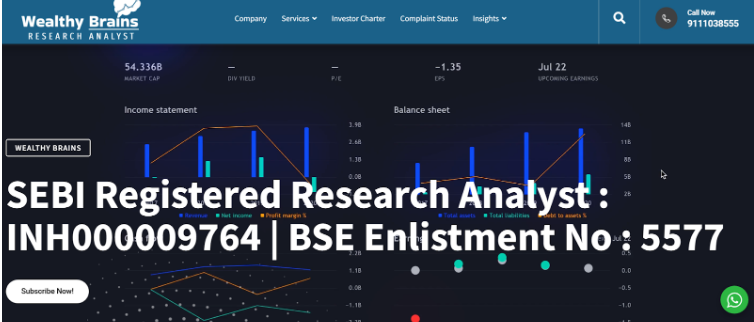
The website prominently displays:
- SEBI Research Analyst Registration No.: INH000009764
- BSE Enlistment No.: 5577
At a surface level, this creates confidence.
But SEBI registration defines what a firm can do, not just who it is.
What SEBI Allows a Research Analyst to Do?
SEBI regulates RA under the SEBI (Research Analysts) Regulations, 2014.
And of course, like any other registered entity, you can trust your RA if they follow SEBI guidelines as below:
1. Publish Research Reports
A Research Analyst can prepare and publish structured research reports on listed securities or market segments.
These reports typically include:
- Fundamental or technical analysis
- Industry or sector outlook
- Financial data interpretation
- Valuation rationale
-
Clearly stated assumptions and risks
Such reports must be factual, unbiased, and supported by reasonable analysis. They must also include proper disclosures regarding conflicts of interest, holdings, or any material connections.
2. Share Research-Based Recommendations
An RA may provide buy, sell, or hold recommendations based strictly on research.
However, these recommendations must:
- Be supported by documented analysis
- Include appropriate risk disclosures
- Avoid language suggesting certainty or guarantees
- Clearly communicate that market outcomes are uncertain
The recommendation should reflect research judgment — not sales intent.
3. Provide Analytical Views on Securities
Research Analysts can offer opinions and analytical insights on:
- Individual stocks
- Market trends
- Sectors or themes
- Macroeconomic developments
- Derivative strategies (from an analytical standpoint)
These views are intended to help investors make informed decisions. The emphasis remains on analysis and interpretation — not on executing trades or managing client funds.
4. Charge Fees Within SEBI-Defined Limits
A Research Analyst is allowed to charge fees for research and advisory services, provided they comply with SEBI’s prescribed fee guidelines.
This generally means:
- Fees must be transparent and agreed upon upfront
- Compensation cannot be linked to trading profits
- No profit-sharing arrangements are allowed
- The fee structure must avoid conflicts of interest
The objective is to ensure that the analyst’s compensation is independent of market outcomes, preserving objectivity in research.
What Is Not Permitted for a SEBI-Registered Research Analyst?
Before engaging with any SEBI-registered Research Analyst, it is important to understand the regulatory boundaries within which they must operate.
The framework set by the Securities and Exchange Board of India is designed to protect investors by ensuring transparency, ethical conduct, and clear separation between research and sales-driven practices.
Knowing what is not permitted is just as important as knowing what services can legally be offered.
1. Guaranteed Profit Promises
Under regulations issued by the Securities and Exchange Board of India (SEBI), a registered Research Analyst (RA) cannot promise guaranteed profits, fixed daily income, or assured returns.
Financial markets are inherently uncertain and involve risk. Any statement suggesting consistent or fixed returns — such as claiming a trader can earn a specific daily amount — creates a false sense of certainty. Even if profits happen occasionally, presenting them as assured outcomes is considered misleading.
SEBI treats such promises as misrepresentation, regardless of actual trading results.
2. Loss Recovery Assurances
Another prohibited practice is assuring clients that losses will be recovered.
A Research Analyst cannot:
- Predict market outcomes with certainty
- Guarantee recovery of trading losses
- Offset losses through future “sure-shot” strategies
- Imply that experience eliminates market risk
Loss-recovery claims often encourage clients to continue trading under unrealistic expectations. SEBI considers such assurances unethical because they distort the true risk involved in market participation.
3. Profit-Linked or Capital-Based Fee Models
SEBI requires Research Analysts to follow transparent and compliant fee structures.
They cannot:
- Charge fees linked to client profits
- Operate on a profit-sharing basis
- Adjust advisory fees based on capital size in a performance-linked manner
- Deduct fees directly from trading gains
When compensation is tied to profits or trading outcomes, it creates a conflict of interest. Advisers may be incentivized to encourage excessive or high-risk trading. To protect investors, SEBI restricts such arrangements.
4. Pressure Selling
SEBI expects intermediaries to allow investors to make informed and independent decisions.
Practices such as:
- Repeated unsolicited calls
- Creating artificial urgency
- Downplaying or ignoring risk disclosures
- Pressuring clients for immediate payment
may violate fair conduct principles.
Even if an entity is registered, aggressive or high-pressure solicitation can raise regulatory concerns if it compromises investor autonomy.
5. Absence of Proper Documentation and Risk Disclosure
SEBI mandates transparency in client onboarding and advisory services.
Clients must be provided with:
- A clear description of services offered
- Detailed risk disclosures
- Transparent fee terms
- Defined limitations of responsibility
Failure to provide proper written agreements and disclosures weakens investor protection and may constitute a regulatory violation.
What to Do If You Face Any Such Issues with Your Research Analyst?
If you believe a Research Analyst has acted in a manner that appears misleading, non-compliant, or inconsistent with regulatory standards, it is important to respond calmly and methodically.
Investor protection mechanisms exist, and taking informed steps can help you safeguard your interests while ensuring that concerns are addressed through the proper channels.
1. Preserve Evidence Immediately
Save:
- Call logs and recordings
- Payment receipts
- Invoices
- SMS and WhatsApp messages
- Emails
2. File a Complaint With SEBI
Use SEBI’s SCORES platform to report:
- Guaranteed return promises
- Fee coercion
- Conduct violations by a registered entity
SEBI treats such complaints seriously.
3. File for an Arbitration
In case no resolution is provided to you by SEBI, or you are unsatisfied with the judgment, then you can escalate it further and file an arbitration in the stock market.
This makes it easier for you to represent your case and to get recovery of losses.
Need Help?
Cases involving SEBI-registered firms confuse people because registration creates false confidence.
Register with us, and we provide clear, step-by-step guidance on:
- Verifying SEBI registrations correctly
- Identifying conduct violations
- Drafting effective SEBI and cybercrime complaints
- Understanding when mis-selling becomes fraud
The focus stays on evidence, process, and accountability.