

Quick Summary
Wealthy Brains is a SEBI-registered Research Analyst firm operating out of Mumbai, run by proprietor Akash Khatri, holding registration number INH000009764. It sells equity and derivatives research recommendations priced between ₹75,000 and ₹1,50,000 a year. The firm’s own disclosure states it has no SEBI penalties or pending litigation on record. This page covers what the registration actually permits, how to verify it, and links to the deeper checks on complaints, reviews, and the proprietor himself.
Somewhere between a confident sales call and a friend’s offhand “check them first,” the name Wealthy Brains landed on your radar, and now you’re doing exactly what a smart investor should do before parting with real money.
Here’s the thing most people get backwards, though.
They check whether a firm is registered, see “yes,” and stop there, as if that single word answers every question worth asking. It doesn’t, not even close.
A registration number indicates that a firm has cleared a legal bar.
It says nothing about what happens after you pay, how complaints get handled, or whether the person behind the name has anything questionable in their own record.
This page pulls all of that together in one place: the firm, the registration, the pricing, and a clear path to every deeper check you’d actually want to run before this becomes your money on the line too.
Wealthy Brains Research Analyst
Wealthy Brains is a Mumbai-based Research Analyst firm run by proprietor Akash Khatri, offering equity and derivatives research recommendations to retail traders and investors across India.
The firm positions itself around structured, research-backed trading calls rather than personalised trade execution, covering equity, stock futures, stock options, and index options.
A closer review of how the firm presents itself, its claims, and its public disclosures sets up everything else worth checking, starting with the one thing that should always come first: whether it’s actually allowed to operate this way at all.
Is Wealthy Brains SEBI Registered?
This is usually the very first thing anyone should verify before trusting any research recommendation, and the answer here is genuinely straightforward to check.
Yes, Wealthy Brains holds an active SEBI Research Analyst registration, number INH000009764, along with BSE Enlistment No. 5577.
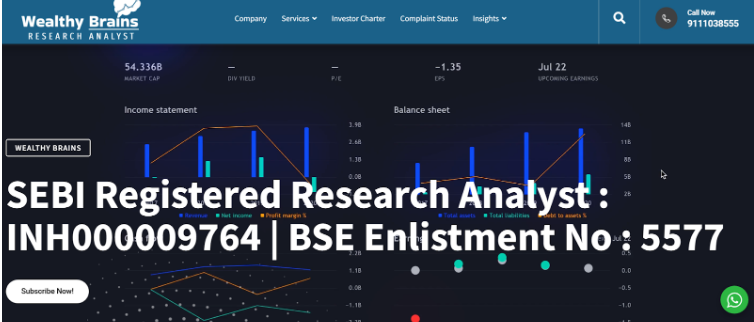
The firm operates under proprietor Akash Khatri and is based in Mumbai.
You can independently verify this registration yourself directly on SEBI’s official intermediary database, which is always the safest way to confirm a firm’s status rather than relying on what its own website tells you.
Here’s something worth knowing that most prospective subscribers never check.
In its own official disclosure, Wealthy Brains states plainly that no penalties or directions have been issued against it by SEBI, and that there are no pending significant litigations, legal proceedings, or regulatory investigations on record.
That’s the firm’s own self-reported regulatory standing, and it’s worth taking at face value as far as formal SEBI action goes, since formal penalties are a different, more serious category than the complaint data covered later on this page.
Registration and a clean formal enforcement record are both genuine, verifiable facts.
But neither one tells you how the firm actually treats its paying subscribers day to day, which is a separate question entirely, covered in full depth elsewhere in this series.
Wealthy Brains Company Services
Once you know the registration checks out, the practical question becomes what you’re actually being asked to pay for, and what you can independently confirm versus what you’re simply being told.
The firm’s website lists several subscription tiers across equity, futures, and options, each described in terms of daily or monthly call volume and risk level.
None of that is independently verifiable from the outside; it’s the firm’s own description of its own product, the same way any advisory describes its own service in the best possible light.
Treat every plan description, every recommendation count, and every risk label as a marketing claim until you’ve seen it hold up in practice, not as a fact simply because it’s written on an official-looking page.
Before any money moves, you should also make sure to verify the firm’s official payment channels to protect yourself against potential copycat schemes or fake UPI handles, a step detailed further down this page.
Also Read: Eqwires Research Analyst, a separate firm with its own registration record and Telegram presence.
Wealthy Brains Founder
Since the firm operates as a sole proprietorship, every decision, recommendation, and response to a complaint ultimately traces back to one person rather than a board or management team, which makes his individual accountability worth understanding on its own.
Akash Khatri is that person, the founder and proprietor behind Wealthy Brains.
That structure isn’t unusual for firms of this size, but it does concentrate responsibility in one place.
Whatever happens with a client’s account, a disputed recommendation, or an unresolved complaint has nowhere else to be redirected to: no separate compliance department, no other partner to escalate to internally.
What’s worth knowing about him specifically, his background, and how the complaint data connects directly to his individual accountability, is covered in full on our page: Akash Khatri.
Is Wealthy Brains a Good Company in India?
Answering this properly means separating two things that get blurred together constantly: whether the firm is legitimate, and whether it treats the people who pay it well.
On legitimacy, Wealthy Brains checks out on paper. It holds active SEBI Research Analyst registration and operates as a sole proprietorship based out of Mumbai.
The firm sells research and trading recommendations across equity and derivatives, priced between ₹75,000 and ₹1,50,000 a year excluding GST, and it asks subscribers to maintain a minimum trading capital of ₹1,50,000 for its stock futures services, or ₹50,000 if you’re going for options instead.
That capital requirement is worth sitting with for a moment, because it means the firm expects you to risk a fairly serious amount of your own money on top of its already premium subscription fee, a combination that raises the stakes of every decision that follows.
Being a real, registered company in India is where the easy part ends. Whether Wealthy Brains is actually good to its subscribers, delivers what it promises, handles complaints honestly, and communicates transparently needs a different kind of evidence entirely, and that evidence tells a more complicated story than the registration number alone suggests.
Also Read: Four Grievance Titles, One Person Behind Every Single One, In RK Research Solutions.
Should You Trust Wealthy Brains?
Trust isn’t something a company can simply state about itself; it has to be earned across real interactions with real subscribers.
Wealthy Brains’ own disclosed record gives you exactly that kind of evidence, not marketing language, but numbers the firm was required to publish, and reading them carefully reveals separate things worth weighing before you decide anything.
1. A Genuine Data Inconsistency That’s Hard to Explain Away
For the same period between 2025 and 2026, two of the firm’s own disclosures tell two different stories, and they can’t both be right.
| Disclosure Type | Period | Complaints Shown |
|---|---|---|
| Monthly disclosure | 2025-2026 | 31 |
| Yearly disclosure | 2025-2026 | 17 |
Read that table plainly; both rows describe the same period, filed by the same firm, and they land 14 complaints apart.
That’s not a rounding difference or a formatting quirk; it’s a genuine contradiction in mandatory regulatory disclosure, and it deserves a direct answer from the firm, not a shrug from you as the investor.
2. A Complaint Trend That Keeps Climbing, Not Settling
Every registered firm gets some complaints; that alone proves nothing.
What matters is looking at the actual year-by-year numbers, and the firm’s own yearly disclosure shows exactly that.
| Year | Received | Resolved | Pending |
|---|---|---|---|
| 2022-2023 | 06 | 06 | 00 |
| 2023-2024 | 05 | 05 | 00 |
| 2024-2025 | 18 | 18 | 00 |
| 2025-2026 | 17 | 16 | 01 |
Look closely at how these numbers move.
Complaints didn’t rise gradually year after year; they jumped sharply between 2023-2024 and 2024-2025, from 5 to 18, more than tripling in a single year, and then stayed elevated the year after.
That’s not a slow climb; it’s a sudden spike that never really settled back down.
There’s also a second detail worth noticing, separate from the yearly figures, and it only shows up when you break the most recent year down month by month instead.
| Month | Carried Forward | Received | Resolved | Pending |
|---|---|---|---|---|
| April 2025 | 00 | 00 | 00 | 00 |
| May 2025 | 00 | 00 | 00 | 00 |
| June 2025 | 00 | 04 | 04 | 00 |
| July 2025 | 00 | 00 | 00 | 00 |
| August 2025 | 00 | 06 | 06 | 00 |
| September 2025 | 00 | 00 | 00 | 00 |
| October 2025 | 00 | 00 | 00 | 00 |
| November 2025 | 00 | 00 | 00 | 00 |
| December 2025 | 00 | 03 | 01 | 02 |
| January 2026 | 02 | 04 | 02 | 04 |
| February 2026 | 04 | 00 | 03 | 02 |
| March 2026 | 02 | 01 | 01 | 02 |
Read this table month by month, and a clear pattern shows up.
From April through November, every complaint that came in was resolved the same month; nothing carried forward at all. Starting in December, that changes: two complaints carry into January, four carry into February, and two are still pending as of March 2026.
The first eight months show a clean resolution record. The last four months show complaints starting to pile up.
That’s a recent, specific shift, not a vague long-term trend, and it’s worth asking why resolution slowed down right in this exact window.
Neither of these two things alone proves wrongdoing.
Plenty of companies show a complaint spike simply because they gained more clients that year, and a data mismatch could genuinely be a reporting error rather than something deliberate.
But when a data inconsistency, a sharp sustained spike, and a recent backlog all show up together in the same firm’s own disclosure, it’s fair to want a direct answer from the firm before deciding anything, and that’s exactly what real subscriber reviews help you cross-check next.
Wealthy Brains Reviews
Numbers from a regulatory disclosure only tell you what a firm was legally required to report.
What actual subscribers say publicly, on platforms nobody is forcing them to write on, is a different and often more honest kind of evidence, and it’s worth reading carefully because it can show you exactly what kind of experience someone else walked into before you decide anything.
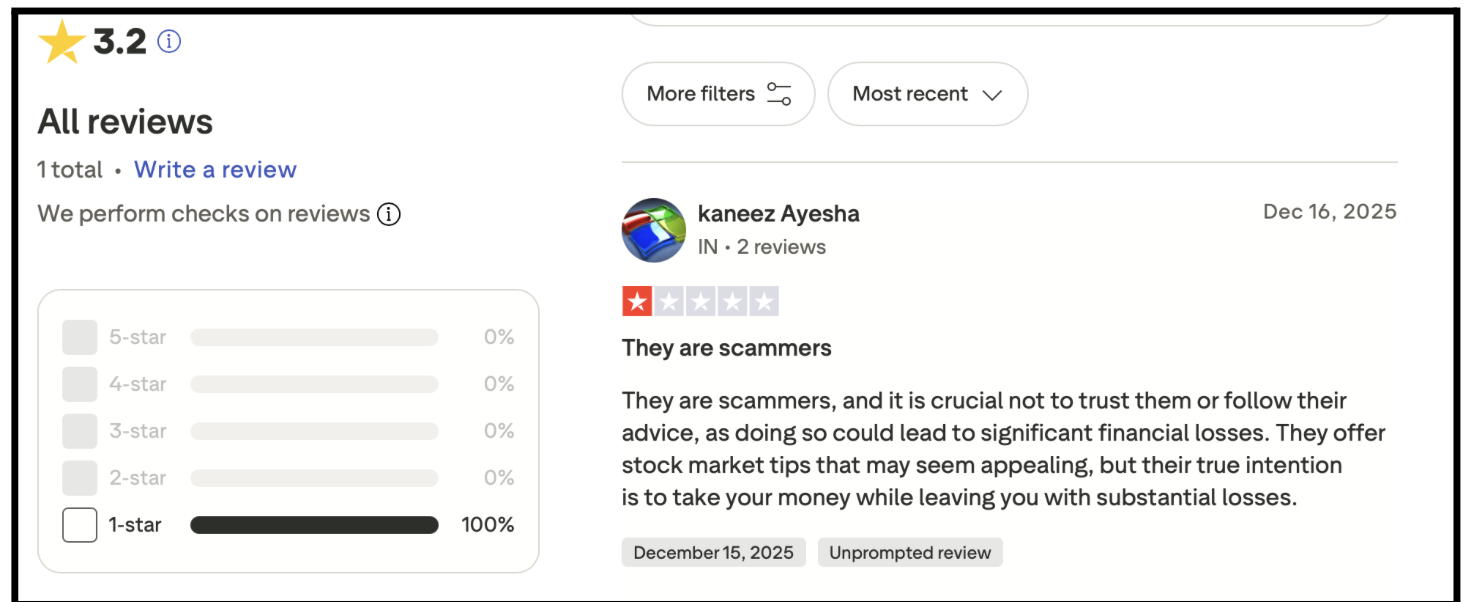
Here is one such review, found on Trustpilot.
The Review: “They Are Scammers”
The review comes from Kaneez Ayesha, posted on 15 December 2025, carrying a full one-star rating.
The title alone doesn’t leave room for ambiguity; it reads plainly: “They are scammers.”
1. What the Reviewer Actually Says?
The body of the review goes further than the title. In the reviewer’s own words: “They are scammers, and it is crucial not to trust them or follow their advice, as doing so could lead to significant financial losses.”
She describes the pattern behind it directly: “They offer stock market tips that may seem appealing, but their true intention is to take your money while leaving you with substantial losses.”
2. Why This Review Lines Up With the Complaint Data Above
Read this review next to the complaint disclosure numbers covered earlier on this page, and something stands out.
The complaint data already showed a mismatch between the monthly and yearly figures, along with a rising trend over time.
This review describes the same underlying concern in plain language: tips that look appealing on the surface, followed by losses that hit hard.
A regulatory number and a personal account, arriving from two completely separate sources, pointing at the same underlying issue, is exactly the kind of alignment that should make any prospective subscriber cautious.
3. One Thing Worth Remembering Before You Judge This Too Quickly Either Way
Not everyone who has a bad experience with a firm like this actually goes and posts a public review about it.
Filing a complaint, or writing a review, takes time and effort, and plenty of people simply walk away quietly instead, which means the real number of unhappy subscribers could be higher than what’s visible here.
At the same time, this also means you shouldn’t treat one strongly worded review as the complete picture on its own; it’s one documented voice, serious and specific, sitting alongside the complaint data you’ve already seen, and both deserve to be weighed together rather than either one being dismissed or treated as the entire story.
How to Verify Wealthy Brains Payment Details Using SEBI Validated UPI ID?
Here’s a quick verification step almost no one thinks to run.
If you want to check SEBI registered company details, this simple check protects you from a completely different kind of risk than the complaint data above.
Every SEBI-registered Research Analyst is issued a SEBI Validated UPI ID, a specific payment address tied directly to their registration, designed precisely so subscribers can confirm their money is going to the actual registered entity rather than an impersonator running a copycat scheme under the same or a similar name.
Before paying Wealthy Brains, or any advisory claiming SEBI registration, ask directly for their SEBI Validated UPI ID and cross-check it against what’s listed on their own official disclosures.
If the payment request comes through a personal UPI handle, a different business name, or anything that doesn’t match the registered validated ID, that mismatch alone is reason enough to stop before your money moves anywhere.
This step matters separately from everything else on this page, because even a firm with a clean complaint record can be impersonated by someone else entirely, and this is the one check that protects you from that specific scenario.
Already paid, now doubting it?
Tell us exactly what you were told, the plan, the projected returns, anything that felt off. We’ll walk through it with you and flag what’s verifiable versus what’s just talk.
Already Facing an Issue? Here’s How to Fix It
Reading about registration and user reviews is one thing. Actually having a problem with Wealthy Brains right now is a different situation entirely, and it calls for action rather than more research.
A defined complaint process exists for exactly this, starting with the firm directly, then moving through official channels if needed.
If you need to report SEBI fraud or file a grievance, the first formal step outside the firm itself is to file complaint in SCORES, SEBI’s official grievance platform.
If that doesn’t resolve things and money is specifically involved, SMART ODR login offers a faster route built for exactly that kind of dispute.
And when nothing earlier has worked, share market arbitration is the final stage that ends in a binding decision.
Exactly what each of these steps involves, what evidence to prepare, and what each one can actually order in your favour, is walked through in full in our guide on how to complaint against Wealthy Brains.
Conclusion
Wealthy Brains is a real, SEBI-registered Research Analyst firm, run by Akash Khatri, offering premium-priced research across equity and derivatives.
That much checks out on paper, and the firm’s own disclosure shows no formal SEBI penalties against it.
But registration and a clean enforcement record are only part of the story; the complaint data, the reviews, and the proprietor’s own individual accountability all deserve their own honest look before you decide anything.
Use this page as your starting point, then follow the links above to the specific evidence that matters most to your decision.
Report. Recover. Stay Fraud Free.
Frequently Asked Questions
Wealthy Brains is a SEBI-registered Research Analyst firm run by proprietor Akash Khatri, offering equity and derivatives research recommendations to retail traders and investors across India.
Yes, it holds registration number INH000009764 along with BSE Enlistment No. 5577, verifiable directly on SEBI's official intermediary database.
Subscription pricing ranges from ₹75,000 to ₹1,50,000 a year excluding GST, and subscribers are also expected to maintain separate trading capital of ₹50,000 to ₹1,50,000 depending on the service chosen.
According to the firm's own official disclosure, no SEBI penalties, directions, or pending litigations exist against it as of its most recent filing.
Registration confirms the firm is legally authorised to operate, but it doesn't guarantee good conduct. Complaint data and subscriber reviews, covered separately, give a fuller picture of actual trustworthiness.
Table of Contents
Toggle




 Add us as a preferred source on Google »

