

Quick Summary
SEBI inspected stockbroker Abhipra Capital Limited for the period October 2021 to May 2022 and found a series of violations, the most serious being the use of clients’ funds for purposes other than what clients intended. In March 2025, SEBI imposed a total penalty of Rs. 8,00,000. Abhipra challenged this before the Securities Appellate Tribunal (SAT), and in December 2025 the Tribunal reduced the total penalty to Rs. 5,00,000, but it upheld every core finding, including the one on client fund segregation. This blog breaks down what SEBI actually found, what changed on appeal, and the practical lessons every retail trader should take away.
You trust your broker from the very first step. You hand over your money, you place your trades, and you assume that money is sitting safely, ready for you whenever you want it back. But what happens when that trust is quietly broken behind the scenes?
It makes you stop and wonder: can a stock broker steal your money?
That question sits right at the heart of the Abhipra Capital case.
This is not a dramatic overnight heist. It is something more subtle and, in a way, more concerning for regular traders. It is a story about a broker whose books did not add up the way they should have, and about a regulator that noticed.
Let me walk you through what happened, in plain language.
Why SEBI Investigated Abhipra Capital
SEBI, along with the stock exchanges NSE and BSE, carried out a joint inspection of Abhipra Capital.
The inspection covered the period from October 2021 to May 2022. This was not a random check. Enhanced supervision rules require brokers to report certain data every week, and the numbers from Abhipra had started raising flags.
When the inspection team dug in, they found more than one problem. Some were technical and paperwork related.
Others went to the core of how a broker is supposed to protect your money. SEBI issued a Show Cause Notice, heard Abhipra’s replies, gave them a personal hearing, and then passed a detailed adjudication order on March 28, 2025.
Here is what they found.
Abhipra Capital and the Misuse of Client Funds
This is the part that matters most to you as a trader.
There is a simple principle in broking. The total money a broker holds for its clients, sitting in bank accounts and with the clearing corporation, should always be equal to or more than what it owes those clients on paper.
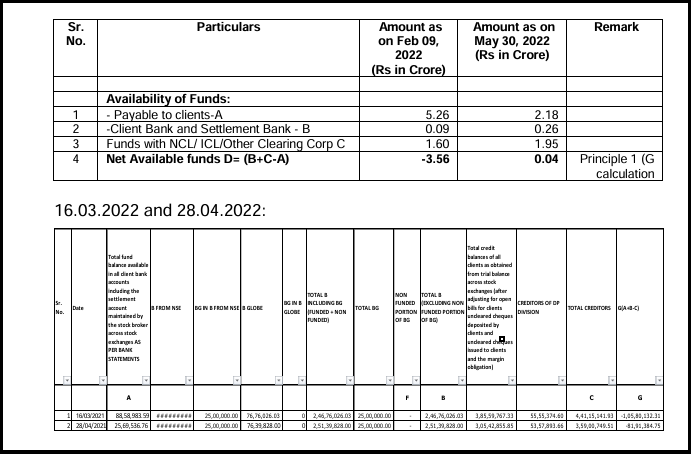
SEBI calls the gap between these two numbers “G.” If G goes negative, it means the broker is holding less than what it owes clients. In plain words, some client money has gone somewhere it should not have.
In Abhipra’s case, this value was negative on all seven sample dates the inspectors checked. On one date the shortfall touched around Rs. 4.68 crore.
SEBI’s order describes this as the funds of credit balance clients being used either to cover the settlement obligations of other clients who owed money, or for the broker’s own purposes.
Now, here is the honest part, and it matters. SEBI did not claim it caught anyone pocketing money for a luxury lifestyle.
The order actually notes that the material on record does not quantify any specific gain the broker made, nor any specific loss to a named investor.
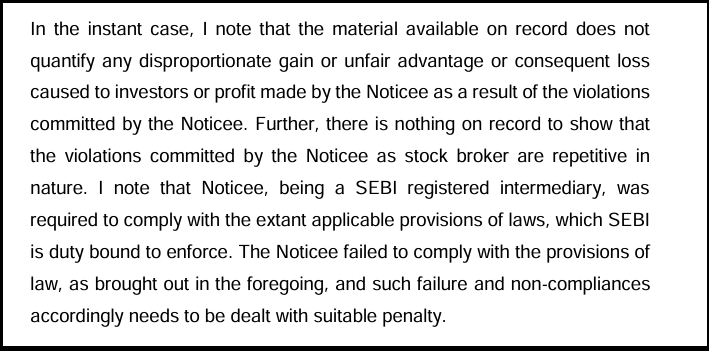
What the regulator established is that the safeguard failed. The money was not sitting where the rules require it to sit.
That failure alone is a violation, regardless of intent, and that is exactly what the law is designed to catch before it becomes something worse.
Abhipra’s defence was that these were inter-account transfers between the same clients’ trading and demat accounts, that no client complained, that the shortfall was due in part to COVID disruptions and the loss of a key person, and that the funds were later recouped.
SEBI heard all of this and held that the violation still stood, because the broker could not adequately demonstrate that the value of G was not negative on those dates.
Other Violations in the Abhipra Capital SEBI Order
The client fund issue was the headline, but it was not the only finding. The order lists several others.
- Non-segregation of funds
Brokers must keep client money and their own money strictly separate.
The inspection found 212 instances where money moved between the client or settlement bank account and the broker’s own account, without a proper daily reconciliation statement to show these transfers were for legitimate reasons. - Bank accounts not reported.
Abhipra had 29 active bank accounts in its books but had reported only 22 to the exchanges. Seven were left out.
Abhipra argued those seven were not related to the securities business, but SEBI held that all accounts in the broker’s name had to be reported regardless. - Settlement of client funds.
SEBI found that funds of inactive clients had not been actually settled as required, and that some retention statements sent to clients contained journal entries that reduced the visible credit balance.
There were also gaps in maintaining logs and in digitally signing weekly statements. - Stock reconciliation.
There was a mismatch between the securities showing in the broker’s back office and what was actually in the depository, a shortfall of 18 scrips worth around Rs. 13.69 lakh and a small excess of 3 scrips. - Net worth in the negative.
This is a big one. Abhipra’s net worth was negative on the dates checked, at around minus Rs. 6.32 crore and minus Rs. 4.09 crore, once doubtful debts and advances were properly deducted.
A chunk of this related to long term loans and advances given out that SEBI said should have been deducted from net worth under the prescribed calculation method.
Abhipra disputed the interpretation and said it had since brought money back, but SEBI held that later recovery does not undo the position during the inspection period. - Margin reporting and cyber security gaps.
There was incorrect margin reporting in two instances totalling Rs. 2,038, and a list of cyber security and cyber resilience documentation requirements that were not met, such as a missing risk register, an unreviewed policy, and an unfiled quarterly report.
The Abhipra Capital Penalty: SEBI’s March 2025 Order
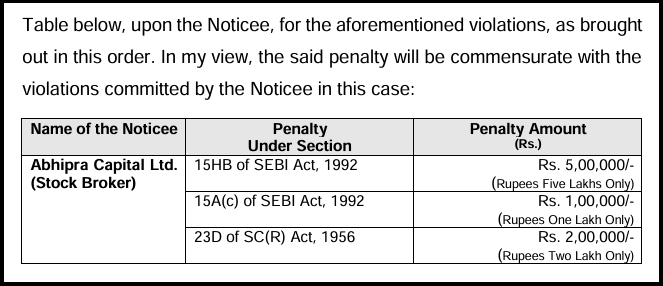
Weighing all of this, SEBI imposed a total penalty of Rs. 8,00,000, split across three legal provisions:
Rs. 5,00,000 under Section 15HB of the SEBI Act, Rs. 1,00,000 under Section 15A(c) of the SEBI Act, and Rs. 2,00,000 under Section 23D of the Securities Contracts (Regulation) Act, which specifically deals with failing to segregate client money.
It is worth noting what SEBI did not do. There was no ban on onboarding clients in this order, and no direction quantifying loans to be recovered. The penalty was monetary and tied to the established violations.
Abhipra Capital SAT Order: What the Tribunal Changed
Abhipra did not accept the order and appealed to the Securities Appellate Tribunal. This is the crucial update, and it is why anyone reading the old version of this story needs the full picture.
On December 3, 2025, SAT heard the appeal.
The broker’s lawyer did not really argue that the violations never happened. Instead, the argument was about proportionality, that the penalty was too high for what were largely compliance and documentation lapses.
The Tribunal partly agreed. It reduced the penalty under Section 15HB from Rs. 5,00,000 to Rs. 2,00,000, saying the ends of justice would be met with the lower figure.
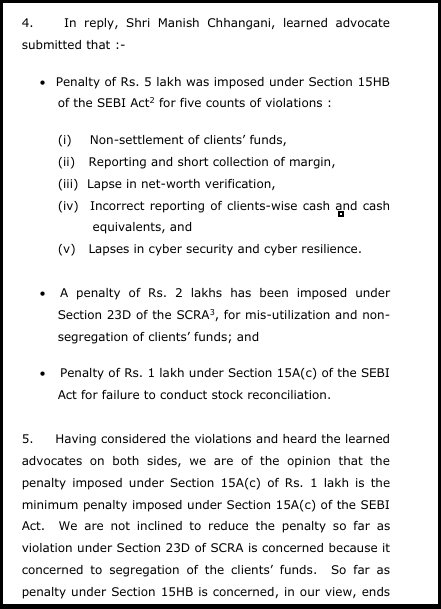
But, and this is the important part, it refused to touch the Rs. 2,00,000 penalty under Section 23D, stating plainly that it was not inclined to reduce it because it concerned the segregation of clients’ funds.
The Rs. 1,00,000 under Section 15A(c) was already the minimum, so that stayed too.
The final total came down to Rs. 5,00,000.
So the correct, current position is this. The penalty is Rs. 5,00,000, not Rs. 8,00,000.
But every core finding survived the appeal, and the Tribunal went out of its way to protect the client fund segregation penalty. If anything, the appeal reinforced that the most serious issue was taken seriously at both levels.
What the Abhipra Capital Case Means for Retail Traders
You might be thinking, this is a small penalty and no client lost money, so why should I care? Here is why.
The rules that Abhipra breached are not bureaucratic box ticking. They exist precisely so that a broker’s financial troubles never become your financial troubles.
When client money is properly segregated and fully available, it does not matter if the broker runs into difficulty, because your money is ring-fenced.
When that wall gets thin, as it did here, your safety depends entirely on the broker recovering in time. That is a bet you never agreed to make.
A negative net worth makes this worse. A broker that owes more than it owns has less cushion to absorb shocks.
Combine that with client money not being fully available, and you have a situation where a single bad stretch could put client withdrawals at risk.
Nobody wants to discover that their money is stuck at the exact moment they need it.
This is also about trust in the wider market. Every time a broker cuts corners, it chips away at the confidence that keeps retail traders participating.
The system works because you believe your money is safe. Cases like this are a reminder to verify that belief rather than assume it.
Lessons from the Abhipra Capital Case
Regulatory penalties and tribunal orders give us a clear picture of what happens behind the scenes, but for an everyday investor, the real value lies in the takeaways.
You don’t have to wait for a SEBI inspection to find out if your funds are fully secure.
By understanding how these systemic gaps occur, you can protect your capital proactively and spot potential red flags before they turn into major problems.
- Check your broker before you commit. Look at their regulatory history, their financial disclosures, and their complaint record. NSE publishes active client numbers and complaint data, and SEBI’s SCORES platform lets you see the nature of complaints filed.
- Reconcile your own account regularly. Do not just glance at the app balance. Pull your statement of accounts and confirm that your funds and securities are actually credited correctly. If the running account statement looks off or contains entries you do not understand, ask questions immediately.
- Do not keep everything in one place. Spreading your funds and holdings across more than one broker reduces the damage if any single broker runs into a problem.
- Watch for the quiet red flags. Delays in payouts, vague answers about your balance, or statements that do not match your own records are worth taking seriously early, not after they become a pattern.
- Report the moment something feels wrong. If you suspect your broker is mishandling your money, do not wait. Raising it early through SCORES protects you and often protects other clients too. If you are unsure about the process, here is a guide on where to complaint against a stock broker so you know exactly what to do.
Suspect Your Broker is Doing the Same? Don’t Wait.
The gaps found in the Abhipra Capital case aren’t always isolated incidents.
If you have noticed unexplained entries in your ledger, sudden delays in processing your payouts, mismatching balances, or if you suspect your stockbroker is mishandling your hard-earned funds, your capital could be at risk.
You don’t have to navigate the complex regulatory maze alone. We help retail investors flag irregularities and escalate their cases to the right authorities effectively.
Register Your Case with Us Now and let our team review your grievance before a minor issue turns into a major loss.
Conclusion
The Abhipra Capital case is not a sensational fraud with dramatic headlines. It is quieter than that, and in some ways that is the lesson.
The risks that reach retail traders are often not the obvious scams but the slow erosion of safeguards happening in the background, in the parts of the business you never see.
SEBI caught it, penalised it, and the Tribunal upheld the substance of it while trimming the amount. The regulatory system did its job.
But your own vigilance is still your best protection. Know your broker, check your statements, and speak up early. That habit is worth far more than any penalty a regulator can impose after the fact.
Frequently Asked Questions
SEBI found multiple violations during its October 2021 to May 2022 inspection. The most serious was that clients' funds were not fully available where they should have been, indicating they were used for other purposes. Other findings included non-segregation of client and own funds, unreported bank accounts, settlement lapses, stock reconciliation mismatches, a negative net worth, incorrect margin reporting, and cyber security documentation gaps.
Based on the order, SEBI did not quantify any specific loss to an investor or any specific gain made by the broker. The violations were about the safeguards failing, not about a proven theft. That said, the whole point of these rules is to prevent client money from ever being put at risk in the first place.
SEBI originally imposed a total penalty of Rs. 8,00,000 in March 2025. On appeal, the Securities Appellate Tribunal reduced it to Rs. 5,00,000 in December 2025. The penalty relating specifically to client fund segregation was not reduced.
The March 2025 SEBI adjudication order did not impose a ban on onboarding new clients. It imposed monetary penalties. A separate restriction on opening new accounts had been mentioned during an earlier NSE limited inspection, which the broker said was later lifted after it recouped the shortfall.
No. The Tribunal reduced the amount on grounds of proportionality, but it upheld all the core findings and specifically declined to reduce the penalty tied to client fund segregation. The violations were confirmed, not reversed.
Regularly pull your statement of accounts and confirm your funds and securities are correctly credited. Check the broker's complaint record on NSE and the nature of complaints on SEBI's SCORES platform. If something looks wrong, raise it immediately rather than waiting.



 Add us as a preferred source on Google »

