
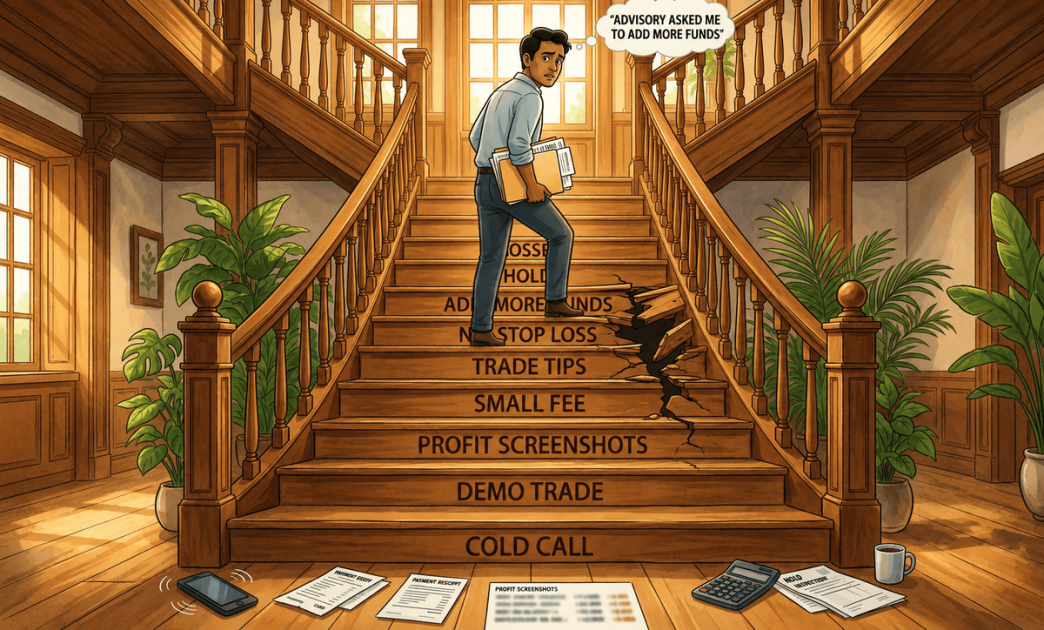
The advisory asked me to add more funds. That sentence appears in nine of the ten case files we hold, in almost the same words, from clients who never met each other.
Some paid 2,500 to start. One paid 5,00,000 in total. They were all sold the same way, in the same order, using the same twelve moves.
That is not a coincidence, and it is not a coincidence you should feel bad about missing. The sequence works because each step is small and each step follows logically from the last.
Here is what it looks like laid out, and where the rules are actually broken.
Advisory Asked Me to Add More Funds: Where That Sits in the Sequence
The request for more money never comes first. It comes at step nine, after eight steps of groundwork.
Step 1: The cold call
Often to someone who has already said they have no money. In one file, the client said plainly that he did not have funds to invest. He was persuaded to put in 30,000 to 35,000 anyway.
Step 2: The demo trade
Usually free and profitable. This is the step that does the selling, because it converts a stranger’s claim into your own experience. In one case, the demo made money on the first day. In another, the client’s account showed a 59,000 profit the day after he paid 2,500.
Step 3: Other clients’ profit screenshots
Showing you profitable trades of other clients and saying things like:
- In one file, this ran for twenty-five consecutive days before the client agreed to trade.
- Look how much profit is being made.
- I will make you profit just like this.
- Why are you not doing this?
Step 4: The small starting fee
2,500. 5,000. 5,999. 10,500. Almost always reduced from a bigger number. One client was quoted 40,000 and offered 10,500 when he hesitated. Another was quoted 1,50,000 and allowed to pay in parts starting at 25,400.
The discount is the hook. It converts a sale into a favour.
Step 5: Personalised trade instructions
Exact stock, exact quantity and exact lot size. One client was told an eight-lot buy. Another was told to take a trade around 12:30 PM on a specific day.
Step 6: No stop loss
Refused when requested. In one file, the client explicitly asked for stop-loss levels, target levels, and risk explanations before placing a trade. He was told to keep it open.
Step 7: The losses start
Sooner or later, the trades move against the investor. What began with profitable demonstrations now turns into significant losses. At this stage, many clients are still reassured that the situation is temporary and that recovery is just around the corner.
Step 8: Hold
Never exit. One client asked to exit and was told to hold. Another was told to hold while a single trade lost roughly 1,25,000.
Step 9: Add funds to recover
Here is where you are. Recover karwa dungi main. Fund add to kariye. Itni tension kyu le rahe ho, ho jayega. In one case, within thirty minutes of the client’s capital being wiped out, a senior representative called and said the trade could be saved if the client deposited 62,000, which would return 2,00,000 in profit.
When the client refused, the ask went up to 1,00,000.
Step 10: A bigger package
A larger fee to fix the problem the last fee caused. One client went from 15,000 to a yearly package of about 82,500.
Step 11: The credit card
It appears in two files. One client was encouraged to pay the 82,500 on a credit card despite saying he had no funds. In another instance, a representative offered to put 30,000 to 32,000 on his own card if the client arranged the rest.
Step 12: Silence
In one file, the client messaged and called for three days while his position collapsed. No response. In another, the representative’s phone number was unreachable within months.
Demo Trade Scam: Why Step Two Does All the Work
The demo trade is the most important step in the sequence, and it costs the firm nothing.
Before the demo, you are being told that a stranger can make you money. After the demo, you have seen it happen in your own account. Those are completely different states of mind, and the gap between them is where the fee gets paid.
It appears in almost every file. The client is called. The client is doubtful. A free trade or a low-cost paid trade is offered. The trade makes a profit. The client subscribes.
One profitable trade proves nothing. Any direction on any day has roughly even odds. A firm making calls to hundreds of people will produce winning first trades for a large share of them by arithmetic alone, and the ones who lose do not subscribe.
You never see the losers. You only ever meet the survivors, and so does everyone else who signs up.
The same logic governs step three. The profit screenshots are real, most likely. They are also selected. Nobody sends you the losing accounts.
Recognising this sequence from your own experience?
We map what happened to you against what the rules actually permit, identify which steps crossed a line, and build the complaint from there.
Register with us for a free consultation.
Advisor Told Me to Hold No Stop Loss: Where the Rules Break
Most of the twelve steps are aggressive selling. Some of them are breaches. Knowing which is which is what turns a bad experience into a claim.
Four steps in the sequence sit outside what a registered firm is permitted to do.
Personalised trade instructions from a research analyst. A research analyst registration permits publishing research. It does not permit telling a specific client to buy a specific quantity at a specific time and then tracking their position. That is account management, and it sits outside the registration.
Refusing a stop loss when asked. Risk disclosure before a recommendation is required, not optional. A refusal, in writing, is one of the cleanest pieces of evidence a file can have.
Assuring recovery. No registered firm may promise you that your losses will come back. Step nine is the step that most reliably produces a documented breach, because the assurance is almost always in a chat or on a call.
Profit screenshots without disclaimers. Past performance shown without prescribed risk disclosures is a documented breach. Twenty-five days of it, timestamped, is twenty-five instances.
This is why step nine matters twice over. It is the moment the money leaves, and it is the moment the strongest evidence is created.
Variants Worth Knowing: When the Fee Itself Breaks the Rules
Three files contain a variation on the fee itself, not just the selling.
One case involved a fee that increased with the client’s account balance rather than with anything about the service. Another involved an invoice describing a subscription while the call recording described a profit share. Yet another involved fees that exceeded a published regulatory limit.
In each of those cases, the fee itself became the issue, without needing to prove anything about the advice. That is a different kind of claim from the twelve steps above, and the advisor charged more than the SEBI limit; the breakdown works through all three structures with the figures.
Identity Confusion: When the Firm You Paid Is Not the Firm You Called
One file contains a variant worth its own warning.
The representative introduced himself as being from one firm and shared that firm’s link. When the client made his first payment of 5,000, the money went to a different company’s bank account.
He asked about it immediately. He was told the second company was just a platform they used to collect payments, like Google Pay or Paytm.
That was not true. The second company was itself the SEBI-registered research analyst providing the service.
The client paid 15,000 in total across two transfers before the position was clarified. Check where your money actually went. The name on your bank statement is the firm you are dealing with, whatever you were told on the call.
What Ten Cases Recovered After the Same Twelve Steps
Every client in these files went through the sequence. The outcomes ranged widely.
| Total claimed | Recovered | Share |
|---|---|---|
| 64,500 | 50,000 | 77.5% |
| 65,000 | 50,000 | 76.9% |
| 7,00,000 | 5,00,000 | 71.4% |
| 4,22,000 | 3,00,000 | 71.1% |
| 3,00,000 | 2,00,000 | 66.7% |
| 4,73,000 | 2,60,000 | 55.0% |
| 3,50,000 | 2,00,000 | 57.1% |
| 8,87,500 | 3,35,000 | 37.7% |
| 2,76,999 | 80,000 | 28.9% |
| 6,60,500 | 90,000 | 13.6% |
Same script, outcomes from 13.6% to 77.5%.
The sequence tells you what happened to you. It does not tell you what you will recover. That is governed by a different factor entirely, which is how much of your claim was fees against how much was trading loss.
The refund from stock advisory breakdown works through that split, case by case.
What to Do If You Recognise the Sequence
Here’s what you need to do if you also recognise the sequence.
- Stop adding money: If you are at step nine or ten, the request for more capital is not a rescue plan. In every file where the client added funds after a loss, the funds went the same way as the rest.
- Export everything today: The chat history with the hold instruction. The refusal to give a stop loss. The profit screenshots they sent you. The assurance of recovery. In most of these files, clients and advisers used WhatsApp for every conversation. Your phone now holds the evidence, but you can lose it the moment you clear a chat or the other number stops working.
- Save your payment records: Bank statements, UPI records, credit card statements. Several clients in these files were never issued an invoice at all, which is a compliance failure in itself. Your bank record still proves the payment.
- Write down the sequence as it happened to you, with dates: Not the feelings. The steps. When the demo was, when the fee was paid, when the stop loss was refused, when they asked for more.
Then the route depends on the entity. A SEBI SCORES complaint opens the registered route, and SMART ODR is where an unresolved grievance goes next.
Conclusion
Nine of ten files, the same twelve steps, in the same order.
This is not ten people making the same mistake. It is one method repeated ten times.
The demo trade persuades you. The small fee makes the offer feel like a favour. The adviser tells you not to place a stop loss, removing your exit. They instruct you to hold the position, keeping you trapped. Asking for more funds is not the crisis. They built it into the process.
SEBI rules prohibit registered firms from taking four of the twelve steps, and those actions usually leave a written record. That record is already on your phone.
Recognising the sequence is not the end. It is the beginning of building your case.
Report. Recover. Stay Fraud Free.
Frequently Asked Questions
One profitable trade proves nothing. Any call on any day has roughly even odds. A firm calling hundreds of people produces winning first trades for a large share of them by arithmetic, and the people who lose never subscribe, so you never hear about them.
Not necessarily. The assurance usually arrives on a call or in a chat rather than a contract, which is precisely why saved recordings and message histories matter so much. In several of these files the strongest evidence was a voice note.
No. Being persuaded to add capital after a loss, on an assurance of recovery, is one of the things that should not have been said to you. It strengthens the file rather than weakening it.
Check whether the account is backed up before assuming it is gone. Payment records and account statements survive independently, and they carry a large part of the case on their own.
Whether the profits were real is not the issue. Past performance shown without the prescribed risk disclosures is a breach regardless of whether the numbers are genuine.





 Add us as a preferred source on Google »

