When people open a trading account, they usually do it with one simple expectation: control. The investor decides when to buy, when to sell, and how much risk to take.
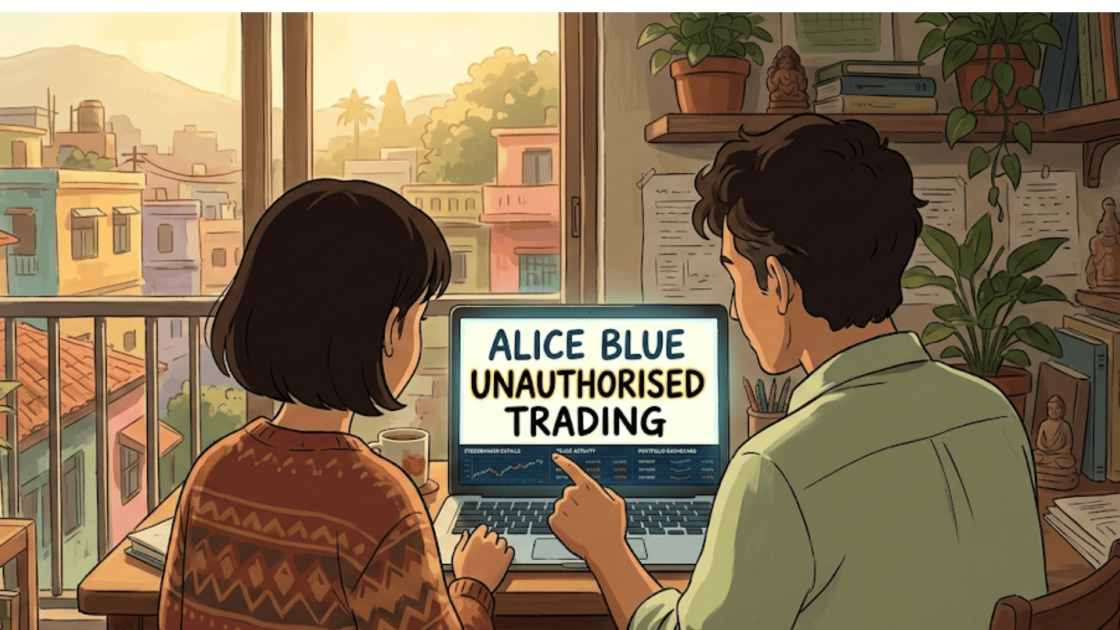
But imagine logging into your trading account one morning and noticing trades that you do not remember placing.
You may notice a derivative position in your portfolio, or you may see that someone bought or sold a stock without your clear instruction.
Situations like this immediately raise a serious concern for any investor: did someone execute the trade without your authorisation?
This is where the term “unauthorised trading” comes into the conversation.
Investors across different brokerage platforms sometimes raise this concern when they believe someone executed trades in their accounts without their consent or proper confirmation.
In recent years, some complaints related to unauthorised trading have also appeared in exchange records involving Alice Blue, a discount stock broker that provides trading services across equities, derivatives, commodities, and currency markets.
At the same time, it is important to approach such topics carefully. A complaint appearing in exchange data does not automatically mean that a violation has occurred.
However, it does highlight an issue that investors naturally want to understand better.
So the real question becomes simple: what do the complaint records actually show, and what should retail traders take away from them?
Alice Blue Unauthorised Trading Complaints
Before we look at the complaint data, we should first understand a little about Alice Blue and how the securities market generally views unauthorised trading complaints.
Alice Blue is a SEBI-registered stockbroker that operates as a discount brokerage platform in India.
The firm offers trading services across equity, derivatives, commodity, and currency segments through online trading platforms.
Like many modern brokers, it focuses on low brokerage charges and technology-driven trading tools that allow retail investors to execute trades quickly.
Because thousands of investors place orders through such platforms every day, trust and order authorisation become extremely important.
In a perfectly functioning financial ecosystem, the relationship between an investor and their brokerage is built on a single, unbreakable rule: the client’s word is final.
Every buy or sell order that appears on a ledger should be the direct result of a specific instruction given by the account holder.
However, when that chain of command breaks, it leads to one of the most serious violations in the markets: unauthorised trading.
In simple terms, unauthorised trading occurs when a broker, an employee, or an affiliated sub-broker executes trades in a client’s account without their explicit consent or proper authorization.
This brings us to a fundamental question many Indian investors face: Can you trust a stockbroker?
Trust in a broker isn’t just about their brand name or the size of their office; it’s about the verification systems they have in place
According to regulatory guidelines, brokers must maintain clear records of how an order was placed. This could include:
- online order logs from the trading platform
- call recordings if orders were placed through a dealer
- written or electronic instructions from the client
If a dispute arises, these records become important because they help determine whether the trade was genuinely authorised.
Complaint Data
Stock exchanges also categorise certain investor complaints under Type IV complaints, which generally involve allegations related to unauthorised trading or disputes about trade execution.
To understand the pattern better, it helps to look at exchange complaint data across several years.
| Financial Year | Total Complaints | Type IV (Unauthorised Trades) | % of Complaints Under Type IV |
| 2020–21 | 38 | 3 | 7.89% |
| 2021–22 | 47 | 4 | 8.51% |
| 2022–23 | 52 | 2 | 3.85% |
| 2023–24 | 56 | 3 | 5.36% |
| 2024–25 | 59 | 2 | 3.39% |
| 2025–26 | 59 | 3 | 5.08% |
When we look at the data carefully, two things become clear.
First, the total number of complaints has gradually increased over the years, moving from 38 complaints in 2020–21 to 59 in recent periods.
This kind of increase is not unusual in the brokerage industry.
As more investors open trading accounts and trading activity increases, the absolute number of grievances recorded by exchanges can also rise.
Second, complaints categorised as Type IV remain limited in number each year. In most years, the exchange recorded only two to four such complaints.
However, this is where many retail investors make a mistake while interpreting such data.
It is easy to look at the percentages and assume that a small number means the issue is insignificant. But complaint percentages do not always tell the full story.
Impact on Traders and Investors
Every Type IV complaint represents a situation where an investor believed that trades were executed in their account without proper consent.
- For the investor involved, this is not a statistical percentage; it can involve real financial exposure, unexpected positions, or losses caused by trades they did not intend to place.
- Even a handful of such disputes can raise important questions about who authorised the orders, how the broker and client communicated, and whether the broker provided proper confirmations at the time of trade execution.
- That is why experienced investors and regulators do not ignore these complaints simply because the numbers appear small.
- Instead, they treat them as reminders of why order confirmation systems, contract notes, and trade alerts play such an important role in protecting investors.
For retail traders, the takeaway is simple. Complaint data should not immediately lead to conclusions, but it should encourage investors to stay attentive.
Regularly reviewing trade confirmations, checking contract notes, and monitoring account activity remain some of the most effective ways to detect any irregular transactions early.
When Can an Action Be Taken Against a Broker?
Unauthorised trading is not just an investor concern; it is also an issue that regulators take seriously.
If a broker executes trades in a client’s account without proper authorisation, the matter can lead to regulatory scrutiny or dispute resolution proceedings.
However, an important point to understand is that not every complaint automatically leads to regulatory action.
Authorities usually examine the evidence before deciding whether the broker followed proper procedures.
Action against a broker may be considered in situations such as:
- trades executed without the client’s consent
- lack of proper order records or audit trails
- absence of call recordings where dealer-assisted trades were placed
- contract notes that do not match the client’s instructions
- Failure to maintain documentation required under regulatory guidelines
In such cases, the exchange or regulatory authorities may review the available records, including order logs, communication records, and trade confirmations.
If the investigation finds that the broker did not follow the required procedures, the matter can move further through the exchange grievance mechanism or arbitration process.
Arbitration allows investors and brokers to present their evidence before an independent panel that reviews the dispute and decides the outcome.
For investors, the key point is that disputes involving unauthorised trades should not be ignored.
If a trader notices transactions that they did not authorise, it becomes important to raise the issue promptly and review the available records.
How To Report A Complaint Against Broker in India?
If an investor believes that someone executed trades in their account without proper authorisation, the investor should act quickly and follow the available grievance process.
1. Contact the Broker
Inform the broker’s grievance redressal team about the disputed trades and ask for a clear explanation.
Request supporting records such as order logs, dealer call recordings, and order confirmation details.
2. File a complaint with the stock exchange
If the broker does not resolve the issue, file a complaint with the stock exchange where the broker operates, such as NSE or BSE.
Use the exchange’s online investor grievance portal and submit all relevant documents.
3. Submit a complaint on SCORES
Investors can also file a complaint through SEBI’s SCORES platform. This platform allows investors to raise regulatory grievances and requires brokers to respond to the complaint.
4. Initiate Exchange Arbitration if the dispute continues
If these steps do not resolve the issue, you may pursue formal redress by filing a complaint through the SMART ODR or initiating arbitration with the stock exchange.
The exchange may examine order logs, authorisation records, and other relevant evidence.
If the dispute still remains unresolved, you can proceed with arbitration under the exchange bylaws.
Need Help?
Unauthorised trading disputes can quickly become complex.
To understand how the trades were executed, investors often need to review several records, such as order logs, contract notes, trade confirmations, and communication history.
If you believe someone executed trades in your account without your consent, start by carefully reviewing these records and identifying any irregular transactions.
You should also gather all relevant documents before raising the complaint with the broker or the exchange.
If you need guidance in evaluating your case or preparing your complaint, you can register with us.
Our team can help you understand the process and assist you in presenting the matter before the appropriate authorities.
Conclusion
Trading accounts operate on the principle that every order should originate from the investor’s instruction.
While complaint data may show that unauthorised trading disputes represent a small portion of total grievances, they remain an issue that investors should take seriously.
Exchange records provide useful insights, but the most important safeguard still lies with the investor.
Regularly checking trade confirmations, reviewing contract notes, and monitoring account activity can help detect irregular transactions early.
Ultimately, staying informed and vigilant is one of the most effective ways for retail traders to protect themselves in the securities market.