
Quick Summary
When a mutual fund complaint survives SCORES and a First Level Review without resolution, AMFI’s mediation and arbitration mechanism becomes the next available route. Mediation is a voluntary process aimed at a settlement both sides accept, while arbitration is a more formal, quasi-judicial process ending in a binding decision from a neutral arbitrator. Unlike broker disputes, which move to NSE or BSE arbitration, mutual fund disputes follow this separate AMFI structured process, since most mutual fund units are not exchange traded. Knowing which of the two routes fits your case, and what evidence each one expects, decides how far this stage actually gets you.
If a SEBI SCORES complaint has closed and a First Level Review still did not fix things, AMFI mediation and arbitration for mutual fund disputes is the stage most investors have never heard of until they need it.
It exists precisely because mutual fund complaints do not follow the same escalation path as broker or trading disputes.
Understanding how this mechanism actually works, and what it expects from you, is what decides whether this stage becomes a genuine resolution or another dead end.
Why Mutual Fund Disputes Do Not Go to Exchange Arbitration?
Broker and trading disputes that remain unresolved after SCORES typically move to NSE arbitration or BSE arbitration, because those disputes involve transactions that happened on a stock exchange.
The exchange has direct oversight of that transaction, which is why it also handles the dispute resolution for it.
Most mutual fund transactions do not work this way.
Units are bought and sold directly through the AMC, a distributor, or a registered transfer agent, not through an exchange order book, except in the case of exchange-traded funds.
Because of this, there is no exchange sitting between you and the fund house to arbitrate the dispute.
AMFI, as the industry body representing all AMCs, has built its own mediation and arbitration structure to fill this gap.
It is not a government body and not part of SEBI directly, but it operates within a framework that SEBI recognises as part of the broader investor grievance system for mutual funds.
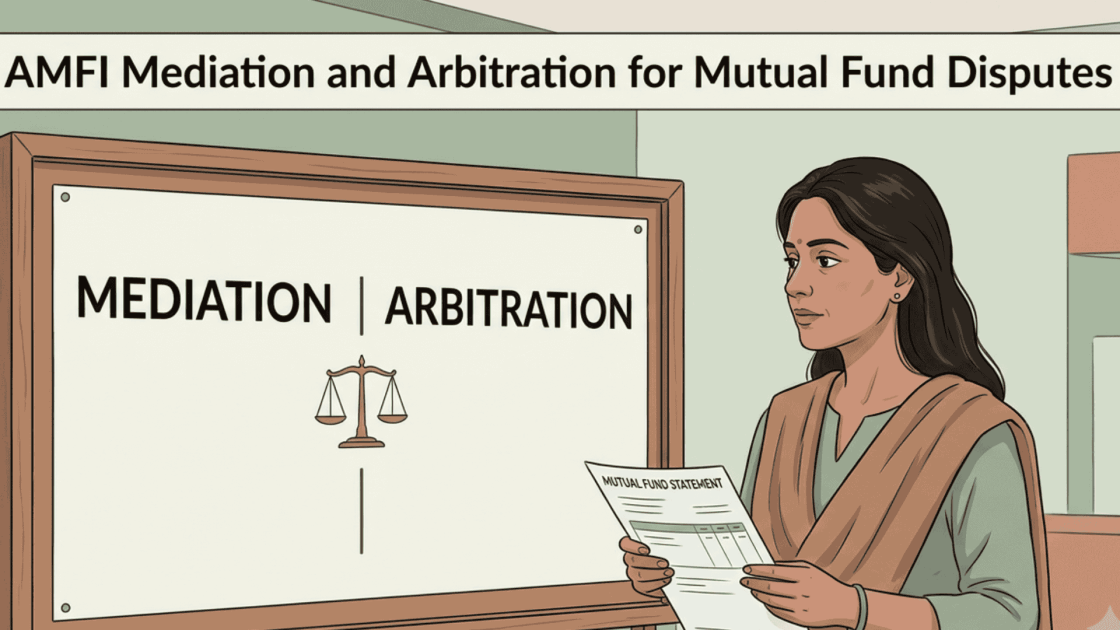
Difference Between Mediation and Arbitration
These two words get used together often, but they describe two very different processes, and knowing which one applies to your situation changes what you should expect and what you should prepare.
Mediation is a voluntary process where a neutral third party helps both sides, you and the AMC, reach a settlement you both agree to. Nobody imposes a decision on either side.
If mediation succeeds, the outcome is whatever both parties accept. If it does not succeed, nothing is lost, and the dispute can still move to arbitration.
Arbitration is different in almost every respect. It is a quasi-judicial process where a neutral arbitrator hears both sides and then makes a binding decision.
Once that decision is made, both sides are generally expected to accept it, and it functions much closer to a court ruling than a negotiation.
Because AMFI’s mediation and arbitration mechanism is generally voluntary, both you and the AMC need to agree to participate for either process to move forward.
This is an important detail, since it means preparing a strong, well-documented request that gives the AMC good reason to engage rather than decline.
Is Your Mutual Fund Complaint Ready for AMFI Mediation?
This stage is not meant for every unresolved complaint.
It generally becomes relevant once your complaint has already gone through the AMC’s own grievance cell, then SCORES, and then a First Level Review, without a resolution that actually fixes your problem.
If you have not yet been through those earlier stages, our guide on how to file a mutual fund complaint in India covers the full sequence from the very beginning, starting with your first written approach to the AMC itself.
Once that stage is done and SCORES alone hasn’t resolved things, our page on mutual fund complaint not resolved on SCORES explains the First Level Review step in detail.
Both of these usually need to be completed first, since AMFI’s mechanism is built as a later stage option, not a first stop.
What You Need Before Requesting Mediation or Arbitration?
Since this stage relies on both sides agreeing to participate, the strength of your documentation matters more here than at any earlier point in the process.
Gather your complete complaint history, starting from your original communication with the AMC, through your SCORES complaint number and the AMC’s Action Taken Report, to your First Level Review request and its outcome.
This history shows that you followed the correct sequence and gave the AMC every earlier chance to resolve things.
Alongside this history, bring the direct evidence of your loss or grievance itself, such as transaction statements, folio records, written communication about mis-selling, or documentation of an unauthorized change to your SIP or STP.
A request built on a clear, well-organised file is far more likely to be taken seriously by both the AMC and the mediator or arbitrator assigned to it.
How AMFI Mediation and Arbitration Actually Work?
Once a request for mediation or arbitration is raised through AMFI, both parties are informed and asked whether they agree to participate.
If mediation is chosen first, a neutral party works with both sides to find common ground, often through a series of exchanges rather than a single hearing.
If mediation does not lead to an agreement, or if arbitration is pursued directly, a neutral arbitrator reviews the evidence and arguments from both sides before issuing a decision.
This process tends to be more formal than anything at the SCORES stage, and it usually requires you to present your case clearly rather than simply restate your original complaint.
Because the process depends on mutual participation, an AMC that chooses not to engage can slow things down.
This is one of the reasons a strong, well-evidenced request matters so much at this stage, since it gives the AMC less reason to decline and more reason to settle.
What Kind of Mutual Fund Complaints AMFI Handles Best?
Cases that arrive at this stage with a clean, well-documented history from every earlier level tend to fare better than cases where the paper trail has gaps.
A complaint where the AMC’s own Action Taken Report contradicts your bank statement, for instance, gives a mediator or arbitrator something concrete to examine.
Mis-selling cases, unauthorized SIP or STP changes, and nominee or succession disputes that survived SCORES without resolution are common candidates for this stage, since these often involve a factual disagreement that a neutral third party can meaningfully assess once both sides present their evidence.
Redemption delays and administrative errors, by contrast, are usually resolved earlier in the process, at the AMC or SCORES stage, since they tend to have a clear, verifiable answer that does not require this level of dispute resolution.
What AMFI Mediation and Arbitration Cannot Resolve?
AMFI’s mediation and arbitration mechanism resolves disputes between you and a specific AMC over a specific transaction or pattern of conduct.
It is not a route for reporting a fund house to a regulator for broader wrongdoing, and it is not a criminal or investigative process.
If your concern involves a scheme or entity that may not be genuinely SEBI registered at all, this mechanism does not apply in the same way, since it is built for disputes with recognised AMCs operating within the regulated mutual fund system.
A different route altogether applies to fake or unregistered schemes, since those cases sit outside AMFI’s mediation framework entirely.
When to Move From SCORES to AMFI Mediation?
Reaching the AMFI mediation and arbitration stage is not a sign that your earlier efforts failed.
It is generally a sign that your complaint involves a genuine disagreement over facts or conduct that a simple written response was never going to settle.
Some disputes are resolved with a single email to the AMC. Others need the structure of SCORES to get a formal response on record.
A smaller number genuinely need a neutral third party to weigh evidence from both sides and reach a conclusion, and that is exactly what this stage is designed for.
Approaching it as the natural next step, rather than a last resort taken out of frustration, tends to produce a more focused and more effective request.
Investors who treat this stage as part of a planned sequence, rather than an emergency reaction to a closed SCORES complaint, generally present their case with more clarity and get taken more seriously as a result.
How Long AMFI Mediation and Arbitration Actually Takes?
This stage is meant for genuine, well-documented disputes rather than every complaint that fails to get a satisfactory SCORES response.
It generally takes longer than a SCORES complaint, since it involves more structured evidence review and, in the case of arbitration, a formal decision-making process rather than a written response within a fixed number of days.
Investors who reach this stage having already built a clear file from the AMC and SCORES stages tend to move through it more smoothly than those arriving with scattered records and no clear sequence behind them.
The work done at the earlier stages is not separate from this one. It is the foundation this entire stage is built on.
Not sure whether your case is ready for AMFI mediation, or whether it needs another round at the SCORES level first?
We will assess your complete complaint history, tell you honestly whether your evidence is strong enough for this stage, and help you build the documentation that gives your case the best chance of a real outcome.
Conclusion
AMFI’s mediation and arbitration mechanism exists precisely because mutual fund disputes cannot follow the exchange arbitration route that broker complaints use.
Knowing the difference between mediation and arbitration, and arriving with a complete, well-organised complaint history, is what decides whether this stage delivers a genuine outcome or becomes another dead end.
Report. Recover. Stay Fraud Free.
No. SCORES is a SEBI system, while AMFI's mediation and arbitration is run by the mutual fund industry body itself. It is a separate, later stage mechanism that generally comes into play only after SCORES and a First Level Review have not resolved the issue. It is not mandatory, but arbitration is more formal than the earlier stages, and professional help in organising your evidence and presenting your case tends to make a meaningful difference to the outcome. Generally no, since the mechanism is largely voluntary. This is why a well documented, serious request matters, as it gives the AMC a stronger reason to engage rather than decline. No. A dispute over one specific transaction or folio issue does not restrict your ability to operate your other investments with the same fund house in the normal course. Timelines vary by case complexity and by how quickly both sides engage with the process. It is generally longer than the SCORES timeline, since it involves a more detailed review of evidence from both sides. An arbitration decision is binding once issued, unlike a mediation settlement, which depends on mutual agreement. The specifics of enforcement depend on the nature of the decision itself. This is not the expected sequence. AMFI's mechanism is generally treated as a later stage option, and skipping the AMC and SCORES stages usually weakens rather than strengthens your position when you do reach this point. No. Mediation is generally the softer first attempt within this stage. If it does not produce an agreement both sides accept, arbitration usually remains available as the next option within the same mechanism.Frequently Asked Questions





 Add us as a preferred source on Google »

