
Quick Summary
A SCORES complaint can close in several different ways, and not all of them mean your problem was actually fixed. Some closures come with a genuine resolution, some come with a First Level Review option, and some are closed simply because the AMC submitted a response, whether or not that response solved anything. Knowing which kind of closure you received decides your next move, whether that is requesting a review within the 15 day window or preparing to take your case to AMFI mediation and arbitration.
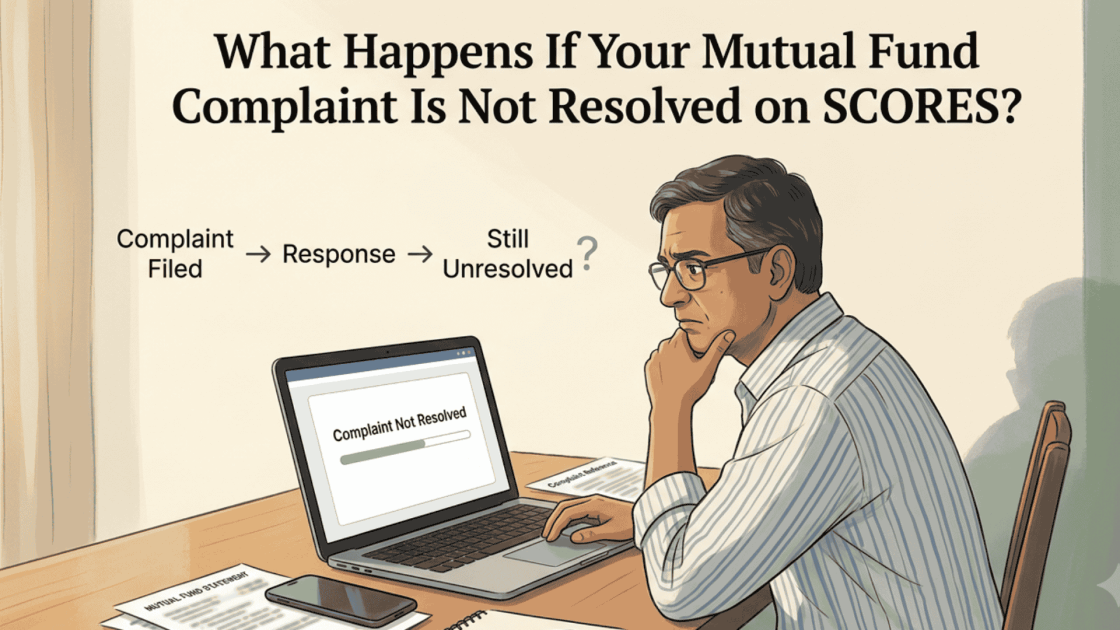
You filed your complaint, you waited, and now your SCORES dashboard shows a status update.
But a mutual fund complaint not resolved on SCORES is a more common search than most investors expect, because a closed complaint on paper does not always mean a solved problem in practice.
The status you see, and the outcome you actually got are two different things, and reading that difference correctly is what decides whether you have options left or whether you have run out the clock.
Why a Closed Status Does Not Always Mean Resolved?
SEBI’s SCORES 2.0 system requires an AMC to submit an Action Taken Report within 21 days of a complaint being forwarded to them.
Once that report is submitted, the complaint’s status changes, and this is where confusion usually starts.
A status change is not the same as your problem being fixed.
The system marks a complaint as responded to once the AMC files something, even if what they filed does not actually address what you asked for.
This is by design, since SEBI’s role at this stage is to confirm that a response happened, not yet to judge whether that response was adequate.
The judgment on adequacy belongs to you, the investor, and it happens in the step that comes right after this status change.
If you haven’t yet filed your original complaint and want the full walkthrough of the SCORES process itself, our guide on filing a complaint in SCORES covers exactly that from the start.
The Three Ways a SCORES Complaint Can End
When your mutual fund complaint is marked closed on SCORES, it does not always mean your issue has been solved.
A closed status simply means the fund house has filed an answer, but how you should respond depends entirely on the outcome you get.
Not every closed SCORES complaint ends the same way, and the path forward depends entirely on which of these three you actually received:
- The first is a genuine resolution, where the AMC’s response matches what you asked for, whether that is a refund, a correction, or an explanation you accept.
In this case, there is nothing further to do, and the complaint closes with your agreement. - The second is a response you disagree with, where the AMC has replied but the reply does not fix your issue or does not match the facts as you understand them.
This is where the First Level Review option becomes relevant, and it is available to you for 15 days after the AMC’s response is logged. - The third is silence disguised as closure, where the AMC’s response is generic, repeats policy language without addressing your specific complaint, or simply denies the issue without engaging with your evidence.
This also qualifies for a First Level Review, since a non-answer is not a resolution just because it was submitted on time.
Knowing which of these three you are looking at is the first thing to check before deciding your next step, because the wrong assumption here can cost you the 15-day window entirely.
How the First Level Review Actually Works?
If you are not satisfied with the AMC’s response, SEBI gives you 15 days from that response to request a First Level Review. This is not a new complaint.
It is a formal request asking SEBI to look again at whether the AMC’s response actually addressed the issue you raised.
When requesting a review, be precise about what was missing from the original response.
Do not simply restate your original complaint. Instead, point to the specific gap, such as the AMC not addressing the NAV discrepancy you flagged, or the AMC’s explanation not matching the transaction dates on your own statement.
The review is examined by SEBI, not by the AMC directly, which is why this stage carries more weight than a second email to the fund house would.
It is your chance to have a neutral party look at whether the AMC actually did its job the first time.
Missing the 15-day window closes this option, and at that point, your only route forward is AMFI mediation and arbitration, which is a heavier process with its own separate procedure.
What to Include in a First Level Review Request?
A First Level Review request works better when it reads like a rebuttal, not a repeated grievance.
This means directly addressing what the AMC said and explaining specifically why it does not resolve your issue.
State the AMC’s exact response in your own words, then explain the specific mismatch between that response and your original complaint.
If the AMC claimed a redemption was processed correctly, but your bank statement shows a different amount or a different date, put both figures side by side in your review request.
Attach anything new that strengthens your case since the original complaint, such as a fresh bank statement showing the amount that was actually credited, or a screenshot of your folio history.
Reviews that bring new specific evidence tend to get more attention than reviews that simply repeat frustration.
What Happens After You Request a Review?
Once a First Level Review is requested, SEBI examines the AMC’s original response against your complaint and your review request.
This step exists specifically to catch cases where an AMC’s response looked complete on paper but did not actually engage with the investor’s specific problem.
The review can result in the AMC being asked to respond again with more detail, or it can confirm the original response stands.
If the review still does not resolve things in your favor, this is generally the point where your mutual fund complaint has exhausted what SCORES alone can offer, and the next step moves outside the SCORES system entirely.
When SCORES Genuinely Cannot Take You Further?
There is a difference between a complaint that has not been resolved yet and a complaint that has hit the actual limit of what SCORES is built to do.
Recognising this difference matters, because pushing the same complaint through SCORES a third or fourth time rarely produces a different result once a First Level Review has already been completed.
At this stage, the mutual fund complaint process moves toward AMFI’s mediation and arbitration mechanism, which functions differently from SCORES in both structure and expectation.
Unlike SCORES, which is largely a written back and forth, mediation and arbitration involve a more formal presentation of your case, and the evidence standard is generally higher.
We have written in detail about AMFI mediation and arbitration for mutual fund disputes, covering how this process is initiated, what it expects from you as the complainant, and how it differs from the exchange arbitration route that applies to broker disputes.
If your SCORES complaint has reached its limit, that page is the right next step to understand before you file anything further.
How to Keep Your SCORES Complaint Records Organised?
Every stage of a SCORES complaint generates a paper trail, and that trail becomes increasingly important the further your complaint travels through the system.
Save the original complaint text you filed, the AMC’s Action Taken Report, your First Level Review request if you filed one, and any further response to that review.
If your case eventually moves to AMFI mediation, this entire history becomes the foundation of what you present there, and arriving without it means rebuilding a case from memory instead of from record.
How This Differs From a Broker or Advisor Complaint on SCORES?
Investors who have previously dealt with a broker or research analyst complaint sometimes expect the mutual fund process to mirror that experience exactly, and this assumption occasionally confuses the review stage.
Broker complaints on SCORES that remain unresolved typically move toward NSE arbitration or BSE arbitration, since broker transactions happen on the exchange.
Mutual fund transactions mostly do not, so the escalation path after SCORES splits away from that model entirely and moves toward AMFI’s own mechanism instead.
This difference is not just procedural. It affects what kind of evidence carries weight at the next stage, and it affects the timeline you should expect.
Arbitration through an exchange and mediation through AMFI are governed by different rules, different panels, and different documentation standards, so preparing for one using the expectations of the other usually leads to a weaker submission.
For anyone dealing with a broker dispute specifically rather than a mutual fund one, our guide on arbitration in share market walks through that separate exchange-based process in full.
What Happens If You Wait Too Long to File a Review?
Investors often feel that a closed status on SCORES means the door has shut, when in most cases it simply means one particular door has shut. The system is built in stages precisely because a single response, even a poor one, is not meant to be the final word on a genuine grievance.
At the same time, timing matters more here than almost anywhere else in the complaint process.
The 15-day review window is firm, and letting it pass without action generally means losing the chance to use it.
If you are even slightly unsure whether your AMC’s response actually resolved your issue, treat that uncertainty as a reason to file the review request rather than wait and see.
If your original complaint has not yet been filed, our guide on how to file a mutual fund complaint in India covers the full three-level process from the very start, including what to prepare before you approach the AMC.
Still unsure whether your SCORES closure was a real resolution or a technical formality?
We will go through your complaint history, your AMC’s response, and your original evidence to tell you clearly whether a First Level Review is worth filing or whether it is time to move to AMFI mediation instead.
Conclusion
A closed complaint on SCORES is not always the end of the road, and confusing the two is the single biggest mistake investors make at this stage.
Understanding which of the three closure types you received, and acting inside the 15-day review window if you disagree with the outcome, is what actually decides whether your mutual fund grievance gets resolved or quietly runs out of time.
Report. Recover. Stay Fraud Free.
Not necessarily. A closed status only means the AMC submitted a response within the required timeline. Whether that response actually resolved your issue is a separate question, and you have 15 days to challenge it through a First Level Review if it did not. Generally no. The review is meant to be a single additional check on the AMC's response. If the review itself does not resolve things, the next step is typically AMFI mediation rather than another review request. Anything that was not already part of your original complaint and that directly supports your position, such as a bank statement showing an incorrect credit, a fresh transaction record, or a written communication from the AMC that contradicts their SCORES response. Compare it line by line against your original complaint. If it restates general policy or procedure without addressing the specific dates, amounts, or facts you raised, it is likely a generic response rather than a resolution. No. The review request is part of the SCORES process itself and does not involve any additional charge to the investor. This is not the standard route, and it rarely helps. Withdrawing loses the response timeline you already have on record. It is usually better to push the existing complaint forward through a review than to restart it. If the window has closed, your remaining option is generally AMFI mediation and arbitration. Document everything from your SCORES complaint carefully, since this history becomes the basis of your case at that stage.Frequently Asked Questions





 Add us as a preferred source on Google »

