

A name you trust, a credential you remember, and a registration that may no longer be active; that combination is exactly where investor risk begins.
If you’ve searched “Anish Vivek Dixit SEBI registered,” you’re doing the right kind of due diligence, the kind most investors skip until it’s too late.
Whatever brought you here, this blog will help you understand what we found, what it means for investors, and most importantly, how to protect yourself before making any investment decision.
Because in the stock market, verification should always come before trust.
Is Anish Vivek Dixit SEBI Registered?
Imagine this: You receive a stock recommendation from someone who sounds knowledgeable.
They discuss valuation models, market cycles, portfolio construction, and investment opportunities with confidence.
Naturally, you want to know: “Is this person SEBI registered?”
Most investors stop after hearing “yes.” The careful investors verify it.
Anish Vivek Dixit’s LinkedIn profile states that he worked as a “SEBI Registered Research Analyst” from June 2017 until April 2025.
The profile also shows experience in:
- Equity market training.
- Fundamental analysis.
- Portfolio design.
- Financial modelling.
- Valuation assignments.
- Investor education programs.
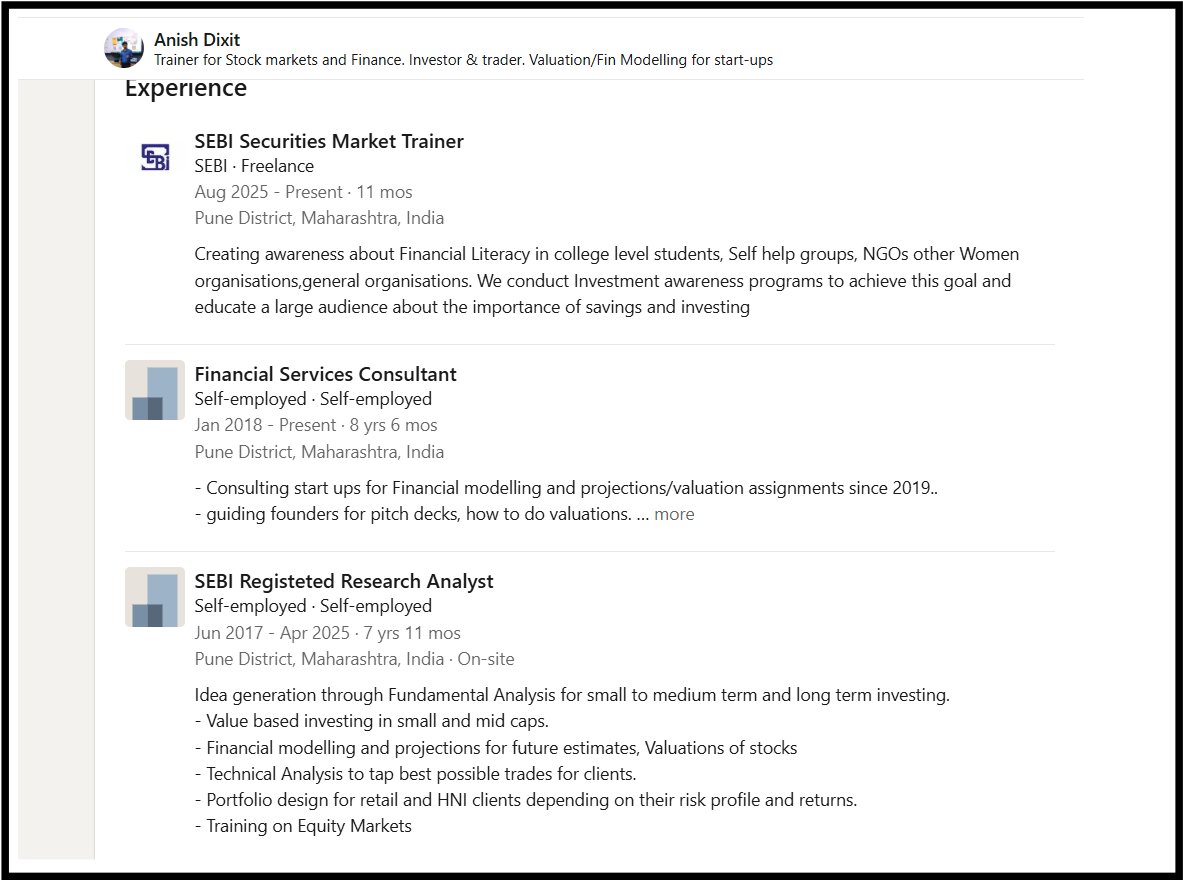
Based on the information publicly displayed on the profile, he appears to have previously served as a SEBI-registered research analyst during that period.
However, there is an important development investors should be aware of.
When checking the current publicly available SEBI registration records, we were unable to locate an active Research Analyst registration for Anish Vivek Dixit.
This means that:
- The individual appears to have previously described himself as a SEBI-registered research analyst.
- His LinkedIn profile shows that his role ended in April 2025.
- At the time of writing, we could not locate an active registration record under that name in publicly searchable SEBI resources.
That distinction matters. And many investors do not realise why.
What an Inactive SEBI Registration Means for You?
When a Research Analyst’s registration is not currently listed on SEBI’s active intermediary database, the regulatory implications are clear.
Any entity providing personalised investment research, stock recommendations, or securities analysis without a current, active SEBI Research Analyst registration is operating outside the regulated framework, regardless of any prior registration history.
This matters practically for investors in the following ways:
- The grievance mechanism changes. When you have a dispute with a currently SEBI-registered intermediary, you can file through SEBI SCORES and invoke the full regulatory escalation pathway. When the entity is not currently registered, that direct pathway is significantly more complex to navigate.
- The accountability structure is different. SEBI-registered Research Analysts are subject to ongoing compliance obligations, mandatory disclosures, regular audits, and SEBI’s supervisory oversight. An entity that previously held registration but no longer does is no longer bound by those ongoing obligations.
- Past performance claims need more scrutiny. Any research calls, recommendations, or performance statistics generated during the period of active registration were produced under a regulated framework. Claims made, or services provided after registration lapsed require independent verification of their regulatory basis.
Many investors only discover that a registration is no longer active after they have already paid for a service.
By that stage, the focus shifts from verification to damage control.
The only thing that matters is: What is the registration status right now?
And that is exactly what every investor should verify before subscribing to any paid market service.
How to Verify If an Advisor is SEBI Registered Before Taking Market Advice?
Anish Vivek Dixit’s situation is actually a clean example of a much broader problem in India’s advisory ecosystem, one worth understanding because it applies far beyond any individual case.
There are currently over 1,900 active SEBI-registered Research Analysts in India.
There are, however, considerably more websites, profiles, WhatsApp groups, Telegram channels, and subscription services that present SEBI registration numbers as a marker of credibility.
The registration number on a website is not self-verifying. It does not update automatically. It does not alert you when the underlying status changes.
The only reliable verification method is SEBI’s official intermediary portal, searched in real time, cross-referenced by both name and registration number.
Before paying any fee or acting on recommendations, consider following this checklist:
- Verify Current Registration.
- Ask for Registration Details.
- Read the Disclosures Carefully.
- Be Careful With Performance Claims.
Education vs Advice: Why a Trainer Is Not a Research Analyst?
One specific distinction worth understanding clearly, because it’s directly relevant to Anish Vivek Dixit’s current professional profile.
The main role that he is showing now on his LinkedIn is that of a SEBI Securities Market Trainer, a programme for qualified people delivering financial literacy and investor education programmes in colleges, NGOs, self-help groups, and other organisations.
It is a legit and worthwhile societal role. SEBI’s financial literacy programmes are truly significant for India’s investor ecosystem.
But it is not identical to a SEBI Research Analyst registration.
While a Securities Market Trainer can only educate, a Research Analyst can provide investment research and recommendations on securities.
They are registered differently, have different regulations, and permissions are different too.
So, any investor who is taking the help of financial guidance from Anish Vivek Dixit or any other related person should check and make sure under which specific regulatory capacity the given guidance is provided and also make sure that the respective registration is currently active on SEBI’s portal.
How To Complaint Against an Unregistered Entity?
If you’ve subscribed to, paid for, or acted on research or advisory services from any entity, including those associated with Anish Vivek Dixit, based on an assumption of active SEBI registration, here is your practical path forward:
Step 1: Verify Registration Status Right Now
Go to SEBI’s official portal and search for registration number INH000004945 and the name “Anish Vivek Dixit.” Note the current status against what was represented to you at the time of your engagement.
This verification creates the factual baseline for every step that follows.
Step 2: Preserve All Evidence Immediately
Before taking any other action, save everything: payment receipts, bank records, subscription invoices, all digital communications (WhatsApp exports, emails, SMS), any marketing material or claims about SEBI registration that you received before paying, and any research recommendations you acted on.
Step 3: Report a Complaint to SEBI
If the advisory service is operating without SEBI registration, you may still report the matter directly to SEBI by writing an email on their official email ID along with all your supporting documents and evidence.
Providing complete details helps regulators understand the seriousness of the issue.
Step 4: File a Cyber Crime Complaint
If the case involves fake profit promises, financial fraud, or suspicious money-related activity, you should also report it through the National Cyber Crime Portal.
This can help initiate further investigation into the matter.
Step 5: Seek Legal Advice if Needed
In the event of a significant financial loss, you may want to speak with a lawyer who has experience handling financial and securities disputes in order to fully understand what legal remedies are available.
Need Help?
Are you someone who has already subscribed to a research, advisory, training, or stock market service and now feels uncertain about the information provided?
What you are expected to do is verify before you pay, document everything from the first interaction, and act quickly if something in your experience raises a concern.
In addition to assessing the regulatory basis for advisory services engaged by investors, our team helps them determine whether conduct or representations raise SEBI’s framework concerns, and prepare complaint documentation that is complete, correctly framed, and directed to the appropriate escalation channel.
A structured review often brings clarity much faster.
Register with us if you would like your situation reviewed and explained in simple, practical language.
Conclusion
Anish Vivek Dixit’s LinkedIn profile indicates that he served as a SEBI registered research analyst until April 2025.
However, at the time of writing, we were unable to locate an active Research Analyst registration under his name in publicly searchable SEBI records.
For investors, the key takeaway is simple:
- Historical registration and current registration are not the same thing.
- Verification should always be performed using current official records.
- Investors should review disclosures, registration status, and service terms before paying for any market-related service.
- Making investment decisions after verification is generally safer than relying on assumptions.
The smartest investors are not the ones who find opportunities first.
They are the ones who verify them first.
Frequently Asked Questions
1. Is Anish Vivek Dixit currently a SEBI-registered Research Analyst?
Based on publicly available information, including his own LinkedIn profile and a search of SEBI’s official intermediary database, Anish Vivek Dixit’s Research Analyst registration (INH000004945) under Equity Analytics appears to have ended in April 2025 and does not currently appear in SEBI’s active listings.
2. Can an entity still provide advisory services after a SEBI Research Analyst registration has ended?
No. Under SEBI’s framework, only entities holding a current, active Research Analyst registration are authorised to provide investment research and recommendations on securities.
3. Should I pay for stock market services without checking registration status?
Verification should ideally be completed before making any payment or acting on investment recommendations.
4. What should I do if I am unsure about a stock market service provider?
Collect all available documents, invoices, emails, and communications and seek guidance to understand the service structure, disclosures, and available options.





 Add us as a preferred source on Google »

