Axis Securities Limited is a financial services company in India that helps people invest and trade in the stock market.
It’s part of Axis Bank, which is one of India’s big private banks. Their online investing platform is called Axis Direct.
Axis Securities (Axis Securities Limited) offers services like buying and selling shares (stocks), trading in F&O (futures and options), investing in mutual funds and SIPs, applying for IPOs, etc.
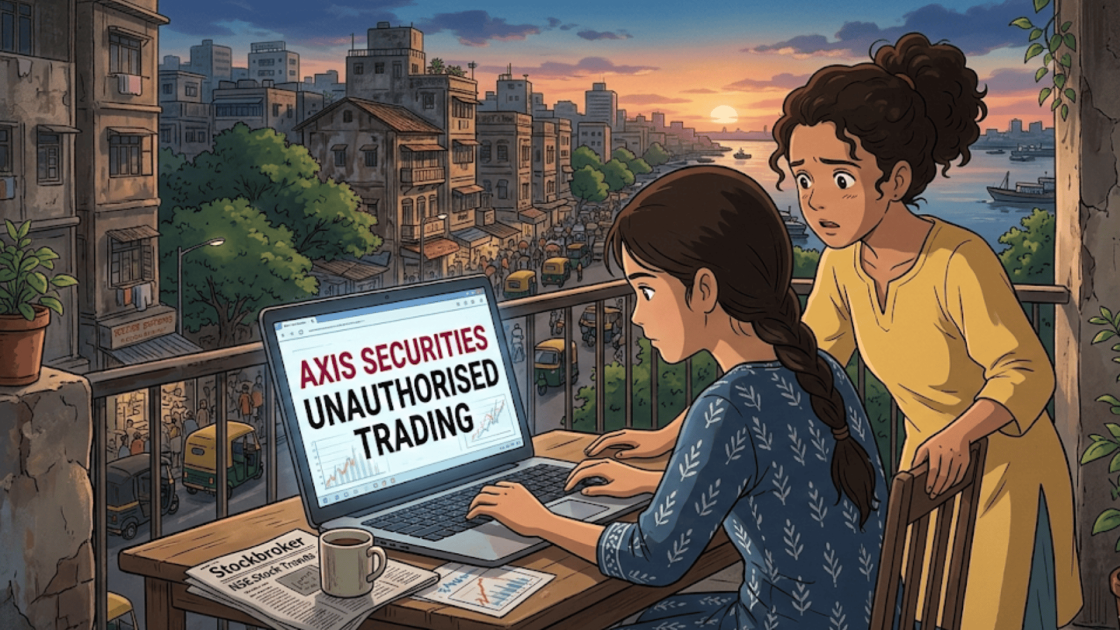
However, like any other digital broker, Axis Securities Limited also has its fair share of complaints. One such complaint is unauthorised trading.
It is important to know the details of this matter before you commit to Axis Securities as your digital broker.
Let’s get into the details.
Axis Securities Unauthorised Trading Complaints
Unauthorised trading refers to situations where buy or sell transactions are carried out in an investor’s trading account without their clear permission or prior instruction.
It typically occurs when a broker, dealer, or intermediary places trades on behalf of a client that the client did not approve or request.
The table given below illustrates the total clientele of Axis Securities from 2022 to 2026 and the exact proportion of that clientele that had any sort of complaint with the platform at all:
| Financial Year | No. of clients | Total complaints | % of complaints w.r.t. Total clients | Complaints resolved | % of complaints resolved w.r.t. Total complaints | Arbitrations |
| 2022-23 | 363904 | 108 | 0.029 | 93 | 86.11 | 1 |
| 2023-24 | 363904 | 156 | 0.042 | 154 | 98.71 | 1 |
| 2024-25 | 419513 | 234 | 0.055 | 234 | 100 | 0 |
| 2025-26 | 411423 | 232 | 0.056 | 212 | 91.77 | 0 |
We learn from the table that as Axis Securities’ clientele grew, so did the total number of complaints and the proportion of customers with complaints.
What this basically means is that although more and more people have started using Axis Securities over the years, more and more people are also having complaints with the platform.
To understand this issue a bit better, take a look at the proportion of complaints filed for unauthorised trading.
Complaint Data Over the Years
| Financial year | Total complaints | No. of complaints for unauthorised trading | % of complaints w.r.t. Total complaints |
| 2022-23 | 108 | 10 | 9.25 |
| 2023-24 | 156 | 24 | 15.38 |
| 2024-25 | 234 | 46 | 19.65 |
| 2025-26 | 232 | 72 | 31.03 |
There are two very noticeable jumps in the portion of complaints regarding unauthorised trading.
The first one was in 2023-24, when the complaints increased by more than double; and the second one in 2025-26, when the complaints rose by more than 10%.
On the surface, these numbers might seem quite low and “nothing to worry about”. But, in fact, you should worry about the pace at which these complaints are increasing.
In 2025-26 itself, almost one-third of the total complaints registered were about unauthorised trading.
Axis Securities Arbitrations
Arbitration cases provide insight into how disputes between investors and brokers are formally examined by stock exchanges.
By reviewing specific cases, investors can better understand how issues like unauthorised trading, system errors, or margin disputes are evaluated based on documented evidence.
Case: Trading Chaos, Margin Mistake & A ₹3.45 Lakh Claim
Ms Sheetal Mehta fought a case against Axis Securities Limited for unauthorised trading and demanded ₹2.6 to ₹3.45 lakhs, claiming trading losses and mental harassment due to system failure and wrong margin addition.
- What Was the Case?
Ms. Mehta said that the broker’s trading system was not working on April 18, and she couldn’t exit her positions in time, which caused heavy losses.
She also claimed that the broker mistakenly added extra margin (around ₹1.17 lakh exposure) to her account without her consent.
Because of this, she unknowingly took bigger positions.
The next day, since there wasn’t enough money in her account to cover that margin, the broker forcefully squared off her trades.
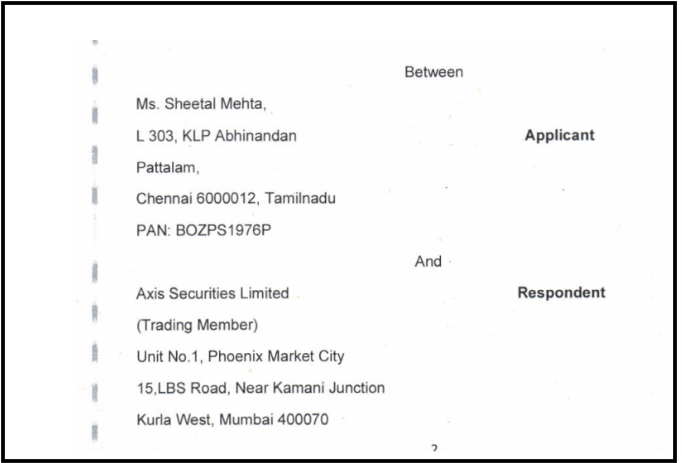
She demanded compensation for financial loss and mental stress.
- Award
The arbitrator ordered ₹23,581 to be paid to Ms Mehta by Axis Securities.
- The broker was not responsible for losses caused by system glitches or market fluctuations.
- However, the broker was responsible for wrongly giving extra trading exposure (margin) and later squaring off those trades.
- Compensation was limited only to the actual loss caused by that margin error.
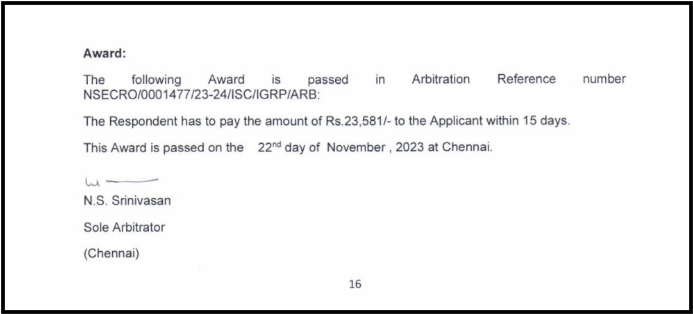
Mental harassment claims were not entertained under NSE arbitration rules.
- Key Takeaway from This Case
- System glitches are usually covered under risk disclosures which are borne by traders.
- But if a broker makes an internal mistake, they can be held responsible.
- Compensation in stock exchange arbitration is usually limited to direct financial loss, not emotional distress.
- Always monitor margin levels and trading limits carefully, even if trading with your own funds.
When Can Action Be Taken Against Brokers?
The best course of action, of course, is to report as soon as possible.
Keep an eye out for any email/SMS mentioning any trades which you did not make. Reach out to the broker between 0-7 days.
Exchanges record complaints under different categories, but action depends on what the investigation or dispute process reveals.
Regulators can take action if:
- The broker fails to produce proper order evidence when asked.
- Arbitration proceedings determine that the broker executed trades without the client’s authorisation.
- Exchange inspection finds non-compliance with SEBI’s order-recording requirements.
- SEBI establishes, through adjudication, that the broker violated regulatory rules.
- There is a repeated pattern of serious investor protection failures.
In cases of unauthorised trading, the key issue is proof.
How To Report A Complaint Against Broker?
If you ever find yourself in such a situation, knowing what to do next and how to get your justice becomes crucial.
-
Preserve Communication
Keep a record of all related emails, messages, call discussions, and payment confirmations.
These communications can help establish what instructions were given and whether proper consent was obtained.
-
Submit a Written Complaint
File a formal complaint with the broker’s grievance officer, clearly mentioning the trades in dispute and whether you had approved them.
If the issue is not resolved, you may escalate the matter through the exchange grievance mechanisms or approach the Securities and Exchange Board of India for further action.
You may also file a SEBI complaint (SEBI Complaints Redress System) and upload all relevant supporting documents if the issue remains unresolved.
-
Use SEBI ODR or Arbitration
If issues remain unresolved after following all the above steps, you can opt to file a complaint in SMART ODR or stock-exchange arbitration.
Need Help?
If you still face any issues in the process, register with us, and you can forget about the back-and-forth, the long forms, and the fear of making a mistake in the paperwork.
Our team of professionals will be with you every step of the way, ensuring everything is set right; from compiling evidence to representing you in front of SEBI, we’ve got your back.
We can help you with:
- Analyse transaction history
- Organise documentation in proper sequence
- Identify potential compliance gaps
- Draft structured complaints
- Prepare submissions for regulatory forums
If you believe trades were executed without your informed approval or that exposure exceeded your understanding, seeking timely advice can help protect your rights.
Conclusion
Choosing a broker is about more than just finding the lowest brokerage fees or a slick mobile interface; it is fundamentally about trust.
You are handing over your hard-earned savings and your financial future to an intermediary, which naturally leads to a deeper question: Does your stockbroker actually care for you?
Despite the operational friction and the specific complaints discussed, Axis Securities Limited remains a major pillar in the Indian market, functioning as a full-service brokerage for a massive, diverse client base.
However, “functioning” and “fostering a safe environment” are not always the same thing.
While Axis Securities has a track record of resolving a significant volume of grievances, the persistent rise in unauthorised trading concerns serves as a vital wake-up call for the retail investor.
It highlights a gap between corporate policy and the actual execution of trades at the ground level.
At the end of the day, a broker’s “care” is best measured by their transparency during a dispute, not just their marketing during a sign-up.