Brokerage charges are just a part of the trading. Every time you buy or sell a stock, your broker takes a small fee for their service. This is standard practice.
However, things get problematic when the trading in your account starts happening just to generate those fees, rather than to actually grow your wealth.
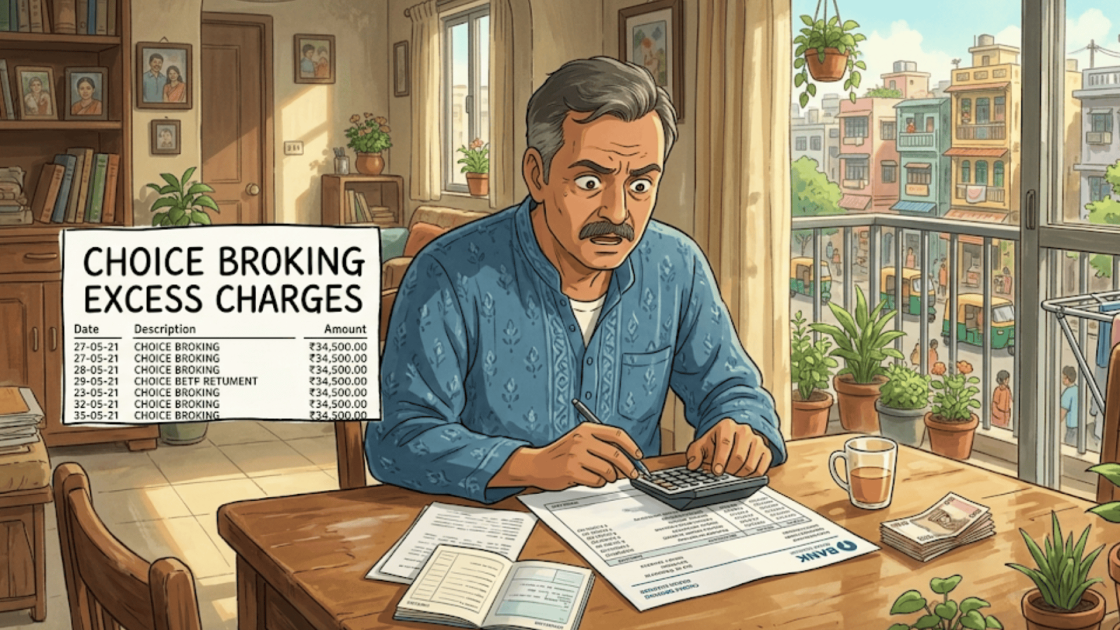
Recently, many investors have reported complaints about Choice Broking’s excess charges.
Investors have reported issues like frequent trades, unexpected deductions, or brokerage bills that seem way too high.
When a broker carries out excessive transactions primarily to fill their own pockets with commission, we call it brokerage churning.
Understanding how brokerage churning works is the best way to spot the warning signs early.
If you know what to look for, you can protect your hard-earned money before it drains away.
Choice Broking Excess Charges Overview
Choice Broking is a full-service stockbroker in India that offers trading and investment services across equities, derivatives, commodities, currencies, and mutual funds.
Unlike discount brokers that mainly provide low-cost execution platforms, full-service brokers usually offer additional services such as research reports, relationship managers, and advisory support.
While this fee structure is perfectly normal across the industry, red flags appear when your account starts showing a massive amount of trades that do not seem to have a clear strategy behind them.
This is where the risk of brokerage churning appears.
It usually happens when relationship managers handle your account too aggressively, or when you are pushed into a cycle of constant buying and selling that does not actually match your long-term financial goals.
Choice Broking Excess Charges Complaints
One of the best ways to see what is really happening is to look at the patterns in the Choice Broking Complaints section.
While one or two complaints might just be a misunderstanding, a steady rise in numbers usually tells a bigger story.
Here is a look at the complaint data for Choice Broking over the last few years:
| Financial Year | Total Complaints | Brokerage Churning Complaints |
| 2021–22 | 57 | Around 13 |
| 2022–23 | 116 | Around 22 |
| 2023–24 | 144 | Around 70 |
| 2024–25 | 264 | Around 109 |
| 2025–26 | 265 | Around 109 |
As you can see, the number of grievances has climbed significantly. A large chunk of these complaints specifically focuses on brokerage churning or accounts that feel “over-traded.”
While these numbers do not automatically prove the broker did something wrong, they do show that many investors are feeling the sting of high charges and questioning why their accounts are so active.
Impact of These Complaints on Retail Investors
For a retail investor, these complaints are not just numbers on a page; they represent real financial hits.
When your account is constantly moving, your brokerage costs skyrocket.
This acts like a slow leak in your investment bucket. You might make a small profit on a trade, but once you factor in the brokerage and transaction taxes, you could actually be in the red.
For new investors, this is especially confusing.
You might think these constant “tips” are necessary to make money, but in reality, the only person guaranteed to make money on every trade is the broker. This erodes trust.
When you see unexplained charges, you naturally start to wonder if the advice you are getting is actually in your best interest.
When Can It Be Considered Brokerage Churning?
In the fast-paced world of equity trading, high activity isn’t always a cause for alarm, if you’re an intraday trader or a derivatives specialist, a high volume of transactions is simply part of the job.
However, there is a fine line between active management and a predatory practice known as Churning in Stockmarket circles
Churning occurs when a broker or relationship manager executes excessive trades in a client’s account, not to improve the client’s portfolio, but specifically to generate more commission and fee income for themselves.
When a broker uses your account as a “fee machine,” you will usually notice a few specific patterns.
This is perhaps the most serious red flag. Unauthorised trading is exactly what it sounds like: trades happening in your account that you never actually approved.
Sometimes, a relationship manager might place orders without telling you, or they might use your login details to execute trades “on your behalf.”
If you look at your contract notes and see dozens of buy-and-sell orders for a stock you never touched, that’s unauthorised trading.
- Account Handling Issues
Sometimes the problem is not a single “bad” trade, but just poor account handling overall.
If your broker is not explaining the strategy behind their moves, you might find yourself in a whirlwind of transactions you do not understand.
A distraction of messy ledger statements, confusing fee breakdowns, or delayed communication makes it hard to track where your money is going.
Often, investors only realize how much they have paid in fees when they sit down weeks later to audit their own accounts.
- Manipulation Through Frequent Trading Advice
Then there is the psychological side: manipulation through constant “advice.” You might get dozens of calls or messages a day urging you to jump in and out of stocks.
For example, a broker might tell you to buy a stock at 10:00 AM and sell it by 2:00 PM, only to tell you to buy it again the next morning.
Unless something massive changes in the market, this “in and out” strategy usually does nothing but generate three sets of brokerage fees for the firm.
Over time, you will see your brokerage costs rising while your actual profits do not increase, or worse, start to shrink.
Choice Broking Arbitration Case
This case was fought by Divya Bajaj (represented by her husband, Vineet Vaibhav) against Choice Equity Broking Private Limited.
She sought a refund of ₹5.5 lakhs for capital losses and ₹4.5 lakhs to cover her mental agony and opportunity loss. The dispute also highlights a broader issue faced by many investors regarding Choice broking excess charges, particularly when trades are executed without proper client consent.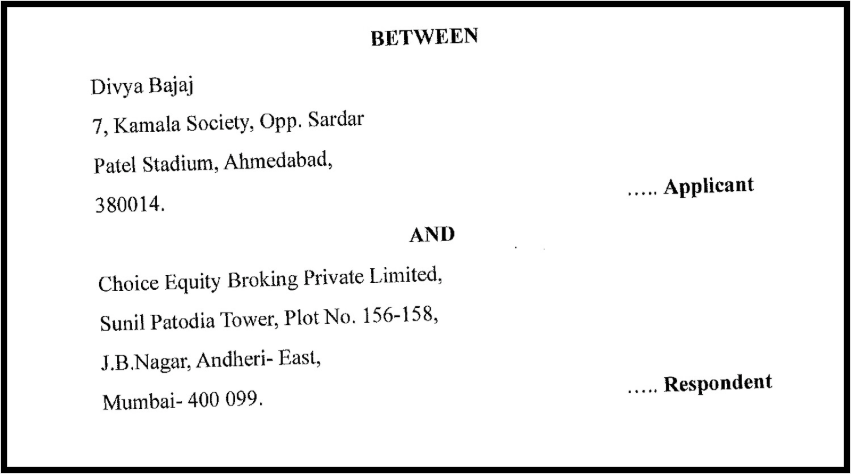
What was the Case?
Divya Bajaj alleged that Choice Equity executed numerous F&O trades in her account without her permission or a Power of Attorney (PoA).
She claimed her Relationship Manager sent fabricated reports that showed profits while her account was actually losing money.
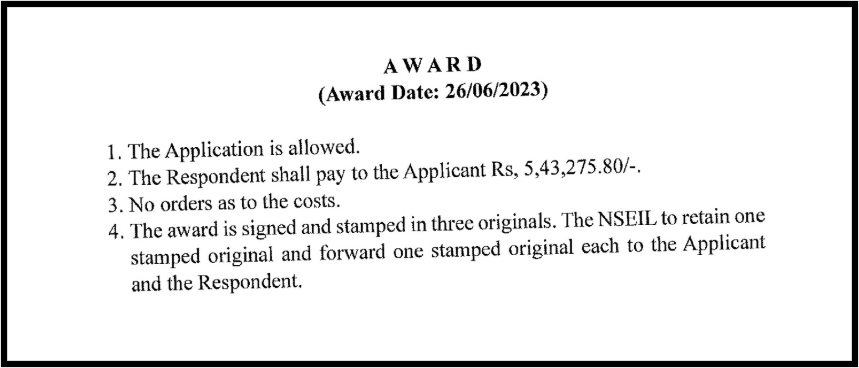
Moreover, while the client lost over ₹5.4 lakhs, the broker earned approximately ₹1.5 lakhs in brokerage from these unauthorised trades.
While the broker argued she received SMS alerts and contract notes for years without complaining, they couldn’t produce the mandatory call recordings to prove she actually ordered the trades.
This evidentiary gap became central to the choice broking unauthorised trading dispute raised by the investor.
The arbitrator ruled that without proof of pre-trade consent, the broker is liable for the losses.
Key Takeaways
- Proof is Mandatory: Brokers must record your consent before a trade; if they can not prove you said “yes,” the trade is considered unauthorised.
- Firm Responsibility: Even if a broker fires a dishonest employee for faking statements, the company is still responsible for paying back the losses.
- Alerts Aren’t Permission: Receiving an SMS or contract note after a trade does not mean you authorized it; the broker still needs proof of your initial instruction.
- The COVID-19 Excuse Has Limits: Regulatory exemptions for recording calls only applied for a specific window (April 2020 to July 2021) and do not excuse a total lack of record-keeping.
How to File a Complaint Against a Stock Broker in India?
If you suspect your account has been churned or you see trades you did not authorize, do not wait. Follow these steps:
1. Gather Proof
Start by collecting all the records that show the charges applied to your account.
Take screenshots of your brokerage charges, save your account statements, and save all the conversations with the broker or relationship manager.
2. Contact the Broker
The first step should always be to raise the issue directly with the brokerage firm.
Start by raising a formal complaint with Choice Broking’s support team. Give them specific trade dates and contract notes.
3. Escalate to the Compliance Team
If the initial response is unsatisfactory, escalate the issue within the organisation. If the first line of support gives you the runaround, move it up to the Compliance Officer.
If the issue remains unresolved, you can approach the market regulator for intervention.
If the broker won’t help, use SEBI’s SCORES portal. This puts the regulator on the case.
For serious disputes, the stock exchange provides a formal resolution mechanism.
If the money involved is significant and the dispute is not being resolved, you can go through the stock exchange’s arbitration process.
Need Help?
If you are facing the brokerage churning issue and do not know what to do next, you can always reach out to us.
We help you gather the proof, like recorded calls or mismatched notes, to build a rock-solid case.
We also guide you through drafting and filing structured complaints with compliance teams and regulators like SEBI.
We also help in tracking SEBI complaint status online.
Getting professional help early can be the difference between recovering your funds and watching your savings disappear.
Conclusion
One of the most common ways capital is depleted is through high-frequency trading tips that don’t align with your long-term goals.
When a broker suggests constant buying and selling, it may not be for your profit, but to generate commissions.
By staying alert and auditing your statements regularly, you can identify red flags early.
You should always be the final authority on your account.
Taking a stand against unauthorized activity like excess charges does more than just protect your own money; it helps build a fairer, more transparent trading environment for everyone. Your broker works for you.
Never the other way around.