When you start trading, you expect to pay a fee for the service; it is a standard part of the process.
Every time you execute a trade, your broker charges a fee for providing the platform and completing the transaction.
The problem starts when you notice your account is being impacted by unexpectedly high deductions or a suspicious amount of trading activity.
If you use Dealmoney Commodities, you may have noticed that there have been several complaints filed in recent years related to excess charges.
Understanding how brokerage churning works is one of the best ways to protect yourself.
When you know the warning signs, you can spot trouble early and take action before your capital disappears into fees.
Dealmoney Commodities Excess Charges Review
Dealmoney Commodities Pvt Ltd operates as a commodity brokerage firm. It offers access to commodity markets and various other financial tools.
Like most firms in the stock market, they make their money through the brokerage fees applied to every single trade you make on their platform.
While paying for a service is normal, things get complicated if your account starts showing an unusual amount of activity without a clear strategy behind it.
This is where churning enters the conversation.
Churning in the stock market happens when the frequency of buying and selling is increased, specifically to generate excess brokerage fees.
This often occurs when investors receive a constant stream of urgent trade recommendations.
Or when intermediaries manage accounts too aggressively, or trades happen far more often than their actual goals require.
Over time, this constant cycle of trades can quietly reduce your investment returns.
Dealmoney Commodities Excess Charges Complaints
If you want to understand the challenges other traders are facing, looking at Dealmoney complaints is a great place to start.
It often highlights patterns that you might be experiencing yourself.
Here is a look at the recent grievance data for Dealmoney Commodities:
| Year | Total Complaints | Complaints Related to Brokerage Churning |
| 2021–22 | 21 | Around 5 |
| 2022–23 | 6 | Around 1 |
| 2023–24 | 22 | Around 14 |
| 2024–25 | 23 | Around 17 |
| 2025–26 | 30 | Around 28 |
The numbers show that while the total volume of complaints has moved up and down, a very significant portion of them relates specifically to brokerage churning and over-trading.
While these figures do not automatically prove a broker did something wrong, they do suggest that many investors feel the sting of high deductions and are raising their concerns through official channels.
Impact of These Complaints on Retail Investors
For a retail investor, brokerage churning is a direct financial hit.
Every single trade comes with a cost. When your account is hyperactive, those costs pile up faster than you might realise.
Even if your trades are technically winning and showing small profits, those gains can be completely swallowed up by the accumulated brokerage and transaction fees.
Many investors who rely on their broker’s advice find it hard to see when the trading has become excessive.
Over time, these repeated, unnecessary trades act like a slow leak, draining your capital while your brokerage expenses continue to climb.
This does not just hurt your wallet; it can seriously damage your confidence in the markets.
When Can Brokerage Churning Be Suspected?
Active trading in an account does not always mean something is wrong.
Many traders deliberately use fast-paced strategies, particularly in commodities and derivatives markets where frequent buying and selling are common.
However, certain patterns should raise concerns and encourage investors to review their account activity more carefully.
- Manipulation through constant trading advice, where a broker repeatedly encourages rapid buying and selling, mainly to increase transaction fees.
- Unauthorized trading, when trades are executed in an investor’s account without clear approval or prior confirmation.
- Lack of transparency in account handling, such as unclear explanations for trades or confusing ledger statements with unexplained deductions.
Such situations can increase trading costs and may reduce the investor’s overall returns if not addressed in time.
Proper monitoring of account statements and communication with the broker is, therefore, important.
If unusual activity appears repeatedly, it may indicate possible misuse of the account.
In such cases, investors should review their records carefully and consider raising the issue with the broker or the appropriate regulatory authority.
Dealmoney Commodities Arbitration Case
This case is a perfect example of why it is essential to stay vigilant.
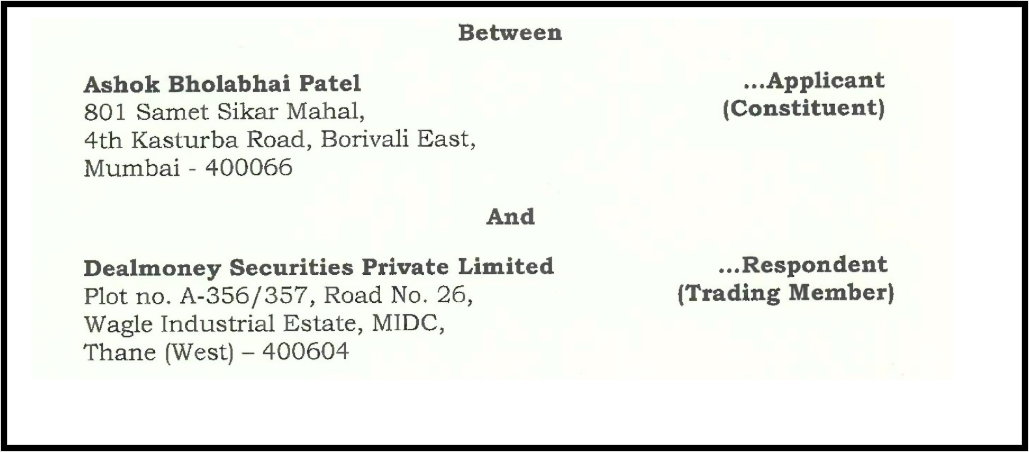
Ashok Bholabhai Patel took Dealmoney Securities Private Limited to arbitration because he realised he was being overcharged for both brokerage fees and taxes.
-
Case Background
Ashok Patel discovered his broker was not honoring the deal they had originally signed.
Even though they agreed on a simple flat brokerage fee, the broker was actually charging him per lot, which sent his trading costs really high.
He also found he was being overcharged on currency and security futures.
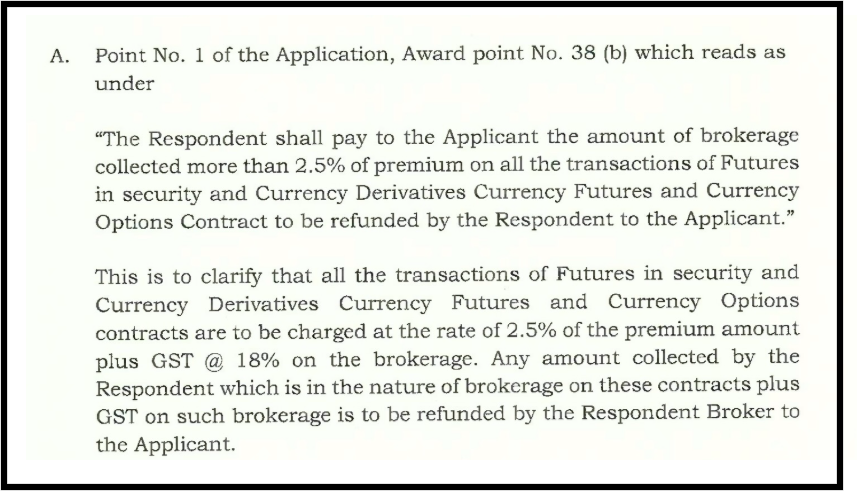
After winning his first case, he filed a second application to ensure he received a refund for the 18% GST the broker had collected on those excess brokerage charges.
-
Award
Refund Ordered: The arbitrator ordered the broker to refund every rupee collected above the 2.5% cap on futures and currency options.
Billing Correction: Dealmoney Securities had to refund the difference between the per lot charges they took and the ₹40 flat fee they were actually supposed to charge.
Tax Refund: Because the underlying brokerage was found to be wrong, the arbitrator ruled the 18% GST must also be refunded.
-
Key Takeaways
Flat vs. Per Lot is Huge: Always double-check your contract notes. A broker might promise a flat rate but bill you for every individual lot, which can drain your account.
Taxes Follow the Fees: If you get a refund for brokerage fees, you are legally entitled to the GST back on those extra fees as well.
Watch the Caps: There are strict limits on how much a broker can charge on certain premiums (like the 2.5% cap here). Anything over that belongs back to you.
How to File a Complaint Against a Stockbroker in India?
If your account looks like it is being churned for fees, do not stay silent. Follow these steps to fight back:
1. Gather Proof
Collect everything. You will need your contract notes, ledger statements, screenshots of communications, and your full trade history.
2. Contact the Broker
Raise a formal complaint with Dealmoney Commodities Pvt Ltd via their official support channels. Be clear, be firm, and attach your evidence.
3. File a Complaint on SCORES
Use the SEBI SCORES platform. This puts your grievance on the regulator’s radar and forces the broker to provide a documented response.
4. Approach Exchange Arbitration
If you still have not found a resolution, you can go to the stock exchange arbitration. They will review all the evidence and make a final, legal decision.
Need Help?
Making sense of complex trade history and ledger statements is difficult, especially when you suspect something is wrong.
If you see high deductions or trades you do not remember authorising, you need to check the details immediately.
Reach out to us. Our team helps investors check their contract notes and trading history to find these issues.
We analyse your records to pinpoint exactly where the excessive charges are coming from.
If needed, we also assist in drafting structured complaint and monitor the SEBI complaint status online.
Our team will also guide you through the entire arbitration process to help you get a resolution sooner.
Conclusion
Brokerage fees are part of trading, but charging excess brokerage fees is not.
Brokerage churning happens when a broker prioritises their own commissions over your financial success, and over time, it can destroy even a well-planned portfolio.
Protecting your wealth starts with staying informed.
Regularly review your statements, understand exactly what you are being charged for, and never hesitate to question why your account is so active.
By staying alert, you keep your money where it belongs.