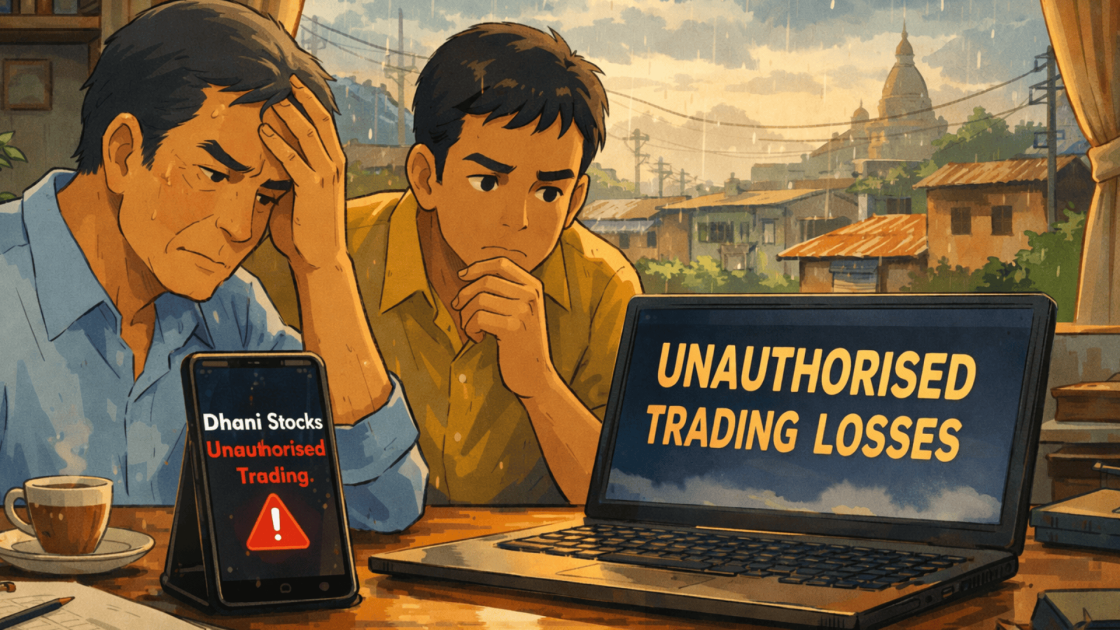
Unauthorised trading does not usually announce itself loudly. Most of the time, it slips in quietly, through a trade you do not even remember placing.
It can also be through a loss that does not line up with your thinking, or a position that simply does not feel like you have done it. It can be confusing.
Retail investors rarely assume wrongdoing at first. Instead, they doubt themselves. Maybe they clicked something by mistake. Maybe they forgot.
That self-questioning is completely normal, and it is also the reason many unauthorised trading disputes surface only after the damage has already happened.
Over the years, a section of investors has raised concerns about Dhani Stocks unauthorised trading.
The recurring complaints suggest certain gaps in execution clarity, user understanding, or post-trade communication.
This blog looks at those gaps closely. So, let us find out the pattern of Dhani Stocks unauthorised trading.
Dhani Stocks Overview
Dhani Stocks, now operating under the name Indiabulls Securities Limited, functions as the discount brokerage arm of the Dhani ecosystem. It offers technology-driven access to Indian stock markets.
Plus, it is a SEBI-registered broker and provides trading access on major exchanges, including the National Stock Exchange (NSE) and Bombay Stock Exchange (BSE).
The platform’s core services typically include:
- Equity trading in the cash and derivatives segments
- Currency derivatives trading
- Fully digital account opening with online KYC
Investors access these services mainly through:
- The Dhani Stocks mobile trading app, which is designed for order placement, real-time monitoring, and position management
- A web-based trading platform used for trade execution, reporting, and account review
The model is clearly built around self-directed investing.
There is minimal dependence on dealer interaction, and most decisions from entering trades to managing risk are expected to be taken directly by the investor via the platform.
Dhani Stocks Unauthorised Trading Complaints
Unauthorized trading refers to a situation where a broker, dealer, or intermediary executes trades in an investor’s trading account without the investor’s permission or instructions.
Complaint data helps move the discussion beyond individual stories and into broader patterns.
You can refer to the overview below of Dhani Stocks Unauthorised trading over recent years:
| Year | Total complaints | Unauthorised Trading Complaints | Percentage of Unauthorised Trading Complaints |
| 2021–22 | 100 | 7 | 7.00% |
| 2022–23 | 48 | 6 | 12.50% |
| 2023–24 | 40 | 1 | 2.50% |
| 2024–25 | 75 | 10 | 13.33% |
| 2025–26 | 51 | 13 | 25.49% |
The share of unauthorised trading complaints shows noticeable fluctuations over the years, rising sharply to 25.49% in 2025–26, the highest in the period shown.
This trend suggests that although total complaints vary year to year, unauthorised trading remains a recurring concern among investors and forms a growing portion of overall grievances.
Impact of These Complaints on Retail Traders
For retail traders, the consequences extend far beyond the disputed transaction.
On the financial side, unexpected trades can trigger losses, margin pressures, excess brokerage, or forced exits that were never part of the investor’s plan.
These effects often unfold quickly, and leave little room for corrective action.
The emotional impact tends to last longer. Investors start monitoring their accounts more anxiously.
They hesitate before placing new trades. Some cut back sharply, and some step away from trading altogether for months.
What complicates matters is that many investors initially blame themselves. That hesitation delays formal action, which can weaken the ability to resolve disputes effectively.
When Can Action Be Taken Against A Broker?
There is a widespread assumption that if a trade appears in your account, responsibility automatically rests with you. That is not always true.
There are certain cases when you can take action against the broker, such as:
-
Absence of Clear Pre-Trade Authorisation
Brokers can execute trades only after they receive clear, verifiable instructions from clients. This could be through system logs, recorded calls, or written communication.
If they can not produce such proof, you can question the legitimacy of the trade.
-
Trades Beyond the Investor’s Stated or Implied Scope
Even where some consent exists, it has boundaries. Trades that significantly exceed an investor’s usual risk level, quantity, or pattern, without clear discussion, can still raise accountability concerns.
-
Failure to Produce Records During a Dispute
Once a complaint is raised, explanations alone are insufficient. The broker must support their position with concrete records. Missing or incomplete documentation weakens their defence.
-
Reliance on System Glitch as Justification
Just because a system places a trade doesn’t mean the investor actually wanted it. Trading software is only a tool. It cannot decide its intent on its own. It is the broker’s responsibility to make sure the system does not place trades unless the investor has clearly agreed to them.
If your broker blames a system glitch, it is your right to take action.
How To File a Complaint Against a Stockbroker?
When an unfamiliar trade appears in your account, it is normal to feel confused. That is understandable. But resolution depends on calm, structured steps, such as:
Step 1: Pause Trading and Preserve Records
Before engaging in debate, secure the facts. Avoid placing further trades. Download and save trade histories, contract notes, margin reports, ledger statements, and app alerts.
These records are the foundation of any complaint.
Step 2: Contact The Broker
Write to your broker, and when contacting the broker, avoid asking why something happened. Instead, ask how it was authorised.
Request evidence such as order logs, timestamps, and any recorded instructions. This keeps the discussion grounded in facts.
Step 3: Escalate the Complaint Through SCORES
If the broker’s response is unsatisfactory or the issue still remains unresolved, you can file a complaint with SEBI through the SEBI Complaints Redress System.
By filing a complaint with SEBI through SCORES, investors can formally escalate their issue to the regulator.
If the broker’s responses are unclear, incomplete, or delayed, raising a complaint with SEBI on the SCORES platform helps create a formal regulatory record.
Step 4: Consider Exchange Grievance Redressal and Arbitration
If the issue is still not resolved, you can take the complaint to the stock exchange’s grievance system. If there is disagreement over what actually happened, the matter can go to arbitration with the relevant stock exchange.
In cases where the complaint involves financial loss or broker negligence and still remains unresolved, you can proceed with arbitration by filing a complaint through SMART ODR.
This platform enables investors to formally resolve disputes with market intermediaries through the arbitration mechanism.
Need Help?
Many investors sense that something is not right but struggle to articulate it.
We help you by:
- Carefully going through trade records to understand how and when each order was placed.
- Spotting gaps where what the system shows does not match what the investor actually intended.
- Organising documents and records so the issue is easy to explain and understand.
- Writing clear complaints and follow-up responses at each escalation stage.
- Guiding investors step-by-step through SEBI, exchange, and arbitration processes.
- Monitoring the complaint status at SEBI.
Our objective is clarity and resolution. So, do not delay further. Reach out to us now.
Conclusion
Unauthorised trading concerns involving Dhani Stocks are not about constant wrongdoing. In most cases, they come from how rushed app-based trading can get.
When trades happen at that pace, misunderstandings are almost bound to happen.
What really makes a difference later is whether they noticed the issue in time and whether they raised it before too much damage was done.
For a retail investor, the hardest part is that uneasy feeling when you look at your trades and think, “I don’t remember saying yes to this.”
Once that doubt sets in, trusting your own account becomes difficult, and that loss of confidence can linger far longer than the loss itself.