
Quick Summary
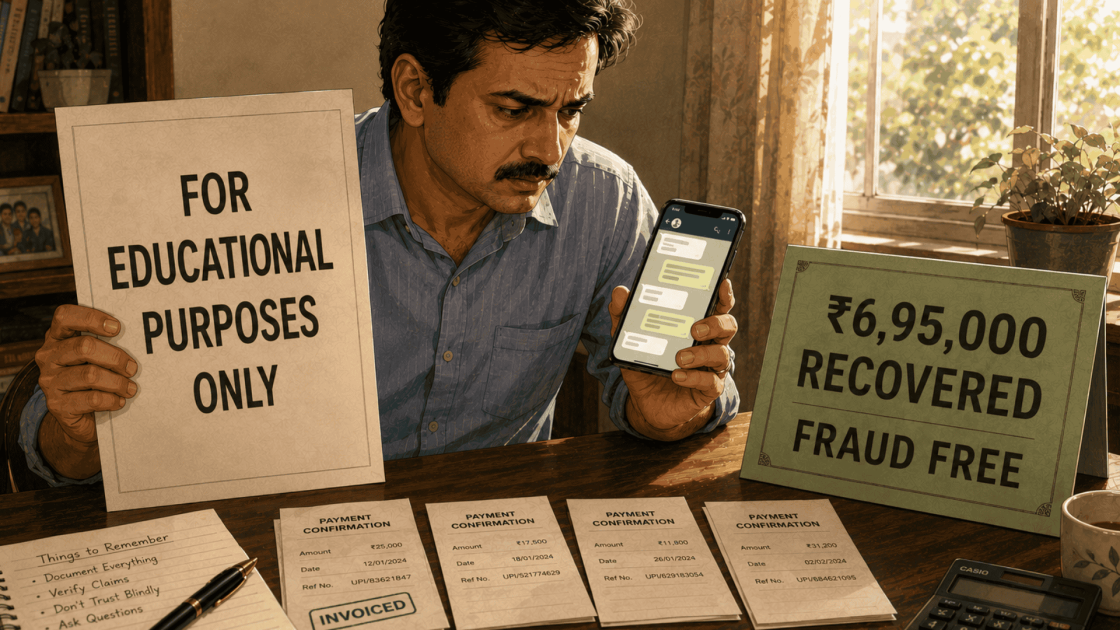
Kunal Deshmukh (name changed) is from Nashik, Maharashtra. He signed something called a learning consent form. What he actually received was months of live trading instructions and a growing pile of unexplained charges. A firm registered as a Research Analyst had used a fake demo profit to sell him one escalating package after another, charging unexplained fees only after his winning trades, all while hiding its advisory role behind that educational consent form. His initial claim came to ₹7,50,000, covering undocumented fees and the trading losses that followed. The case went through SEBI SCORES after a formal legal notice, closing with a recovery of ₹6,95,000.
Kunal(name changed) received an unsolicited call from a representative of a firm registered with SEBI as a Research Analyst. Before he paid anything, he was shown a demo trade on the representative’s own system.
That demo showed a profit of about six and a half thousand rupees. No capital of his was ever at risk in that demo. It existed purely to prove the firm could deliver, and it worked.
On the strength of that single controlled result, he was pushed toward a monthly package worth thirty-five thousand rupees, then a yearly package at three lakh rupees, then a further package priced at six lakh rupees once he was already trading.
A Form That Called Itself Education
The only document Kunal ever signed was titled as a learning consent form. It described the relationship as educational, with no guarantees tied to outcomes and no advisory relationship implied.
What he actually received was nothing like education. He was asked directly how much capital he had available, then instructed to buy specific lot quantities on specific days.
Personalised instructions built around one client’s own capital are the function of a licensed Investment Adviser, not a Research Analyst. The education label did not change what was actually happening on WhatsApp.
Anyone who signed something similar while receiving live trade calls can lodge a complaint against a research analyst using the same mismatch between the document and the conduct.
Fees That Only Appeared When He Won
Once trading began, a strange pattern emerged. On days with no profit, no charge was applied. On days with a profit, an additional fee showed up, described only as a senior support charge or a profit realisation fee.
The amounts varied from trade to trade with no formula ever explained. No percentage was disclosed in advance. No written fee schedule existed anywhere in the relationship.
Over less than a month, Kunal paid a total of ₹7,65,493 to the firm and its related entities. Only ₹1,80,000 of that was ever invoiced. The remaining amount, close to three-quarters of everything he paid, has no documentation at all.
Losses That Followed The Same Instructions
Trading on the firm’s recommendations over roughly four weeks left Kunal with a realised loss of about ₹1,75,000. Positions were large, expiry timed, and repeatedly moved past their own stop loss levels.
Even after the losses were clear, the response was not caution. He was offered the six lakh rupee package as the next step, positioned as access to even better trades.
The Recovery Strategy: How Our Team Did It
The gap between the education label on paper and the advisory conduct in practice became the center of this case. So did the sheer scale of what was never invoiced.
Step One: We Reconstructed The Full Payment Trail
Every transaction across multiple payment routes was compiled into a single ledger and compared against the handful of invoices Kunal had actually received.
Step Two: We Separated The Document From The Conduct
The learning consent form was treated as evidence in itself. A document that disclaims advisory status while its author gives live, personalised trade instructions works against the firm, not for it.
Step Three: We Mapped The Profit-Linked Fee Pattern
Days with charges were laid out next to days without them. The pattern tracked profit almost exactly, which made the absence of any written fee formula far harder to explain.
Step Four: We Flagged The Personalised Instructions As An IA Violation
Messages asking about available capital, followed by specific lot instructions, were compiled as a distinct violation separate from the fee and documentation issues.
Step Five: We Sent A Legal Notice With A Firm Deadline
Our notice detailed every violation with dates, evidence references, and the exact SEBI provision each one breached, giving the firm five business days to settle.
Step Six: We Filed Through SEBI SCORES
When the deadline passed without resolution, our team filed a grievance through SEBI SCORES, attaching the payment trail, the consent form, and the WhatsApp instructions together.
Charged Fees You Never Agreed To In Writing? Our Team Can Help
We trace every undocumented payment and every mismatched form into one clear timeline, then push it through a formal notice and SCORES until it is resolved. Register with us.
Final Outcome On Recovery After Undocumented, Profit-Linked Fee Extraction
Kunal’s claim stood at ₹7,50,000, covering the undocumented portion of the fees he had paid and the trading losses that followed the firm’s instructions.
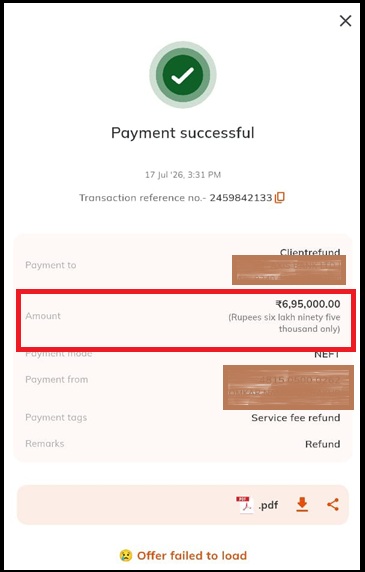
Through the SEBI SCORES process, the matter was resolved with a recovery of ₹6,95,000, restoring the large majority of what had been extracted without any written basis.
Conclusion
If a firm calls itself educational while giving you live trade instructions, or charges you only when you win, that pattern is documented and worth challenging directly.
Report. Recover. Stay Fraud Free.
Frequently Asked Questions
No. What matters is the actual conduct. Personalised trade instructions remain personalised advice regardless of what the signed document calls itself.
No. Any fee structure must be disclosed in writing before engagement begins. Charges applied only after wins, with no formula given, are a red flag.
A controlled demo carries no real risk and proves nothing about future results. Using one to induce a paid subscription is a recognised inducement tactic.
Save every payment confirmation you have, even without an invoice. Bank and payment app records can establish the trail on their own.
No. That question signals personalised advice tailored to your account, which sits outside what a Research Analyst is licensed to provide.





 Add us as a preferred source on Google »

