Imagine handing over your hard-earned money to someone you believe is a financial expert. Now imagine that person vanishing with your money or making disastrous investment decisions that wipe out your savings in months.
Sounds like a nightmare? For thousands of Indian investors, this nightmare is very real. Financial advisor complaints have become one of the fastest-growing grievances in India’s investment space. SEBI receives thousands of complaints annually against unregistered advisors, fraudulent schemes, and unethical practices that cost investors.
The situation becomes even more dangerous when you realise how easy it is for fraudsters to pose as genuine professionals.
With just a WhatsApp message, a convincing website, or an Instagram post promising “guaranteed returns,” they blur the line between real and fake, leaving many investors confused about a basic but critical point: are Financial Advisors regulated, and who is actually accountable when things go wrong?
In 2024-25, cybercriminals and fraudsters stole a staggering ₹22,842 crore from Indians through various scams, with investment fraud being among the top culprits.
The real danger? Most of these fraudulent financial advisors operate without any SEBI registration, meaning they’re completely outside the regulatory system.
But here’s the good news: you have powerful weapons to protect yourself, that is, knowledge and the proper complaint mechanism.
This blog will guide you to everything you need to know about financial advisor complaints, the types of fraud you should watch out for, and exactly how to fight back when things go wrong.
Types of Financial Advisor Complaints
Not all financial advisor complaints are created equal. Understanding the different ways advisors can mislead or defraud you is your first line of defense.
Let’s break down the most common types of complaints that investors file with SEBI:
1. Unsuitable Investment Recommendations
They remain the most common complaint category, accounting for about 21.3% of all misconduct cases. This happens when an advisor recommends investments that don’t match your risk tolerance, age, or financial goals.
For example, pushing a 60-year-old retiree to invest in volatile cryptocurrency or convincing a first-time investor to put their entire savings into penny stocks falls into this category.
The advisor knows these recommendations are risky for you, but pushes them anyway, often because they earn higher commissions.
2. Misrepresentation and outright fraud
It represents the second-largest complaint category at 17.7% of cases. This includes advisors making false claims about their qualifications, exaggerating investment returns, or promising “guaranteed profits.”
One of the most dangerous tactics is the “guaranteed returns” tra,p which is a red flag that immediately screams fraud. No legitimate financial instrument can guarantee returns without risk, yet thousands of investors fall for this deception every year.
3. Unauthorized trading
These are equally devastating. Churning occurs when an advisor executes excessive trades in your account primarily to generate commissions rather than to benefit your portfolio.
You see your account statement filled with constant buying and selling, transaction fees eating away your returns, and yet your advisor conveniently explains it all as “market strategy.” This practice breaches fundamental fiduciary duties and can destroy your wealth systematically.
4. Omission of key facts and inadequate risk disclosure
These represent another critical category. Your financial advisor might hide the real fees you’re paying, downplay investment risks, or fail to disclose conflicts of interest.
Perhaps they recommend a mutual fund that also pays them high commission and they never mention it. This deceptive practice keeps you in the dark about crucial information needed to make informed decisions.
5. Unregistered investment advisory activities
These have exploded in recent years. These advisors operate outside SEBI’s regulatory framework, meaning they have zero accountability.
They often charge substantial fees while providing advice that’s either non-existent or dangerously speculative, all without any regulatory oversight.
Real Cases of Financial Advisor Complaints in India
Understanding what happened to real people helps you recognize dangers before they affect you. Here are landmark cases that changed India’s financial advisory landscape:
1. The Option Research Consultancy Fraud: ₹30.39 Lakh Refunded
In 2022-23, SEBI cracked down on optionresearch.in, a fraudulent website offering illegal investment advisory services. The platform promised guaranteed returns and charged fees for advice that are both prohibited under securities laws.
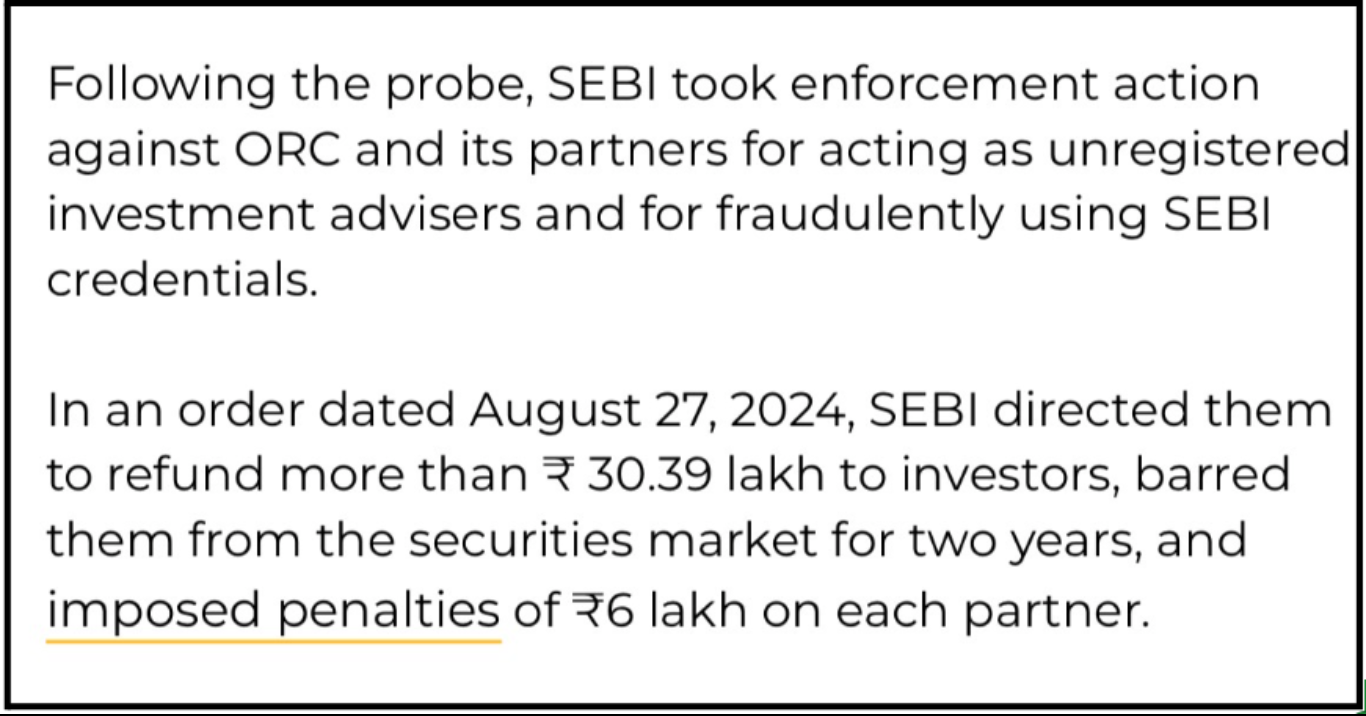
The masterstroke of fraud? The operators fraudulently used the SEBI registration number of a legitimate registered analyst, Purooskhan, to mislead investors into believing the platform was SEBI-certified.
The scheme worked until investors started reporting heavy losses after following the platform’s advice. SEBI’s investigation revealed that Option Research Consultancy, operating as an unregistered firm, had defrauded multiple investors.
In its August 2024 order, SEBI directed the firm to refund ₹30.39 lakh to investors, barred the partners from the securities market for two years, and imposed penalties of ₹6 lakh on each. Purooskhan’s registration was cancelled for negligently sharing his SEBI credentials.
2. The Avadhut Sathe Trading Academy: ₹546 Crore Unlawful Gains
This case became a landmark example of SEBI’s crackdown on influencers. These were individuals with massive social media followings who pose as financial experts.
Avadhut Sathe, a popular influencer, operated his trading academy by offering unregistered investment advice disguised as “educational content.”
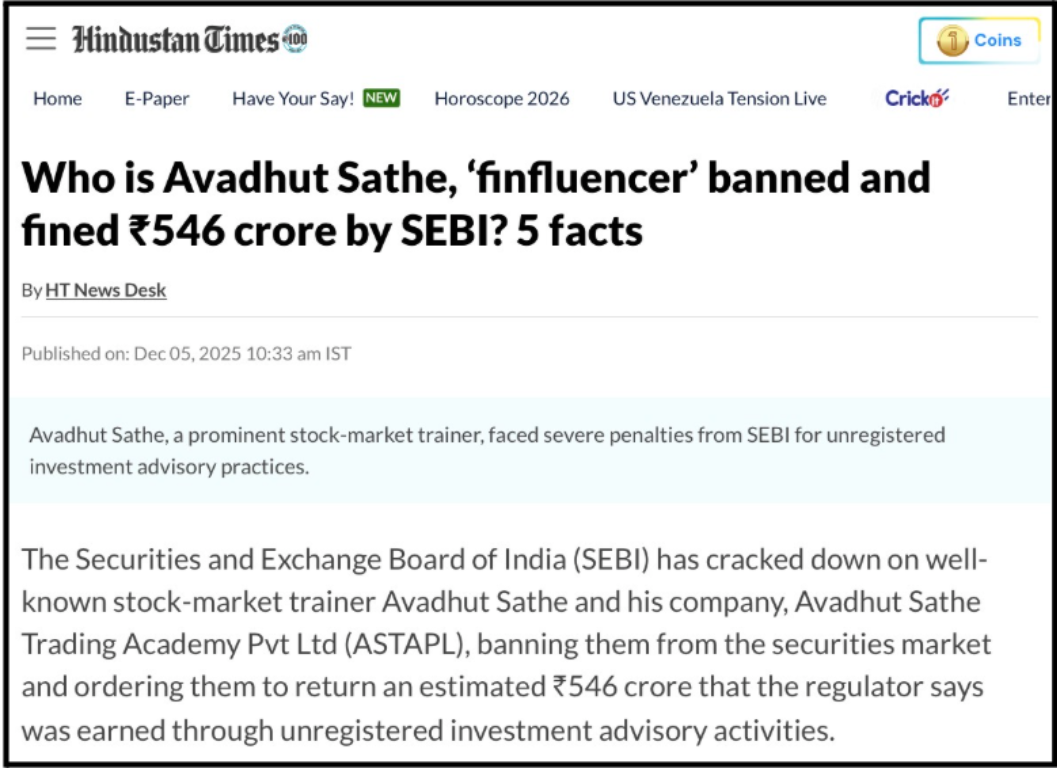
His course materials and videos contained specific buy-sell recommendations. In other words, actual trading calls, not education.
Investors paid substantial course fees (sometimes lakhs of rupees) expecting general stock market knowledge, but instead received direct investment advice from an unregistered advisor. When those recommendations went wrong, investors suffered catastrophic losses.
SEBI’s investigation concluded that the academy had collected approximately ₹546 crore in unlawful gains. The regulator barred Avadhut Sathe and his associates from the securities market and ordered them to return the entire amount.
3. The Hyderabad Student Who Lost ₹27.55 Lakh in 90 Days
In 2024, a 26-year-old student from Hyderabad was defrauded of ₹27.55 lakh in an investment scam that unfolded on WhatsApp.
A man named Sachin, claiming to be a credible financial advisor from Bangalore, contacted the student with an irresistible offer: “short-term investment opportunities with assured profits and no risks.”
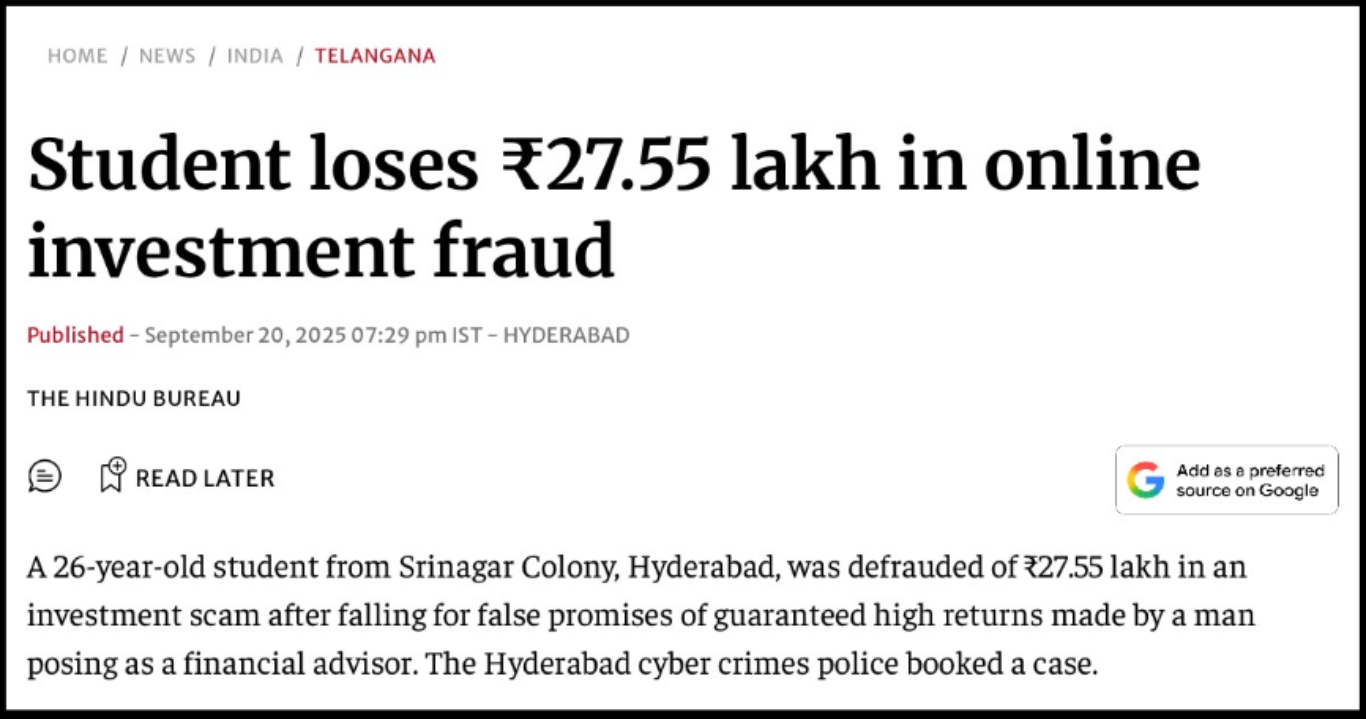
Convinced by these false promises, the desperate student borrowed money from friends and family and deposited ₹27,55,600 across multiple bank accounts as instructed by “Sachin.”
After the transfer, the promised returns never materialized. The advisor stopped responding to calls and messages, and the money, along with the student’s dreams vanished.
Hyderabad Cyber Crimes Police registered a case, highlighting a bitter truth: investment fraud happens quickly, silently, and often through platforms you trust.
4. Anand Rathi’s Fund Mismanagement: ₹5 Lakh Fine
Even major brokerage firms aren’t immune to complaints. In January 2025, SEBI fined Anand Rathi ₹5 lakh for serious violations.
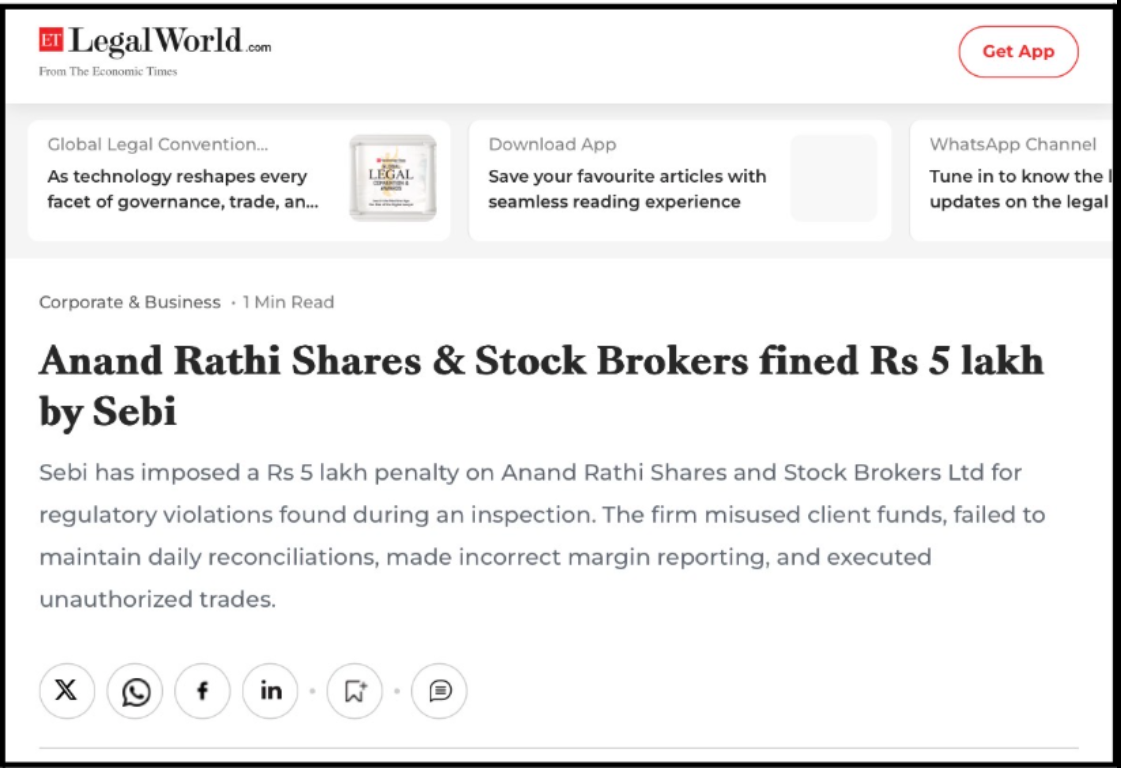
The violations included unauthorized trades in client accounts, misappropriation of funds ranging from ₹22 lakh to ₹16 crore, and failure to maintain proper documentation, like call recordings.
The case revealed how even established firms can engage in practices that harm investors’ trust and financial security.
How to Register a Financial Advisor Complaint?
If you feel trapped by an advisory company, don’t wait for “one more trade” to fix it. Report it step-by-step, like a clean case file.
Stop payment, stop access
Pause further payments immediately and do not share the following:
- OTPs
- remote-access app permissions
- UPI PINs
- screen-sharing during trading.
If they are “handling your trades,” take control back because the longer it continues, the harder it becomes to separate advice from execution and responsibility.
- Collect proof
Save every proof, such as:
- WhatsApp and Telegram messages
- call recordings (if available)
- payment proofs
- bank statements
- UPI screenshots
- invoices
- any “profit calculation” they sent
Also, write a simple timeline: date, what they promised, what you paid, and what happened after.
- Demand a written resolution first
Send a clear message/email:
“I want a refund/closure. Here are the payment details. Here is the problem.”
Keep it short and factual. If they threaten you, save that too because threats become evidence.
SCORES is SEBI’s online platform to lodge complaints related to the securities market.
Upload your proof, write the timeline, and clearly mention the exact issue: unregistered advisory, misleading profit-sharing promise, pressure trading, non-refund, or harassment.
For disputes that go beyond normal complaint handling, SEBI’s Smart ODR framework is meant to help resolve eligible disputes through an online dispute resolution process instead of going to court.
Use it when the complaint is stuck, and you need a structured dispute route with documentation.
- Use SEBI’s investor grievance guidance mindset
SEBI’s investor grievance information emphasizes that entities are expected to respond with an Action Taken Report within a defined timeline, and escalation routes exist when complaints are not resolved.
So don’t just “informally follow up” but track complaint numbers, keep closure emails, and escalate with proofs.
Need Help?
If you need help, you can reach out to us. We have a team that specialises in money lost to such traps.
We will guide you throughout the journey and support you in the arbitration in the stock market and the counselling process. We make sure that your journey is smooth and satisfactory.
Conclusion
Approximately 78% of registered investment advisors have zero complaints, but the remaining 22% account for massive complaint volumes.
This asymmetry tells you something crucial: while fraud exists, so do legitimate advisors. Your job is to distinguish between them, remain vigilant, and act decisively when things go wrong.
Financial advisor complaints often involve crores of rupees and shattered dreams, yet most victims remain silent, embarrassed by their mistake or overwhelmed by the process. Don’t be that victim.
The path to financial security isn’t complicated: verify credentials, understand fee structures, document all communications, and never ignore red flags like guaranteed returns or high-pressure tactics.
The key difference between a cautionary tale and a success story often comes down to one decision: taking action immediately instead of accepting your losses as “investment risk.”