
Quick Summary
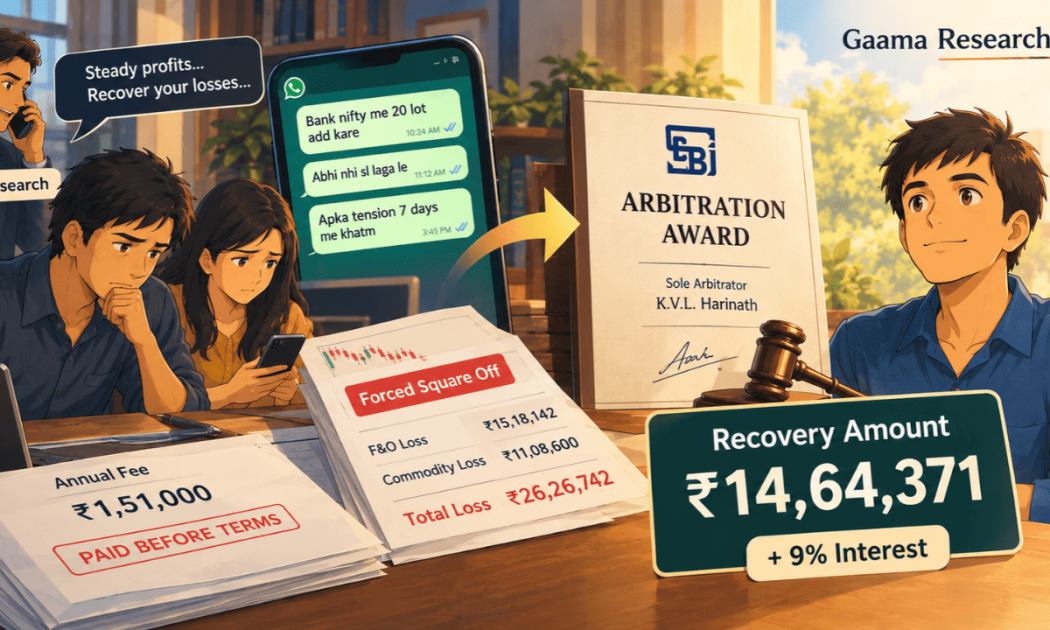
In this NSE SMART ODR arbitration, a retail investor from Dakshina Kannada, Karnataka, claimed ₹27,77,742 against Gaama Research Private Limited, a SEBI registered Research Analyst (Registration No. INH000013509). The claim covered ₹26,26,742 in trading losses and ₹1,51,000 in fees, with 18 percent interest and costs. Our team represented the claimant before a Sole Arbitrator (Case No. NSE-RA-2026-01-821087, seat Bangalore). The Tribunal awarded ₹14,64,371, being a full fee refund of ₹1,51,000 plus 50 percent of the net trading loss (₹13,13,371), with 9 percent simple interest from 10 August 2026.
This is not an anonymized story. The names, numbers, and reasoning come from a signed public award.
We are publishing it in full, including the parts where the Tribunal reduced the claim.
The title page of the award, signed by Sole Arbitrator K.V.L. Harinath.
How the Case Began: Cold Call, Recovery Promise and ₹1,51,000 Fee
In June 2025, a CRM named Mr. Devender from Gaama Research approached Irfan’s household. He said the firm could generate steady profits and recover past losses.
Irfan’s Zerodha account was operated by his wife, Ms. Afiya Banu. Gaama itself accepted that she subscribed on his behalf.
The Tribunal treated her acts and payments as his.
1. Fee Paid Before the Terms Were Sent
Between 24 and 28 June 2025, the family paid ₹51,000, ₹90,000, and ₹10,000.
Together, these made up ₹1,51,000, the full annual fee ceiling.

The terms of engagement were emailed only on 26 June 2025. Nobody ever signed them.
The first rupee had already been collected two days before.
2. Six Months of WhatsApp Trade Directions
From June to December 2025, Mr. Devender sent one to one WhatsApp directions on equity options, silver, gold, and copper. He named contracts, lot sizes, entries, exits, and averaging.
He also asked how much fund she had. Then he sized the next trade to the answer.
3. Three Forced Square Offs by Zerodha
The account lost ₹15,18,142 in F&O and ₹11,08,600 in commodities, net of profits.
Zerodha force closed positions for want of margin on 15 September, 20 November, and 21 November 2025.
Ms. Banu had even pledged gold to raise money for the account. Directions to add and enlarge positions kept coming.
How Our Team Built the Claim: 5 Arguments Before the Tribunal
The case was built on the firm’s own documents and its own WhatsApp messages. Irfan claimed ₹27,77,742, made up of the losses of ₹26,26,742 and fees of ₹1,51,000.
We argued five points before the Tribunal:
Step 1: Fee Collected Before Any Consent
Clause 1.12(b) of the Master Circular for Research Analysts bars both service and fee until the client’s consent on the terms is received. The fee came first.
Step 2: Personalised Advice Is Investment Advice
Messages sized to one client’s funds are not published research. We argued the firm crossed into Investment Adviser territory, which it was never registered to enter.
Step 3: Messages Promised Outcomes
We placed the dated WhatsApp record in front of the Tribunal, line by line, showing promises of certain profit and certain loss recovery.
Step 4: No Research Produced by the Firm
We asked for research reports, dispatch records, and client interaction records. The firm produced none at any stage.
Step 5: Firm Answers for Its CRM
Mr. Devender collected the fees and forwarded the firm’s bank details. We argued the firm is bound by what its own employee said in the course of its business.
Anyone holding a similar chat record can file a complaint against a research analyst before deciding between conciliation and arbitration.
Gaama Research’s Defence: 3 Arguments Heard by the Tribunal
The firm raised three main defences. Each one was heard in full.
Commodity losses are outside this forum. Gaama said gold and silver are not “securities”, so the Tribunal could not decide those losses.
The fee was within the ceiling. It said consent was sought, and that the client failed to return the signed form.
It also said advance fees were permitted.
Directions were permitted, and it gained nothing. It said lot sizes and real time calls are not advice.
It said it was not a broker, earned no brokerage, and could not be liable beyond the fee.
Gaama also described a later offer of six to eight months of free service as a settlement gesture made without prejudice.
Commodity Derivatives Losses: Why the Tribunal Rejected the Jurisdiction Objection
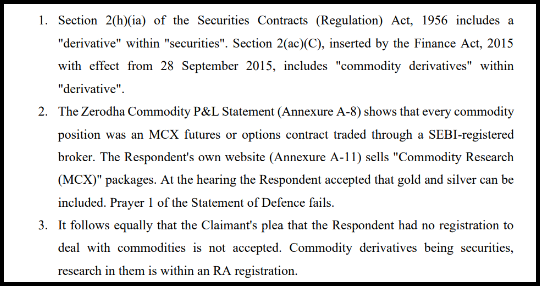
Section 2(h)(ia) of the Securities Contracts (Regulation) Act includes derivatives within “securities”. Section 2(ac)(C) includes commodity derivatives within derivatives.
Every commodity position in the Zerodha statement was an MCX futures or options contract. Gaama’s own website sells “Commodity Research (MCX)” packages.
At the hearing, it accepted gold and silver could be included.
The Tribunal rejected the objection. It also held that research in commodity derivatives sits within an RA registration.
Research Analyst Fee Refund: Why the Tribunal Ordered ₹1,51,000 Back?
The Tribunal found the total fee collected was ₹1,51,000, matching two invoices.
After examining the chronology of payments and regulatory requirements, the Tribunal set out three clear reasons why the entire amount had to be refunded:
1. Fee Collected Before Consent
The first fee was collected on 24 June 2025. The terms were emailed on 26 June.
The Tribunal said the duty to obtain consent first sits with the RA, not the client.
Gaama also contradicted itself. On 17 February 2026, it told the Exchange the client had reviewed and agreed to the terms.
Its defence said she refused to return the signed form.
2. Contract by Conduct Did Not Cure the Breach
The Tribunal held that a contract formed by conduct under the Indian Contract Act. Payment and rendered service were enough for that.
But it added that such a contract is not the documented prior consent Clause 1.12(b) requires. A contract under general law does not cure a regulatory breach.
3. Advance Fee Limit and the Non Refundable Clause
The firm’s own Most Important Terms and Conditions limited advance fees to one quarter. Invoice A/25-26/0151 ran fifteen months, which was more than a year.
The “Payment is non refundable” clause conflicted with Clause 1.9(g) of the Master Circular. The Investor Charter says an investor is not bound by any clause contravening SEBI regulations.
The Tribunal ordered the whole ₹1,51,000 back, not a proportionate share for the unexpired period.
Personalised Advice Without Investment Adviser Registration
The WhatsApp record was never disputed. When the Arbitrator asked Gaama’s representative directly, she said they were not denying the chat filed by the Claimant.
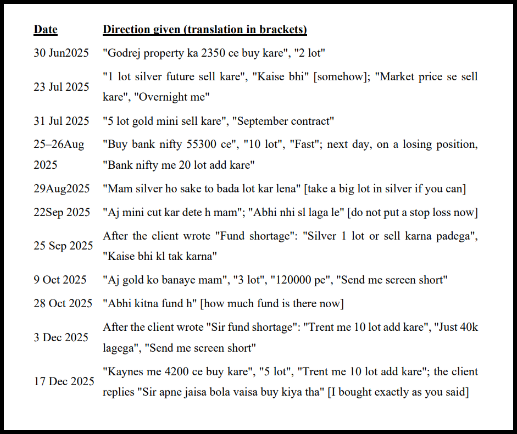
The chat showed instructions like “Bank nifty me 20 lot add kare” on a losing position. It showed “Abhi nhi sl laga le” on 22 September 2025, meaning do not put a stop loss now.
When the client wrote “Fund shortage,” the reply was “Trent me 10 lot add kare.”
The Tribunal called this “advice tailored to a particular client’s portfolio and circumstances”.
Regulation 3(1) of the Investment Advisers Regulations bars giving it without IA registration, which Gaama admittedly does not hold.
Building further on this lack of registration, the Tribunal closely examined the specific nature of the communications and the shifting defenses presented by the firm:
1. The Firm’s Own Description of Its Scope
The firm described its own scope as “what to trade, how to trade, executions, directions”. The Tribunal said that confirmed the finding.
Gaama produced no research report, no dispatch record, and no interaction record. The Tribunal drew an adverse inference that none existed.
2. Changing Stop Loss Explanations
At conciliation on the SMART ODR complaint, Gaama said a stop loss was given for every trade. In its defence, it said “in most instances”.
At the hearing, it said none was required.
The record showed a stop loss mentioned only rarely.
Assured Recovery Messages: What the WhatsApp Record Showed
Gaama’s defence denied any assurance and said there was no documentary evidence. The WhatsApp record said otherwise.
On 25 September 2025, the chat said “Apka tension 7 days me khatm”. On 27 September, it said “Apka loss cover hoga poora mam”, in ten days.
On 8 October, it said up to ₹4 lakh would be covered, and ₹2 lakh by the next day. On 3 December, it said the last gold trade had doubled and the same would happen again.
The Tribunal found these were statements of certain, quantified outcomes and recovery of past losses.
It held they are prohibited by Clauses 6 and 7 of the MITC and the advertisement code in Clause 11.1 of the Master Circular.
No Brokerage Earned: Why the Tribunal Rejected This Defence
Gaama argued it earned no brokerage, so it should not answer for losses. The Tribunal rejected this for three reasons.
Benefit is not an element of liability. Compensation under Section 73 of the Contract Act measures the loss from the breach, not the gain of the party in breach.
Gaama did benefit. It collected the full annual ceiling in four days against an invoice running fifteen months.
Its assurances kept the client subscribed and delayed any refund demand.
No brokerage aggravates the breach. Gaama could not see the margin it was exposing the client to, yet it directed sizes and averaging.
The three forced square offs were the result.
The “market risk” defence, the Tribunal said, belongs to an intermediary acting within its licence. It does not protect one that directs trades without the registration such direction needs.
The Tribunal also noted that the SILVER25DECFUT position alone lost ₹11,34,030.
It was taken on Gaama’s call and held for two months against repeated promises that recovery was days away.
Why Did the Tribunal Award 50% of the Net Trading Loss?
The Tribunal took the net realised loss of ₹26,26,742 from the Zerodha statements, ₹15,18,142 in F&O and ₹11,08,600 in commodities.
It used the net figure because profits on other calls had to be set off.
It then apportioned responsibility equally.
It said Ms. Banu placed every trade herself, could decline calls, kept adding funds, and set no stop losses of her own. An adult who trades leveraged derivatives accepts a share of the risk.
Against that, she was inexperienced and had pledged gold. She was met at every sign of hesitation with assurances of certain recovery.
Directions continued after she said her funds were exhausted.
Gaama was ordered to bear 50 percent. That came to ₹13,13,371.
Operative Award: ₹14,64,371 Payable With 9% Interest
The operative portion of the award is short.
The Tribunal rejected Gaama’s objection to jurisdiction over commodity derivative losses. It ordered Gaama to pay Irfan Shaikh Usman ₹14,64,371.
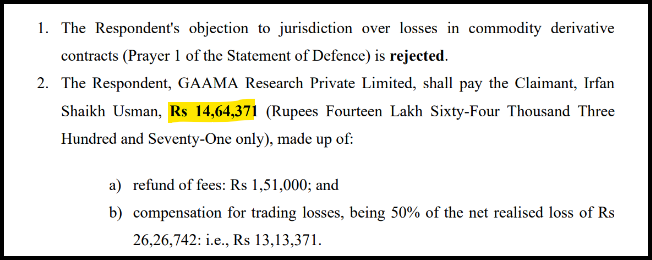
That sum is the ₹1,51,000 fee refund plus ₹13,13,371 as 50 percent of the net realised loss. Simple interest at 9 percent a year runs from 10 August 2026 to the date of the award.
Payment is due within 30 days of receipt of the award. If it is not paid, the principal carries further simple interest at 9 percent a year from the award date until payment.
Costs, including the arbitration fee paid by the Claimant, are shared equally.
A copy of the award was also directed to BSE Limited, as the Research Analyst Administration and Supervisory Body, and to SEBI.
Of ₹27,77,742 claimed, ₹14,64,371 was awarded, about 53 percent. The Tribunal declined the 18 percent interest rate as excessive and awarded 9 percent.
The operative portion, on page 12 of the award.
If you want to take a similar dispute forward, the usual starting point is a SCORES SEBI complaint, because SMART ODR follows the SCORES process.
Research Analyst Directing Your Trades? Get Help From Our Team
Irfan’s award rested on a dated WhatsApp record, contract notes, and the firm’s own invoices.
If a firm sized your trades and promised recovery, save every chat and statement today.
Register with us and we will take it forward.
Conclusion
This award shows what a well documented arbitration can do. The Tribunal refunded every rupee of the fee, because the money was taken before consent.
It also ordered Gaama to share the trading loss, because the firm had directed the trades and promised their recovery.
It also shows why the claim was not paid in full. The Tribunal found that the client’s side placed each order, could say no, and kept adding funds.
Hence the loss was split equally. Pleading mistakes, like a lot size and a mapped contract, did not defeat the claim.
The Tribunal relied on the primary records instead.
The practical lessons are plain. Keep the full WhatsApp chat in its original form. Download the broker’s profit and loss statement and contract notes.
Check the dates on every invoice against the dates of payment.
Report. Recover. Stay Fraud Free.
Yes. In this award, the Tribunal ordered the whole ₹1,51,000 back, because the fee was collected before the client’s consent was received. The Tribunal held commodity derivatives are securities under the SCRA, so losses on MCX futures and options fell within its jurisdiction. It found the firm’s directions caused the loss, but the client’s side placed every trade, could decline calls, and set no stop losses of its ow No. The Tribunal held that benefit is not an element of liability, and that absence of brokerage aggravated the breach. Payment is due within 30 days of receiving the award. Post award interest is waived if the whole sum is paid within that period.Frequently Asked Questions





 Add us as a preferred source on Google »