Trust is the foundation of any relationship between an investor and a stock broker. When you place trades through a broker, you expect that every transaction in your account happens only after you authorize it.
However, disputes sometimes arise. An investor may review their trading statement and notice trades they claim they never approved.
Situations like these often raise a serious concern in the stock market, unauthorised trading.
Unauthorised trading refers to trades that are allegedly executed in an investor’s account without proper consent.
At the same time, it is important to remember that a complaint alone does not automatically prove wrongdoing.
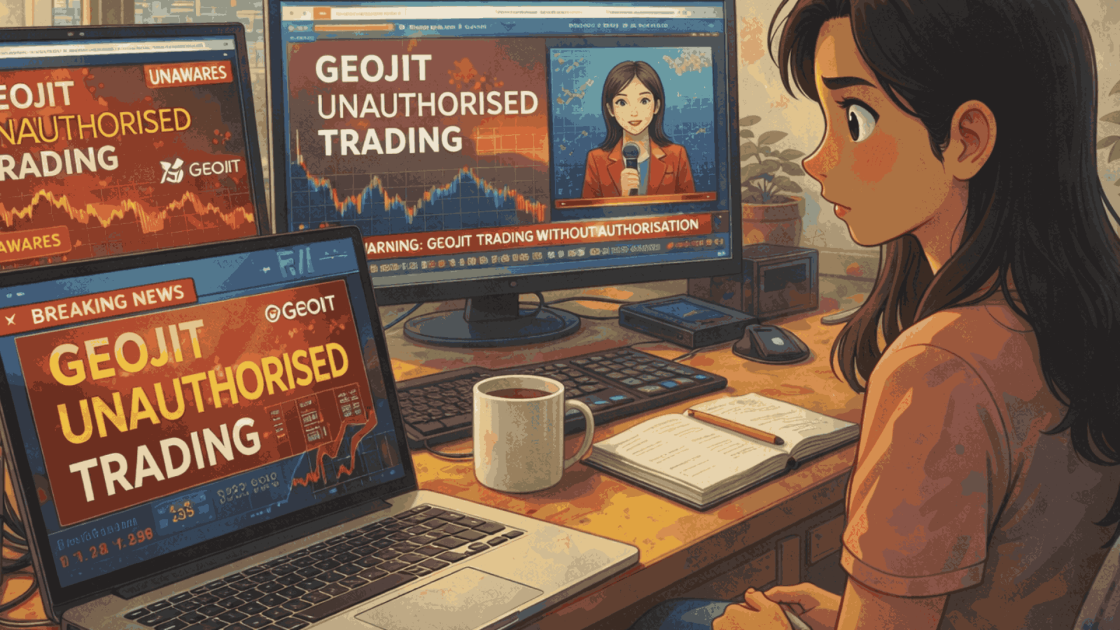
So when discussions around Geojit unauthorised trading appear, the key question becomes simple: what do the complaint records actually show?
To understand this better, it helps to examine complaint data published by the National Stock Exchange (NSE).
These reports provide insight into the types of issues investors have raised and how frequently such allegations appear.
Geojit Complaints
Geojit Financial Services Limited is a full-service brokerage firm that has been operating in the Indian capital markets for decades.
The company provides services such as equity trading, derivatives trading, investment advisory, and mutual fund distribution to a large base of retail and institutional investors.
Like most brokerage firms that manage thousands of trading accounts, Geojit also receives investor complaints from time to time.
These complaints may relate to various issues, including service delays, account disputes, or trading-related concerns.
Among the different categories of complaints reported by exchanges, one category that often attracts attention is unauthorised trading.
Before looking at the numbers, it helps to briefly understand what this term actually means.
Unauthorised trading generally refers to situations where an investor claims that a broker executed trades in their account without proper consent.
For example, a client may allege that a dealer placed trades without their instruction or executed transactions without clear authorization.
To understand how often such allegations appear in relation to Geojit, it is useful to examine complaint data published by the National Stock Exchange of India.
In these reports, Type IV complaints generally relate to allegations of unauthorised trading or misuse of funds and securities.
The following table summarizes the complaint data reported for Geojit over recent years.
| Year | Total Complaints | Type IV | % Type IV |
|---|---|---|---|
| 2020–21 | 24 | 2 | 8.33% |
| 2021–22 | 29 | 2 | 6.90% |
| 2022–23 | 31 | 1 | 3.23% |
| 2023–24 | 35 | 2 | 5.71% |
| 2024–25 | 41 | 1 | 2.44% |
| 2025–26 | 48 | 2 | 4.17% |
At first glance, these numbers may not appear alarming. In most years, Type IV complaints represent only a small share of the total complaints reported against the broker.
However, retail investors should avoid dismissing these numbers too quickly.
Even a small percentage can represent real disputes raised by investors who believe trades were executed in their accounts without proper authorization.
For the investor involved, the issue is rarely about percentages.
It is usually about unexpected transactions, financial losses, or confusion about how certain trades appeared in their account, highlighting the unauthorized trading risk that investors need to stay aware of.
Another important point to consider is that complaint statistics do not always capture every dispute that occurs in the market.
Some investors may resolve issues directly with the broker, while others may choose not to pursue formal complaints because the process can feel time-consuming or complicated.
At the same time, the presence of complaints does not automatically confirm wrongdoing.
When Can Action Be Taken Against a Broker?
Unauthorised trading allegations become serious when there is clear evidence that trades were executed without the investor’s consent.
Regulators and stock exchanges treat such situations seriously because they directly affect investor protection.
Under the framework established by the Securities and Exchange Board of India, stock brokers must maintain proper records to demonstrate how the client authorized every trade.
These records may include call recordings, order logs, written instructions, or confirmations generated through online trading platforms.
If an investor claims that someone executed trades without their consent, regulators and exchanges ask a straightforward question: Can the broker prove that the client authorized the transaction?
Regulators or stock exchanges may take action against a broker if evidence shows that the broker executed trades without proper authorization.
For example, regulators or exchanges may intervene in situations where:
- The broker executed trades without receiving any instructions from the client.
- Dealers executed transactions without recorded approval
- Brokers failed to maintain proper order records
- Client funds or securities were misused.
In such cases, stock exchanges may impose penalties, direct compensation through arbitration, or escalate the matter further depending on the circumstances.
At the same time, regulators and arbitration panels examine each case based on the available evidence.
If brokers provide order logs, call recordings, or communication records that show client approval, regulators may reject the allegation.
This is why maintaining proper documentation plays an important role in resolving disputes related to trading authorization.
How To Report A Complaint Against Broker?
If you believe unauthorised trading or any other irregular activity has taken place in your account, it is important to act promptly. Investors can report the issue by following these steps:
1. Contact the broker first
Start by raising the issue directly with your broker’s customer support or grievance redressal team.
Many disputes get resolved at this stage once the broker reviews the order records or trade confirmations.
2. File a Complaint with Stock Exchange
If the broker fails to resolve the issue, you can file a complaint in BSE through the investor grievance portal of the National Stock Exchange of India or the exchange where the broker holds registration.
Investors can also register complaints through the SCORES system maintained by the Securities and Exchange Board of India.
This platform allows investors to track the status of their grievance and forwards the complaint to the concerned intermediary.
4. Arbitration in Stock Market
If the complaint remains unresolved even after exchange intervention, investors can initiate arbitration.
In this process, an independent panel examines evidence such as order logs, call recordings, and contract notes before issuing a decision.
Need Help?
If you believe that unauthorised trading has taken place in your account, you do not have to deal with the situation alone.
Many investors struggle to understand trading records, contract notes, and order logs when disputes arise with a broker.
Without proper guidance, investors may struggle to determine whether they authorized the trades or whether the broker acted without clear instructions.
If you are facing a similar situation, Register with us and our team will guide you in taking the next steps.
With the right approach, investors can file complaints through the appropriate regulatory channels and pursue recovery if the evidence shows that someone executed unauthorised trades in their accounts.
Conclusion
Unauthorised trading allegations are serious because they affect investor trust in the financial system. At the same time, complaint statistics alone do not always provide the full picture.
In the case of Geojit unauthorised trading complaints, the available exchange data shows that a small number of complaints have been filed over the years.
While these numbers do not automatically confirm wrongdoing, they do highlight that disputes related to trading authorization have surfaced from time to time.
For retail investors, the most important takeaway is to stay informed and monitor trading activity regularly.
Reviewing contract notes, trade confirmations, and account statements can help investors detect unusual transactions early and address concerns before they escalate.
Remaining attentive and informed is one of the most effective ways investors can protect themselves in the stock market.