
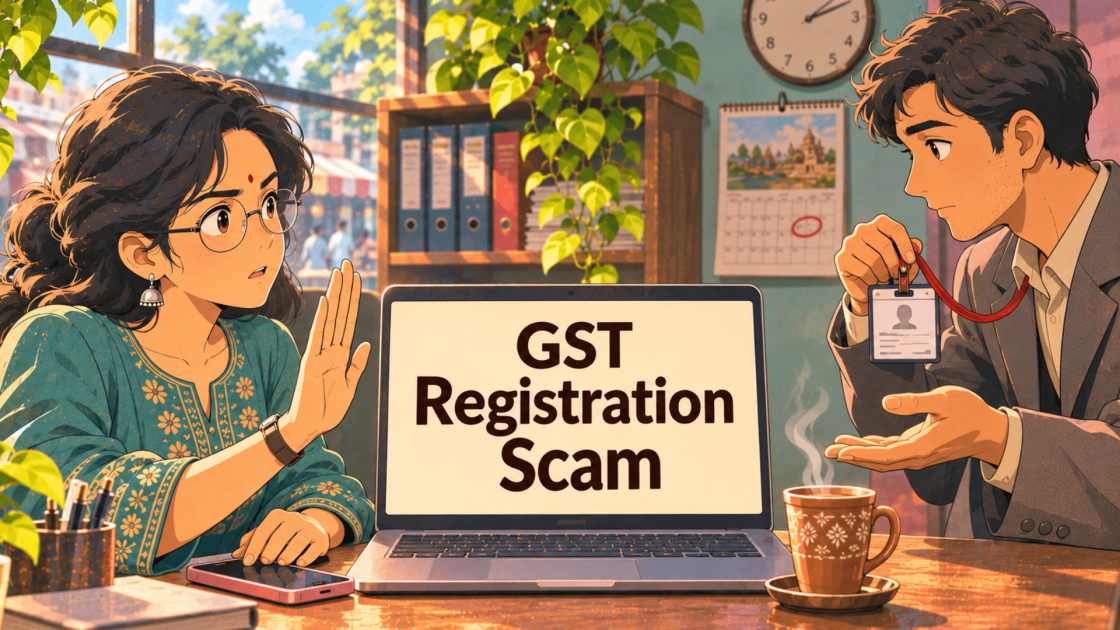
Quick Summary
A GST registration scam usually starts with an agent, caller or visitor who promises fast approval, a “department fee” or a way out of a notice. Reported cases from Indore, Mumbai and Bengaluru show the same pattern. Someone claims official authority, takes cash, and leaves. This article explains how these scams work, how to spot a fake GST officer, how to check a GSTIN, and where to report if you already paid. Read this before you pay anyone a rupee.
If you searched for GST registration scam, chances are someone has asked you for money in the name of the GST department, or you are afraid they might.
It usually begins with a friendly call. An agent says your registration will clear faster with a small payment, or a stranger walks into your shop with an ID card and talks about a raid.
By the time you double check, the cash has gone and the phone number is switched off.
You are not alone. Police in several cities have reported cases like this over the past few years, and the stories look surprisingly alike.
Let us walk through how the fraud works, how to spot it early, and what to do if you have already paid.
What Is a GST Registration Scam?
A GST registration scam is any trick that uses the GST registration process to take your money or your identity.
The person may promise to get you registered, pretend to be a GST officer, or offer to “help” with your account.
The story changes, but the goal stays the same. They want cash from you, or access to your GST login.
It usually reaches people in one of three ways.
- Fake agent. Promises quick registration or approval for a fee, takes the money and delivers nothing.
- Fake officer. Claims to be from the GST department, talks about a raid or penalty, and asks for payment to settle it.
- Borrowed login. Offers help with a loan or filing, collects your certificate, login or OTPs, and then misuses your GST number.
None of this is rare. Going by the cyber crime latest data, India logged over 21 lakh cyber fraud complaints in 2025, and fake agents and fake officers sit inside that number.
It also helps to know how genuine registration works, because that takes the scammer’s advantage away.
You apply on the government GST portal.
Part A collects your PAN, phone number and email and gives you a temporary reference number.
Part B is the full application, followed by Aadhaar authentication.
You then receive an Application Reference Number (ARN) by email and SMS, and you can track it on the portal.
The portal’s user guide lists no registration fee. So when someone asks for money to approve or speed up your application, that payment is not a government step.
Paying a tax professional to file the application for you is a different matter, and it is perfectly legal.
The warning sign is money for approval, speed or protection from a notice.
GST Scam Cases in India
Warning lists help, but a real case sticks in the mind far better.
The four reports below come from different cities and different years, yet they follow almost the same script.
Someone claims to speak for the GST department, or promises to sort out a registration, and then asks for cash or login details.
Each case sits under the form it matches from the section above, so you can find the one closest to your own story.
The accused in each report remain accused unless a court says otherwise.
1. Indore GST Registration Fraud Case
This case follows the paid shortcut pattern, where the victim pays first and waits for a registration that never comes.
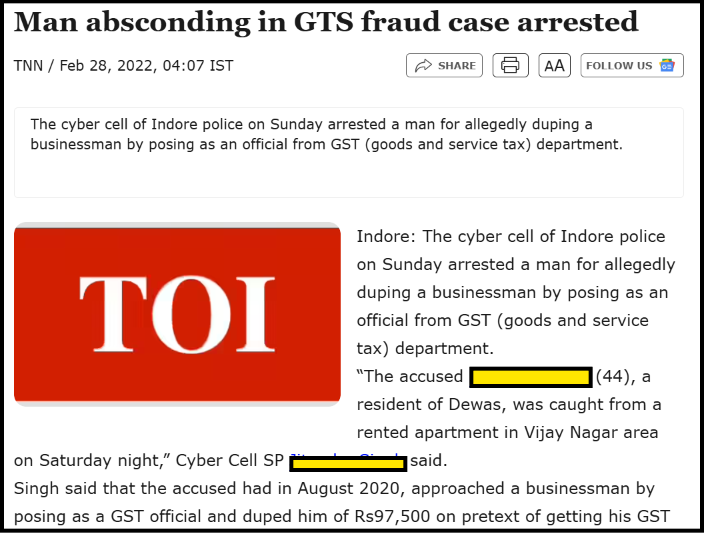
In February 2022, the Times of India reported that Indore Cyber Cell had arrested a man accused of posing as a GST official.
Police alleged he took ₹97,500 from a businessman in August 2020 on the promise of arranging GST registration.
The report mentions sections of the Indian Penal Code on cheating and impersonation, along with the IT Act.
It does not say how the payment was made or whether the money came back.
2. Mumbai Fake GST Officials Raid Case
This one matches the fake officer form, and it shows how quickly an ID card can open a door.
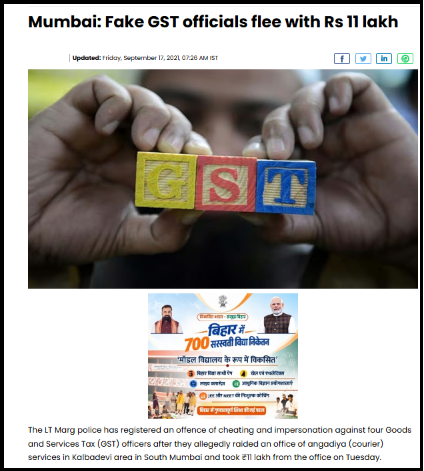
In September 2021, the Free Press Journal reported that four people posing as GST officials entered a courier office in Kalbadevi, Mumbai.
They claimed a raid and showed ID cards.
The report says they left with ₹11 lakh in cash.
LT Marg police registered an FIR under Indian Penal Code sections on cheating and impersonation.
3. Bengaluru Fake GST Officers Extortion Case
Five years later, a similar pattern showed up in Bengaluru, this time with people who worked close to the department.
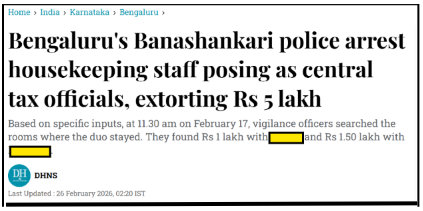
In February 2026, a report citing NewsFirstPrime said Banashankari police arrested two men who allegedly posed as GST Intelligence Wing officers.
Police said the two worked as outsourced housekeeping staff at a GST office.
They allegedly showed fake ID cards and threatened raids on gutkha traders in Peenya, collecting about ₹5 lakh.
A GST Superintendent filed the complaint, and police said they were checking whether anyone helped make the fake IDs.
4. Mumbai GST Login Misuse Case
This last case is the borrowed login at work, and nobody here paid a fee at all.
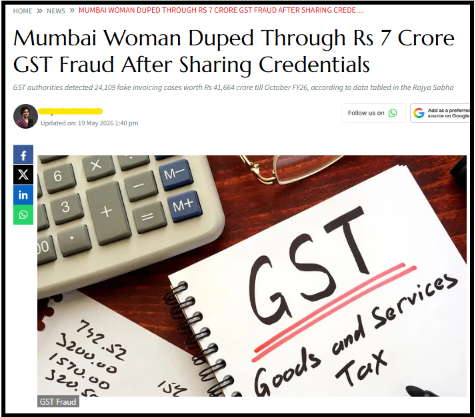
In May 2026, Outlook Money reported that a Mumbai business owner allegedly shared her GST certificate and login details with a man who had offered to help with a business loan.
Police say he later collected OTP details and the SIM card linked to the GST account.
Police allege he then created fake invoices in her company’s name, which left a GST liability of nearly ₹7 crore.
She grew suspicious after a notification that her GST password had changed.
Bangur Nagar police registered a case, and the report mentions no arrest.
Four cities, four stories, one pattern. Someone offered official help, and the victim paid in cash or in trust.
Also Read: Fake Invoice Scam India, a look at how shell firms allegedly use fake invoices to claim GST input tax credit.
How to Identify a Fake GST Officer?
A stranger at your counter saying “GST department” is stressful enough.
The trick is to slow the moment down, and these four signs help you do that.
- They want cash on the spot. Genuine tax demands come through written notices and the official portal, not money handed over at your door.
- They rely on an ID card alone. A card proves very little. CBIC has warned that fake summons use the CGST logo and made up Document Identification Numbers.
- They create panic. Raids, arrests, a sealed shop, all promised within the hour so you do not stop to think.
- They refuse to wait. A genuine officer lets you call your tax consultant and check the notice first.
In January 2026, the Free Press Journal reported that CBIC asked taxpayers to check the DIN printed on every notice or summons against the CBIC portal.
If the DIN is genuine, the portal confirms it.
The Mumbai and Bengaluru cases above show these signs in action.
Both visits began with an ID card and ended with cash.
How To Check if a GST Number Is Real or Fake?
Sometimes the doubt is about a number, not a person.
A supplier, an agent or a new client hands you a GSTIN, and you want to be sure it belongs to a real business before you pay or sign.
These quick checks catch most fake numbers in a couple of minutes.
- Count 15 characters. A genuine GSTIN is always 15 characters long.
- Match the state and PAN. The first two digits show the state, and the next ten are the holder’s PAN.
- Search it on the portal. Type the number into the Search Taxpayer option on the GST portal and compare the legal name, trade name and registration status.
- Ignore WhatsApp certificates. An image is easy to edit, and the portal record is the one that counts.
- Track your own application. Use Services, then Registration, then Track Application Status with your ARN. An agent needs nothing more than that.
Can Someone Misuse a GST Number?
Not every scam asks you for money.
Some quietly borrow your identity, and you only find out when a notice or a password alert lands in your inbox.
It can happen when someone gets hold of your GST certificate, login details or the OTPs that reach your phone.
The Mumbai login misuse case above shows how little a helper needs to build a liability in someone else’s name.
Three habits protect you from this kind of misuse.
- Keep your login to yourself. A loan agent or filing helper does not need your password.
- Keep control of your SIM and email. Your registered phone and email receive the OTPs, so treat them like a cheque book.
- Check your filings often. Look at your invoices and returns every month, and report anything you did not create.
Also Read: Mumbai College Girl GST Scam, a reported identity theft story where a student’s Aadhaar and PAN were allegedly used to register a firm she never ran.
Paid for GST Registration and Lost Money? What To Do Now
If you already paid, the first few hours matter more than the next few weeks.
Here is a practical order that protects your evidence and keeps your options open.
- Stop paying. Ignore requests for a “release fee”, “clearance charge” or “penalty settlement”. They only grow.
- Save everything. Keep call logs, WhatsApp chats, payment receipts, the UPI or bank reference number, and any photo of an ID card or certificate.
- Call your bank right away. Give the transaction details and ask them to flag the receiving account.
- File a report. Use the routes in the next section, and file one even if the amount feels small.
- Secure your GST account. If you shared a login or OTP with anyone, change the password and check your filings.
Most of these agents collect their fee on UPI.
If yours did, knowing how a UPI cyber crime complaint reaches the bank can speed up step three.
No one can promise your money will come back, and anyone who does is part of the problem.
What you can control is how fast and how clearly you report.
Paid an agent for GST registration and now cannot reach them?
Our team reviews GST agent and fake officer fraud where the loss is above ₹30,000. Send us your payment proof, chats and call details, and we will look at your case. Register with us.
How To Report Fake GST Registration?
Where you report depends on how the fraud reached you.
A phone call or online payment goes one way, and a person at your shop goes another.
The four steps below follow the order that works for most victims, so start with the one that matches your case and then finish the rest.
1. Report an Online or Phone Payment Right Away
Report it on the national cybercrime portal or call the helpline as soon as you can.
Early reports give banks the best chance to act on the receiving account.
Many people stall at the portal’s first screen, so it helps to read how to file a cyber crime complaint before you start and keep your proof in order.
2. File an FIR if Someone Visited You
File an FIR at your local police station, the way the Mumbai trader did in the Kalbadevi case.
Carry your ID, payment proof and any photo of the card the person showed.
3. Check Any Notice or Summons Before Replying
Check the DIN on the notice first.
If it does not match, write to your local GST office with a copy of the notice and the caller’s number.
4. Keep Every Complaint Number Safe
Whichever route you choose, keep a copy of every complaint number.
You will need it if the bank or police ask for it later.
Conclusion
A GST registration scam rarely looks like a scam at the start. It looks like a helpful agent, a polite caller or an official ID card.
The reported cases from Indore, Mumbai and Bengaluru share one thing.
Someone claimed to speak for the GST department and asked for cash or credentials.
The official portal lists no registration fee, and genuine notices carry a DIN you can check.
Those two facts alone defeat most of these tricks.
If you already paid, save your proof, call your bank and report on the cybercrime portal as early as you can.
Report. Recover. Stay Fraud Free.
Frequently Asked Questions
The GST portal's registration guide lists no registration fee. A tax professional may charge for filing on your behalf, and that is a separate service fee.
Ask for the written notice and check its DIN on the CBIC portal. Call your tax consultant before you pay or sign anything.
It can happen when someone gets your PAN, documents or login details. While applying, the portal shows GSTINs linked to your PAN, so check that list and report numbers you do not recognise.
Stop all further payments and save every receipt and chat. Call your bank, then report on the cybercrime portal or the cyberfraud helpline.
Log in to the GST portal, go to Services, then Registration, and open Track Application Status. Use the ARN you received by email or SMS.



 Add us as a preferred source on Google »