
You place a trade with Upstox expecting it to execute smoothly.
Instead, you notice an unexpected charge, face difficulty withdrawing funds, or feel your concern isn’t being addressed despite repeated follow-ups.
Situations like these often lead investors to search how to complaint against Upstox so they can understand the correct grievance process.
This guide explains the structured complaint process available to investors, the role of SEBI’s grievance mechanisms, and the steps you can take if your concern remains unresolved.
How to Complaint Against Upstox Online?
Upstox is a SEBI-registered stockbroker and a member of recognised stock exchanges.
As a regulated intermediary, it is required to maintain an investor grievance redressal mechanism and comply with SEBI’s regulatory framework.
This means investors have access to structured escalation mechanisms if their concerns remain unresolved.
Don’t scatter your energy across random emails and social media threads.
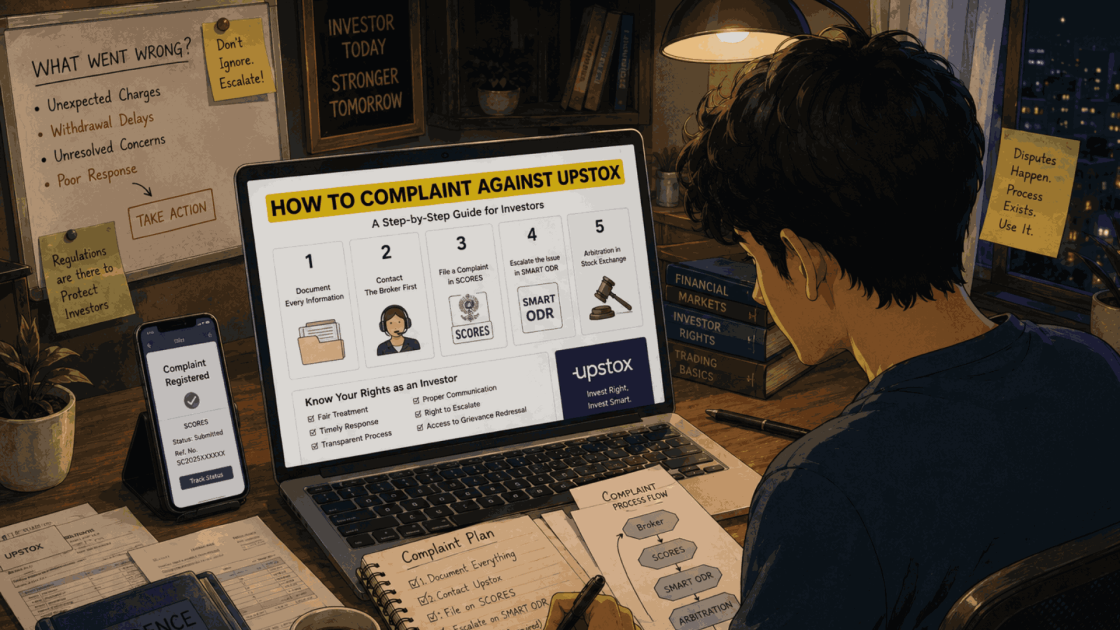
Follow this structured escalation path to file your Upstox complaint:
Step 1: Document Every Information
Before approaching anyone, organise all documents relating to your concern.
Do not rely only on memory.
Create a folder containing every record connected to the dispute.
This may include:
- Contract notes, ledger statements and trade confirmations.
- Payment receipts, bank statements and withdrawal records.
- Emails, chat conversations and customer support ticket numbers.
- Screenshots of transactions, app notifications and account activity.
Also, prepare a timeline describing when the issue occurred, what action you took, and how the company responded.
A properly documented complaint is generally easier to understand than a complaint based only on verbal conversations.
Step 2: Contact The Broker First
Before escalating the matter, communicate directly with Upstox through its official grievance redressal channels.
Clearly explain:
- Your client ID.
- The nature of the dispute.
- The date on which it occurred.
- The documents supporting your concern.
- The resolution you expect.
Where possible, request that all responses be provided in writing.
Written communication creates a formal record that may become important if the matter later requires regulatory review.
Upstox Complaint Email ID
If you prefer written correspondence or need to attach supporting documents like screenshots or ledger statements, you can directly email their dedicated support desk at [email protected].
For tracking purposes, ensure you send this from your registered email ID and keep the automated ticket number safe for future reference.
Upstox Complaint Customer Care Number
For real-time assistance or to discuss your grievance directly with a support representative, you can call their official helpline at (022) 24229920.
Be sure to note down the time of your call and the executive’s name to maintain an accurate timeline of your interactions.
Step 3: File a Complaint in SCORES
If the issue remains unresolved or you are dissatisfied with the response received, investors may file a complaint through the SEBI Complaints Redress System (SCORES).
SCORES is SEBI’s online grievance platform designed for investors dealing with regulated intermediaries.
Knowing how to lodge complaint in SCORES is highly beneficial, as this official platform enables investors to:
- Submit complaints electronically.
- Upload supporting evidence.
- Track complaint status.
- Review responses submitted by intermediaries.
When filing your complaint, focus on presenting a factual sequence of events rather than emotional arguments.
A clear timeline supported by documentary evidence often helps the grievance process.
Step 4: Escalate the issue in SMART ODR
If the matter continues after the complaint stage, investors may consider filing a complaint against the broker in NSE using SMART ODR (Online Dispute Resolution).
SMART ODR provides a structured digital mechanism for resolving disputes arising within the securities market.
Depending on the nature of the dispute, the matter may first proceed through conciliation or mediation.
If no settlement is reached, eligible disputes may subsequently move to arbitration in accordance with the applicable framework.
Step 5: Arbitration in the Stock Exchange
If the dispute still remains unresolved, investors may have the option of pursuing stock market arbitration, depending on the nature of the matter and the applicable exchange rules.
Arbitration is a formal dispute resolution mechanism in which an independent arbitrator reviews the evidence submitted by both parties before delivering an award.
Many securities market disputes involving unauthorised trades, account handling concerns, settlement issues, and broker-related disagreements have ultimately been resolved through arbitration.
The strength of an arbitration case often depends on the quality of documentation available.
This is why preserving records from the beginning is so important.
When Should You File a Complaint Against Upstox?
Many investors delay filing complaints because they assume the issue will eventually resolve itself.
Unfortunately, waiting too long can sometimes make matters more difficult.
Knowing exactly when and how to file a complaint against stock broker platforms like Upstox ensures your capital and consumer rights remain protected.
You should consider filing a formal complaint when:
- Your written grievance has not been resolved within a reasonable time: If the company has acknowledged your complaint but has not provided a satisfactory resolution within a reasonable period, it may be appropriate to escalate the matter.
- Important questions remain unanswered: If the broker or service provider is unable or unwilling to explain transactions, charges, account activity, or service-related issues, you should seek clarification through the formal grievance process.
- You believe there is a service-related dispute: Issues such as unauthorised transactions, incorrect order execution, misleading communication, billing disputes, or failure to provide agreed services may justify filing a complaint.
- You have repeatedly contacted customer support without meaningful progress: If multiple emails, calls, or support requests have not resulted in a practical solution, escalating the issue through the appropriate regulatory channels may be necessary.
- Documentation supports your concern: Before filing a complaint, ensure you have supporting evidence such as emails, WhatsApp messages, payment receipts, account statements, screenshots, call records (where legally permissible), or other relevant documents.
At the same time, investors should distinguish between market losses and broker-related service issues.
Losses arising from normal market movements are not, by themselves, evidence of broker misconduct.
The complaint should relate to the service provided, account handling, contractual obligations, or other matters connected with the broker’s responsibilities.
Need Help?
Most investors lose valid cases not because they’re wrong, but because they don’t know the process.
A complaint supported by organised evidence is generally much easier to assess than one based entirely on recollection.
If you are dealing with concerns relating to Upstox, unauthorised trading, account handling, fund withdrawal delays, brokerage disputes, or unresolved grievances, obtaining guidance early can help you understand your available options.
Our team can assist you in:
- Reviewing your documents.
- Preparing a structured complaint.
- Organising supporting evidence.
- Understanding the SEBI complaint process.
- Identifying whether your matter may proceed through SCORES, SMART ODR, or stock market arbitration.
Taking timely action often strengthens the quality of your complaint and improves the clarity of your case.
Conclusion
If you are searching how to complaint against Upstox, the most effective approach is to follow a structured grievance process rather than relying solely on repeated customer support interactions.
Start by preserving every relevant document, especially if you face financial impact due to Upstox not working during critical market hours.
Approach the broker through its official grievance channels, and provide a reasonable opportunity for resolution.
If the issue continues, investors may escalate the matter through SEBI SCORES, explore SMART ODR, and, where appropriate, pursue stock market arbitration.
Most importantly, remember that well-organised documentation is often the foundation of a strong complaint.
Acting early and maintaining a clear record of events can make the grievance process significantly more effective.
Frequently Asked Questions
1. Should I contact Upstox before approaching SEBI?
Yes. Investors should generally give the broker a reasonable opportunity to resolve the issue before escalating the matter through regulatory mechanisms.
2. Can I recover money from Upstox if my complaint is successful?
The outcome depends on the facts of the case, the available evidence, the applicable regulations, and the dispute resolution process. Every complaint is evaluated individually.
3. When should I consider stock market arbitration?
Arbitration may be considered where disputes remain unresolved after the available grievance mechanisms have been explored, subject to the applicable rules and circumstances.
4. Does losing money in the stock market automatically justify a complaint?
No. Market losses are part of investing.
Complaints generally relate to broker services, account handling, settlement, communication, or other operational issues rather than market performance alone.



 Add us as a preferred source on Google »

