
Quick Summary
Tradevia Research holds SEBI Research Analyst registration INH000018009 under proprietor Manish Sahu. The complaint process runs through four stages. First, a written complaint directly to the firm. Then SEBI SCORES. Then SMART ODR. Then arbitration if needed. Profit sharing demands, demo trade losses used to pressure subscriptions, and upselling after losses are all specific SEBI violations that strengthen your complaint. The process is free at every stage. For claims below Rs. 10 lakh, arbitration costs you nothing.
Tradevia Research has received 6 formal complaints between FY 2024-25 and FY 2025-26. All 6 are marked resolved. But behind each number is an investor who felt strongly enough about what happened to go through a formal regulatory process.
If you are reading this, you are probably at that same point. Something went wrong after you paid. The demo trade lost you money. The upselling never stopped. Someone demanded 40% of your profits. Support disappeared after losses appeared.
Every one of those situations gives you a specific complaint ground under SEBI regulations. This page covers the exact process from your first contact with Tradevia Research all the way through arbitration if it comes to that.
What Qualifies as a Valid Complaint Against Tradevia Research
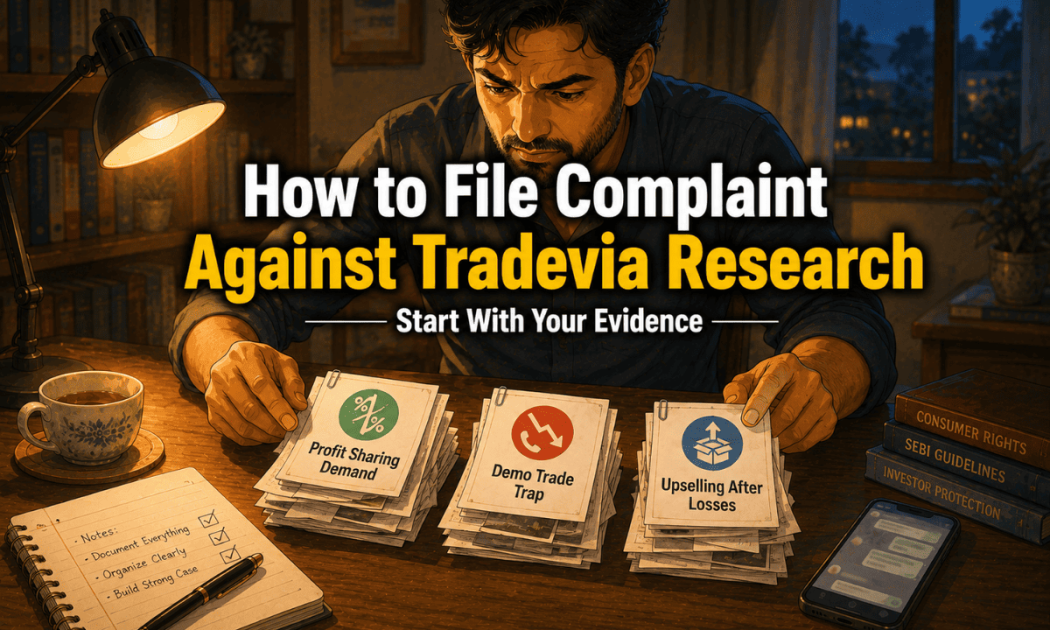
Not every loss gives you complaint grounds. But three situations described by real users of Tradevia Research map directly to specific SEBI violations.
These are the situations that turn a bad experience into a formal case. Read each one carefully and see which applies to you.
1. Profit Sharing Demand
If Tradevia Research or any representative asked you for a percentage of your trading profits, that is a direct violation of SEBI Research Analyst Regulations 2014.
SEBI explicitly prohibits any registered research analyst from entering into profit-sharing arrangements with clients.
All fees must be flat, transparent, and agreed upon before services begin. A 40% profit demand is not a grey area. It is a regulatory violation you can cite by name when you file.
2. Demo Trade Used to Pressure Subscription
If you were offered a free demo call, the trade went against you, and you lost money, and that loss was then used to pressure you into subscribing with promises of recovering the demo loss through a paid plan, that is a specific unfair practice.
SEBI’s Code of Conduct requires all advisory communications to be truthful and not designed to trap investors through manufactured urgency.
3. Upselling After Continuous Losses
If you experienced consistent losses on one plan and Tradevia Research then approached you to buy a more expensive package promising better calls, more coverage, or loss recovery, that pattern violates SEBI’s suitability requirements.
A registered research analyst must map services to a client’s risk profile and financial capacity. Exploiting loss-recovery panic to sell more expensive plans is specifically what that rule is designed to prevent.
If your situation matches any of these three, you have a case worth filing.
Also Read: AAA Profit Analytics complaints, five stages, from a written letter to arbitration.
Step-by-Step Guide to Complain Against Tradevia Research
A written complaint to Tradevia Research starts a 21-day clock; after that, SCORES, SMART ODR, and arbitration follow in that exact order.
Whether your ground is the profit-sharing demand, the demo trade, or the upselling pattern, the paperwork you gather in Step 1 is what decides what happens in every step after it.
From your first message to Tradevia Research to a binding arbitration award, here’s what actually happens at each stage, and what you need ready for it.
Step 1: Collect Your Evidence Before Contacting Anyone
This step happens before you contact Tradevia Research. Evidence collected now is what your entire case rests on at every subsequent stage.
Save every WhatsApp message from any representative of Tradevia Research. Screenshot the demo call details including the date, the stock recommended, the entry and exit levels, and the loss amount.
Save all payment receipts, bank transfer records, and any invoice or subscription confirmation you received.
If a representative demanded a percentage of your profits verbally, write down the exact date, the exact words used, and any follow-up message where the demand was repeated. Any voice recording you have is extremely valuable.
Save bank statements showing every amount transferred to Tradevia Research across the full period of your subscription. Tradevia Research accepts payments via NEFT/IMPS directly to their bank account. Those bank transfer records are your primary proof of payment.
Save any marketing message, screenshot of a profit call, or promotional content sent to you before you subscribed. Write a one-page chronological summary of what happened with dates and amounts at each stage.
Do not delete anything.
Step 2: Contact Tradevia Research Formally
SEBI requires investors to attempt internal resolution before escalating. A written complaint to the firm creates the paper trail SEBI will ask for when you file on SCORES.
Write your complaint by email if an email address is available on their website.
If the firm only accepts phone contact, follow up any phone complaint with a written summary sent by WhatsApp to the same number. State clearly that you are formally raising a complaint and want a written response.
State what you paid, on which dates, for which plans. Also, mention what was promised before you subscribed and what you actually experienced.
State the specific resolution you are seeking: a refund, a written explanation, or both.
Give the firm 21 days to respond. If they do not respond or the response does not address your specific concern, move to Step 3 immediately.
Step 3: File on SEBI SCORES
If 21 days pass without a satisfactory response, SEBI SCORES is your next step.
Select Research Analyst as the intermediary type. Enter INH000018009 as the registration number. In the complaint description, name the specific SEBI violation that applies to your situation.
For profit sharing, cite the SEBI Research Analyst Regulations 2014 prohibition on profit sharing arrangements.
For demo trap, cite the SEBI Code of Conduct requirement for truthful and non-deceptive advisory communications.
And for upselling after losses, cite SEBI suitability requirements.
Attach your payment records, WhatsApp messages, demo call details, and any profit-sharing demand message you saved.
Filing on SEBI SCORES is completely free. Tradevia Research has 21 days to respond formally after the complaint is forwarded.
When you are ready to file, the full process covering every SEBI SCORES field and what each status label means after submission is on this site. Reading it before you file saves you from common errors that cause complaints to be returned without action.
Step 4: Escalate to SMART ODR
If SCORES does not resolve the matter, SMART ODR follows.
One rule before filing here is critical. Do not file on SMART ODR while your SCORES complaint is still active.
Filing on SMART ODR automatically disposes the SCORES complaint. Confirm SCORES has genuinely concluded before moving here.
An independent conciliator is assigned. Both you and Tradevia Research must participate.
Pre-conciliation runs first, where both sides submit their positions online. Formal conciliation follows if pre-conciliation produces no agreement.
Most cases with strong documentation and clear SEBI violation grounds settle at this stage. The firm knows what arbitration costs them.
Step 5: Arbitration
If SMART ODR conciliation fails, formal arbitration produces a binding award.
An independent arbitrator reviews all evidence and issues a legally binding decision. The award is enforceable as a civil court decree under the Arbitration and Conciliation Act 1996.
For claims below Rs. 10 lakh, the exchange bears the arbitration cost. You pay nothing.
Arbitration outcomes depend entirely on documentation. The investor with clear payment records, written proof of a profit-sharing demand, and a chronological account of the upselling pattern is in a far stronger position than an investor who relied on verbal conversations with no written follow-up.
Not sure your documentation is strong enough, or want someone to review your case before you file?
We review your evidence, identify every applicable SEBI violation, draft the SEBI SCORES complaint, and represent you through SMART ODR and arbitration. Register with us for a free consultation.
Conclusion
Tradevia Research holds SEBI registration INH000018009. That registration also means the firm is subject to SEBI’s complaint mechanism, and you have a formal path to pursue your case.
Profit-sharing demands, demo trade pressure tactics, and upselling after losses are not just bad experiences. Each one is a named SEBI violation with a specific complaint ground behind it.
Collect your evidence today. File formally. Follow the sequence. Six investors already filed formal complaints against this firm. You have the same right and the same path available to you.
Read the complete review on Tradevia Research, including user complaints and red flags on this site.
Report. Recover. Stay Fraud Free.
Frequently Asked Questions
Tradevia Research operates under SEBI Research Analyst registration INH000018009, held by proprietor Manish Sahu, valid from July 30, 2024, on a perpetual basis. The firm is also BSE-listed with enlistment number 6342. Verify the current status at SEBI's website under the Research Analyst intermediary category.
No. SEBI Research Analyst Regulations 2014 explicitly prohibit any registered research analyst from entering into profit-sharing arrangements with clients. All fees must be flat, transparent, and agreed upon before services begin. A profit-sharing demand is a named regulatory violation you can cite directly in your SEBI SCORES complaint.
Yes, if the demo loss was used to pressure you into subscribing. SEBI's Code of Conduct requires advisory communications to be truthful and not designed to manipulate investor decisions. Using a demo that resulted in loss as a sales pressure tool conflicts with this requirement and gives you specific complaint grounds.
Tradevia Research disclosed 6 complaints between FY 2024-25 and FY 2025-26, all resolved. The 2025-26 year alone saw 4 complaints, up from 2 the previous year. Full complaint table and user review details are on the Tradevia Research review page on this site.
Give them 21 days from your written complaint. If no satisfactory response arrives, file on SEBI SCORES under Research Analyst using registration number INH000018009. Non-response to an internal complaint is itself grounds for escalation and strengthens your SCORES filing considerably.





 Add us as a preferred source on Google »

