Most investors open a brokerage account expecting their money to be managed according to their specific goals.
You expect that every trade in your account is there for a reason.
However, it is becoming more common for investors to notice a sudden increase in trading activity or fees that do not seem to align with their actual plans.
This is often the result of brokerage churning.
It happens when a broker carries out an excessive number of trades in your account.
The primary goal of this activity is not to improve your portfolio’s performance; it is to generate more brokerage and commission fees for the firm.
Over time, these costs act as a constant drain on your capital.
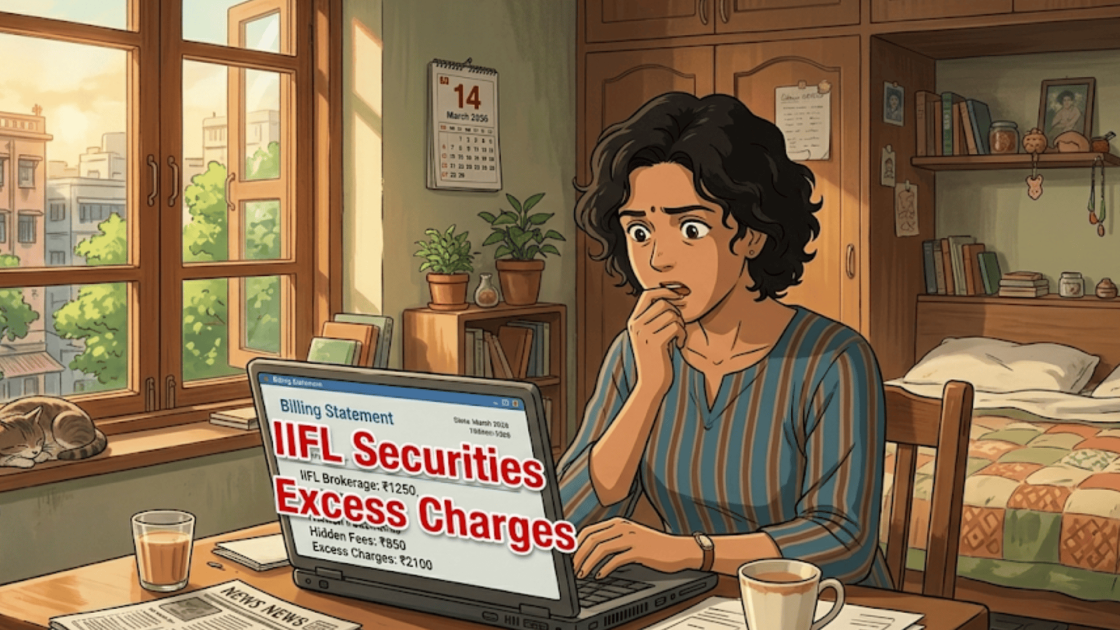
In this blog, we will look at the complaint trends for IIFL Securities excess charges and what you can do if you feel your account is being over-traded.
IIFL Securities Excess Charges Overview
IIFL Securities is a large Indian brokerage firm providing a range of services, including equity trading, derivatives, and wealth management.
Because they are a full-service broker, they often assign relationship managers (RMs) to provide trading suggestions and research support.
While having access to an RM can be useful, it also changes the dynamic of your account. Full-service brokers often earn their revenue through transaction fees.
This means if an RM encourages you to buy and sell frequently without a clear strategy, your costs will rise quickly.
Many investors have raised concerns about seeing high transaction volumes that do not seem to serve a clear investment purpose.
If you are not regularly checking your contract notes, these repeated trades can significantly increase your costs and eat into your potential profits before you even realise it.
IIFL Securities Excess Charges Complaints
If you are concerned about the number of trades in your account, the complaints against IIFL Securities show that many other investors have had similar experiences.
Here is a look at the complaints filed over the last few years:
| Year | Total Complaints | Brokerage Churning Complaints |
| 2021-22 | 363 | Around 133 |
| 2022-23 | 304 | Around 47 |
| 2023-24 | 284 | Around 155 |
| 2024-25 | 658 | Around 370 |
| 2025-26 | 380 | Around 183 |
Every year, a large portion of complaints is related to brokerage churning issues.
Plus, numbers for 2024-25 show a sharp increase in both total complaints and those specifically related to churning.
Such a high percentage of reports related to trading frequency is a signal to be cautious.
It suggests that a significant number of investors are unhappy with how their accounts are being handled and the charges they are seeing.
Impact of These Complaints on Retail Investors
For most retail investors, the biggest issue with brokerage churning is the total cost of trading.
Every trade is not just a buy or sell; it is a list of charges, including brokerage, STT, exchange fees, and taxes.
When your account is traded excessively, these costs pile up. Over a few months, these expenses can significantly lower your overall returns, even if your stocks are performing well.
For people trying to build wealth over the long term, these unnecessary costs are a major obstacle.
When Can It Be Considered Brokerage Churning?
Spotting brokerage churning is not always easy, especially when frequent trading is presented as professional advice. However, certain patterns in your account activity can signal that something may not be right.
If you notice unusual trading behaviour, it is important to review your account activity carefully.
These warning signs are often associated with churning in the stock market, a practice where frequent trades are carried out primarily to increase brokerage income.
- Unauthorised Trading: Trades appearing in your account without your approval can indicate that transactions are being executed only to generate brokerage fees.
- Lack of Transparency: Frequent buying and selling without a clear explanation from the broker may suggest that the trading activity is not aligned with your investment strategy.
Another possible sign is constant recommendations to buy or sell within short time intervals.
When advice seems to focus more on increasing trade volume than improving your portfolio, investors should proceed cautiously.
Monitoring your trade history and questioning unclear recommendations can help protect your investments.
How to File a Complaint Against a Stock Broker in India?
If you think your account has been hit by unfair charges or excessive trading, you need to take action. Here is the process you can follow:
Step 1: Gather Supporting Documents
Collect all relevant records, such as contract notes, account statements, and your trading history for the period you are questioning. It is also useful to save emails, chat messages, or call records from your broker or relationship manager.
Keeping these documents organised strengthens your case if the issue needs to be reviewed by regulators.
Step 2: Report the Concern to the Broker
Start by contacting IIFL Securities through their official grievance or support channels. Clearly mention the trades or charges you believe are incorrect and request a detailed clarification.
Keeping a written record of this communication is important because it shows you first tried to resolve the matter directly with the brokerage firm.
Step 3: Submit a Complaint on SCORES
If the broker does not resolve the issue or fails to provide a satisfactory explanation, you can file a complaint in SEBI.
SEBI SCORES platform is designed for investor grievances and allows SEBI to monitor the case. Once submitted, the broker is required to provide a formal response within a specified timeframe.
Step 4: Escalate Through Stock Exchange Arbitration
You may also escalate the dispute through the arbitration in the stock market provided by NSE or BSE. These exchanges can review trade records and mediate between you and the broker.
Since they regulate brokerage activities, their involvement can help move the resolution process forward more effectively.
Need Help?
Dealing with these issues can be complicated, but you do not have to do it alone. If you suspect your account is being charged extra, we can assist you in several ways:
- Audit Your Trades: We can help you look through your statements to find exactly where unauthorised or excessive trading occurred.
- Organise Your Evidence: We help you put together your messages and records into a clear file that is ready for regulators.
- Draft Your Letters: We can help you write formal, professional complaint letters so your concerns are clearly stated.
- Step-by-Step Guidance: We walk you through the entire process, from the first email to the final resolution.
Conclusion
Brokerage churning is a quiet way for your money to be lost to unnecessary fees. The data for IIFL Securities shows that many investors have raised these concerns over the past few years.
The best way to protect yourself is to be proactive and check your statements as soon as you get them.
Do not hesitate to ask questions if you see a trade you did not recognize or a charge that seems too high.
Holding your broker accountable is the only way to make sure your money is actually working for you.
Keeping an eye on your ledger and transaction costs is a key part of managing your investments and reaching your financial goals.