

Quick Summary
Three detailed Google reviews describing direct dealings with Investomania Research Services were found, all one-star ratings. Two independently describe a similar sequence, an initial promise of daily or guaranteed profit used to draw the client into a paid membership, followed by a demand for further payment once a loss occurs. One review includes a dated, named UPI payment screenshot confirming a real Rs 20,000 transaction to the firm, giving that account a stronger evidentiary basis than text alone. This page covers all three reviews in full and what they have in common.
Investomania Research Services reviews on Google are limited in number, but the three that exist are detailed enough to be worth reading in full before you subscribe.
One of them includes something rare for a review like this: a dated, named UPI payment screenshot confirming the reviewer actually paid the firm Rs 20,000.
That level of evidence moves a review from an unverifiable complaint to something closer to documented proof of a real transaction.
This page goes through each of the three reviews, then looks at the pattern connecting them.
What Do Investomania Research Reviews Actually Show?
A search across Google turned up three reviews describing direct dealings with Investomania Research, all rated one star.
None of the three reviewers’ accounts appear anywhere in the firm’s own disclosures, which is expected, since these are independent, unaffiliated reviewers rather than parties named on the site.
No aggregate Google Business rating or total review count for the firm’s listing was confirmed during this research, so these three should be read as specific, individually detailed, negative accounts rather than a statistically representative sample of the firm’s full client base.
1. A Review Backed by a Dated Payment Screenshot
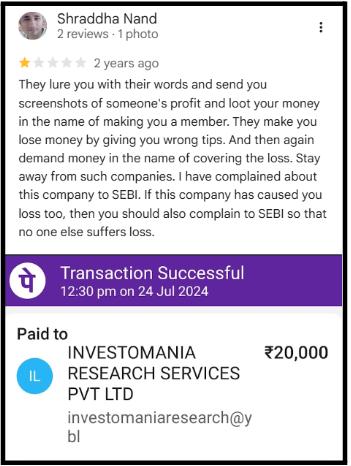
The first review, posted by Shraddha Nand two years before this review, states that the company lures clients in with promises and sends screenshots of someone else’s profit, then uses this to draw the client into paid membership.
The review states the firm makes clients lose money through wrong tips, then demands further payment afterward, framed as covering the loss. The reviewer directly warns other readers to stay away from the company, states they have personally complained to SEBI, and urges anyone else who suffered a similar loss to do the same.
Attached to this review is a photo of a UPI payment confirmation screen, timestamped 12:30 pm on 24 July 2024, showing a Transaction Successful status. The payment recipient is listed as Investomania Research Services Pvt Ltd, with the UPI handle investomaniaresearch@ybl, for an amount of Rs 20,000.
This is a specific, dated, and named piece of transaction evidence directly tying this reviewer’s account to a real payment made to an account bearing the company’s full legal name. That is a materially stronger form of corroboration than a text-only review alone, since it demonstrates the reviewer was a genuine paying client at the stated time.
We are reporting what this reviewer said and shared on a public platform. We are not independently verifying every detail of this account beyond the payment screenshot shown, and no SEBI order confirming this conduct has been issued as of the date of this review.
2. A Detailed Sequence of Escalating Demands
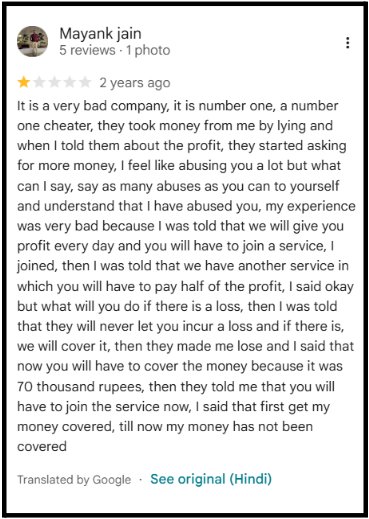
The second review, posted by Mayank Jain two years before this review, opens by calling the company a very bad company and states it took money from the reviewer through dishonest claims.
The review lays out a specific sequence. The reviewer was first told they would receive profit every day and would need to join a service, which they did. They were then told about a second service requiring them to pay half of any profit made. When the reviewer asked what would happen in the event of a loss, they were told the company would never let that happen, and that any loss would be covered.
A loss did occur, amounting to Rs 70,000 according to the review. When the reviewer asked the company to cover it as promised, they were instead told they would need to join yet another service. The reviewer states that, as of writing the review, the money had still not been covered.
3. A Brief but Consistent Warning
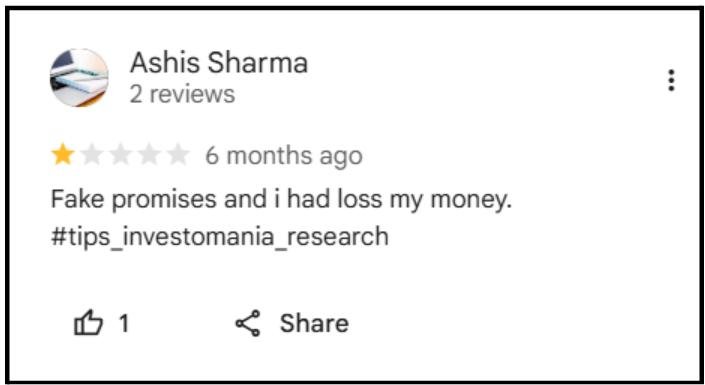
The third review, posted by Ashis Sharma six months before this review, is short and direct, stating “fake promises and i had loss my money,” tagged with a hashtag referencing the firm by name.
This review carries less detail than the other two, but it is consistent in direction, a loss following what the reviewer describes as fake promises. It was also posted far more recently than the other two, indicating whatever pattern the earlier reviews describe is not necessarily confined to 2024.
Also Read: Affinity Wealth Management reviews, one reviewer’s moderate rating, worth reading in full.
What Do These Reviews Have in Common?
Two of the three reviews independently describe close variations of the same underlying sequence. An initial promise of daily or guaranteed profit is used to draw the client into a paid membership or service, followed by a demand for further payment once a loss occurs, framed either as covering the loss or as the entry fee for a second, supposedly loss-proof service.
This is the same shown-profit-then-escalating-payment-demand pattern documented against other Research Analyst entities reviewed on this site. The presence of an actual, dated, named UPI payment screenshot attached to one of the three reviews gives this particular instance a stronger evidentiary basis than a review consisting of text alone.
The third review is shorter and less detailed, but consistent in direction, and its more recent posting date suggests the underlying pattern has continued rather than stopped.
None of these three reviews can be independently verified beyond what is shown in the review and the attached payment screenshot. For the firm’s registration details, the full pricing breakdown against SEBI’s fee cap, and the complaint disclosure covering the same period, the Investomania Research page on this site covers all of that.
Also Read: Brightways Financial Services reviews, two calls that worked, then a ₹3.5 lakh loss.
What Does Investomania Research’s Official Complaint Data Show?
Alongside these three independent reviews, it is worth checking what Investomania Research’s own SEBI complaint disclosure says, since the two sources tell different parts of the same story.
| Year | Carried Forward | Received | Resolved | Pending |
|---|---|---|---|---|
| 2024-25 | 0 | 1 | 1 | 0 |
| 2025-26 | 0 | 1 | 1 | 0 |
| 2026-27 | 0 | 1 | 1 | 0 |
| Grand Total | 0 | 3 | 3 | 0 |
On the numbers as disclosed, this is a clean record: one complaint per year for three consecutive years, each resolved, none pending. That is a genuine positive, but it is also self-reported by the firm and not independently audited by SEBI before publication.
A very low official complaint count sits oddly next to three separate, detailed public reviews describing losses and unmet promises. Neither of the three reviewers above appears to have filed a formal SCORES complaint that shows up in this disclosure; one review even states the reviewer complained to SEBI directly, yet the official yearly totals stay at exactly one each year. This does not prove either source wrong. It shows why a clean disclosure table and a set of negative public reviews can both be true at the same time, and why relying on only one of them gives an incomplete picture.
Also Read: Global Vision Research reviews, the three complaint-table issues, explained one by one.
What Should You Do If Your Experience Matches These Reviews?
If the shown-profit-then-payment-demand pattern described above sounds familiar, particularly a demand to pay more after a loss to have it covered, treat it as grounds for a formal complaint rather than something to absorb quietly.
Save your own payment receipts and any messages describing profit promises or loss-covering demands, in the same way the UPI screenshot strengthened the first review above.
From there, a formal complaint against a Research Analyst typically starts with a SEBI SCORES complaint filing, referencing registration number INH000009898.
If that does not resolve things, SMART ODR portal offers structured online mediation as the next stage before formal arbitration.
Recognise the profit-then-payment-demand pattern described in these reviews?
We review your payment evidence, match it against the specific conduct these reviewers describe, and help you build a complaint SEBI can act on.
Register with us for a free consultation.
Conclusion
Only three detailed reviews of Investomania Research were found, but two of them describe a consistent, specific pattern rather than vague dissatisfaction, and one carries dated payment evidence that is hard to dismiss.
Shown profit, pressure to join a paid service, and a demand for further payment once a loss occurs appear across two independent reviewers, with a third, more recent review consistent in direction. None of this has been independently verified beyond what each reviewer shared.
Read the pattern above against your own experience, and treat the UPI-backed review as the strongest single data point among the three, since it ties a real payment to a specific date and account.
Report, Recover, Stay FraudFree
Frequently Asked Questions
Three detailed Google reviews describing direct dealings with the firm were located, all rated one star. No aggregate Google Business rating or total review count for the listing was confirmed.
Two of the three reviews describe being promised daily or guaranteed profit to join a paid service, then being asked for further payment once a loss occurred, framed as covering that loss.
Yes. One review, from Shraddha Nand, includes a dated UPI payment screenshot showing a Rs 20,000 transaction to Investomania Research Services Pvt Ltd, dated 24 July 2024.
Treat them as detailed, individually reported accounts rather than independently confirmed facts. The attached payment screenshot on one review adds real evidentiary weight, but none of the three has been confirmed by a SEBI order.
The Investomania Research page on this site covers the full SEBI registration verification, the pricing breakdown against SEBI's fee cap, and the three-year complaint disclosure data.





 Add us as a preferred source on Google »

