

While Ambareesh Baliga’s SEBI registration checks out fine, does having a registration number actually lower your risk as an investor?
As it turns out, verifying an analyst’s paperwork is only the first step; protecting yourself from impersonation and misconduct is a different battle entirely.
This blog talks about his registration, what risks stay exactly where they were regardless of it, and what to do if something goes wrong.
Is Ambareesh Baliga SEBI Registered or Not?
Yes, Ambareesh Baliga is a SEBI-registered Research Analyst, and his registration number, INH000001139, has remained actively on record with SEBI since July 22, 2015.
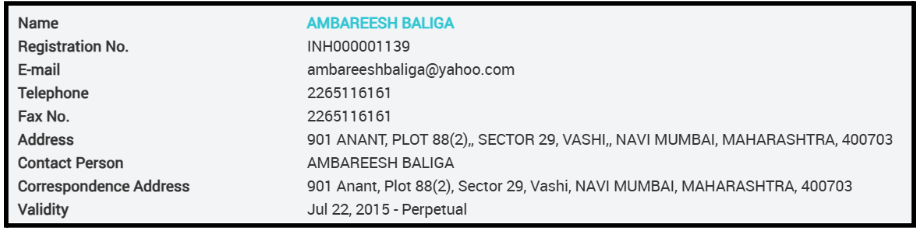
It lists his registered address as 901 Anant, Plot 88(2), Sector 29, Vashi, Navi Mumbai. It also lists an email ID and a telephone and fax number sharing the same digits.
One detail on that record confuses people. The validity status reads “perpetual.” That word does not signal extra safety.
It simply means this registration category carries no renewal cycle, unlike some other SEBI categories.
The paperwork holds up cleanly on every count.
But one point matters more than the paperwork itself: registration was never designed to lower every risk an investor carries.
Can SEBI Registration Protect You From Any Misconduct?
Not by itself. A SEBI Research Analyst registration confirms exactly one thing: that the person cleared SEBI’s entry checks and can legally publish research.
It does not confirm accurate calls. It does not confirm fair conduct. And it does not confirm that every channel using that name today is genuinely his.
Even though Ambareesh Baliga is genuinely registered, investors still face two major risks.
The first is conduct risk.
This happens if an analyst stops giving general stock research and starts giving personalized investment advice, a direct violation of Research Analyst SEBI rules, which strictly prohibit them from providing individualized portfolio management or execution services.
The other is identity risk, whether the platform in front of you is actually his to begin with.
- Conduct risk exists even for a genuinely registered analyst, since nothing on a certificate stops advice from turning personal.
- Identity risk exists separately, since a website carrying his name is not automatically tied to his verified accounts.
- Neither risk shows up on the registration record itself; both require checking on their own.
Baliga’s case shows the identity side clearly.
He runs research through exactly two disclosed channels, GameChangers on MoneyControl and a smallcase basket, and both trace directly back to him.
A separate website carrying his name shows the correct registration number too, yet no verified account of his links back to it.
In June 2025, he confirmed publicly that scammers were using his identity and had already filed a cybercrime complaint over it.
Registration closed the eligibility question. It never touched this one.
Also Read: Is Springpad AI legit? Explore the registration, user concerns, and marketing practices discussed in detail.
Don’t Just Ask ‘Is He Registered?’, Ask This Instead
Checking if Ambareesh Baliga is SEBI registered is a good start, but it’s only half the job.
Confirming his identity is one thing; knowing how he actually operates is another.
The good news?
The identity check takes just a few minutes.
- Don’t take anyone’s word for it, including ours: Go to SEBI’s official intermediary search and look up INH000001139 yourself. See if the details match what’s mentioned here.
- Check everything, not just one line: The name, the address, and whether the registration is still active; all three need to match up. If even one is off, that’s a red flag.
- A registered person isn’t the same as a registered website: Just because Baliga is genuinely SEBI registered doesn’t mean every page or channel using his name is legitimate. Scammers often borrow real names to look credible.
- Stick to his known channels only: As far as verified sources go, that’s GameChangers on MoneyControl and his smallcase basket. Anything else claiming to be him should be treated as unconfirmed until proven otherwise.
Doing this much clears up who he is.
But it doesn’t tell you how he works, what his track record looks like, or whether his advice is sound.
That’s a completely different, and equally important, question to answer.
What If a Research Analyst Breaks SEBI Rules?
Picture this instead.
Suppose Ambareesh Baliga, or anyone claiming to act on his behalf, started telling a client exactly which lot size to buy, or promised that fresh investment would recover an old loss.
That is no longer general research. That is personalized advice, and his registration does not authorise him, or anyone under his name, to give it.
SEBI provides a structured escalation process for exactly this kind of situation.
It runs in a fixed sequence.
Step 1: Raise the Issue With the Analyst Directly
Start by raising the concern through the analyst’s verified contact channel. Escalate elsewhere only after this step.
Put the complaint in writing, including every message and email.
A meaningful share of disputes gets resolved right here.
Step 2: File a Complaint on SEBI SCORES
If that does not resolve the matter, file a complaint on SEBI’s SCORES portal next. Attach every piece of evidence, including payment records and screenshots.
SEBI requires the entity to respond within 21 days of filing.
Step 3: Escalate Through SMART ODR
An unresolved SCORES complaint is not a dead end. It can move to SMART ODR, the platform built for securities market disputes.
If you are wondering about the SMART ODR meaning, the acronym stands for “Securities Market Approach for Resolution Through ODR Portal.” Backed by SEBI, this centralized, tech-driven platform connects investors directly with independent Online Dispute Resolution institutions.
A neutral conciliator works with both parties toward a resolution. The process moves faster than formal court proceedings.
Step 4: File Arbitration in BSE
If conciliation does not resolve the matter, arbitration is the final formal step. An arbitrator reviews the evidence from both sides and issues a binding decision.
That decision is enforceable in the same manner as a court order.
Each of these steps depends heavily on proper documentation.
That is often exactly where investors need the most support.
Need Help?
Whether the concern involves a fake account operating under someone else’s registration number or a genuinely registered analyst overstepping permitted limits, both situations need a clear, evidence-backed approach.
Register with us, and our team will help identify which category the case falls under.
We organise the documentation and carry the complaint through SCORES, SMART ODR, and arbitration wherever it needs to go.
Conclusion
Ambareesh Baliga’s SEBI registration is genuine. Number INH000001139 has remained on record since 2015.
That fact closes only the eligibility question. It does nothing to guarantee accurate calls, fair conduct, or that every channel carrying his name is authentic.
Investors should verify identity independently and stay alert to conduct that exceeds what a Research Analyst is permitted to do, since registration was never built to cover either.
Frequently Asked Questions
1. Does SEBI registration reduce the risk of dealing with a Research Analyst?
It only confirms the person has cleared SEBI’s eligibility checks, but it does not guarantee accurate research or ethical conduct going forward.
2. What should I do if someone impersonates him to scam me?
Treat it as a cybercrime and report it through the National Cyber Crime Reporting Portal, since impersonation falls outside SEBI’s direct complaint process.
3. Can a SEBI-registered analyst guarantee my returns?
No, no Research Analyst, regardless of reputation, is permitted to promise guaranteed or assured returns under SEBI’s regulations.





 Add us as a preferred source on Google »

