
Imagine this: it’s commodity trading hours. The commodity market is open. Gold is moving. You need to exit a position, now. You hit the button.
Nothing happens. You refresh your trading app, and the screen is frozen.
By the time the system comes back online, the price has moved ₹2,000. Your stop-loss never fired.
The loss is real, but the exchange has already moved on.
This isn’t a hypothetical. It has happened to thousands of traders on MCX, India’s largest commodity derivatives exchange, not once, but multiple times across 2024 and 2025.
These kinds of incidents have also led to a surge in MCX complaints, as traders seek accountability and resolution for losses caused by system failures.
This blog documents the real incidents where MCX stopped working, what traders experienced, how the exchange and regulator responded, and most importantly, what you should do if it happens to you.
MCX Glitch
The Multi Commodity Exchange of India (MCX) is India’s dominant commodity derivatives platform, commanding roughly 98% of the total value of commodity futures contracts traded in the country.
Launched in 2003 and regulated by SEBI, it is the go-to exchange for trading gold, silver, crude oil, natural gas, and base metals.
With that kind of market share, there is no backup exchange for most commodity traders. If MCX goes down, trading in those commodities effectively stops for everyone.
In this context, even a technical glitch in stock market infrastructure, especially at an exchange as critical as MCX, can have widespread consequences beyond individual trades.
That’s what makes every technical outage at MCX so damaging and so consequential
Here is the summary of technical glitches in MCX in the last 2 years.
| Date |
Incident |
Duration | Cause (Official) |
Impact |
| Feb 13, 2024 |
Platform outage |
~4 hours | Backend file processing failure |
Full morning session lost |
| Jul 09, 2024 |
Delayed opening |
~1+ hour | Technical issue (undisclosed) |
Trading start postponed |
| Jul 23, 2025 |
Trading halt |
1 hr 15 min | Clearing process issue |
Futures trading impacted |
| Oct 28, 2025 |
Major outage |
~4+ hours | Capacity breach (unique client code threshold) |
DR site activated; SEBI review triggered |
| Mar 17, 2026 |
Execution issues |
Intermittent | Not officially acknowledged |
Order failures, stop-loss issues, margin errors |
Let’s get into the detail of each case:
1. February 13, 2024: The Four-Hour Morning Blackout
On the morning of February 13, 2024, traders logged in at 9 AM expecting a normal session. It wasn’t.

The entire morning session was effectively lost. MCX, which normally opens at 9 AM, only commenced trading at 1 PM, a delay of nearly four hours.
The exchange attributed the delay to “slow processing and generation of backend files for its members.”
The critical margin file, which contains each client’s margin and open position data and is normally available by 6–7 AM, had not been generated.
As one industry leader at the time explained, members could not access essential data needed to initiate trading.
The issue appeared to affect all registered members simultaneously.
The February 2024 glitch was particularly significant because it came just a few months after MCX had migrated to a new Commodity Derivatives Platform (CDP) developed by Tata Consultancy Services (TCS) in October 2023, a migration meant to upgrade the exchange’s capabilities.
What traders faced: Anyone with overnight positions in gold, silver, crude oil, or other commodities could not manage their risk during one of the most active parts of the trading day.
Traders with positions that needed to be closed or rolled could not act. The morning session, from 9 AM to 5 PM, is the primary session for most participants.
2. July 09, 2024: Delayed Opening Due to Technical Issues
On July 09, 2024, MCX again faced technical issues that prevented trading from starting at its normal opening time.
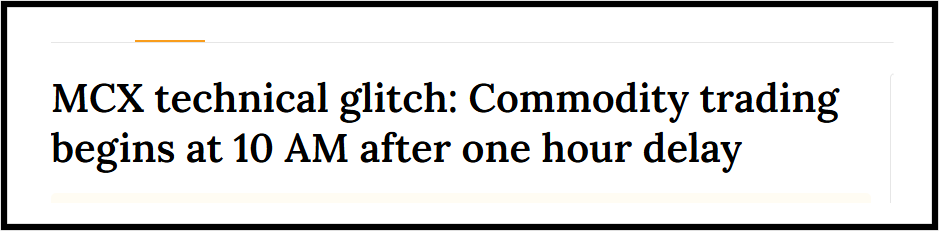
The exchange informed members that the delay was due to technical reasons, but did not immediately disclose detailed specifics.
Trading was initially expected to start at 9:00 AM, but was postponed by roughly an hour before operations resumed later in the morning.
Although the disruption was shorter than the February incident, it still affected traders who rely on early session liquidity to manage overnight positions and execute short-term trading strategies.
The delayed opening created a gap between global commodity market movements and the ability of Indian traders to react.
During this period, traders were unable to initiate trades, close positions, or respond to price developments in international markets, resulting in temporary execution risk and missed trading opportunities.
Repeated delays within the same year also began raising concerns among market participants about infrastructure reliability following the platform migration.
3. July 23, 2025: Trading Halt and DR Site Activation
On July 23, 2025, MCX experienced another disruption when trading was halted due to technical difficulties.
The exchange had to temporarily suspend operations and activate its disaster recovery systems before trading could resume.

The market eventually reopened after more than an hour of delay.
While the exchange described the issue as technical in nature, detailed explanations were limited in initial communications.
Even relatively short disruptions can create operational risk in leveraged derivatives markets.
During the halt, traders were unable to execute trades, adjust positions, or hedge exposures, creating a temporary disconnect between market risk and trading access.
For intraday traders, especially, such interruptions can eliminate planned trade setups and distort execution strategies dependent on market timing.
4. October 28, 2025: The Worst Outage in Recent Memory
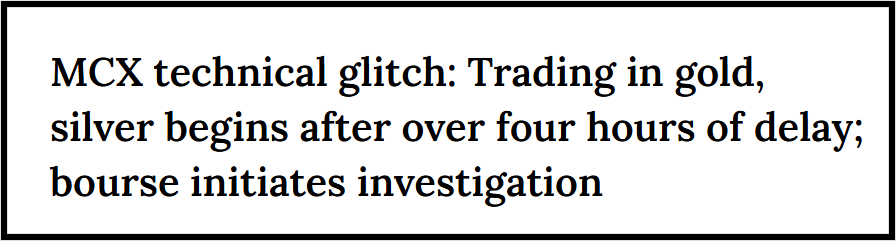
The October 28, 2025, outage was the most severe and widely reported disruption MCX had faced in years. It unfolded across several extended disruptions.
Timeline of the day:
- 9:00 AM: MCX fails to open at its scheduled time
- 9:30 AM: Exchange announces a delayed start, pushes resumption to 9:45 AM
- 9:45 AM: No resumption; pushed again to 10:00 AM
- 10:00 AM: Still no trading; pushed to 10:30 AM
- 10:30 AM: MCX withdraws the update entirely
- 11:05 AM: MCX issues official notice: “The commencement of trading is delayed due to a technical issue. Trading will start from the DR site.” No timeline given.
- 1:20 PM: A special session is announced from 1:20 PM to 1:24 PM
- 1:25 PM: Normal trading finally resumes, over four hours after the scheduled open
The investigation later revealed that the root cause was not a typical software bug or network failure.
According to the exchange’s report to SEBI, the system had hit an internal capacity limit, specifically, thresholds on the number of unique client codes that could be active simultaneously.
When trade volumes spiked, the system exceeded this preset parameter, triggering the halt.
Crucially, even the Disaster Recovery (DR) site, designed precisely for such situations, could not bypass this capacity constraint, as it operated under the same parameters.
What traders faced: The day of the outage was particularly damaging because global gold and silver prices were already volatile.
Traders with open positions in bullion could not manage their exposure during one of the most price-sensitive windows.
Those with stop-losses set were unable to execute them. Bullion traders who needed to exit positions as prices corrected globally simply had no access to do so.
As one market participant described it bluntly: prices moved, positions became costly, and without access to the platform, reaction time vanished entirely.
MCX shares themselves fell nearly 2% that day, reflecting the market’s own reaction to the disruption.
5. March 17, 2026: The Silent Glitch
Unlike the October 2025 outage, the March 17, 2026, incident received no official acknowledgement from MCX and no mainstream media coverage.
Yet traders reported significant disruptions throughout the day.
Reported issues included:
- Order execution delays: Orders remained in a pending state for far longer than normal, causing slippage and missed opportunities
- Stop-loss failures: Stop orders behaved unexpectedly, with some not triggering at all
- Price display anomalies: Some traders noticed candle spikes and price mismatches across platforms
- Login and access problems: Sudden logouts during critical market moments
- Order rejections: Orders rejected with RMS (Risk Management System) error messages
- Margin display errors: Temporary discrepancies in margin and open position data
The lack of official acknowledgement made this incident particularly frustrating for affected traders.
When an exchange officially declares a disruption, traders at least know the problem is on the exchange’s side.
When there is silence, traders are left guessing, and many assume the problem is with their own internet, broker, or device.
The absence of acknowledgement does not mean the losses were not real. It means affected traders have to work harder to document and report them.
Common Reasons Behind MCX Glitch
Looking at these incidents together, a clear picture emerges:
- The exchange migrated to a new platform in October 2023. MCX transitioned from its previous technology vendor (63 Moons) to a new Commodity Derivatives Platform developed and serviced by TCS.
While trading volumes grew, the daily average value of trades rose from around ₹98,371 crore to over ₹1.18 trillion post-migration; the new infrastructure clearly carried unresolved capacity and stability issues.
- The glitches follow a recognisable pattern. Nearly every incident involves the same sequence: delayed start, repeatedly pushed resumption times, eventual shift to the Disaster Recovery site, and a vague acknowledgement blaming “technical issues” without disclosing specifics.
- Industry voices have grown louder. The Commodity Participants Association of India (CPAI), which represents brokers and traders, has repeatedly raised concerns about MCX’s infrastructure reliability and has sought meetings with MCX leadership.
Industry leaders have pointed directly to the need for structural technology upgrades and a more resilient architecture from TCS, given their expertise with globally benchmarked exchange solutions.
What Traders Lose When MCX Goes Down
The losses from an MCX outage are not abstract. They are specific and measurable:
- Directional losses on open positions: If you hold a long gold position and cannot exit when prices fall during the outage, you absorb the full downside. Your stop-loss becomes meaningless if the system cannot execute it.
- Missed opportunity costs: Traders who were waiting to enter a position during a favourable morning window lose that window entirely. This is particularly damaging for intraday traders.
- Forced mark-to-market losses: Because MCX operates on a marked-to-market margin system, positions are revalued daily. A sharp adverse move during an outage window translates directly into margin calls and financial settlement losses.
- Hedging failures: Many commercial participants use MCX specifically to hedge their physical commodity exposure.
When the exchange is unavailable, their hedges become unbalanced. A bullion jeweller hedged on MCX, for instance, is fully exposed to spot price moves during the outage period. - Psychological and operational damage: Even traders who do not suffer direct financial losses during an outage bear the stress of uncertainty — not knowing when trading will resume, whether their orders are in the system, or whether their broker has taken protective action.
What You Should Do When MCX Is Not Working?
If you are an active commodity trader and face a similar situation, do not remain passive. Take an action by following the steps below.
Step 1: Start documenting immediately
The moment you notice something wrong, start capturing evidence. Take screenshots of:
- The error message or frozen screen
- Your open positions
- The bid-ask spread or the last traded price at the time
- Any order rejection messages with timestamps
- Screenshots showing your broker’s platform displaying the same issue.
Time-stamped screenshots are the foundation of any successful complaint. Do not wait until after the issue is resolved.
Step 2: Check official MCX channels
MCX typically posts notifications on its website and sends circulars to registered members. Check if there is an official notice about a disruption.
This matters because it establishes that the issue was exchange-side, not broker-side or device-side.
If there is no official notice but you are experiencing problems, check trader forums and social media, if others are reporting the same issue, document that too.
Step 3: Call your broker immediately
Alert your broker’s dealing room or risk management team right away.
Most brokers have protocols for exchange downtime, including the ability to accept offline orders by phone. Request that your positions be managed under their risk policy for exchange-outage situations.
Get a written record, email or in-app message of everything you communicate with your broker during the outage.
Step 4: File a formal complaint with MCX
Once the session resumes, do not let the issue pass without a formal record. Write to MCX’s Investor Grievance Department:
Include your Client ID, the date and time of the disruption, a description of what happened, and the financial impact you suffered. Attach your screenshots.
Step 5: Escalate to SEBI SCORES if MCX does not respond
If MCX does not resolve your complaint satisfactorily within 21 days, file a complaint in SCORES.
This officially puts your complaint on the regulatory radar.
SEBI mandates that MCX respond with an Action Taken Report, and all correspondence is tracked.
Step 6: File a Complaint in SMART ODR
If your complaint involves a quantifiable financial loss and you are not satisfied with how it has been handled, use India’s Online Dispute Resolution portal for securities markets:
The ODR process begins with conciliation (21 days) and can move to binding arbitration if needed. It is designed specifically for situations like these.
Need Help?
If you’re unsure how to begin or which category your complaint fits into, you can register with us for guided support throughout the process.
Our team will assist you at every step, helping you organise the necessary documents, file the complaint correctly, and stay on top of follow-ups until your case progresses.
Conclusion
MCX outages are not just technical events. They are risk events.
When an exchange experiences disruptions, traders are not merely inconvenienced; they are temporarily stripped of their ability to manage risk.
Positions cannot be adjusted, stop-losses may fail, and market exposure becomes uncontrolled.
The incidents between 2024 and 2026 show that even major financial infrastructure can face operational vulnerabilities, particularly during technology transitions and periods of rising trading volume.
For traders, the key lesson is simple: exchange risk is also trading risk.
This means preparation matters.
Maintaining documentation, understanding complaint mechanisms, keeping broker escalation channels ready, and managing position sizing are no longer optional precautions; they are necessary safeguards.
Most importantly, traders should remember that every reported incident strengthens regulatory oversight.
Filing complaints is not just about recovering losses; it is about improving market reliability for everyone.
Technology failures may be outside a trader’s control.
How a trader prepares and responds to them is not.