
Ever stared at your bank balance and wondered, “I’m hustling every day, but is my money hustling for me?” You’re not alone.
If you’ve dipped your toes into the Indian markets, chances are you’ve come across Money Guru Advisory.
The name pops up often, especially in an era crowded with fin-fluencers, flashy screenshots, and “guaranteed returns” promises.
So the big question is: Is this a genuine financial partner or just more noise in a very loud market? That’s exactly what we’re here to find out.
In this deep dive, we’ll unpack everything that matters when it comes to securing your financial future, taking a close look at Money Guru Advisory’s services, investment philosophy, and legitimacy.
Because when it comes to your money, curiosity isn’t optional; it’s essential.
Money Guru Advisory Review
Money Guru Advisory Services presents itself as a one-stop destination for trading and investment advice. It covers stocks, commodities, and even FOREX markets.
From equity tips and commodity calls to “complete investment solutions” and personalised portfolio strategies, the website paints a picture of data-driven expertise designed to help traders and investors across India maximise returns.

Sounds impressive, right? But here’s where a smart investor pauses.
In the world of investing, a sleek website and confident claims are never enough. The real question is simple yet critical: is the “Guru” behind the advice actually authorised to guide your money?
In India, anyone offering investment advice must be registered with SEBI as a Registered Investment Adviser (RIA). This isn’t just a formality; it’s a stamp of credibility.
SEBI registration ensures that an adviser follows strict ethical standards, discloses conflicts of interest, and operates with transparency and accountability.
Now, here’s the red flag- Despite claiming to be an investment adviser, Money Guru Advisory Services does not provide any verifiable proof of SEBI IA registration on its website.
There is also no visible Investment Charter, which is a mandatory disclosure for registered advisers.
In simple terms, while the claims sound convincing, the absence of basic regulatory disclosures makes the authenticity of Money Guru Advisory Services as a legitimate Investment Adviser highly questionable.
And remember, when it comes to your hard-earned money, questioning credentials isn’t being suspicious; it’s being smart.
Money Guru Advisory: Real Case Study
We got a case where the investor, Nilesh (Name Changed), fell victim to fraudulent advisory services from Money Guru Advisory.
Imagine waking up to see your family’s entire life savings, money meant for emergencies, education, or retirement, wiped out in a matter of months.
This is the reality for Nilesh, an investor who fell victim to the predatory tactics of an entity calling itself Money Guru Advisory.
The Case Details
Nilesh had been a disciplined investor with Angel One since 2022, building a portfolio of ₹8.50 lakh. In May, he was contacted by a “Senior Trading Expert” named Anshul Jain from Money Guru Advisory.
Using high-pressure sales tactics and promises of 20–25% daily profits, the firm coerced him into risky trades and large lot sizes, resulting in the complete loss of his family’s lifetime savings of ₹8.50 lakh, plus an additional ₹50,000 paid as “advisory fees.”
Nilesh asked several times for the SEBI registration number from the firm; however, they tactfully ignored that.

Once Nilesh paid an advisory fee of ₹50,000, the “expert” advice turned sour. He was pressured into high-risk Intraday and Commodity trades with massive lot sizes. Every loss was met with a new excuse: “Don’t worry, the next trade will recover everything.”
By the time the dust settled, Nilesh’s entire ₹8.50 lakh was gone.

It all started innocently. Nilesh was shown a few “demo trades” that delivered small but steady profits—just enough to spark confidence and build trust. Once he was convinced, the real pressure began.
He was nudged and often pushed into taking frequent trades across Intraday, Monthly Expiry, and even Commodity markets. The strategy quickly shifted from cautious to aggressive.
Despite repeatedly expressing concern and hesitation, Nilesh was constantly urged to increase his lot sizes. This pushed him to take on far more risk than he was comfortable with.
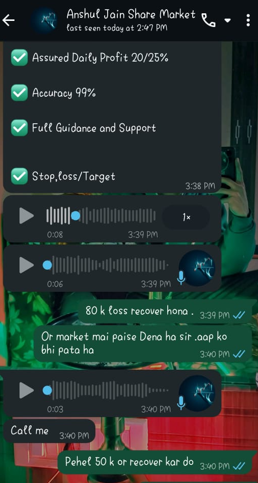
What began as a confidence-building exercise soon turned into a high-pressure trading trap.
Key SEBI Violations
The case of Nilesh vs. Money Guru Advisory is a textbook example of how unauthorised entities bypass legal safeguards to exploit retail investors.
When a firm operates without registration and uses high-pressure tactics, it isn’t just being “unethical”. They are violating specific federal laws designed to protect your savings.
Here is a detailed breakdown of the SEBI Regulation Violations and the legal “traps” used:
1. Unauthorised Investment Advisory
Under Section 12(1) of the SEBI Act, 1992, no person can act as an investment adviser unless they have obtained a certificate of registration from SEBI.
Money Guru Advisory allegedly claimed to be SEBI-registered to gain Nilesh’s trust. If they do not hold a valid INA or INH number, every “tip” they gave was an illegal act.
2. Promise of “Assured” or “Guaranteed” Returns
Regulation 15(1) of the SEBI (Investment Advisers) Regulations, 2013, mandates that advisors act in a fiduciary capacity. Furthermore, SEBI circulars strictly prohibit the promise of “guaranteed” or “assured” returns.
Mr. Anshul Jain promised 20–25% daily profits. In the volatile world of equity and commodities, such a guarantee is a direct violation of the SEBI Code of Conduct.

3. Use of Fraudulent & Manipulative Tactics (PFUTP)
The SEBI (Prohibition of Fraudulent and Unfair Trade Practices) Regulations, 2003 (PFUTP), prohibit “deceptive devices” and “emotional manipulation” to induce trading.
The firm used “demo trades” to create a false sense of security and later used emotional triggers like to force more capital into the market.
What Investors Can Learn From This Case?
The case of Money Guru Advisory serves as a stark reminder of the sophisticated tactics used by unauthorised entities to exploit retail investors.
Based on current regulatory standards and investor protection guidelines, here is what investors can learn:
- Guaranteed Returns are a Legal “Fire Alarm”
- The promise of 20–25% daily profits is the single biggest indicator of a scam.
- Fraudsters often share fake links or claim registration to build false trust.
- A common tactic is providing “demo trades” that result in small profits to lure investors into a false sense of security.
- Legitimate advisors never ask for your Demat login credentials.
How To File a Complaint in Such Cases?
To file a complaint against an unregistered, fraudulent entity like “Money Guru Advisory,” you need to use a multi-pronged approach involving both regulatory and law enforcement agencies.
Since SEBI’s SCORES portal primarily handles complaints against registered intermediaries and listed companies, you must approach other authorities as well.
- Report to the National Cyber Crime Portal: Immediately call the national helpline number to report the financial fraud.
- Lodge a Complaint with SEBI SCORES: When lodging the complaint, select a relevant category such as “Unauthorised Advisor” or “Information to SEBI”.
- File a Police Complaint: For significant financial losses, you should also file an FIR at your local police station
If the process feels overwhelming for you, register with us. Our Representative and legal team will guide you step-by-step.
Our Team will assist you in:
- Clearly explain your legal options
- Getting trade statements, ledgers, contract notes, emails, chats, and screenshots so that your case is supported by solid evidence because SEBI’s audits require clear trade records.
- Filing a complaint in Smart ODR
Moreover, we prepare unambiguous complaint letters in line with the formats of NSE, BSE, SEBI SCORES, and SMART ODR so that the complaints are neither ignored nor rejected on the grounds of wording or format.
Conclusion
The most painful part of Nilesh’s story is that he worked since 2022 to build his savings, only to lose them in a matter of months to predatory tactics.
This highlights a fundamental truth: In the stock market, your “Defense” (Risk Management) is more important than your “Offense” (Profit Seeking).
Never assume a website’s professional look equals professional integrity. If an advisor talks more about “guaranteed wealth” than “risk management,” you are looking at a red flag, not a guru.
Wealth is built through compounding and discipline, not through high-risk shortcuts sold by unauthorised strangers.
No advisory is a “money-making machine.” If you join Money Guru Advisory expecting every trade to be a winner, you will likely end up disappointed and calling it a scam.
But if you use their calls as a supplement to your own research, focusing on risk management and stop-losses, you can find significant value in their expertise.