Trading today feels effortless. A few taps on a phone, and a trade is done. For many investors, this ease is exactly why they entered the stock market in the first place.
But when trades appear in your account that you never placed, that convenience suddenly turns into anxiety.
Motilal Oswal is a well-known name in Indian broking. It has decades of history, a strong research reputation, and a large retail client base.
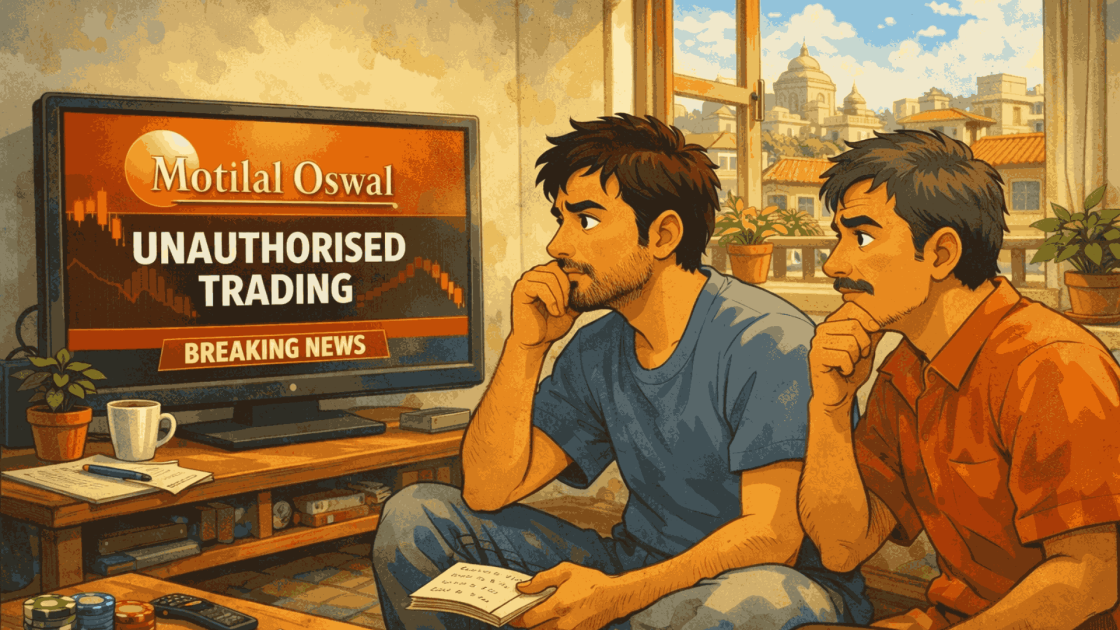
Yet, year after year, complaints related to Motilal Oswal Unauthorised trading continue to surface.
These complaints do not mean every client faces problems, but they do highlight an issue that retail investors should understand clearly.
This blog breaks down what Unauthorised trading really means, how it shows up in Motilal Oswal complaints, what impact it has on everyday investors, and what practical steps make sense when something feels wrong in your trading account.
Motilal Oswal Unauthorised Trading Complaints
Motilal Oswal Financial Services Ltd is a full-service brokerage firm founded in 1987. The firm offers a wide range of services.
Clients can trade in equities, derivatives, commodities, and currencies.
Beyond trading, Motilal Oswal also provides mutual funds, portfolio management services, wealth advisory, and institutional research.
Unauthorised trading happens when a transaction is executed in your trading account without your clear approval.
It does not matter whether the trade was placed by a dealer, a relationship manager, or someone who had temporary access to your account.
If you did not explicitly agree to that trade, it is considered Unauthorised.
|
Financial Year |
Total Complaints | Unauthorised Trading Complaints |
Percentage of Unauthorised Trading Complaints |
|
2025–26 |
761 | 286 |
37.58% |
|
2024–25 |
1,079 | 366 |
33.92% |
|
2023–24 |
498 | 174 |
34.94% |
|
2022–23 |
516 | 195 |
37.79% |
Across these financial years, unauthorised trading complaints consistently form a significant share of the total grievances, ranging from about 33% to nearly 38% of all complaints recorded.
This means that roughly one out of every three complaints raised by clients falls under the category of unauthorised trading.
While the total number of complaints fluctuates from year to year, the proportion of such complaints remains relatively high.
This pattern indicates that concerns related to trade authorisation continue to form a major part of investor disputes reported to the exchanges during this period.
How These Complaints Affect Retail Traders?
For retail investors, Unauthorised trading is not just about money, it is about trust.
Unexpected trades can drain savings, create panic, and push people into forced decisions they never planned to make.
In derivatives trading, losses can multiply quickly, especially when leverage is involved.
Even after the financial impact, there are also psychological effects. Investors become hesitant.
Some stop trading altogether.
Some lose confidence not only in the broker but in the market itself and start questioning whether they can trust a stockbroker again.
That is why understanding how to respond matters just as much as understanding what went wrong.
When Action Can Be Taken Against a Broker?
If something feels off, like trades you never approved or explanations that do not add up, these are the cases where you are within your rights to raise a complaint and seek action.
1. When the broker places trades without your permission
If a broker executes any trade without your clear approval, action can be taken against them.
As per directions issued by the Securities and Exchange Board of India (SEBI), brokers are allowed to place trades only after receiving proper authorization from the client.
2. When the broker cannot prove that you placed the order
A broker must keep valid proof that you placed the trade, such as a signed instruction, recorded phone call, email from your registered email ID, online trading logs, or message records.
If the broker is unable to show this proof when asked, you can take action.
3. When you raise a complaint about Unauthorised trading
If you complain that a trade was not done with your consent, the broker must produce records to support their claim.
If they fail to do so, the trade can be treated as Unauthorised and regulatory action can follow.
4. When technical excuses are used without justification
Even if the broker claims there was a technical issue or exceptional situation, they are still responsible for proving that the trade was not placed without your permission.
Lack of proper systems, repeated complaints, or weak controls can lead to penalties or disciplinary action.
How to Report Against Motilal Oswal?
When something feels off in your trading account, clarity and calm action matter more than speed alone.
Seeing trades you never placed can be stressful, but reacting in the right order makes a big difference. So, follow these steps:
1. Lock Down Your Account
Start by securing your account. Change your trading password immediately and enable two-factor authentication if it is not already active.
If anyone else has trading access to your account and you did not approve it, ask the broker to remove it right away.
2. Identify the Problematic Trades
Go through your contract notes and transaction history carefully.
Note down the trades you did not authorise, along with dates, quantities, and the losses involved. Being clear and specific here helps later.
3. Write to the Broker
Raise the issue with the broker through email, not just phone calls. Clearly mention that the trades were Unauthorised and ask for a written explanation.
Even if they call you, always follow up in writing.
4. Escalate If Needed
If the response is delayed or unsatisfactory, file a complaint in SCORES with all supporting documents.
This step often pushes the matter forward.
5. File Arbitration in Stock Exchange
When the issue remains unresolved, you can approach the stock exchange for arbitration.
It is a formal but investor-friendly process where an independent party reviews the case.
Need Help?
A lot of investors stay silent because they feel unsure or overwhelmed. Some assume losses are simply “part of trading,” even when they did not authorise the trades in the first place.
But Unauthorised trading is not something you are expected to accept quietly. Understanding your rights and acting methodically can make a real difference.
If you need help regarding your complaint, you can reach out to us.
We help you in organising the evidence and reviewing the case carefully. Our team then offers clear guidance about the next steps.
Conclusion
Motilal Oswal is a long-standing and respected name in Indian financial services.
At the same time, complaint data clearly shows that Unauthorised trading remains a recurring concern for a significant number of retail investors and highlights the presence of unauthorised trading risks.
The key takeaway is awareness. Brokers provide platforms and access, but investors must remain actively involved in monitoring their accounts.
Regularly checking contract notes, questioning unfamiliar trades, and speaking up early are simple habits that can prevent much larger problems later.
In the end, your trading account should reflect your decisions, not anyone else’s. Staying informed is the best way to make sure it stays that way.