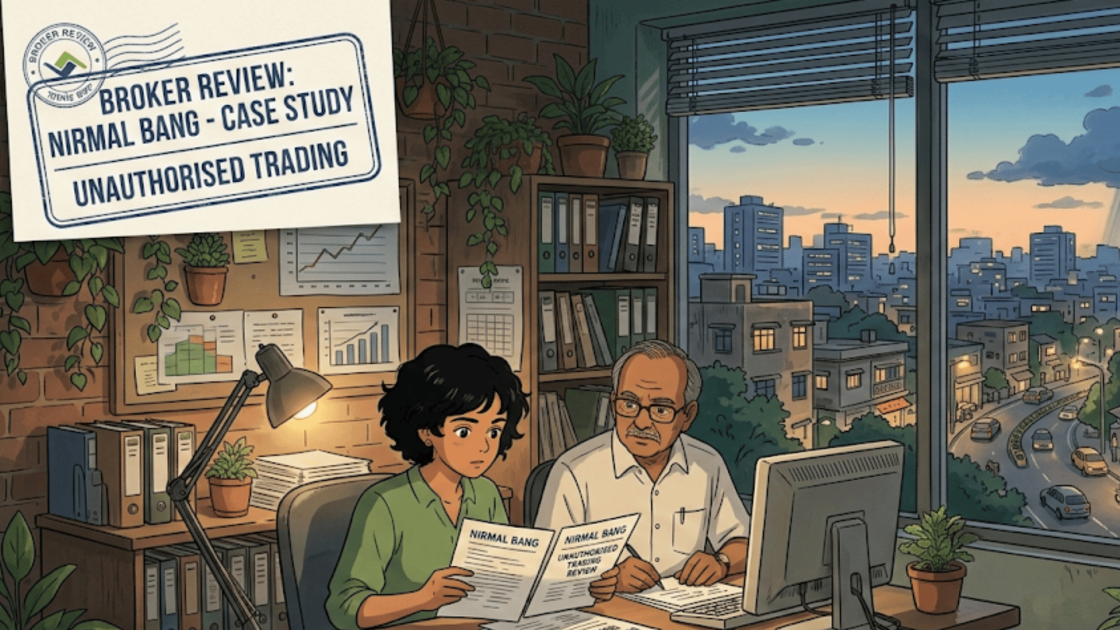
Unauthorised trading is a serious allegation in the stock market.
It raises one simple but important question: Did the broker place the trades with the client’s clear consent?
When the phrase “Nirmal Bang unauthorised trading complaints” comes up, it’s easy to assume something major has gone wrong. But numbers alone don’t tell the full story.
We need to understand what qualifies as unauthorised trading under SEBI rules and how complaints are classified.
Unauthorised trading is not about market losses or wrong investment decisions.
It is about whether the broker can produce proper evidence, like call recordings, system logs, or written instructions, to show that the client actually placed the trade.
In this blog, we’ll look at the complaint data across multiple financial years, break down what falls under the unauthorised trading category, and examine what the trends really indicate.
Nirmal Bang Unauthorised Trading Review
Nirmal Bang Securities Pvt. Ltd. is a full-service stock brokerage firm that provides trading and investment services such as equities, derivatives, commodities, currency trading, mutual funds, IPO investments, and portfolio management.
It operates by allowing clients to open trading and demat accounts through its platforms or branches.
Investors can buy and sell financial instruments while receiving research reports, market analysis, and investment recommendations from the firm.
Now, what exactly is “unauthorised trading”?
It’s not about making a loss, a bad stock tip or market volatility.
Unauthorised trading, under SEBI rules, means a broker placed a trade and cannot show proper proof that the client gave that order.
This is where the exchange’s Report 1A comes in. NSE publishes Report 1A every year.
It lists complaints received against trading members. The exchange divides these complaints into specific categories.
Type IV is the category for “Unauthorised trades/misappropriation.”
Important point: Type IV shows how the complaint was classified. It does not automatically mean the allegation was proven.
Nirmal Bang Unauthorised Trading Complaints Data
With that context, let’s now look at the six-year Nirmal Bang complaints data.
| Financial Year | Total Complaints | Type IV (Unauthorised Trades) | % of Complaints Under Type IV |
| 2025–26 | 40 | 11 | 27.5% |
| 2024–25 | 110 | 54 | 49.1% |
| 2023–24 | 49 | 19 | 38.8% |
| 2022–23 | 63 | 20 | 31.7% |
| 2021–22 | 50 | 12 | 24.0% |
| 2020–21 | 61 | 19 | 31.1% |
That means unauthorised trading–related allegations formed a meaningful share, but they were not overwhelmingly dominant.
Then comes FY 2024–25.
In that year, almost half of all complaints (around 49%) fell under Type IV. That represents a clear increase compared to previous years.
The data also shows that clients filed several complaints in clusters during certain months instead of spreading them evenly across the year.
However, here’s the key part: A spike in Type IV complaints does not automatically confirm that unauthorised trading occurred.
It means more clients raised allegations under that category.
Whether those complaints resulted in findings against the broker depends on arbitration outcomes or regulatory action, not just the classification itself.
In FY 2025–26 (partial year), the percentage appears to moderate again. So far, it does not reflect the same concentration seen in the previous year.
Over multiple years, unauthorised trading complaints have appeared consistently. One financial year shows a sharp rise in proportion. But complaint data alone cannot establish guilt.
Conclusions on a broker’s integrity depend on documented evidence, formal arbitration decisions, and specific regulatory findings from SEBI.
For the average investor, the takeaway is simple: Can you trust a stockbroker implicitly?
The answer is no. Trust must be verified through constant monitoring.
You should never confuse high complaint numbers with confirmed fraud, but you should use those numbers as a signal to tighten your own security.
When To Take Action Against a Broker?
Now, the important question: when does a complaint turn into real regulatory trouble for a broker?
A complaint alone does not automatically lead to a penalty or suspension.
Exchanges record complaints under different categories, but action depends on what the investigation or dispute process reveals.
Regulators can take action if:
- The broker fails to produce proper order evidence when asked.
- Arbitration proceedings determine that the broker executed trades without the client’s authorisation.
- Exchange inspection finds non-compliance with SEBI’s order-recording requirements.
- SEBI establishes, through adjudication, that the broker violated regulatory rules.
- There is a repeated pattern of serious investor protection failures.
In cases of unauthorised trading, the key issue is proof.
If the broker can show call recordings, system logs, email confirmations or other documented evidence of client consent, the case may not result in a regulatory penalty.
But if the broker cannot provide such evidence, the matter can escalate.
Possible consequences may include:
- Monetary penalties
- Directions to strengthen internal controls
- Enhanced supervision
- Suspension in serious cases
So, the trigger for action is not the number of complaints; it is the outcome of verification, arbitration, or regulatory review.
Understanding this difference helps investors separate allegation from established violation.
How To Report A Complaint Against Broker in India?
If you suspect unauthorised trading, follow these steps:
- Contact the broker immediately from your registered email ID.
Mention the exact trade details (date, segment, quantity, contract note number) and clearly state that you dispute the transaction. - Preserve all documents and communication.
Keep contract notes, ledger statements, margin reports, SMS alerts, emails, and any call records. Documentation is crucial. - Escalate the matter to SCORES (SEBI Complaints Redress System). If the issue remains unresolved at the exchange level.
- File a complaint with the stock exchange (NSE or BSE, depending on where the trade was executed).
Use the official investor grievance portal. - Initiate arbitration in the stock exchange if required.
Arbitration is a formal dispute process where an independent arbitrator reviews evidence from both sides and issues a decision.
Act quickly and keep communication in writing. In unauthorised trading cases, documented proof makes the difference.
Need Help?
If trades have appeared in your account without your approval, the key is documentation.
Before escalating, it’s important to check whether the broker can produce valid order proof and whether the case fits SEBI’s definition of unauthorised trading.
We assist investors by:
- Reviewing trade records
- Assessing whether the case qualifies under SEBI rules
- Filing a SEBI complaint
- Drafting structured complaints
- Guiding through exchange grievance and arbitration processes
If you want clarity before taking action, you can register with us. We’ll review your case and guide you on the right next steps.
Conclusion
Unauthorised trading raises a serious concern, and investors must understand it in the right regulatory context.
The multi-year complaint data shows that Type IV complaints have appeared consistently, with a noticeable spike in FY 2024–25.
At the same time, complaint classification alone does not establish proven misconduct.
Regulatory action depends on evidence, arbitration outcomes, and formal findings, not just the number of complaints recorded.
For investors, the takeaway is simple: monitor your trades regularly, review contract notes carefully, and act promptly if something does not look right.
In matters involving unauthorised trading, documentation and timely action make all the difference.