
Quick Summary
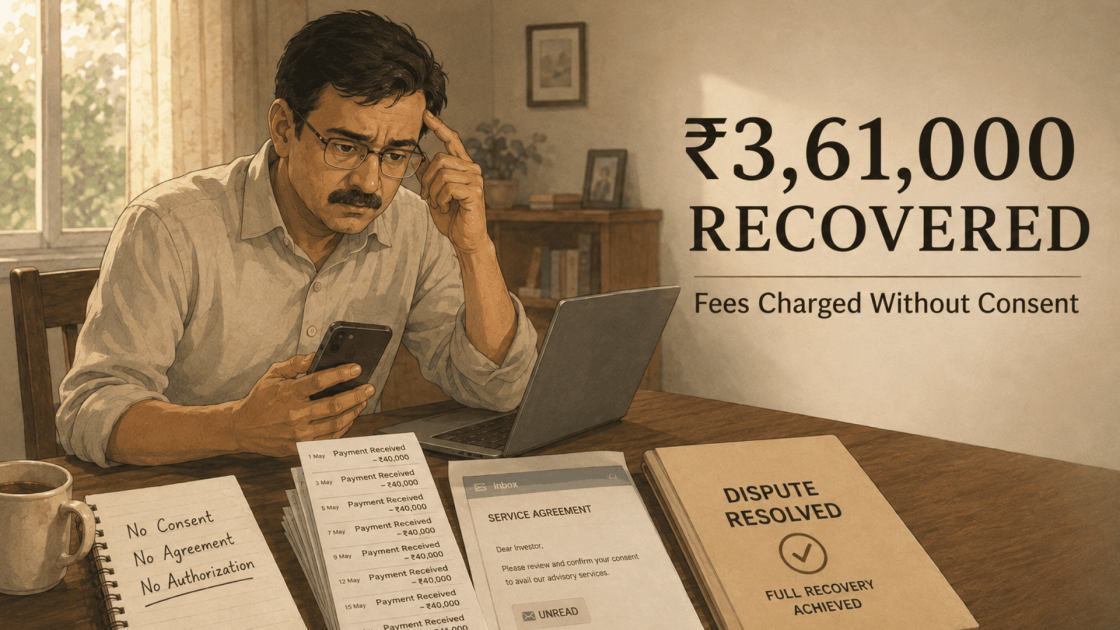
The investor Aman Tiwari (name changed) claimed totaled ₹6,75,783.50 initially, comprising ₹3,61,000 in fees and ₹3,14,783.50 in trading losses. At the heart of the case was a clear violation: a firm registered as a Research Analyst had charged fees without ever obtaining client consent, breached the annual SEBI fee ceiling within just nineteen days, and directed thousands of lots into expiry-day options. After a legal notice with a five-day deadline went unanswered, the matter was escalated to SEBI SCORES 2.0. The result was full recovery of ₹3,61,000, the entire amount of every fee collected. Notably, the client had never typed the words “I agree” and that single missing reply became the foundation of the entire case.
Aman Tiwari (name changed) traded only in cash market stocks. He had no history in futures and options when a firm registered with SEBI as a Research Analyst called him with an offer of a free trial.
The trial produced a small profit within days. On the strength of that result, he paid twenty-five thousand rupees for a service package on the same day an agreement was emailed to him.
He never replied to that email. Nor did he type his acceptance or sign anything. SEBI rules are explicit that no fee can be charged until the client’s consent on the terms is received.
Nine Payments In Nineteen Days
What followed was not one fee, but a rapid sequence of nine separate payments across just nineteen days. Each new demand arrived whenever a position briefly showed profit, framed as the step needed to recover prior losses.
The total collected across those nine payments came to ₹3,61,000. SEBI’s own fee ceiling caps annual charges per his family at ₹1,51,000. This firm collected more than double that ceiling in under three weeks.
On a single morning alone, two payments totalling ₹1,10,000 were collected within twenty minutes of each other. That one morning came close to the entire yearly cap by itself.
The exact ceiling firms are permitted to charge, and how to report a breach of it, is covered in a complaint against a SEBI registered research analyst.
Thousands Of Lots, Averaged Down Into Zero
Aman account statement told its own story once we laid out the trading pattern. Large quantities of expiry day options were bought, then bought again at lower prices as they kept falling.
In one session alone, over five thousand lots of a single put option were accumulated across six separate purchases as the price dropped, before the entire position was sold near expiry for a fraction of the entry cost.
In another session, a position worth close to two and a half lakh rupees in premium expired at fifty paise. This is not a research recommendation gone wrong. This is active, real-time position management with no stop loss in sight.
Blamed For Losses He Did Not Cause
When Aman questioned the mounting losses, representatives told him the losses happened because he had not followed instructions correctly. He had followed every instruction given to him.
A recorded exchange captured the same representatives brushing off responsibility once losses had piled up, before calling him back days later to resume trading as if nothing had happened.
The Fighting Strategy: What Our Team Did
The strongest asset in this case was a paper trail the firm itself had created. Every payment, every message, and every missing reply worked in Aman’s favour once organised properly.
Step One: We Proved Consent Was Never Given
We reviewed Aman’s full email history and confirmed no acceptance was ever sent. This turned the firm’s own unsigned agreement into evidence against it rather than proof of a valid relationship.
Step Two: We Calculated The Fee Cap Breach
Every payment was dated, totalled, and measured against the SEBI annual ceiling. The math made the violation impossible to argue away, since the numbers came directly from the firm’s own payment records.
Step Three: We Reconstructed The Options Trading Pattern
Working from the account’s profit and loss statement, we traced each expiry day position lot by lot. This showed a clear pattern of averaging down with no exit discipline at any stage.
Step Four: We Flagged The Missing Tax Invoices
Every payment had only a generic payment confirmation attached, with no GST breakdown, no invoice number, and no service description. We built this into a standalone record-keeping violation.
Step Five: We Sent A Legal Notice With A Five-Day Deadline
Our notice detailed every violation with dates, amounts, and the exact regulation each one breached, and gave the firm five business days to settle before further escalation.
Step Six: We Filed Through SEBI SCORES
When the deadline passed without resolution, we filed a formal grievance on SEBI SCORES 2.0, attaching every payment confirmation and the full trading record as supporting evidence.
Filing a SEBI SCORES complaint puts a documented grievance directly in front of the regulator, with a defined response timeline the firm cannot simply ignore.
Step Seven: We Kept The RAASB Route In Reserve
Alongside SCORES, our notice placed the firm on record with the possibility of a reference to the Research Analyst Administration and Supervisory Body under BSE, should the matter remain unresolved.
Complaints referencing conduct like this can also be routed through the BSE complaint portal, which oversees this supervisory function for research analysts.
Final Outcome And Recovery
Aman’s total claim stood at ₹6,75,783.50, covering every fee collected across nine payments and the full realised trading loss shown in his account statement.
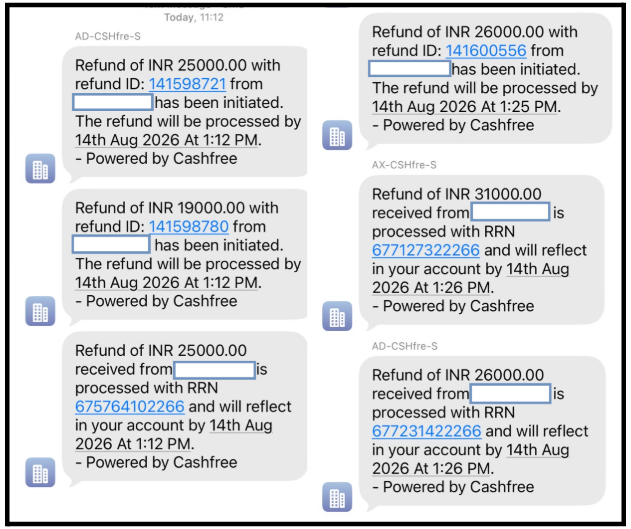
Through the SEBI SCORES process, the matter was resolved with a recovery of ₹3,61,000. This restored every rupee of fees the firm had collected without ever receiving valid consent.
Fees that vanish before you ever say yes shouldn’t sit unquestioned.
Charged Without Consent? We Are Here To Help.
Our team reviews cases like this every day, tracing payment trails, checking fee ceilings, and rebuilding trading records lot by lot to build claims that hold up. When a firm stays silent past its deadline, we don’t stop at a notice; we carry the fight through SCORES, SMART ODR, and arbitration. Register with us.
Conclusion
If a firm charged you before you ever agreed to anything, or if your fees for the year add up to far more than they should, that math is worth putting in writing today.
Report. Recover. Stay Fraud Free.
Frequently Asked Questions
No. SEBI rules require the client's consent on terms before any fee is charged or any service is rendered.
Yes. SEBI sets a maximum annual fee per client family under the Master Circular for Research Analysts. Charges well above this figure are a direct violation.
A proper invoice must show the GSTIN, invoice number, service period, and a full tax breakdown. A payment confirmation email alone is not a tax invoice.
Adding more lots to a losing position as it falls, with no stop loss, is a recognised sign of unsuitable and undisciplined trading direction.
Keep the original email and any replies, or the absence of one, exactly as they are. That gap is often the clearest evidence you have.





 Add us as a preferred source on Google »

