
For access to stock markets, trading tools, and investment advice in the current digital trading environment, a large number of investors rely on online brokerage platforms and advisory services.
While some companies function openly under appropriate regulatory supervision, others cause concern because of persistent user complaints, aggressive marketing tactics, or compliance problems.
When making financial decisions, investors should carefully consider Patel Wealth Advisors Private Limited’s background, regulatory status, and potential risks because it is one such entity that has come under regulatory scrutiny.
Patel Wealth Review
Patel Wealth Advisors Private Limited operates in the financial services sector, offering access to capital market products such as equities, derivatives, and mutual funds.
These services allow investors to trade listed securities, invest in diversified mutual fund schemes, and hold securities in electronic form through depository arrangements.
While such services are common in the financial industry, equity and derivatives trading can involve significant volatility and potential capital loss.
Investors should thoroughly understand product risks, charges, margin requirements, and suitability before proceeding.
No financial service provider can eliminate market risk or guarantee consistent profits.
Is Patel Wealth SEBI Registered?
Patel Wealth Advisors Private Limited holds a SEBI Research Analyst registration bearing number INH000015242.
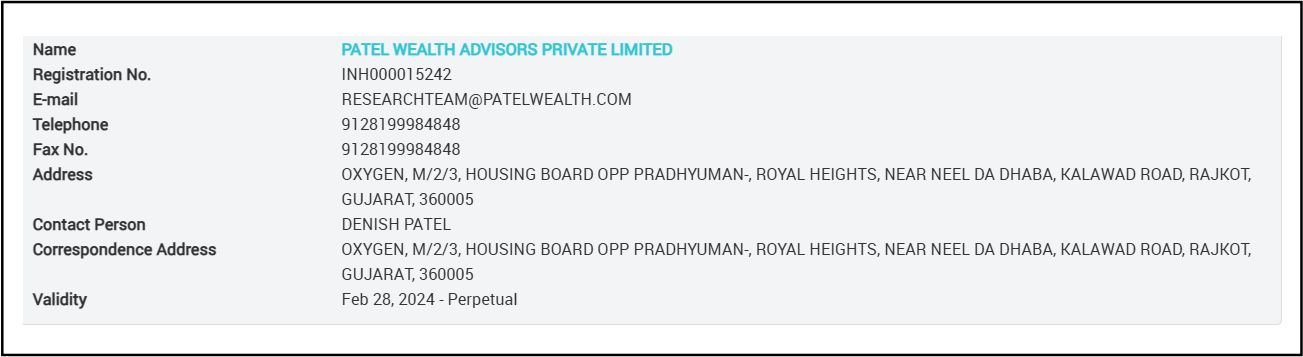
Investors should independently verify this registration directly on SEBI’s official website rather than relying solely on promotional material or shared documents.
It is important to understand that SEBI registration signifies regulatory oversight and compliance requirements, but it does not guarantee returns, assure safety from losses, or confirm the quality of services.
Regulatory registration is a compliance requirement, not a performance certificate.
Investors must remain cautious, review disclosures carefully, and make informed decisions based on their own financial goals and risk tolerance.
Patel Wealth SEBI Order
Have you ever looked at a stock’s “Market Depth” and seen a massive buy order waiting to be filled, only to see it vanish the moment the price ticked up?
If you felt like someone was “gaming” the system, you might have been right.
In a landmark decision in early 2026, the Securities and Exchange Board of India (SEBI) issued a Confirmatory Order against the Rajkot-based stockbroker Patel Wealth Advisors Private Limited (PWAPL) and its directors.
This order isn’t just a legal document; it’s a masterclass in how modern market manipulation, specifically “Patel wealth advisors spoofing scam“, and why the regulator is tightening the noose.
-
What is the Order About?
The order, dated February 11, 2026, follows an intense investigation that began with an Interim Order in April 2025.
SEBI found that PWAPL, a registered stockbroker, was engaging in a sophisticated form of market manipulation known as Spoofing.
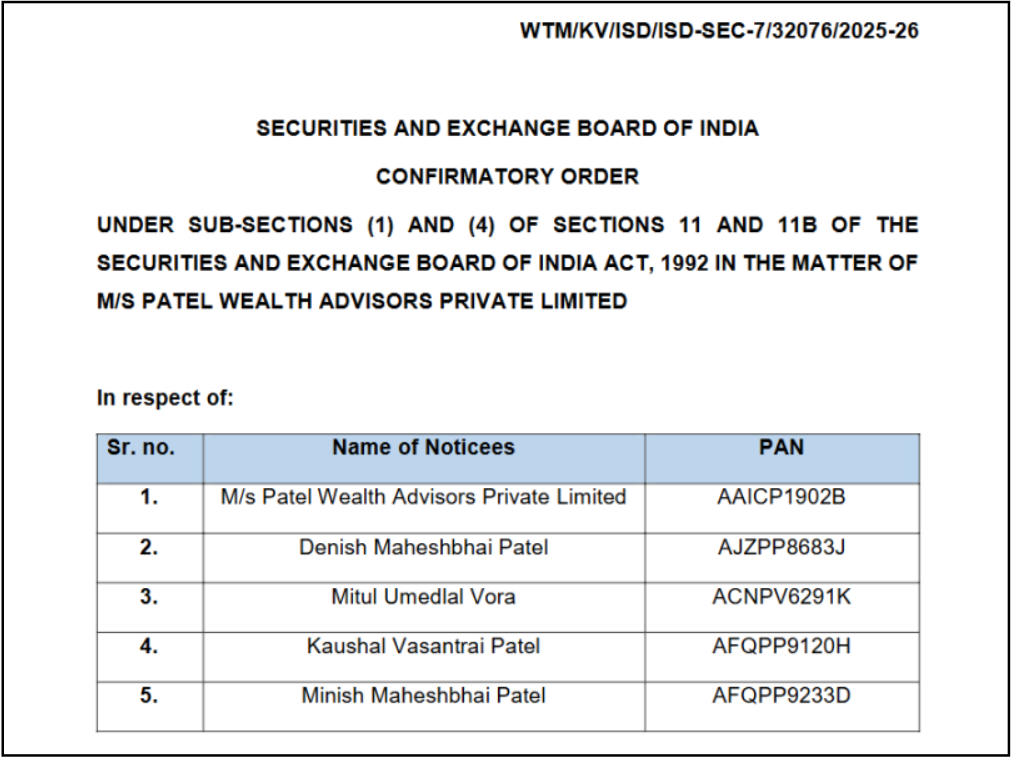
In the legal world, SEBI often issues an “Interim Order” when it finds immediate red flags that need to be addressed.
After giving the accused party a chance to explain their side (the right to be heard), SEBI then issues a Confirmatory Order.
This document confirms, modifies, or withdraws the original restrictions based on new evidence and arguments.
In this case, SEBI has confirmed its stance that there were serious lapses in how the firm handled client funds and operations, leading to a continuation of the ban on certain market activities for the noticees.
-
Background of the Case
The story begins with a routine but rigorous inspection by SEBI and the stock exchanges.
Patel Wealth Advisors, a well-known brokerage firm, came under the scanner for inconsistencies in its books.
The investigation spanned a period where the market was seeing high volatility. During such times, the role of a stockbroker is to act as a “fiduciary”, a fancy word meaning they must act in the best interest of their clients.
However, the data suggested that instead of safeguarding client interests, the firm was allegedly using the system to its own advantage.
-
Allegations Observed by SEBI
SEBI doesn’t pull punches when it comes to financial integrity. The allegations against Patel Wealth Advisors were multi-layered:
- Misuse of Client Funds: The most serious allegation. Brokers are required to keep client money in separate accounts. SEBI found evidence that client funds were being used to meet the firm’s own settlement obligations or the obligations of other clients.
- Falsification of Records: To hide the “hole” in the accounts, it was alleged that records were manipulated to show a healthier financial picture than what actually existed.
- Non-Settlement of Running Accounts: There are strict rules about returning unused money to clients within a specific timeframe (monthly or quarterly). The firm allegedly failed to do this, keeping client money in their own ecosystem for longer than allowed.
- Inadequate Disclosures: Transparency is key in finance. The firm was accused of not being upfront with the regulator and the exchanges about its actual financial liabilities.
-
Interim and Confirmatory Directions
When SEBI first caught wind of these issues, it issued an Interim Order.
This was like a “temporary suspension” to prevent further damage. It barred the firm and its directors from taking on new clients and restricted their access to the capital markets.
In the Confirmatory Order (Feb 2026), SEBI reviewed the replies sent by Patel Wealth Advisors.
The firm tried to argue that the lapses were technical or due to market pressures. However, SEBI found these explanations “unsatisfactory.”
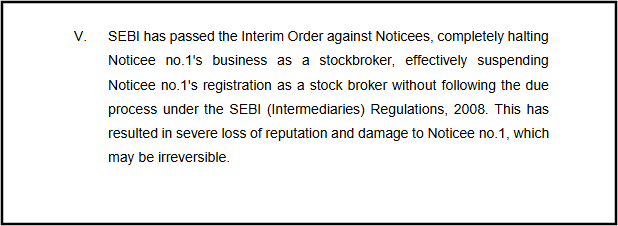
SEBI confirmed the interim directions.
This means the restrictions on the firm and its key individuals remain in force. They are effectively sidelined from certain market activities until the final investigation and adjudication process is complete.
-
Penalty and Regulatory Consequences
While the Confirmatory Order focuses on keeping the restrictions in place, the broader regulatory consequences are severe:
- Market Ban: The directors and the entity remain barred from the securities market.
- Reputational Damage: In the financial world, once SEBI issues a confirmatory order citing misuse of funds, regaining client trust is an uphill battle.
- Impending Fines: While this order confirms the restrictions, a separate “Adjudication Proceeding” usually follows, where heavy monetary penalties are levied based on the scale of the fraud.
- Operational Paralysis: By being unable to onboard new clients or trade freely, the business model of the firm effectively grinds to a halt.
Lessons for Investors
Cases like Patel Wealth Advisors serve as a wake-up call for every retail investor. Here are some “pro-tips” to keep your portfolio safe:
- Monitor Your SMS and Emails: Always cross-check the SMS/emails you receive from the National Stock Exchange (NSE) or Bombay Stock Exchange (BSE) with your broker’s statement.
- Don’t Keep Excess Cash with Brokers: Use the “Running Account Settlement” feature wisely. Better yet, only transfer money to your broker when you intend to buy, and move profits back to your bank account promptly.
- Check SEBI Score: Before choosing a broker, look up their history on the SEBI website. Frequent “Administrative Warnings” or “Orders” are red flags.
- Understand that Big isn’t always Safe: Just because a firm has a fancy office or a long history doesn’t mean they are immune to ethical lapses. Always stay vigilant.
Patel Wealth Telegram Channel
Have you come across the Patel Wealth Telegram channel promising impressive trading results?
Many people are drawn to channels like these because of the bold claims and profit screenshots. But before you act on any tips, it’s important to pause and look a little deeper.
Let’s break down a few things you might notice on such channels.
- You may frequently see posts celebrating “100% target achieved” trades. While these updates can look convincing, they often highlight only the successful trades while leaving out the losing ones. This can create a misleading impression of consistent success.
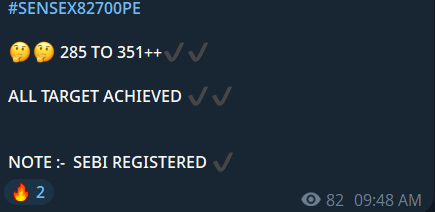
- Another common tactic is giving overconfident or “guaranteed” trading calls. In reality, no one can guarantee profits in the stock market. Any service suggesting otherwise should raise a red flag.
- There are issues with promotional methods. Unrealistic expectations may be created by frequent “target achieved” assertions, high profit forecasts, or aggressive marketing without adequate risk information. In the stock market, no reputable player can ensure steady gains.
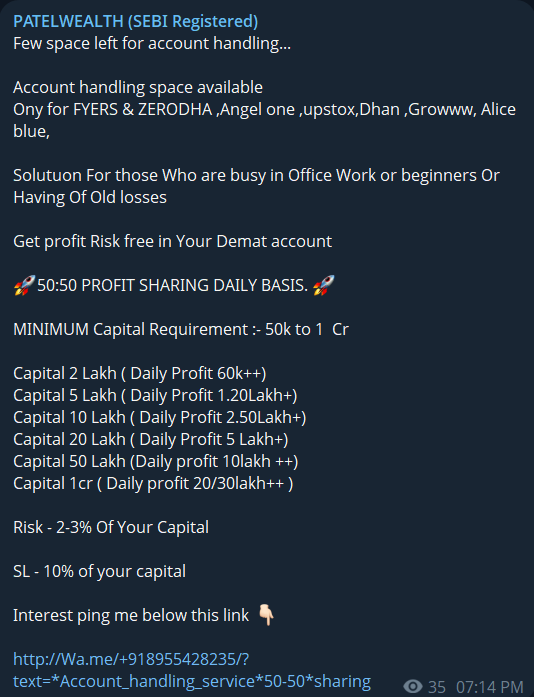
- If someone offers to handle your trading account without proper registration, that should immediately raise concerns. In many cases, such services operate without the required authorization. When someone also promises guaranteed or fixed returns, the risk becomes even higher.
Screenshots of profits, bold claims, and aggressive Telegram promotions can be very persuasive, but they should never replace proper research.
Remember, the stock market is naturally unpredictable and volatile. No individual or firm can realistically promise guaranteed profits. Any claim suggesting otherwise deserves careful scrutiny.
Patel Wealth User Reviews
When it comes to your hard-earned money, a broker’s reputation is everything. But what happens when the glossy marketing brochures don’t match the reality of the people using the service?
Lately, Patel Wealth Advisors Private Limited has been under the scanner, not just by regulators like SEBI, but by frustrated investors.
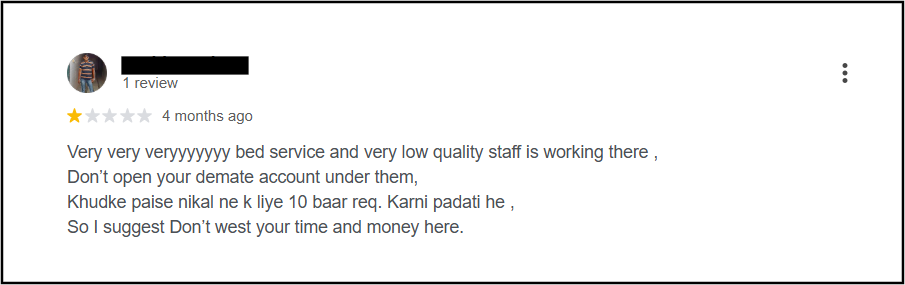
One of the most alarming complaints involves the withdrawal process.
Users report having to request their own funds multiple times before seeing any action. In a digital age where “instant” is the standard, a broker that makes you beg for your own capital is a massive red flag.
This aligns with SEBI’s recent findings regarding the misuse of client funds. If a broker is using client money to settle other obligations, they often face liquidity crunches when multiple users ask for their money back at once
What To Do in Such Cases?
If you suspect misleading advice, regulatory violations, unauthorised transactions, or financial loss, it is important to act promptly and follow a structured reporting process.
Timely action improves the chances of resolution and regulatory intervention.
1. Preserve Evidence Immediately
Before filing any complaint, preserve all relevant evidence. This step is critical.
Maintain copies of:
- Account opening forms, agreements, and KYC documents
- Trade confirmations, contract notes, and account statements
- Screenshots of Telegram posts, profit claims, “target achieved” messages, and advertisement
- Bank statements, UPI references, and transaction IDs
Organized documentation strengthens your complaint and prevents disputes over facts later.
2. Reach Out to the Registered Research Analyst
As a first step, raise your grievance directly with the concerned entity.
Send a written complaint (email is preferable) explaining:
- The issue faced
- Dates, transactions, and amounts involved
- The resolution you are seeking
SEBI regulations require registered intermediaries to have a grievance redressal mechanism. Retain proof of communication and responses received, if any.
3. File a Complaint on SCORES
If the issue is not resolved satisfactorily, file a complaint through SEBI SCORES (SEBI Complaints Redress System).
On the portal:
- Register yourself using your PAN and contact details
- Select the appropriate intermediary category (Research Analyst / Broker / Investment Advisor)
- Upload supporting documents and screenshots
Once submitted, SEBI forwards the complaint to the concerned entity and monitors their response. You will receive a complaint reference number to track progress.
4. Escalate Through Arbitration or Regulatory Process
If the response through SCORES is inadequate or rejected, investors may:
- Seek escalation under SEBI’s dispute resolution framework
- Avail arbitration in the stock market and check the mechanisms available through stock exchanges, where applicable
Arbitration provides a formal platform to resolve disputes involving registered market intermediaries without lengthy court proceedings.
Need Help?
If you are unsure whether a platform is legitimate or if you have already faced issues, seeking guidance early is important. You can reach out to us.
We can assist you by:
- Reviewing your situation and identifying potential regulatory or compliance concerns
- Helping you organize and preserve evidence in a structured manner
- Guiding you on the appropriate reporting route, including the Research Analyst, broker grievance mechanism, SEBI SCORES, arbitration, or cybercrime reporting
- Assisting with drafting clear, fact-based complaints aligned with regulatory expectations
- Tracking SEBI complaint status
If you are uncertain about the next step or need clarity on how to proceed, reaching out sooner rather than later can help protect your interests and prevent further loss.
Conclusion
Investor knowledge is crucial, as demonstrated by Patel Wealth’s regulatory vigilance and Telegram marketing strategies.
Claims of selective performance and assured returns are red flags in stock markets, particularly when paired with regulatory orders.
Verify regulatory status, steer clear of illegitimate app downloads, and thoroughly assess danger before putting your trust in any advisory services or Telegram channels.
Your best defences in financial markets are prudence and due diligence.