
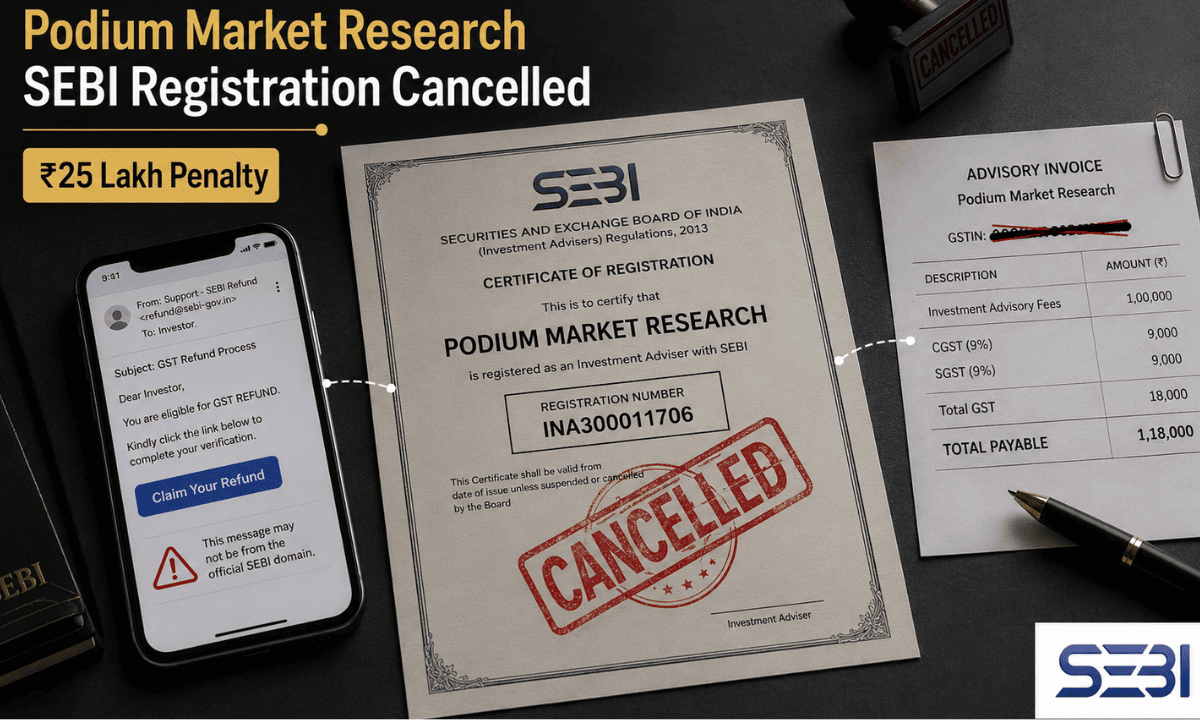
Quick Summary
SEBI has cancelled the investment adviser registration of Podium Market Research, run by Suman Kumar, for failing to pay its renewal fee. This comes about a year after SEBI’s own enquiry found the firm had failed to protect client data and had fraudulently charged GST it wasn’t registered to collect, a case where at least eight clients lost money to a fake refund scam. SEBI chose to suspend the licence for three months back then instead of cancelling it. The registration, INA300011706, is dead now anyway
Podium Market Research wasn’t some fly-by-night operator. It held a real SEBI licence and had been advising clients for years out of Patna.
That’s exactly why what happened to its clients stings more than the usual unregistered-tipster story.
This piece walks through what SEBI actually found, what Suman Kumar argued in his defence, and what you can do if you paid this firm for advice.
How the Fake SEBI Refund Email Scam Actually Worked?
SEBI’s enquiry traces back to a former Podium employee, Prakash Kumar, who worked there from July 2019 to February 2020.
After he left, he allegedly kept using information he’d had access to as a relationship manager.
He set up a fake email ID made to look like Podium’s own compliance desk, and a second fake ID made to look like it belonged to SEBI itself.
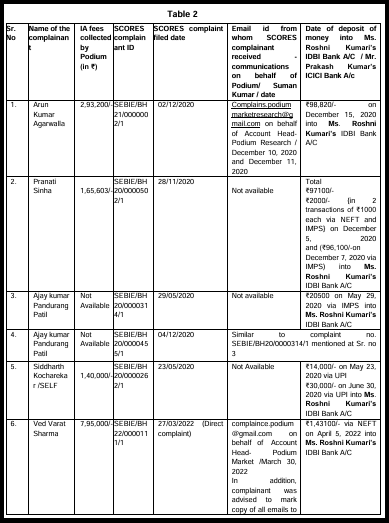
Using these, he contacted clients who’d already filed complaints on SEBI’s SCORES portal and told them their advisory fees would be refunded, provided they first paid an amount described as GST.
At least eight clients paid up between 2020 and 2022, with individual transfers ranging from a few thousand rupees to over a lakh.
One client, whom we’re identifying only by initials, V.V.S., transferred ₹1,43,100 in April 2022 after receiving one of these fake emails.
He was told to keep the fake SEBI address in copy on all correspondence, which made the whole thing look official.
None of these clients got their money back.
The funds went into personal bank accounts belonging to Prakash Kumar and another individual, Roshni Kumari, not back to the clients and not to Podium itself.
Why SEBI Didn’t Accept Suman Kumar’s Defence?
Suman Kumar’s defence, when SEBI came asking, was that he was a victim too.
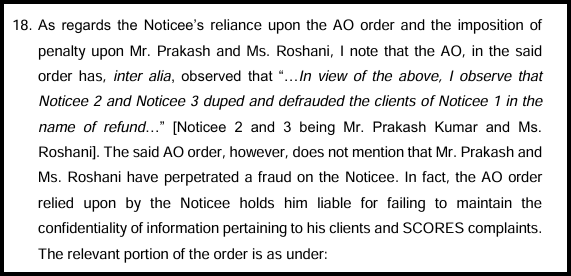
He argued Prakash Kumar had used old access to run this scheme without his knowledge, and pointed to a separate SEBI order that fined Prakash Kumar and Roshni Kumari ₹7 lakh each for their role.
SEBI’s Whole Time Member didn’t accept that framing.
The order draws a specific distinction here: the earlier penalty order against Prakash Kumar and Roshni Kumari found that they had defrauded Podium’s clients, not Suman Kumar himself.
He wasn’t the victim in that finding.
He was the adviser who was supposed to protect those clients’ information in the first place.
Under SEBI’s rules, an investment adviser owes clients a fiduciary duty that doesn’t end when an employee walks out the door.
SEBI held that Suman Kumar failed to take reasonable steps to stop a former employee from continuing to misuse client data long after he’d left, and that failure alone was enough to establish a violation.
How Podium Charged GST Without a Valid GST Registration?
Separately, SEBI’s enquiry looked at how Podium billed its clients.
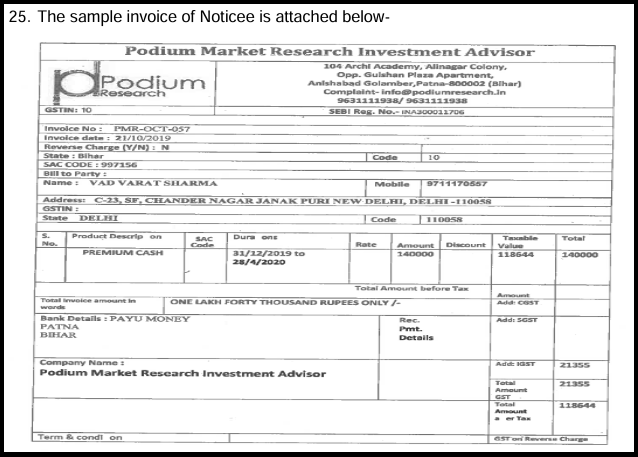
From at least 2018 to 2020, invoices charged clients a composite GST amount on top of the advisory fee, listed clearly as CGST and SGST with a “total amount after tax” line.
There was one problem. Podium didn’t have a GST registration until May 2021. The firm had no legal basis to be collecting that money at all.
SEBI also flagged that the invoices contradicted themselves, one field marked reverse charge as “No,” while the terms and conditions on the same document referred to “GST on reverse charge.”
SEBI treated this as more than a paperwork slip, ruling that the invoices themselves were false and that clients were misled into paying money they didn’t actually owe.
Why SEBI Suspended Podium Instead of Cancelling It?
Here’s the part that makes this case genuinely unusual.
SEBI’s own Designated Authority, after investigating both issues, recommended that Podium’s registration be cancelled outright.
The Whole Time Member disagreed with that recommendation.
Citing a legal doctrine that penalties should be proportionate to the violation, and pointing to a prior Securities Appellate Tribunal ruling on the same principle, SEBI decided a full cancellation was too severe.
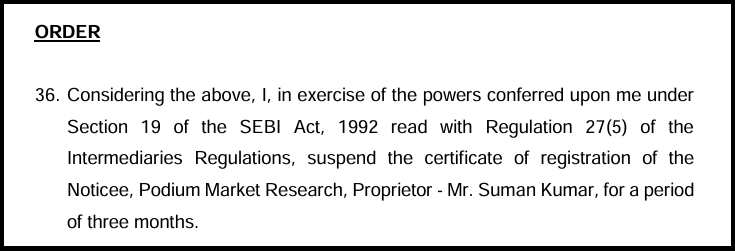
Instead, it suspended Podium’s registration for three months, starting October 23, 2025.
The reasoning: Suman Kumar hadn’t personally conspired with Prakash Kumar and Roshni Kumari, and he’d since fixed the GST registration problem.
SEBI gave him the benefit of the doubt.
Less than a year later, the licence is gone anyway, not because of the fraud, and not because of the GST case. It’s gone because Podium never paid its five-year renewal fee.
Also Read: SEBI Cancels Investment Advisers License List
Is Podium Market Research SEBI Registered Now?
No. In an order dated August 7, 2026, SEBI formally cancelled Podium Market Research’s registration, INA300011706, held by proprietor Suman Kumar.
This specific order has nothing to do with the fraud or GST findings above.
It’s purely about non-payment; every SEBI-registered investment adviser must renew their registration every five years, and SEBI’s records show Podium simply didn’t pay that fee.
That non-payment, on its own, was grounds for cancellation under Section 12(3) of the SEBI Act.
So Podium Market Research is not currently a SEBI-registered investment adviser in any capacity.
Anyone who still sees the firm marketing itself as SEBI-registered after this date should treat that as a red flag on its own.
Can Podium Market Research Clients Get Their Money Back?
This is the question that actually matters if you were a client, and the honest answer depends on what kind of money you’re chasing.
The penalties SEBI has imposed, whether the ₹7 lakh fines on Prakash Kumar and Roshni Kumari, or the ₹25 lakh order against Suman Kumar that’s currently under appeal at the Securities Appellate Tribunal, go to the regulator.
They aren’t compensation orders, so don’t expect that money to land back in your account automatically.
If you paid a “GST refund” transfer to a personal account after getting an email like the one V.V.S. received, that’s impersonation fraud, not a simple service dispute.
Your strongest route is a police or cybercrime complaint, since the money moved through fake identities rather than through your actual advisory relationship with the firm.
If your issue is that Podium charged you GST it had no registration to collect, SEBI’s own order has already established that fact for you.
That existing finding strengthens your position if you file a SCORES SEBI complaint against the registration number.
We’ve walked other investors through a similar situation where SEBI had already penalised a firm for the exact practices they were complaining about.
Our Streetgains SEBI order guide covers how an existing SEBI finding can support your own complaint.
If SCORES doesn’t resolve things, escalation through SEBI’s SMART ODR platform or exchange arbitration is the next step.
What Current Podium Market Research Clients Should Do Now?
Today’s cancellation order still requires Podium Market Research to keep handling investor grievances, preserve client records, and support a smooth transfer of your account or funds, even though the registration is gone.
That means the firm can’t just vanish and leave you stranded.
If you have an active advisory relationship with them, now is the time to get your records, agreements, and payment history in writing before anything gets harder to trace.
Podium isn’t the only name on this particular SEBI order.
We’ve also covered Shubh Stocks Capital, another investment adviser caught up in the same batch of cancellations, if you want to check whether your adviser shows up there too.
Conclusion
Podium Market Research held a genuine SEBI licence for years, which makes its clients’ losses harder to dismiss than an unregistered scam would be.
SEBI chose leniency once, suspending rather than cancelling the registration, but that decision was overtaken by a simple unpaid renewal fee.
If you paid this firm, treat any refund email as suspicious, and act now, while records are still traceable, whether through SCORES, a cybercrime complaint, or both.
Report. Recover. Stay Fraud Free.
No. SEBI cancelled its registration, INA300011706, in an order dated August 7, 2026, after the firm failed to pay its renewal fee. Yes. SEBI's enquiry found the firm had failed to protect client confidentiality and had fraudulently charged GST it wasn't registered to collect. SEBI suspended the registration for three months in October 2025 rather than cancelling it outright. No. Penalties SEBI imposes go to the regulator, not directly to investors as compensation. You'll need to pursue your own complaint or legal route to recover your money. Treat any unexpected refund email asking you to pay GST or processing charges as suspicious. This is the exact scam pattern SEBI found in this case, run through fake email addresses designed to look official. Start with a written complaint to the firm, then escalate through SEBI's SCORES portal if you don't get a response. For money sent to a third-party account under false pretences, also file a cyber crime complaint. SEBI's order requires the firm to preserve records and support client transfers despite the cancellation, so you're entitled to ask for your documents and trading history in writing. You can search any registration number on SEBI's intermediary portal. If you're unsure how to verify or file a complaint, we can walk you through it.Frequently Asked Questions



 Add us as a preferred source on Google »

