

Quick Summary
Streetgains is a real, SEBI registered research firm, and that answers only the first layer of the safety question. The firm’s own disclaimers promise no guaranteed returns, yet SEBI’s investigation found sales chats promising exactly that, a gap the regulator priced at ₹8 lakh plus a one month ban on new clients. Add the user pattern, calls arriving late, accuracy claims that skip stop loss hits, support fading after payment, and safe stops being a yes or no word. This page weighs all of it, the registration, the guarantee question, the documented conduct, and the complaints, and gives you the honest verdict in plain words.
There is a quiet moment most investors never talk about, the one that comes after the money has moved.
You have signed up, transferred the fee, and placed your first trade on someone else’s recommendation.
The charts are moving. The market feels alive. And the question inside you quietly changes shape.
It stops being how much will I make.
It becomes, did I make the right choice trusting this platform?
That question does not come from greed. It comes from responsibility toward your money, and this page exists to answer it properly, with the record open.
Is Streetgains Safe in India?
The honest answer needs more than one word, so here it is in full, starting with what you are actually evaluating.
Streetgains is a Bengaluru based, SEBI-registered Research Analyst platform selling trade calls through its app, WhatsApp, and Telegram.
That much is real and verifiable.
Whether it is safe depends on splitting one word into three separate questions, because safe means something different depending on what you are asking about:
- Is the firm genuine?
Yes, the registration is real and active, and confirmed directly on SEBI’s own portal, not just claimed on the firm’s website. - Is your money safe from the market?
No platform can promise that, and this firm’s own paperwork says so plainly. - Is your money safe from how the firm sells itself?
That is the question with a documented answer, and it is not a comfortable one. The regulator investigated this exact question and found a gap, as told fully next.
Also Read: Is Supreme Investrade safe? Understand the concerns investors should consider before subscribing.
The Gap Between What Streetgains Promises and What Its Sales Team Said?
Merging the safety question with the guarantee question is deliberate, because for this firm, the guarantee question is where the real answer lives.
On paper, the promise is a clean no guarantee.
The firm’s website states that returns are not guaranteed and that every market recommendation carries risk. The client acceptance policy repeats it: no assured profits, no promised outcomes.
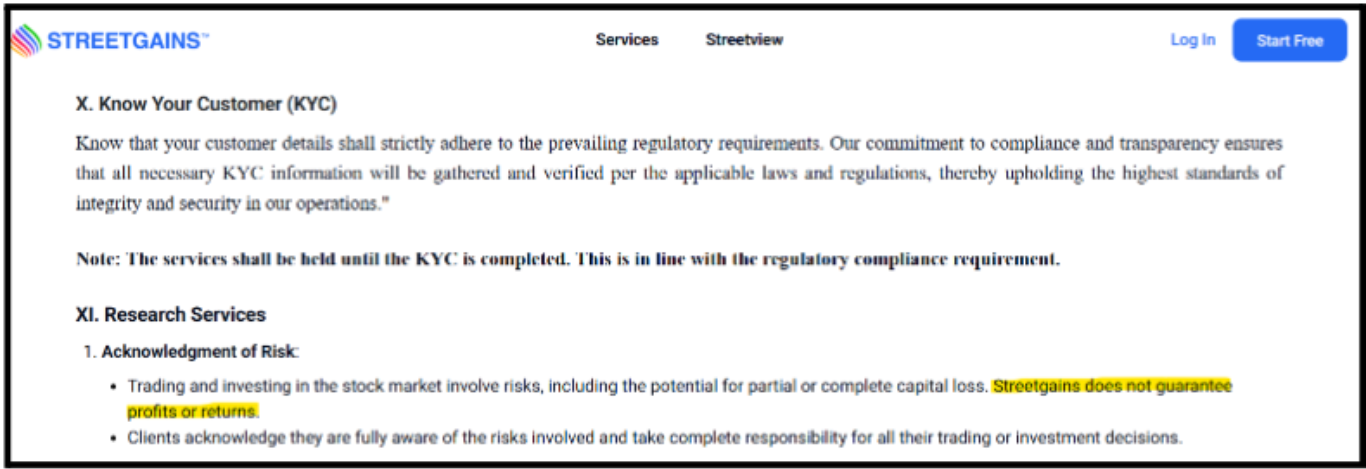
In practice, the regulator found something else, and it’s serious enough to walk through on its own.
A firm can write honest disclaimers and still sell through promises, and when that happens, the disclaimers protect the firm, not you.
Market Risk vs. Conduct Risk: Why the Difference Matters for Safety
This is where most traders get the safety question wrong, mixing two risks that need completely separate answers.
Market risk is unavoidable. Even honest, well-researched calls lose money, and no subscription anywhere removes that. Losing on a fairly given call is not a safety failure; it is trading.
Conduct risk is different, and it is the one on this firm’s record. Being sold through promises, shown only winning calls, or pushed into products unsuitable for you, those are failures of conduct, and the regulator documented each of them here.
Notably, SEBI chose correction over cancellation; the registration survived, which tells you the regulator saw a firm worth reforming, not a fraud worth erasing.
One more test decides which risk you are actually facing, right now, in your own conversation with this firm.
If your sales conversation is factual, risk stated, terms in writing, no outcome promised, the documented pattern is history you are aware of, not something happening to you.
If your conversation includes assured profits, loss recovery, or accuracy figures doing the persuading, you are hearing the exact practice the regulator already penalised, live, aimed at you.
Safe, in other words, is not something the firm simply is.
It is something your specific interaction with it either respects or violates, and now you know how to tell which.
What Did SEBI Actually Investigate?
The gap between the paper promise and the WhatsApp reality wasn’t just observed once; it was the subject of a formal, two-year investigation.
SEBI examined the firm’s conduct from April 2022 to March 2024, covering how it communicated with clients and prospects, how it marketed itself, how recommendations were structured and recorded, and whether its internal incentives followed the rules.
The question throughout was whether day-to-day conduct matched what the Research Analyst Regulations, 2014 and the PFUTP Regulations demand.
The investigation identified six distinct violations. Here’s each one, and the exact rule it broke.
1. Sales Executives Promised Guaranteed Profits and Loss Recovery
Streetgains’ sales personnel messaged prospective clients on WhatsApp with assurances no Research Analyst is legally allowed to make. Phrases like “you will get good returns,” “your loss will be recovered the same day,” and specific daily profit figures were used to persuade people to subscribe.
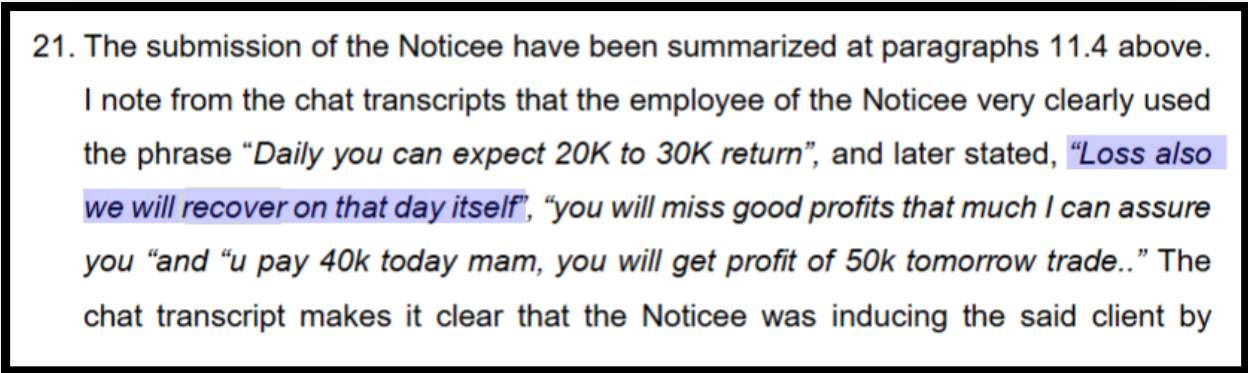
SEBI held that such language amounts to inducement and mis-selling, a direct breach of the PFUTP Regulations.
2. An Incentive Structure That Encouraged Mis-Selling
SEBI found that the firm’s internal incentive model could motivate employees to push services aggressively without properly checking suitability.
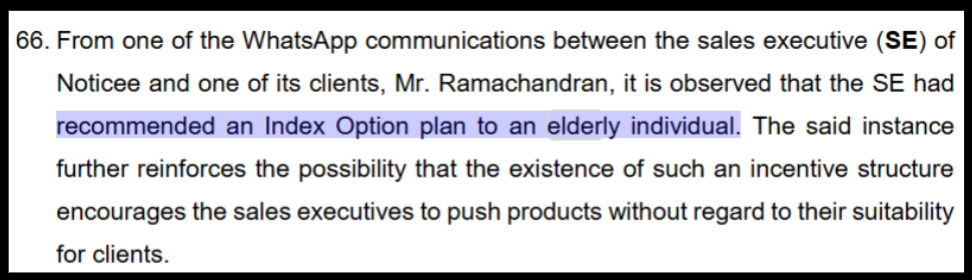
Index options were recommended to elderly investors, a category for whom such high-risk derivatives are explicitly flagged under SEBI’s August 2013 circular on mis-selling prevention.
3. Vague Research Records and Unsigned Reports
Recommendations ran on generic templates with brief, vague reasoning, lines like “intraday price volume breakout” standing in for actual analysis.
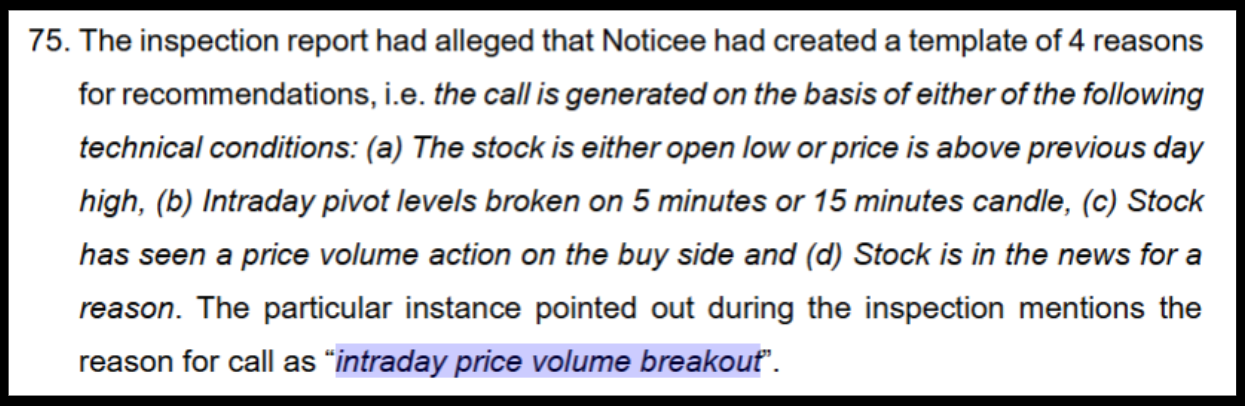
The firm’s research reports were also not digitally signed, violating Regulations 25(1)(i) and 25(2).
4. Selective Performance Posting
Streetgains ran an active social media handle posting “Top 5 Research Calls of the Day,” highlighting profitable recommendations while quietly leaving out the calls that failed.
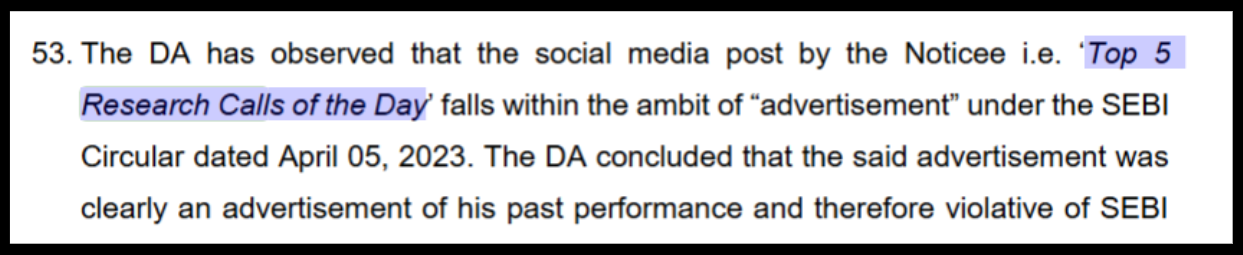
SEBI’s circulars of April 2023 and May 2024 are explicit that a Research Analyst cannot showcase past performance selectively in a way that could mislead investors.
Why this specific tactic works on people is worth understanding on its own terms.
Repeatedly seeing winning trades displayed publicly makes profit feel common and predictable; a screenshot never shows the losses or drawdowns behind it.
High-accuracy language repeated often enough makes losses feel rare, even though no advisory eliminates market risk.
And when promotional content shouts about wins while risk disclosures whisper in the footer, the overall impression becomes one-sided.
Every violation, in one view:
| What Streetgains Did | The Rule It Broke |
|---|---|
| Sales staff assured guaranteed returns on WhatsApp | PFUTP Regulations and RA Regulations, 2014 |
| Promised clients their losses would be recovered | PFUTP Regulations |
| Posted only winning calls as Top 5 of the day | SEBI circulars of April 2023 and May 2024 |
| Pushed index options to elderly investors | SEBI circular of August 2013 on mis-selling |
| Ran incentives that rewarded aggressive selling | RA Regulations, 2014 |
| Kept vague research records, reports unsigned | RA Regulations 25(1)(i) and 25(2) |
What Action Did SEBI Take?
Two separate orders followed, each doing a different job.
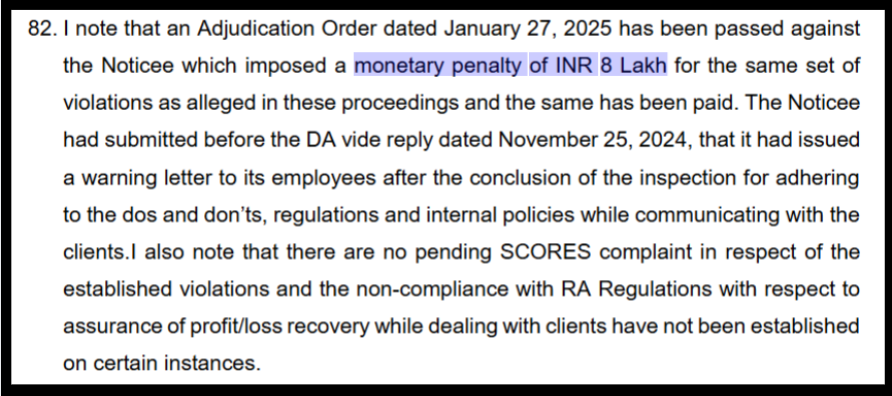
The first, an Adjudication Order in July 2025, imposed a monetary penalty of ₹8 lakh on Kumar Venkataramegowda Santhosh, the proprietor of Streetgains Research Services, for the documented violations.
The second, the Final Order of March 2026, hit operations directly. SEBI issued a formal regulatory censure and barred the firm from onboarding any new clients for one month.
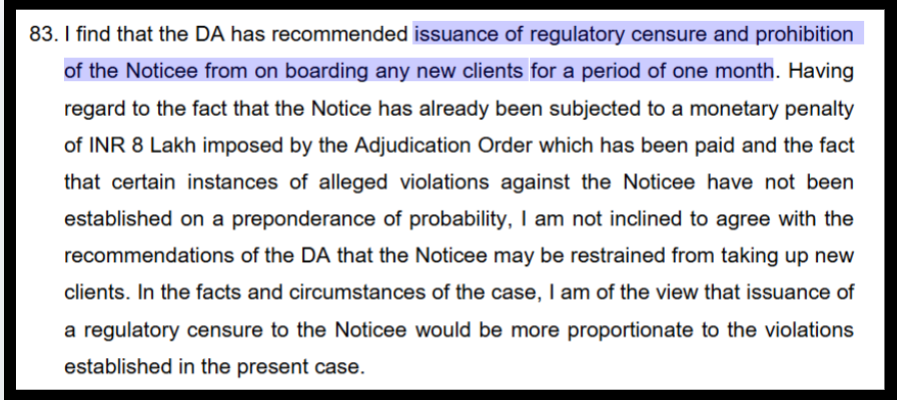
What didn’t happen matters equally. The registration was not cancelled. The firm continues operating as a Research Analyst under the new entity, Streetgains Technologies Private Limited.
Also Read: Manish Goel SEBI order, he appealed, and mostly lost
What Streetgains Users Report After Paying?
Beyond the regulator’s own findings, real subscribers have separately documented similar experiences after paying: calls arriving late, accuracy claims that quietly exclude losses, support that fades once payment clears.
Every one of those accounts, thirteen reviewers in total, grouped by pattern, with names and screenshots, is covered in complete detail on our page on Streetgains reviews.
Stock Advisory Red Flags: What This Case Teaches?
The Streetgains file isn’t an isolated story. The same patterns fill advisory complaints across the industry, and recognising them before paying is the cheapest protection there is.
If you’re evaluating this firm, or weighing whether to subscribe anywhere, hold every advisory against these five: only profits highlighted, extremely high accuracy positioning, pressure-based sales messages pushing a same-day decision, little real discussion of risk, and heavy dependence on screenshots as proof.
A legitimate advisory doesn’t vanish if you take a week to verify the registration, read the disclosures, and ask for the full track record, losers included.
The Verdict, Compressed Into One Straight Answer
Everything above compresses into a verdict, and it deserves to be given straight.
Streetgains is not a fake firm. The registration is real, the research operation exists, and the regulator chose to correct it rather than shut it.
Streetgains is also not automatically safe, because the documented record shows the selling side of the business crossing lines the research side disclaims, and the user pattern echoes the same gap.
So the working answer looks like this.
The platform can be used with open eyes if you verify the registration yourself, get every term in writing, treat all accuracy and profit talk as marketing rather than fact, and size your subscription against money you can afford to risk.
And it stops being safe the moment a promise enters the conversation, because a guaranteed return from this firm is not a perk.
It is the violation already on file, wearing your name this time.
Did a Streetgains conversation include a promise you can still scroll back to?
Save that chat before anything else. We will tell you honestly whether it matches the practices SEBI has already penalised, what it makes you entitled to, and how to act on it while the record is fresh.
What to Do If You Lost Money with Streetgains?
Some readers reach this page too late for prevention; the fee is paid, the doubt is real, and the question is what now.
The answer is a defined road, not a dead end.
Because the firm is a registered Research Analyst, your complaint carries formal weight, and the general process for any Research Analyst dispute applies here too, from the firm’s own support desk through SEBI’s SCORES platform under the Research Analyst category, and onward to dispute resolution where money is at stake.
Our guide on how to complain against SEBI registered Research Analyst puts the entire general route in your hands, the evidence list, the right desk for each stage, and what every forum can actually order.
Conclusion
Is Streetgains safe? The honest answer has three parts, and you now hold all of them.
The firm is real and registered. The conduct record shows it promises its own disclaimers forbid, priced by the regulator at ₹8 lakh. And the deciding factor is not the firm’s paperwork but the conversation it has with you, because that is where the documented pattern either stays in the past or repeats.
Ask for everything in writing, believe the disclaimers over the sales talk, and treat any promised outcome as your signal to stop.
In the market, nobody can guarantee returns, and anyone who does has already told you what you need to know.
Report. Recover. Stay Fraud Free.
Frequently Asked Questions
The firm is real and SEBI registered, so it is not a fake operation. Safety depends on conduct, and SEBI has penalised the firm ₹8 lakh over promises its sales team made, so use it only with written terms, verified registration, and zero reliance on any assured outcome.
The firm's own disclaimers and client policy say no returns are guaranteed. SEBI's investigation, however, found sales executives promising returns and same day loss recovery on WhatsApp, and that gap between paper and practice is what the ₹8 lakh penalty punished.
It is a genuine, registered research firm, not a scam in the fake company sense. The concerns on record are conduct based, misleading promises and selective performance display, which the regulator addressed through a penalty and a one month ban on new clients rather than cancellation.
Yes. Market risk exists in every trade, and even honestly researched recommendations fail regularly. Losing on a fairly given call is normal market risk, while being induced through promised profits is a conduct violation, and telling the two apart protects both your money and your case.
Preserve the chats and messages immediately, because a promised return from a registered Research Analyst is a documented violation, not a sales quirk. Then raise it in writing with the firm and escalate through SEBI's SCORES platform if the response disappoints.





 Add us as a preferred source on Google »

