
AI and the stock market; it’s a powerful combination.
Over the last few years, we’ve seen a surge in workshops promising to simplify investing using artificial intelligence.
One such name that often appears in this space is Rahul Chandra, co-founder of SpringPad, a platform positioned as an AI-driven EdTech and wealth advisory ecosystem.
The marketing highlights are strong- SEBI-registered Research Analyst, global finance experience and “30%+ returns” frameworks with algorithmic trading tools like BullsAI.
At first glance, it looks like the perfect mix of regulation, technology, and expertise.
But in financial markets, credibility is not built only on credentials. It is built on regulatory boundaries.
When a SEBI-registered Research Analyst promotes AI-powered trading systems and return-focused frameworks, an important question naturally arises:
Where does education end, and where does regulated investment activity begin?
This blog takes a structured look at Rahul Chandra, SpringPad’s AI workshops, BullsAI, SEBI registration, fee norms, and what investors should understand before enrolling in such programs.
Who is Rahul Chandra?
Rahul Chandra is publicly presented as the co-founder of SpringPad, alongside Pratik Chakraborty. Both are positioned as the faces behind the AI-driven investing workshops and BullsAI ecosystem.
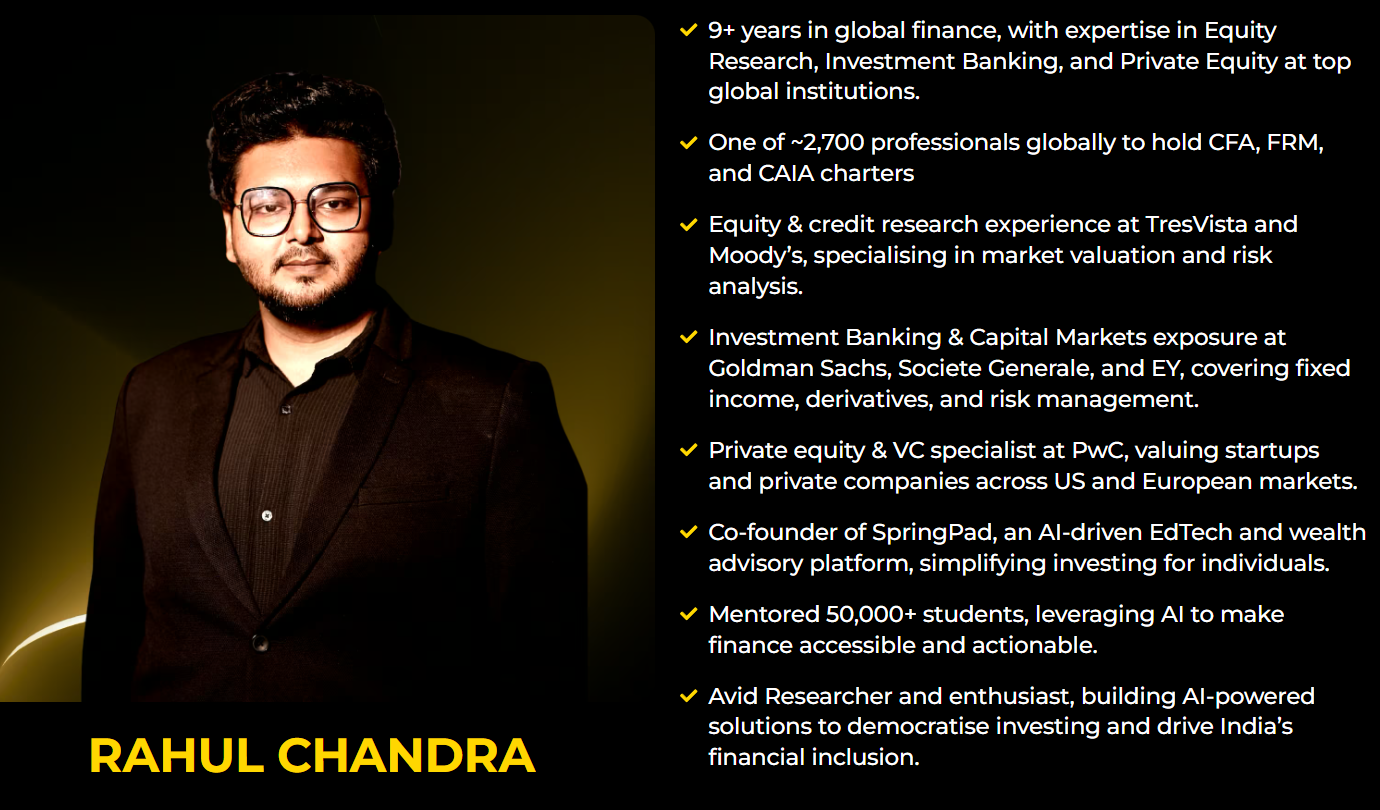
According to the profile displayed on the website, Rahul Chandra has:
- 9+ years in global finance
- Experience across equity research, investment banking, capital markets, and private equity
- CFA, FRM and CAIA charters
- Mentored 50,000+ students
- Built AI-powered tools aimed at simplifying investing
The positioning is clear: institutional finance meets artificial intelligence, delivered through structured workshops and paid programs.
Pratik Chakraborty, as co-founder, is also actively involved in conducting these sessions and presenting the SpringPad framework.
The marketing narrative presents both Rahul and Pratik as mentors bringing global exposure and structured systems to retail investors.
On paper, this profile builds strong credibility.
However, in financial services, professional background and regulatory permissions are two different things.
Experience creates trust.
Registration defines what activities are legally permitted.
So the next logical step is not to question credentials, but to understand the ecosystem they are operating in.
Let’s examine SpringPad’s AI workshop claims and the BullsAI tool more closely.
Is Rahul Chandra SEBI Registered?
Rahul Chandra, along with co-founder Pratik Chakraborty, operates SpringPad under a SEBI Research Analyst (RA) registration.
Before examining any claims or allegations, it is important to establish this clearly.
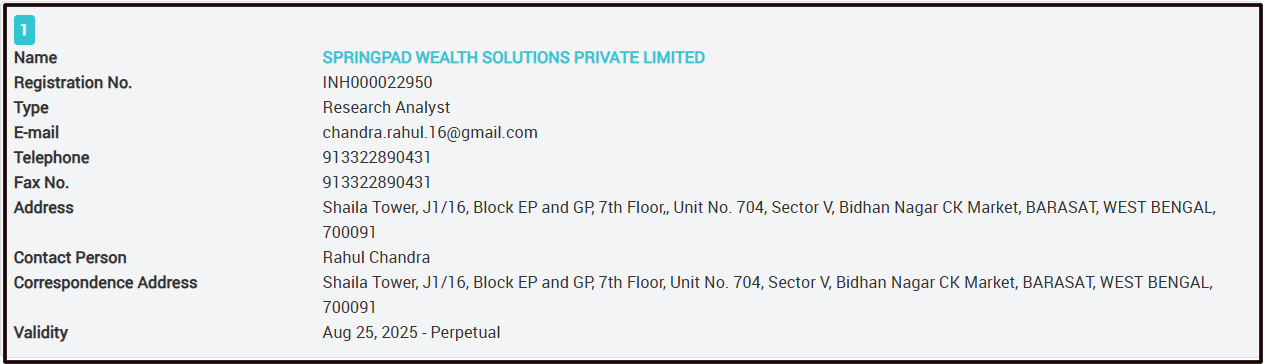
SpringPad Wealth Solutions Pvt. Ltd. is registered as a SEBI Research Analyst under registration number INH000022950.
This means the entity is legally permitted to:
- Publish research reports
- Provide stock recommendations
- Offer model portfolios
- Conduct educational workshops
- Charge fees for research services within regulatory norms
However, a Research Analyst license does not permit:
- Managing client funds
- Offering discretionary portfolio management
- Acting as a Portfolio Management Service (PMS)
- Guaranteeing returns
- Misleading investors through performance projections
This distinction becomes important when high-ticket programs and AI-driven trading systems are involved.
SpringPad AI
SpringPad’s flagship positioning revolves around SpringPad courses, the AI-powered stock market education.

The 4-Day AI Workshop page highlights strong, attention-grabbing phrases such as:
- “Unlock consistent 30%+ returns”
- “Surpass average industry returns”
- “Automate your stock trades”
- “Effortless, hands-off profits”
This language is designed to appeal to modern retail investors, especially those looking for structured systems rather than discretionary trading.
Rahul Chandra and co-founder Pratik Chakraborty present the workshop as a framework-driven approach to using artificial intelligence for:
- Stock screening
- Strategy backtesting
- Portfolio construction
- Risk management
- Workflow automation
On the surface, this can fall within financial education and research.
However, when performance-oriented language such as “30%+ returns” or “consistent profits” appears alongside a SEBI-registered Research Analyst identity, the classification becomes important.
Is this:
- Pure education?
- Research-based framework?
- Or a system implying performance expectations?
That distinction matters from a regulatory standpoint.
BullsAI: Algorithmic Trading Tool
Within the SpringPad ecosystem led by Rahul Chandra and co-founder Pratik Chakraborty, BullsAI is positioned as an AI-powered algorithmic trading tool.
It is presented as a structured system designed to reduce emotional decision-making and bring automation into trading.
The idea is attractive:
Use algorithms. Follow data-backed strategies. Let AI handle the complexity.
SpringPad User Complaints
But whenever automation and performance expectations are combined, clarity becomes essential. Now let’s look at what some users are saying.
1. High Pricing, Less Transparency
One review raises concerns about the program being priced around ₹1,25,000. The allegation suggests that the pricing felt high relative to the clarity provided during the sales process.
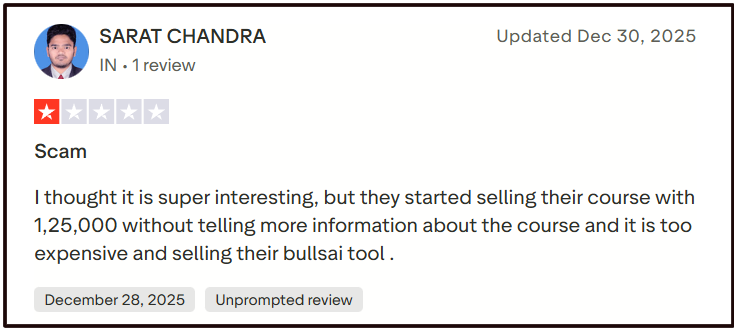
It’s important to state clearly that premium pricing is not illegal. Many financial education programs charge high fees.
However, when pricing approaches six figures and is linked, directly or indirectly, to trading outcomes, regulatory classification becomes relevant.
If BullsAI is bundled as part of a research subscription under a SEBI Research Analyst license, fee norms and advance collection rules may apply.
Historically, industry references have cited limits around ₹1.51 lakh per annum per family for retail research services, along with advance fee restrictions.
That is why investors should always understand:
Is the payment for education?
Is it for research access?
Or is it something closer to advisory?
Now, let’s examine the second theme raised in reviews.
2. Refund Issues
Another review alleges that BullsAI requires manual activation before 9 AM despite being positioned as an automated AI-based system. It also raises concerns about refund commitments.
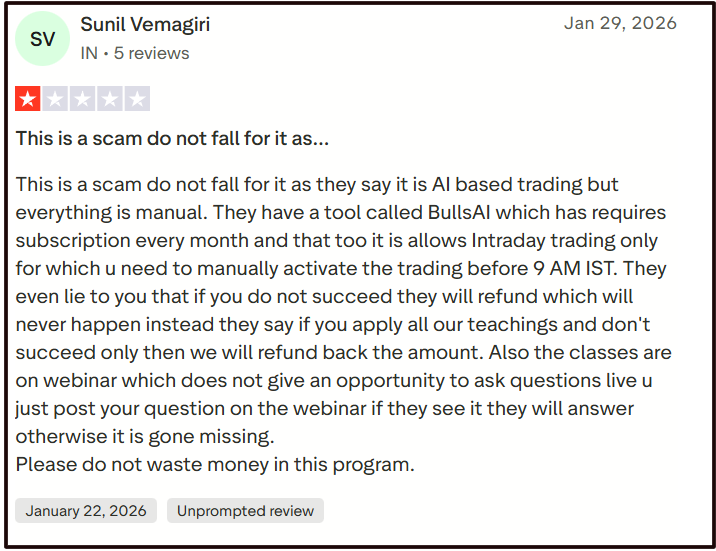
Again, these are user allegations, not regulatory findings.
But they highlight two important areas: regulatory risk and financial risk.
From a regulatory standpoint, a SEBI Research Analyst like Rahul Chandra can provide research and trading strategies. However, an RA cannot manage client funds or operate discretionary portfolio management without separate registration.
So the key question becomes:
Is BullsAI simply a signal-generating research tool where users execute trades themselves?
Or does it operate in a way that resembles managed trading?
That distinction matters under SEBI regulations.
From a financial perspective, algorithmic trading carries real risk.
Backtests do not guarantee live performance. Market volatility can break strategy logic.
Intraday systems increase transaction frequency and cost. Manual activation reduces the perception of full automation.
AI can assist in analysis. It cannot eliminate drawdowns.
If someone pays ₹1,25,000 and then deploys trading capital based on expectations of structured AI consistency, the total financial exposure extends beyond the course fee; it includes potential capital loss.
That is why transparency around how BullsAI operates, what level of automation it truly offers, and what regulatory category it falls under becomes critical for investors.
When Can You File a Report Against a Research Analyst?
You can consider filing a complaint against a SEBI-registered Research Analyst (such as Rahul Chandra / SpringPad, if applicable) in the following situations:
- Guaranteed or Assured Returns Are Promised
If specific profits or fixed returns are promised or strongly implied without proper disclaimers. - Misleading Performance Claims
If past performance, backtested results, or return projections are presented in a way that creates unrealistic expectations. - Portfolio Management Without Proper Registration
If the service resembles discretionary trading, managed accounts, or profit-sharing arrangements without PMS or Investment Adviser registration. - Lack of Proper Disclosures
If conflicts of interest, risk disclosures, or service limitations are not clearly communicated. - Fee Structure Violates SEBI Norms
If fees appear excessive, collected in advance beyond permitted limits, or structured in a way that conflicts with Research Analyst regulations. - Refund Commitments Are Not Honoured
If refund assurances were made in writing but not respected. - Service Delivered Differs Materially From What Was Marketed
If there is a significant gap between promotional claims and actual service provided. - Misuse of SEBI Registration for Marketing
If SEBI registration is used to create an impression of regulatory approval for activities beyond what an RA license allows.
Filing a complaint should be based on documented evidence, not dissatisfaction alone.
Regulatory action is appropriate when there is potential non-compliance, misrepresentation, or breach of SEBI Research Analyst regulations.
How to Report a Research Analyst?
If you believe a SEBI-registered Research Analyst has crossed regulatory boundaries, the process is structured, not complicated. What matters most is documentation.
Here’s how to proceed:
Step 1: Gather Your Evidence First
Before filing anything, collect:
- Payment receipts and invoices
- Screenshots of marketing claims
- Refund promises (if any)
- Email / WhatsApp conversations
- Screenshots of performance or return statements
- SEBI registration number of the entity
Complaints without documents usually go nowhere. Evidence gives weight.
Step 2: File a Complaint on SEBI SCORES
Go to the official SEBI SCORES portal.
- Register as a complainant
- Select “Research Analyst” as the intermediary category
- Enter the registration number
- Upload all supporting documents
SEBI forwards the complaint to the entity and monitors the response.
Step 3: Follow Up if the Response Is Unsatisfactory
If the response provided by the Research Analyst does not resolve your concern, you can escalate the matter within the SCORES system.
Step 4: Consider Consumer Court (For Refund Disputes)
If the issue relates to fee disputes, refund denial, or misrepresentation in sales, the Consumer Disputes Redressal Commission can be approached separately.
Need Help?
Facing an issue with a Research Analyst can feel overwhelming. Most investors don’t know where to begin, what qualifies as a violation, or how to structure a complaint properly.
That’s where clarity makes the difference.
Register with us, and we will help you to:
- Organise payment proofs, screenshots, and communication records
- Identify whether the issue relates to SEBI regulations, fee norms, or misrepresentation
- Draft a clear, fact-based complaint
- Track the SEBI complaint status online
Beyond filing, we guide you through the follow-up process, tracking responses, identifying next steps, and ensuring your concern doesn’t get lost in procedural delays.
Conclusion
Rahul Chandra, along with co-founder Pratik Chakraborty, operates SpringPad under a SEBI Research Analyst registration. That registration brings credibility, but it also defines clear boundaries.
AI-driven investing, algorithmic tools like BullsAI, and high-ticket financial programs are not inherently wrong. Innovation in finance is welcome.
But when automation, performance-oriented language, and regulatory registration intersect, transparency becomes critical.
A Research Analyst can publish research and conduct workshops. They cannot manage funds or guarantee returns.
Pricing must align with regulatory norms. Marketing must match the service delivered.
The real issue is not whether AI is powerful. It is whether expectations are aligned with regulation.
Before enrolling in any high-fee trading program Verify the registration, understand the service category, read the refund terms and assess the real financial risk.
In financial markets, enthusiasm is easy. Due diligence is essential.
SEBI registration provides oversight. Investor awareness provides protection.