

Quick Summary
Initial Claim: ₹1,89,000, covering the trading loss and the brokerage charged in one session Core Violation: A broker’s franchisee gained access to the client’s account under pressure and executed thousands of lots of deep out of the money options in a single day, generating brokerage far beyond any reasonable trading logic. Forum Used: Direct negotiation with the broker’s compliance team, following a formal legal notice. Recovery Secured: ₹1,89,000, the full claim amount. Agraj Khare (name changed) is from Gwalior, Madhya Pradesh. What happened to his account did not unfold over weeks. It happened in a single afternoon.
Agraj was introduced to a broker’s franchisee through a business contact, who assured him of safe trading and guaranteed profits. He never handed over his login credentials directly.
Under sustained pressure and repeated verbal reassurance, he was made to log into his own demat account while she watched. That access became the entry point for everything that followed.
The High-Volume OTM Trade Strategy Used to Spike Brokerage
On a single trading day, the franchisee executed numerous trades in deep out-of-the-money options priced between two and three rupees each, in quantities running to two and three thousand lots per trade.
Options priced that far out of the money carry almost no realistic path to profit. Trading them in such enormous volume has one clear purpose: generating brokerage on turnover rather than pursuing any genuine investment outcome.
By the end of that single session, the account had been charged brokerage of ₹1,80,581. The trading loss on top of that came to a further ₹8,616.
Anyone whose account shows brokerage this disproportionate to trading activity can file a complaint through NSE’s investor grievance channel, since exchange level records can independently confirm the pattern.
Key Evidence: How a Written Admission Anchored the Claim
Unlike most cases built entirely on inference, this one included something rare. An email from the franchisee herself acknowledged fault for what had happened to Agraj’s account.
Alongside that admission, Agraj had preserved chat screenshots documenting the pressure and inducement that led to the account access in the first place, along with the contract notes and profit and loss statement from the day itself.
Why Principal Brokers Share Legal Liability for Sub-Broker Misconduct?
Under SEBI rules, a principal broker carries responsibility for the conduct of its registered sub-brokers and franchisees.
The franchisee’s actions were not a rogue event outside the broker’s own accountability.
A single day of trading this disproportionate should have triggered internal surveillance alerts on the broker’s own side, regardless of who was physically placing the trades.
How We Built and Fast-Tracked the Recovery Case?
The combination of a written admission and a single, cleanly isolated trading day made this one of the more direct cases to build.
Step One: We Isolated The Single Day Trading Pattern
Every trade from that one session was pulled from the contract notes and laid out together, showing the volume and pricing pattern that made the churning unmistakable.
Step Two: We Secured The Admission As Central Evidence
The franchisee’s own email acknowledging fault was preserved and positioned as the anchor of the complaint, since it removed any need to argue intent from circumstantial evidence alone.
Step Three: We Calculated The Brokerage To Loss Ratio
Comparing the ₹1,80,581 in brokerage against the relatively small trading loss made the disproportion immediately clear to anyone reviewing the account.
Step Four: We Documented The Access Inducement Separately
The pressure and manipulation that led to account access being granted was recorded as its own violation, distinct from the churning that followed once access was obtained.
Step Five: We Sent A Legal Notice With A Firm Deadline
Our notice laid out every violation with the supporting evidence attached, including the admission email, and gave the broker seven business days to respond in full.
Step Six: We Pushed Through Direct Negotiation With Compliance
With an admission of fault already on record, our team engaged the broker’s compliance function directly, moving quickly toward a complete resolution rather than a partial one.
Was Your Account Churned In A Single Session? Our Team Can Help
We will isolate the exact trading pattern, calculate the brokerage against any real trading logic, and push it through a formal notice until every rupee is accounted for.
Case Outcome: How We Secured the Full ₹1.89 Lakh Claim
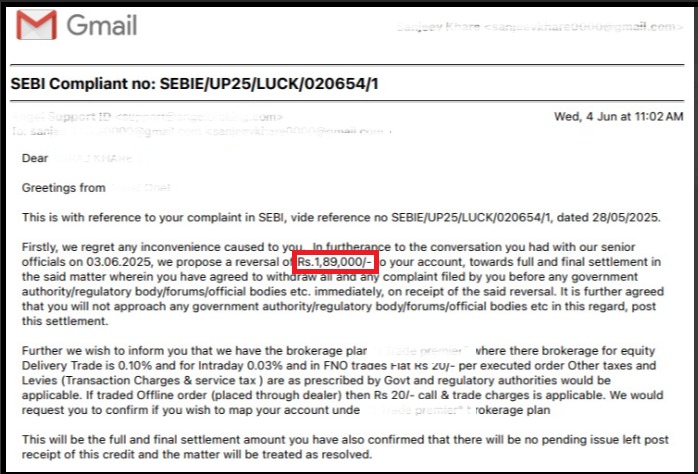
Agraj’s claim stood at ₹1,89,000, covering the trading loss and the entire brokerage charged during the single session in question.
Through direct negotiation with the broker’s compliance team, the matter was resolved with a full recovery of ₹1,89,000, the complete amount originally claimed.
Conclusion
If your brokerage charges for a single trading session appear completely disconnected from actual market logic, that gap is your strongest piece of evidence.
Disproportionate fees generated from irrational trading patterns cleanly expose account churning. Preserving contract notes, communication records, and account statements creates an undeniable case against broker misconduct.
When supported by clear documentation, filing a formal SEBI SCORES complaint or an exchange investor grievance ensures excessive single-day charges are thoroughly challenged and successfully recovered.
Frequently Asked Questions
Options priced far from any realistic profit outcome, traded in massive lot sizes, generate brokerage far more reliably than they generate returns. That pattern alone is a strong warning sign.
Yes. Under SEBI rules, the principal broker carries responsibility for the conduct of its registered sub-brokers and franchisees.
Significantly. A written acknowledgment removes much of the argument a firm might otherwise raise about intent or authorisation.
Churning is measured by comparing charges against reasonable trading activity. A trading loss alone does not prove churning. Disproportionate brokerage on flimsy positions does.
Save your contract notes, your profit and loss statement for that day, and any communication, written or verbal, that led to the access being granted.





 Add us as a preferred source on Google »

