

Quick Summary
Initial Claim: ₹90,000 Core Violation: A sub-broker promised fixed monthly returns of three percent, ran the account with no stop loss discipline, and eventually took out a loan against the client’s holdings without ever seeking his consent. Forum Used: Direct negotiation with the broker, following a formal legal notice. Recovery Secured: ₹65,000. Bhaskar Roy (name changed) is from Durgapur, West Bengal. He opened a demat account on a friend’s recommendation. He did not open a credit line. Somewhere along the way, one appeared anyway.
Bhaskar was introduced to a broker through a friend and opened a demat account with an initial deposit of ₹3,00,000.
At the time of opening, he was assured a fixed monthly return of three percent, an annualised figure well beyond anything a genuine market-linked return could reliably promise.
He paid ₹5,000 in account management fees, split between an online payment and cash, without ever being told exactly what services that fee covered.
A Successful First Month That Masked The Trap
The first month delivered a return of ₹18,000, lining up almost exactly with the promised rate. That single month of alignment did more to build trust than any explanation ever could have.
The months that followed told a different story entirely.
Losses began appearing, and the response to them was reassurance rather than any actual change in approach.
No Risk Control: How Losses Were Allowed To Run?
Throughout the account’s management, no stop loss mechanism was ever put in place.
Positions were allowed to run against Bhaskar with no defined point at which a loss would be cut.
When he raised concerns, he was told the market would recover, without any concrete plan describing how or when that recovery might actually happen.
How Was a Secret Loan Created Against His Account Holdings?
On the pretext of helping recover the mounting losses, Bhaskar was asked to deposit a further ₹50,000. That recovery never materialised. Instead, he discovered a loan of ₹1,00,000 had been taken out against his account.
No approval was sought from him before this loan was arranged. No documentation outlining its terms, including the interest rate, was ever shared with him.
He learned of its existence only after the fact, through his own account review.
Taking a loan against a client’s holdings without consent is a serious breach that can be raised through a complaint against your stock broker, since it sits entirely outside any authorization the client actually gave.
How Unapproved Orders Led To ₹1.16 Lakh In Extra Losses?
Alongside the loan, further trades were executed on Bhaskar’s account without his approval at any stage, producing an additional loss of ₹1,16,000.
He was neither consulted before these trades nor informed of the risk they carried.
The individual managing his account operated as a sub-broker, a role that carries specific obligations under SEBI’s sub-broker regulations around transparency, diligence, and obtaining explicit client consent before every transaction.
How We Built Two Distinct Claims For Maximum Impact?
An unapproved loan and a pattern of unconfirmed trades needed to be argued as two distinct breaches rather than folded together into one general complaint.
Step One: We Documented The Loan As Its Own Violation
The absence of any approval, documentation, or disclosed terms for the ₹1,00,000 loan was recorded independently, since taking on debt without consent is a serious breach regardless of the trading losses around it.
Step Two: We Reconstructed The Missing Stop Loss Pattern
Every position run without a defined exit point was reviewed to show a consistent absence of basic risk management across the account’s entire trading history.
Step Three: We Flagged The Guaranteed Return Promise Made At Onboarding
The specific three percent monthly figure promised before Bhaskar ever deposited funds was documented as a guarantee no legitimate account management arrangement is permitted to offer.
Step Four: We Matched Each Unauthorized Trade To The Sub-Broker’s Specific Obligations
Trades executed without confirmation were reviewed against the sub-broker regulations requiring explicit consent for every transaction, building a clear, regulation-specific violation.
Step Five: We Sent A Legal Notice Demanding Reversal Of The Loan And Full Restitution
Our notice specifically demanded reversal of the unauthorized loan alongside compensation for the trading losses, treating the two as separate but connected claims requiring separate resolution.
Step Six: We Pushed Through Direct Negotiation With The Broker
With the loan documentation gap and the unconfirmed trades both clearly established, our team engaged the broker directly to move the matter toward resolution.
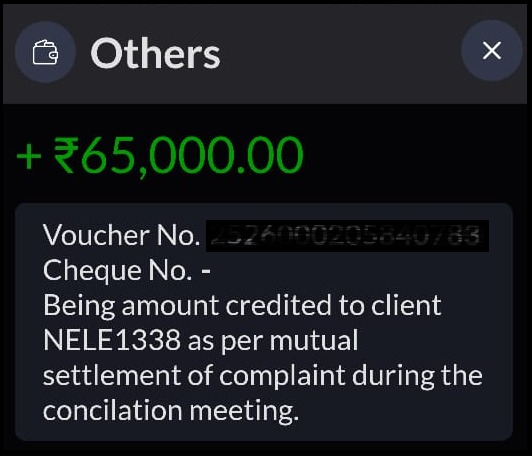
Through direct negotiation, the matter was resolved with a recovery of ₹65,000.
Found A Loan Or Trade On Your Account You Never Approved? Our Team Can Help
Bhaskar’s case turned on one gap, no paperwork existed for the loan taken against his account. Check your own account statement for anything you don’t recognise, then reach out.
Register with us and we will take it from there.
Conclusion
An unauthorized loan against a demat account is not a smaller version of unauthorized trading; it is a separate and serious breach on its own, since it creates debt a client never agreed to carry.
Bhaskar’s case shows why treating a loan discovered after the fact as its own distinct violation, backed by the simple absence of any paperwork or consent, gives a case real weight beyond the trading losses alone.
A promise of a fixed monthly return at onboarding is often the first sign worth questioning, well before any loan or unconfirmed trade ever appears on the account.
Report. Recover. Stay Fraud Free.
Frequently Asked Questions
No. Any loan or credit facility against your holdings requires your explicit approval and documented terms, including the applicable interest rate.
Yes. No legitimate market linked account management arrangement can reliably guarantee a fixed monthly percentage return, regardless of how the first month performs.
Sub-brokers are required under SEBI regulations to act with diligence and transparency, and to obtain explicit client consent before executing each transaction on the client's behalf.
Review your full account statement for any debit entries you do not recognise, and request the broker's complete loan or margin facility documentation for your account.
Yes. These can be raised as two distinct violations within the same complaint, each supported by its own evidence and regulatory basis.





 Add us as a preferred source on Google »

